


When you set out to develop an Android application in the year 2026, one of the first questions you are going to ask yourself is, “What is the cost of developing an Android app?” Whether you are a startup founder, a product manager at an enterprise, or a design agency that is pitching a client, it is important to know the breadth and major levers of the budget.
We categorize Android app development costs into three levels: Simple, Moderate, and Advanced. The cost for a Simple app ranges from $30,000 to $60,000; a Moderate app costs between $60,000 and $140,000; and an Advanced app can range from $140,000 to over $500,000.
We will step through the entire picture in this article, starting with a wide range of estimations and moving down to the specifics of how much it can cost you to develop an Android app. At the end of it, you will have a clear guideline to consider the cost of Android app development.
Read More: Top 10 Mobile Apps for Businesses
Overview of Android App Development Market
The Android app development market is expanding at an alarming rate due to the increase in smartphone usage and the variety of devices operating in the market. The mobile app market is estimated to surpass 673.8 billion US dollars by the year 2027, with Android apps commanding the highest percentage since they hold a presence in the rising markets.
Huge demand is expected as there will be more than 300 billion downloads globally in 2026. This expansion, along with the growing complexity of features, artificial intelligence, augmented reality, the Internet of Things, and multi-device support, raises the price of developing an Android app, and thus, both startups and businesses need to budget and plan carefully.
Cost Estimates Based on App Categories
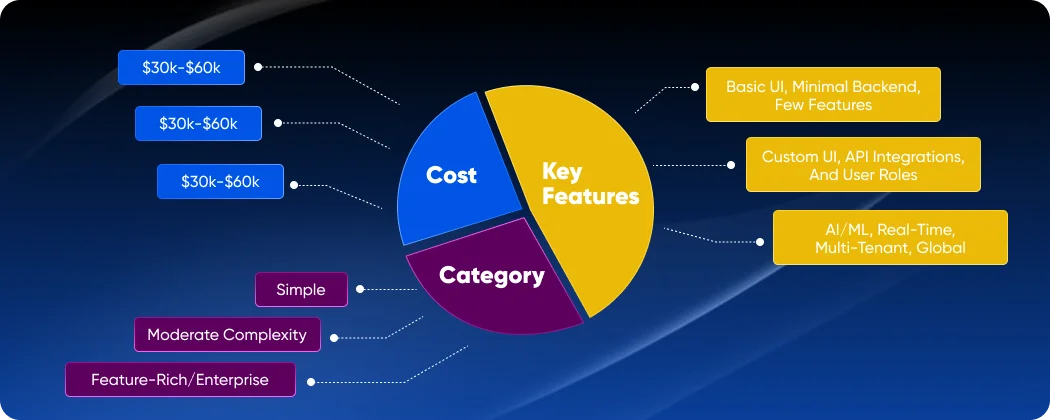
To respond to what it will cost to develop an Android app in 2026, it is useful to divide the field by category or complexity, as the field might be quite wide.
Simple Apps
Simple apps, such as basic utility apps or reference applications with minimal backend, are usually around $30,000-$60,000 for Android in 2026. The average time required to develop it is 2-4 months. They can be used to develop MVPs or proofs of concept and are more focused on basic functions rather than features.
Moderate Complexity Apps
Moderate apps featuring e-commerce experience, API integration, or simple real-time updates will cost between $60,000-$140,000 on Android. It will take 4-8 months to develop, based on the backend, UI/UX, and integrations. Such examples are booking systems, marketplaces, or social-fitting apps.
Advanced/Feature-Rich/Enterprise Apps
Advanced apps cost between $140,000-$500,000+ for Android with AI/ML, multi-tenant, security compliance, or IoT. It requires 9-18 months to develop due to complex infrastructure, real-time data, and scalability requirements. They are appropriate for enterprise-level or high-security applications.
Tiered Summary Table
# |
Category |
Cost |
Key Features |
| 1 | Simple | $30k–$60k | Basic UI, minimal backend, few features |
| 2 | Moderate Complexity | $60k–$140k | Custom UI, API integrations, and user roles |
| 3 | Feature-Rich / Enterprise | $140k–$500k+ | AI/ML, real-time, multi-tenant, global |
The total revenue of the global mobile-app market is expected to show an annual growth rate (CAGR 2022-2029) of 7.48%, resulting in a projected market volume of US$781.70bn by 2029.
Key Factors of Developing an Android App
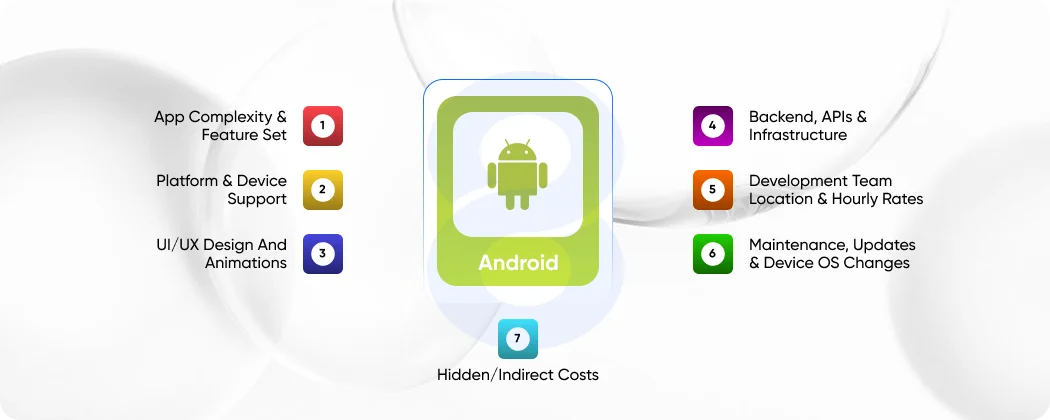
To understand the Android app development cost, it is essential to take a closer look at the complex issues that can determine the end-investment numbers. In this regard, we shall discuss the key determinants that define development budgets in 2026.
App Complexity & Feature Set
The primary cost driver is the complexity of the app, and the development costs are higher when the app has advanced features.
Examples:
- User authentication, profile management
- Payment gateway integrations, subscriptions
- Real-time messaging, chat, in-app media
- AI/ML models, AR/VR components
- Offline mode, multi-device sync
Each added feature increases development hours.
Platform & Device Support
Although this will be Android-centric, you are likely to be required to cover multiple form factors (phones, tablets, and foldables) and OS versions. The greater the fragmentation, the greater the cost of QA/testing.
UI/UX Design and Animations
A better quality of the UI/UX design and animation impacts the cost of developing an Android app profoundly because custom drawings, micro-interactions, smooth transitions, motion design, etc., require more hours of development and design, which drives the total budget up.
Backend, APIs & Infrastructure
A powerful backend (user data, analytics, push notifications, and cloud services) will contribute substantially to the Android app development cost. This will involve the cost of infrastructure (hosting, scaling, databases).
Development Team Location & Hourly Rates
Android app development cost is highly influenced by the geographical location of the development team. In US or Canada, hourly rates vary between $80-$150+, whereas Eastern Europe or Asia costs between $30-$70/hour, but offshore teams might imply time zone, communication, and quality trade-offs.
# |
Team Location |
Hourly Rate (USD) |
Notes / Considerations |
| 1 | US / Canada | $80 – $150+ | High-quality work, easy communication, and higher cost |
| 2 | Western Europe | $70 – $120 | Skilled developers, slightly lower cost than US, reliable |
| 3 | Eastern Europe | $35 – $70 | Cost-effective, good quality, may involve time-zone differences |
| 4 | Asia (India, Pakistan) | $20 – $50 | Very affordable, large talent pool, variable quality |
| 5 | Latin America | $25 – $60 | Growing developer base, good time-zone overlap with US |
| 6 | Africa (Nigeria, Kenya) | $15 – $40 | Emerging market, lower cost, quality can vary |
Maintenance, Updates & Device OS Changes
Averagely the post-launch support, bug fixes, and OS updates, as well as new devices, are charged at an average of 15-20% (or higher) of the initial build per year. Omitting this will add to the expenses of coming up with an app in the long run.
Hidden/Indirect Costs
These are coverage tests of all devices, compliance/licensing (GDPR/CCPA), localization, app store charges, marketing, and user acquisition. These are usually ignored during early budgeting.
By understanding these levers, you can more reliably project the cost of your Android app development in 2026 and where to spend or save on features.
Read More: Top 10 Apps for Delivery Drivers
Detailed Android App Development Cost Breakdown
To stipulate the general disclosure of the Android app development cost structure, we shall examine a disintegration of the expenses of the entire development procedure. The granular analysis enables better budget allocation and expectations control.
Phase 1: Discovery and Planning
The discovery stage lays the groundwork of the project and avoids expensive errors at subsequent stages of development. This is a critical preliminary work that involves:
Components:
- Market research and competitive analysis
- User persona development
- Requirements documentation
- Feature prioritization workshops
- Budget and timeline estimation
Duration: 1-3 weeks
Investment in this step is quite effective in lowering the chances of scope creep and costly mid-project pivots.
Phase 2: UI/UX Design
Design quality has a direct effect on user engagement, user retention, and the overall success of an application. Therefore, the provision of adequate resources for design is critical in assuring competitive positioning.
Components:
- Information architecture
- Wireframing and user flow mapping
- High-fidelity mockups
- Interactive prototypes
- User testing and feedback incorporation
Duration: 2-6 weeks
Additionally, modern design trends of motion design, micro-interaction, and immersion demand specialized skills, which are priced uniquely.
Phase 3: Frontend Development
Frontend development converts design specifications into a functional user interface, and all elements that can be seen and used are implemented.
Components:
- Screen implementation across device sizes
- Animation and transition implementation
- Form validation and user input handling
- API integration for data display
- Offline functionality implementation
Duration: 4-12 weeks
Android app frontend development costs can be quite different depending on the complexity of the interface, the need for custom animation, and the responsive design.
Phase 4: Backend Development
Backend infrastructure offers the non-visible base of application functionality, data management, and execution of business logic.
Components:
- Database architecture and implementation
- API development (REST or GraphQL)
- Authentication and authorization systems
- Data encryption and security protocols
- Third-party service integration
Duration: 6-16 weeks
Notably, those applications that have complex data needs, real-time synchronization, or complicated business logic are likely to mirror more significant investments in the back-end.
Phase 5: Quality Assurance and Testing
Complete testing guarantees the stability of applications, security, and the best user experience on various Android devices and applications.
Components:
- Functional testing across all features
- Performance and load testing
- Security vulnerability assessment
- Beta testing coordination
- Bug fixing and optimization
Duration: 3-8 weeks
Therefore, proper quality assurance investment avoids the expensive post-launch problems and bad user feedback that may irreversibly harm the reputation of the application.
Phase 6: Deployment and Launch
An effective application launch involves proper preparation, verification of compliance, and planning rather than just submitting code.
Components:
- Google Play Console registration ($25 one-time fee)
- App store optimization (ASO)
- Store listing creation and optimization
- Compliance verification
- Initial monitoring and support
Duration: 1-2 weeks
Phase 7: Post-Launch Support and Maintenance
The initiation of application launch is the start and not the end of development investment. Continuous maintenance, upgrades, and additions of features are key to success in the long term.
Annual Maintenance Components:
- Bug fixes and performance optimization
- Security patches and updates
- Feature enhancements
- Analytics monitoring and optimization
- Third-party SDK updates
Maintenance and support costs have generally been estimated at 15-20% of the original development cost, depending on the complexity of its use and frequency of updates.
Comprehensive Android App Development Cost Summary Table
# |
Development Phase |
Simple App |
Moderate App |
Complex App |
| 1 | Discovery & Planning | $2,000 – $5,000 | $5,000 – $10,000 | $10,000 – $15,000 |
| 2 | UI/UX Design | $5,000 – $10,000 | $10,000 – $20,000 | $20,000 – $30,000 |
| 3 | Frontend Development | $10,000 – $20,000 | $20,000 – $40,000 | $40,000 – $80,000 |
| 4 | Backend Development | $8,000 – $15,000 | $15,000 – $50,000 | $50,000 – $100,000 |
| 5 | Quality Assurance | $5,000 – $8,000 | $8,000 – $15,000 | $15,000 – $30,000 |
| 6 | Deployment | $1,000 – $2,000 | $2,000 – $3,000 | $3,000 – $5,000 |
| 7 | Total Initial Cost | $31,000 – $60,000 | $60,000 – $138,000 | $138,000 – $260,000 |
| 8 | Annual Maintenance | $5,000 – $10,000 | $10,000 – $25,000 | $25,000 – $50,000 |
Note: The above are merely estimates of the prices and can change depending on the complexity of the project, expertise of the developer, location, technology stack, and client needs. The real costs may vary based on the particular deadline, features and customization requirements.
Read More: How to Make an App that Makes Money
Methods to Minimize Android App Development Cost
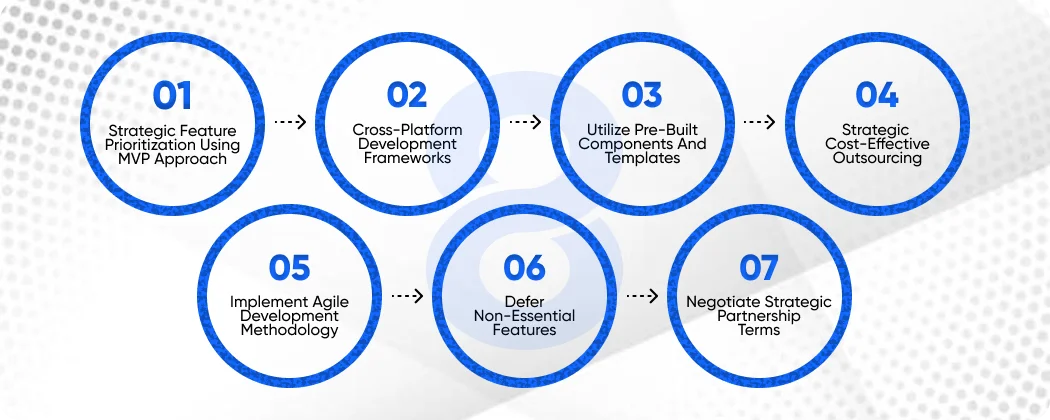
Understanding how to create affordable Android apps without affecting the quality is critical to start-ups and low-end firms. Thus, we will examine some of the best practices in cost optimization and still compete in the market.
1. Strategic Feature Prioritization Using MVP Approach
The MVP approach reduces the development expenses by concentrating on the necessary features. It authenticates the user requirements at the outset, mitigates risk, and provides quicker launches and returns on all developmental efforts.
MVP Benefits:
- 40–60% lower initial investment
- Launches within 2–4 months
- Real user validation
- Reduces rework and waste
2. Leverage Cross-Platform Development Frameworks
Flutter and React Native frameworks allow rapid budget development based on a single codebase between Android and iOS. They provide almost native performance and significantly reduce time and maintenance costs.
Advantages:
- Single codebase for both platforms
- 40–50% cost savings
- Consistent design across devices
- Rapid feature rollout
3. Utilize Pre-Built Components and Templates
Ready-made templates, UI packages, and open-source elements save on development time. They help to speed up the delivery process, ensure the quality of design, and decrease total costs without losing user experience and app performance.
Resources:
- Google Material Design system
- Firebase Authentication
- Open-source UI libraries
- Backend-as-a-Service platforms
4. Strategic Outsourcing to Cost-Effective Regions
When communication, milestones and project oversight are well handled, outsourcing development to expert teams in South Asia or Eastern Europe will save a lot of money but still deliver high quality.
Best Practices:
- Vet partners through portfolios
- Maintain clear communication
- Use milestone-based payments
- Protect intellectual property
5. Implement Agile Development Methodology
Agile methodology guarantees flexibility, high feedback frequency, and efficient resolution of issues in the course of app development. It avoids late-stage problems, enhances teamwork, and brings out economic improvement in line with enterprise objectives.
Cost Benefits:
- Early issue detection
- Regular stakeholder input
- Transparent workflows
- Reduced rework
6. Defer Non-Essential Features
Value delivery and market testing should be prioritized as the must-have features. Further functionality may be added in the future, depending on feedback from users, and keep resource efficiency and development cost under control.
Feature Framework:
- Must-Have: Core essentials
- Should-Have: Later releases
- Could-Have: Optional upgrades
- Won’t Have: Deferred features
7. Negotiate Strategic Partnership Terms
Effective collaborative contracts maximize prices and quality. Properly selected pricing models, clarity, and structure based on milestones will result in accountability and flexibility to meet the changing requirements of the project.
Contract Strategies:
- Fixed price for defined projects
- Time-and-material for dynamic work
- Milestone-linked payments
- Long-term collaborations
Read More: How to Create an App for Your Business
Turning Ideas into Affordable Apps That Scale
At 8ration, we focus on the provision of high-quality app development services that are innovative, performing, and cost-effective. Our team of professionals integrates the latest technology with design thinking to create applications that can interest users and grow easily.
Knowing what you want to achieve and making the most of resources available to you, we make the cost of developing an Android app clear, controllable, and in line with your business vision, transforming ideas into market products.
Final Thoughts!
The price of creating an Android application in 2026 varies with complexity, features, the location of the team, and maintenance. Basic apps are priced at $30k-60k, intermediate at $60k-140k, and complicated at $140k or more. The actual financial investment is furthered by the continuous improvement, updating, sustaining, and scaling of activities beyond development.
Using clever tricks such as MVPs, scope management, reusability of modules, and low-budget teams, you will be able to develop affordable Android apps without sacrificing quality, make realistic budgets, and develop a successful roadmap of the project implementation.