


The online store revolution is here, and businesses all over the world are in a frenzy to become well-established in the mobile arena. Mobile-first consumers in 2026 will anticipate an easy-to-use, personalized, and smooth shopping experience. Knowledge of ecommerce app development costs plays an important role in startups, SMBs, and business organizations seeking to develop high-performance applications at a minimal cost.
The global eCommerce platform market (i.e., software that powers eCommerce stores) is projected to grow from USD 10.5 billion in 2025 to about USD 66.1 billion by 2035, at a CAGR of 20.1%.
Statista indicates that the number of downloads of the mobile app on the Google Play Store will reach 143 billion by 2026, compared to 111 billion downloads as of 2021. This explosive expansion underscores the surging demand for mobile applications such as eCommerce applications. With shopping on mobile platforms becoming more and more popular, businesses need to make the right choice when investing in their development, while at the same time keeping the costs transparent and manageable.
This topical map of ecommerce app development costs presents a detailed cost breakdown, key features, and an insight into trends guiding eCommerce in 2026.
Key Takeaways
- eCommerce market is booming, expected to hit $9.3 trillion by 2026
- Mobile apps drive 61% of sales and convert 3x better than websites
- Basic app costs $15K–$35K, advanced apps go $80K–$250K+
- Features and complexity are the biggest cost drivers
- AI and personalization can increase revenue by 20–25%
- AR/VR features boost conversions but significantly raise costs
- Developer location impacts cost heavily ($20/hr to $150/hr range)
- Maintenance costs 15–25% annually of initial development
- Hidden costs include cloud, APIs, app store fees, and marketing
- Scalable architecture and MVP approach help reduce long-term costs
The Rising eCommerce App Market in 2026
The world eCommerce market is still growing at a high pace. As stated by 2026, the market is projected to be at 9.3 trillion, supported by mobile commerce, omnichannel retail plans, and digital-first consumer behavior.
Mobile Commerce Dominance
- By the year 2026, mobile commerce (mCommerce) will have 61% of the total online sales.
- Shoppers are spending 322 percent more time on shopping applications than on mobile websites.
- The number of conversions done through apps is three times more than that of mobile web conversions.
App Downloads & Engagement
- By 2026, the number of shopping app downloads is expected to be above 187 billion.
- Customers are demanding quick loading time, AI-powered suggestions, and easy checkout.
- Apps that provide personalized experiences and push notifications have a higher retention rate.
AI and Personalization Trends
- 74% of consumers prefer brands that use AI to personalize product recommendations.
- Predictive analytics integrated into apps can increase revenue by 20–25%.
These trends underscore why eCommerce app development is not just a budgetary consideration; it is a strategic investment in business growth.
Read More: How Much Does it Cost to Develop an App
Understanding eCommerce App Development Cost in 2026
The e-commerce app price will be determined by the complexity, platform, features, design, and development strategy. Here’s a high-level overview:
# |
App Type |
Features |
Estimated Cost |
| 1 | Basic | User login, product listing, cart & checkout, standard payments | $15,000 – $35,000 |
| 2 | Mid-range | Advanced filtering, multiple payments, order tracking, push notifications | $35,000 – $80,000 |
| 3 | Advanced / Enterprise | AI recommendations, AR try-on, multi-store, omnichannel, loyalty programs | $80,000 – $250,000+ |
Market Drivers Affecting eCommerce App Development Cost
Several forces in the market will influence the ecommerce app development cost in 2026. Knowledge of these drivers assists a business in making investments and setting expectations of expenses.
AI & Personalization
Intellectual AI to suggest the product, predictive analytics, and dynamic pricing would contribute to the cost of development, but it would raise user engagement substantially. The personalized experiences are demanding, with complex backend logic and machine learning models, and drive up development time and investment.
AR & Virtual Try-On
The augmented reality (AR) capabilities are being applied in fashion, beauty, and furniture applications. AR enables people to test products virtually prior to buying them, leading to a lower level of returns and an increased level of satisfaction. Nevertheless, the AR implementation can add a high app development cost because of the need to design, test, and align it with devices.
Omnichannel Integration
The current eCommerce applications frequently require being linked with the web, social commerce networks, enterprise resource planning, and brick-and-mortar stores. Multi-channel synchronization involves advanced backend development and constant maintenance, which increases the costs.
Quick Checkout and Payments Integration
Consumers require hassle-free and safe transactions. The combination of various payment gateways, digital wallets, and one-second checkout solutions enhances conversion but changes the price of developing an ecommerce app. The budget is also increased with security measures, PCI compliance, and encryption.
Regional Factors Affecting eCommerce App Development Cost
The location of your development team plays a critical role in ecommerce app development cost. Hourly rates, expertise, and project management capabilities vary widely across regions.
# |
Region |
Hourly Rate (USD) |
Notes |
| 1 | US / Canada | $80–$150+ | High-quality work, direct communication |
| 2 | Western Europe | $70–$120 | Skilled developers, slightly lower cost |
| 3 | Eastern Europe | $35–$70 | Cost-effective, good quality |
| 4 | Asia (India, Pakistan) | $20–$50 | Very affordable, variable quality |
| 5 | Latin America | $25–$60 | Good time zone overlap with the US |
| 6 | Africa | $15–$40 | Emerging market, cost-effective |
Feature-Wise Costs, Key Factors, and Hidden Expenses
Feature-Wise Cost Breakdown
In estimating the cost of developing ecommerce apps, it is important to have an awareness of the set of features. Features have a direct effect on the time required to develop the feature, the complexity, and the maintenance requirements. Now, we shall venture into some of the most vital features in 2026 that eCommerce applications need and how they affect their cost.
1. User Authentication and Profile Management
The first step of personalized experiences is user authentication. The use of such features as social login (Google, Facebook), two-factor authentication (2FA), and passwordless login makes the process of logging in more secure and more complicated. A powerful profile management system enables the user to monitor orders, preferences, and store payment options.
- Approximate Price: $2,000 – $5,000 to install simple functionality; $5,000-$10,000 to install enhanced security.
- Influence on the eCommerce App Development Cost: Security takes the first position on the priority list because any attack may lead to fines and an affected reputation. IBM declared that the mean price of a data breach is 4.45 million dollars in 2025, which clarifies why the investment in secure authentication should be non-negotiable.
2. Product Catalog and Advanced Search
The retention of users requires a well-planned and active product list. The shopping experience is enhanced with advanced search filters and sorting options, and AI-powered recommendations. Users demand immediate product search, low load times, both when they browse through thousands of SKUs and only dozens of them.
- Estimated Price: Basic catalog: 3000 – 8000 dollars; AI-refined search and recommendation engine: $10,000 – $20,000.
- Statistics: A 2024 report by Shopify found that apps that had a strong search and recommendation engine boosted the conversion rate by 30-40%.
3. Shopping Cart and Checkout
Checkout is one of the most delicate items of an eCommerce app. The simplicity, safety, and speed of the checkout can have an enormous impact on conversion rates. The features will include various payment gateways, one-second checkout, and integration of discount codes and digital wallets.
- Estimated Cost: $5,000 – $15,000 based on the complexity of payment integration.
- Impact: Baymard Institute states that the average cart abandonment is 69.57, and it can be optimized by 20-30, which directly affects revenue.
4. Marketing Automation and Push Notifications
The presence of notifications can raise retention and persuade users to make repeat buys. Individual offers, flash deals, and cart abandonments are common.
- Estimated Price: 2000 to 7000 based on automation and segmentation.
- Stat: According to a 2025 Localytics report, apps with AI-driven push notifications have 3x more engagement.
5. AR/VR Integration and Advanced Features
By 2026, augmented reality (AR) and virtual try-on capabilities are going to be the norm, particularly in fashion, beauty, and furniture apps. AR enables customers to see products in their home or test clothes without having to purchase.
Estimated Cost: $10,000 – $50,000 based on complexity.
Impact: According to the Shopify statistics, AR-based apps decrease returns by a quarter and boost conversion by 40 percent.
6. AI Insights and real-time analytics
The modern apps are based on real-time analytics to give information about the users’ behavior, inventory information, and sales prediction. The implementation of AI algorithms to suggest products to individuals and predictive analytics needs advanced data processing and a backend.
- Estimated Cost: $8,000 – $25,000
- Advantage: According to McKinsey 2025 research, companies that apply AI to product recommendations achieve a 20-30% growth in average order value.
Read More: How Much Does It Cost to Develop an Android App
Key Factors Affecting eCommerce App Development Cost
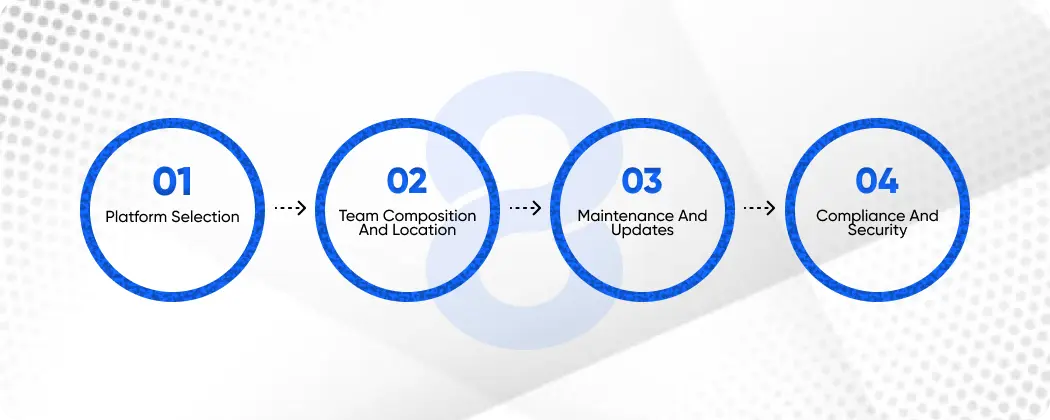 In addition to features, several fundamental aspects determine the cost of developing an ecommerce app:
1. Platform Selection
Cost is influenced by the choice of native development, cross-platform development, or hybrid development.
# |
App Type |
Cost |
Summary |
| 1 | Native Apps | $80–$150/hour (US) | Fast and high-performance, but the most expensive |
| 2 | Cross-Platform Apps (Flutter, React Native) | Reduced cost, shared codebase | Nearly native performance with lower development costs |
| 3 | Hybrid Apps | Lowest cost | Budget-friendly, but it can deliver a poor user experience |
The decision impacts the rate of development, experience, and maintenance in the long run.
2. Team Composition and Location
The cost is highly sensitive to the rate of developers per hour, depending on the location:
# |
Region |
Hourly Rate (USD) |
| 1 | US / Canada | $80 – $150 |
| 2 | Western Europe | $70 – $120 |
| 3 | Eastern Europe | $35 – $70 |
| 4 | South Asia (India, Pakistan) | $20 – $50 |
It is possible to select a combination of onshore and offshore developers to maximize quality and budget. As an illustration, complicated backend modules may be designed offshore, and the UI/UX design may be onshore to maintain consistency.
3. Maintenance and Updates
Annual updates, bug fixes, compatibility with OS, and security patches are usually included in 15-25% of the original cost of development. Any negligence in maintenance leads to costs in the long term as a result of technical debt and possible security breaches.
4. Compliance and Security
The regulations of PCI DSS, GDPR, and CCPA would require more development work. Integrations of payment methods and data protection systems will become compulsory in 2026. Companies that choose to invest in compliance will save on future fines and decrease the risk involved.
Hidden Aspects Affecting Overall Cost
Although the above are the key development processes and characteristics, other concealed costs tend to blow up the cost of the ecommerce app development:
- App Store Listing + Registration: Google Play (25 one-time), Apple App Store (99/year).
- Cloud Infrastructure and Hosting: AWS, Firebase, or Azure expenses for scaled architecture.
- Third-Party APIs: Shipping, Payment, and AR libraries.
- Marketing Expenses: Paid advertisements, ASO, and user acquisition.
- Localization and Multi-Language Support: Increases coverage but needs more resources.
Examples: A middle-tier multi-vendor marketplace application may cost 100,000 dollars upfront, but another 20,000 per year in maintenance, API, and cloud costs.
Real-World Example: Multi-Vendor eCommerce Application
Suppose it is a 2026 multi-vendor marketplace application:
- Frontend: Android/iOS Flutter.
- Backend: AWS – Node.js, microservices.
- Functions: Onboarding vendor, live tracking, AI-guided recommendations, push notifications, AR try-on.
- Estimated Cost: $140,000 – $180,000 startup + $25,000 of maintenance.
The example presents the influence of feature richness, source of technology, and team location on the cost of app development in e-commerce.
Future-proofing your Investment
Strategic investments in scalable architecture and feature-based modules minimize the costs in the long term. With microservices, cloud computing, and cross-platform structures, you will be able to upgrade your app to follow new trends without having to rewrite the entire application.
Key Factors Influencing Ecommerce App Development Cost in 2026

A profound examination of factors that influence the ultimate budget must be done in order to grasp the ecommerce app development cost in 2026. These considerations affect the first construction as well as the scaling prospects over the long term, the performance, and the capacity of the app to remain competitive in the dynamic digital market. The detailed, content-filled analysis of each cost-driving factor and its effects on your ultimate investment is given below.
1. Type of Ecommerce App
The nature of the ecommerce app is a determining factor in almost 40-60 percent of the total ecommerce application development. Applications that are simple to browse are not comparable to multi-vendor marketplaces or applications that rely on AI-driven personalization.
a) Single-Vendor Ecommerce Applications (Less Cost Tier)
These applications link an organization to its clients. The features are simple, they include product catalog, cart, checkout, tracking orders, and notifications.
It is faster to develop and needs fewer modules, thus cheaper.
Why are these apps cheaper?
- Minimal user roles
- No vendor management system
- Simple backend logic
- Limited real-time features
- Average Cost (2026): $30,000 – $60,000
b) Multi-Vendor Marketplace Applications (Med to High Price range)
Examples: Amazon, Etsy, Daraz-like sites.
They require:
- Vendor onboarding
- Inventory sync per seller
- Vendor dashboards
- Dispute management
- Multi-payment distribution logic.
Impact on cost:
- Offloads 2x-3x backend development time.
- Average Cost (2026): $80,000 – $250,000+
c) High-End Tier Enterprise-Grade Ecommerce Apps.
Millions of users, international product collections, complicated search, in-house tools, and sophisticated analytics are processed by these apps.
Features include:
- AI recommendations
- Smart search engines
- Multi-country pricing
- Loyalty engines
- ERP/WMS integrations
- Hyper-personalized experiences
Average Cost (2026): $150,000 – $500,000+
The higher the level of the architecture and automation, the higher the cost of the ecommerce app development.
2. Features and Functional Modules
Ecommerce applications are effective when they are convenient, reliable, and personalized. However, the cost will increase with every feature added, as it needs additional time to develop.
The main features have been described below:
a) User Profiles and Registration
Frictionless onboarding is expected by the users, such as social login, OTP login, or email login.
Cost Impact: Recurring API prices are added with advanced authentication (2FA, biometric, and OTP gateways).
b) Product Catalog Management
Far more complicated catalogs demand:
- Dynamic filters
- Variants & attributes
- Stock updates
- Advanced search
A catalog containing 10,000 or more SKUs needs to be well-cached and optimally queried, which adds complexity and cost to the entire backend.
c) Shopping Cart & Checkout
Advanced carts include:
- Auto-coupons
- Cart recovery messages
- Recommended smart upsells
Another layer introduces additional logic, more development, more cost.
d) Integration with Payment Gateway
Several payment methods will bring more conversions but also a higher budget.
Examples:
- Credit/debit card
- Apple Pay/Google Pay
- PayPal
- Stripe
- BNPL (Buy Now Pay Later)
- Cryptocurrency processors
- Local gateway (Razorpay, JazzCash, M-Pesa)
- Every integration needs to be tested, complied with, and hardened.
e) Order Tracking & Logistics
The real-time updates are desired by the present users.
Your app may need:
- Shipment API integration
- GPS tracking
- Driver apps
- Warehouse sync
When you are in favor of same-day delivery, things get complicated two times.
f) Admin Dashboard (Vendor Portfolio) Portals.
Administration panels and vendor portals are priced nearly the same as the end-user application.
Why?
They require:
- Analytics
- Product control
- Order management
- Performance metrics
- Refund systems
- Dispute resolution
The more elaborate the dashboard, the more expensive it is.
g) AI & Personalization
AI is not an option anymore; it increases the number of conversions significantly.
AI features that impact cost:
- Recommendation engines
- Dynamic search
- User behavior analysis
- Smart product tagging
- Automated promotions
The additional budget will be $20,000 – $80,000 based on the complexity of the model used by AI.
h) AR/VR Product Preview
AR previews are useful for furniture, fashion, accessories, and beauty products.
Examples:
- Try-on glasses
- Visualize furnishings in your room.
- Virtual fitting rooms
AR requires 3D modeling, device calibration, and thorough software testing, which increases the development cost significantly.
i) Customer Support Tools and Chatbots
The development and subscription costs include the integration of AI chatbots, live chat, or WhatsApp support.
Applications that have thousands of users simultaneously need to invest in good backend architecture, which raises the cost of development.
j) Third-Party Integrations
Major integrations include:
- Shipping providers
- Payment gateways
- ERP/CRM systems
- Inventory management tools
- Automation systems in marketing.
- Push notification services
Every integration will increase the number of setup and testing hours, increasing the budget.
k) Security, Compliance & Data Protection
E-commerce applications deal with confidential customer information. There is no question of compromising on security.
Required compliance:
- PCI-DSS (for payment data)
- GDPR
- CCPA
- OWASP standards
A complicated security design adds more costs to the development of the back-end and its maintenance.
Read More: How Much Does it Cost to Develop an iOS App
Location & Experience Level of the Development Team

Developer rates in the world differ:
# |
Region |
Hourly Rate |
Notes |
| 1 | US / Canada | $80–$150+ | Premium quality, highest cost |
| 2 | Europe | $50–$120 | Skilled & reliable |
| 3 | Eastern Europe | $35–$70 | Balanced choice |
| 4 | Asia (India, Pakistan) | $20–$50 | Cost-effective |
| 5 | Latin America | $25–$60 | Good overlap with the US timezone |
The same application can be priced at 40k in Asia and 200k in the US.
Scaling, Updates, and Maintenance
An average of 15-25% of the original cost of development is post-launch costs.
This includes:
- Bug fixes
- Feature updates
- Security patches
- Server costs
- New OS compatibility
- Subs renewal by third parties
According to research,
A market projection indicates mobile commerce will become the digital marketplace leader by reaching $745.16 billion in sales by 2030.
Complete Phase-by-Phase Breakdown of Ecommerce App Development Cost
Ecommerce app development cost cannot be understood by just considering one estimate. An actual project is going to be executed in several stages, and each stage will have its duties, team organization, schedule, and budget. It is not just the components included in a particular project, but their efficacy in a specific phase that determines the overall level of investment in your project, be it a basic shopping application or a multi-vendor marketplace of the enterprise scale.
This section disaggregates the whole of the development process, and that is, idea validation to post-launch expansion, so that you can understand precisely where your budget is being spent and why each of these phases is necessary to an effective ecommerce application in 2026.
Discovery & Idea Validation
You confirm your business idea, customer requirements, and market penetration to determine the cost of developing the initial ecommerce application. This stage includes competitor study, initial wireframes, and viability analysis, which will assist with the question of whether your concept can be profitable to scale.
Requirements Gathering & Technical Planning
Features, user flow, and architecture are defined by your team and define how every decision will influence the total cost of the ecommerce app development. This stage of planning encompasses technical documentation, data structure design, and a comprehensive roadmap of development.
UI/UX Design
Designers create intuitive shopping interfaces based on wireframes, high-fidelity screens, and interactive prototypes. The cost of ecommerce app development also depends on how complicated the design is, particularly in cases with custom images or a large offering.
Backend Development and Frontend Development
The core shopping engine, which includes product management, checkout, payments, and user accounts, is developed by the developers. It is the most resource-intensive stage and the most significant to the total cost of ecommerce app development, as it is full-coded, API developed, and integrated with database development.
Integrations and Advanced Features
Your application is integrated with payment processing, shipping, CRM/ERP, and marketing. The development of additional AI features and personalized and multi-vendor modules is are costly addition that can eat up the ecommerce app development budgets, depending on the complexity of the integration.
QA Testing & Optimization
Testers ensure stability, security, performance, and usability in all platforms. The higher the number of testing cycles, or rather the complexity of ecommerce flows, the higher the cost of ecommerce apps development, particularly those that may work with more devices and provide real-time inventory synchronization.
Launch and Support
Your team deploys the app to stores, implements cloud hosting, and starts with continuous enhancements. The long-term cost of ecommerce app development includes maintenance, updates, and expansion efforts, particularly when dealing with apps that are meant to be scaled very fast.
Read More: How to Create an App for Your Business
Why Choose 8ration for eCommerce App Development in 2026?
Selecting the proper development partner has a huge influence on the cost of your final e-commerce app development, the quality of the project, the timeline, and even the scalability in the long run. 8ration is a big winner as a global technology partner and the one that is trusted the most.
Here’s why businesses across the USA, UAE, Europe, and Asia choose 8ration:
1. Proven Expertise Across All Ecommerce Models
We create various kinds of e-commerce applications, single-vendor, multi-vendor, marketplace, subscription-based, D2C, wholesale B2B, and enterprise-grade app solutions.
This diverse experience enables us to optimize the cost of ecommerce app development without sacrificing quality.
2. Scalable, Future-Ready Architecture
Our developers implement microservices, cloud-native frameworks, and modular development to ensure your ecommerce application scales without hassle, even when product catalogs, user loads, and global regions grow. This will lead to reduced long-term maintenance costs and also lower future redevelopment costs.
3. Advanced AI, AR, and Personalization Integration
8ration is an expert in building AI-driven recommendation engines, AR try-ons, smart search platforms, chatbot automation, and predictive analytics, all of which convert a great deal.
Integrating the advanced module through our cost-efficient partnership will help you achieve a higher ROI on your overall e-commerce app development costs.
4. Transparent Prices & Zero Hidden Fees
We have a straightforward pricing model, comprehensive timelines, feature-by-feature estimates, and milestone-based payment systems. Our openness guarantees that you are always well-informed about the allocation of your ecommerce app development cost.
Build Your Next eCommerce App with 8ration

The year is 2026, and if you are looking for a partner to create an ecommerce store that will truly stand out, 8ration is the one for you. No matter if it’s a single-vendor store, multi-vendor marketplace, or enterprise-level solution, we create fast, secure, and scalable apps that perfectly fit your business goals. Our skilled team applies the most advanced technologies, integrates AI for personalization, and creates smooth connections between systems to make sure your app is not only user-friendly but also conversion-friendly.
When you work with 8ration, you get transparent pricing, optimized ecommerce app development cost, and a dedicated team that stays with you from idea to launch, and even beyond. Don’t just develop an app; build a digital storefront that is profitable, drives continuous growth, attracts loyal customers, and positions your brand for long-term success. Go ahead, choose 8ration, and turn your ecommerce vision into a high-performing reality!