



The time required to create a video game depends on several key factors. Below is an estimated development timeline based on game category: Hyper-casual mobile games typically take 3-6 months, mid-core mobile games take 12-18 months, Indie projects (small teams) take 2-4 years, AA (Mid-Market) games take 3-5 years, and AAA (Major Studio) blockbusters can take 5-7+ years.
The game development industry is a multi-billion-dollar ecosystem where technical accuracy meets innovation. Knowing the time that it takes to create a video game is important in your strategic planning and resource management as an indie developer or a corporate stakeholder.
The thing is that the time spent on the average game development is extremely diverse, ranging from months with simple titles in the mobile market to more than a decade with powerful AAA titles.
The root cause of this variability is the complexity of the scope, the team makeup, the technological infrastructure, and the budget constraints. Besides, video game development is an ongoing process that is being constantly enhanced with new technologies and agile approaches.
In this guide, we are going to break down the phases of video game development and examine case studies in the real world to understand how an expert game development company can help you get from the idea to the commercial launch.
Understanding the Video Game Development Cycle
The video game development process involves a sequence of organized work across various stages, each requiring specialized knowledge and time. Essentially, this is a cyclical process to provide systematic refinement, with alignment of creative vision across multidisciplinary teams.
| Development Phase | Duration Range | Key Activities | Team Focus |
| Pre-Production | 1–6 months | Concept development, GDD creation, prototyping, market research | Design, Production |
| Production | 6 months–5 years | Programming, art creation, level design, audio implementation | All departments |
| Alpha Stage | 2–6 months | Feature completion, core gameplay refinement | Programming, Design |
| Beta Stage | 2–4 months | Content completion, bug fixing, balance tuning | QA, All departments |
| Post-Production | 3–12 months | Final polish, certification, launch preparation, marketing | QA, Production, Marketing |
| Post-Launch Support | Ongoing | Updates, patches, DLC development, community management | Live ops team |
Pre-Production Phase: Laying the Foundation
The blueprint stage is pre-production, where ideas are transformed into action. The game design document (GDD), technical specifications, prototypes, and market viability are developed by teams.
The GDD contains mechanics, narrative, characters, UI, and monetization. The time of pre-production of indies can take 4-8 weeks, and the pre-production of AAA studios can take 3-6 months. Vigorous planning has fewer risks, curbs the scope creep, and creates definite milestones regarding the time of the video game development.
Production Phase: Building the Interactive Experience
The production is the most resource-consuming part of the video game development phases, and the virtual designs become the scope for play. This stage involves concurrent activities within the programming, art development, level design, audio development, and quality assurance integration.
- Programming and Technical Implementation
The practice of core programming includes creating game engines, physics simulations, artificial intelligence systems, networking protocols, and performance optimization based on the specifications of the target hardware.
Even though engines such as Unreal Engine 5 and Unity enhance development work, tailored gameplay systems and the use of proprietary technology, as well as platform-specific optimization, require large amounts of code. The time spent on programming is generally 30-40 percent of the production time, and more with multiplayer, procedural generation, etc.
- Art and Asset Production
The process of visual content creation is an intense time commitment in 2D sprites, 3D modeling, texturing, rigging, animation, visual effects, and UI design. AAA games with high-fidelity may take hundreds and thousands of hours to develop a single character, or the environment art and lighting may take thousands of artist-hours, which affects the production timeline and budget.
- Audio Design and Music Composition
Audio implementation includes sound effects, ambient audio, voice acting in role-playing, musical composition, and adaptive audio (audio is dynamically adjusted to the gameplay). A professional game audio usually takes 2-6 months, and adaptive music systems would demand more sophisticated middleware integration and continued development to ensure an emotional connection.
- Level Design and Gameplay Balancing
Level design and gameplay balancing deal with the space layouts, pace of encounters, telling stories about the world around, gates of progress to control, and difficulty curves to control player experience. These levels have gone through several cycles of iteration through playtesting and optimization. Games based on narrative that have 15-20 hours of content may need 12-18 months of development in general.
2D vs 3D Game Development: Timeline & Resource Comparison
The decision on whether to develop 2D or 3D affects the schedules, financials, and the composition of the team tremendously. The decision usually becomes a determining factor on whether a project will ship within 12 or 36 months.
2D Development Advantages
The games on 2D run more quickly since they have simplified asset pipelines. A skilled artist creates 10-15 animation frames per day compared to 1-2 seconds of 3D animation finished. The complexity of code is reduced dramatically; no 3D physics code, light, or camera code is needed.
Timeline benchmarks:
- Hyper-casual 2D: 2-4 months (Flappy Bird, Temple Run)
- Complex 2D platformer: 12-18 months (Celeste, Hollow Knight)
- Metroidvania scope: 24-36 months (Hollow Knight: 3.5 years)
3D Development Considerations
Exponential complexity is brought about by 3D. One character needs to be modeled, rigged, textured, and animated compared to 2D sprite sheets. Environment art is scaled in different ways; every specific asset must be modeled instead of reused on a 2D tile.
Critical path differences:
- Prototyping: 2D (2-4 weeks) vs. 3D (6-10 weeks)
- Vertical slice: 2D (2-3 months) vs. 3D (4-6 months)
- Content production: 2D assets average 40% faster creation
The Hybrid Approach
Most successful indies have 2.5D, 3D environments with a 2D game (Ori and the Blind Forest). This maximizes visual impact and limits scope. 8ration suggestion: Begin 2D unless 3D mechanics are central to your vision of your game.
Post-Production Phase: Polishing and Launch Preparation
Post-production involves intensification of quality assurance, performance enhancement, certification compliance of the platform, creation of marketing assets, and organization of launch logistics. Day-one patch development is also part of this step to fix the critical bugs found in final testing releases.
Also, post-production will entail international market localization, addition of accessibility features, integration of analytics, and deployment of live-service infrastructure with games whose content delivery models are based on continuous content delivery.
According to Future Market Insights, the video games market could reach nearly US$977.4 billion by 2035, marking a strong expansion over the next decade.
Read More: Guide to the Main Stages of Video Game Development
How Long Does a Video Game Take to Make: Breaking Down by Category
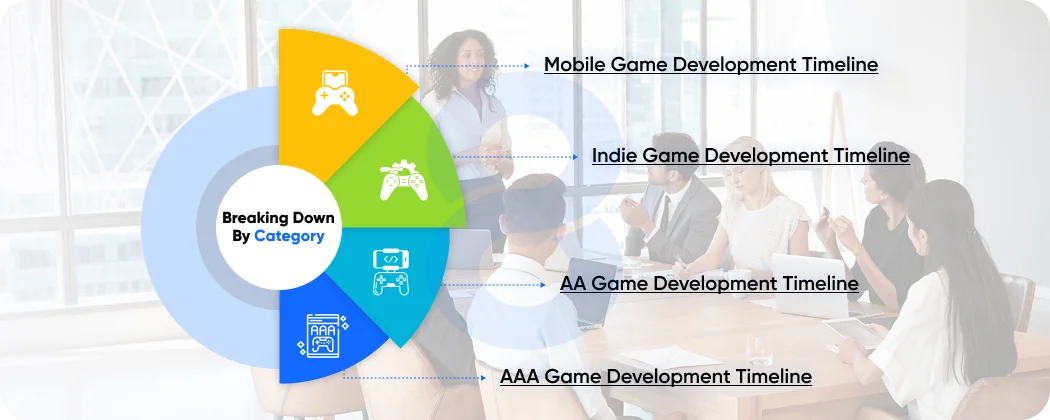
Categorical analysis by scope, platform, and genre specifications is required to understand how long it will take to make a video game. The table below represents general development timelines of various types of games:
| Game Category | Development Timeline | Typical Budget Range | Example Games |
| Hypercasual Mobile | 2–4 months | $5,000 – $50,000 | Temple Run, Flappy Bird |
| Casual Mobile | 6–12 months | $50,000 – $500,000 | Candy Crush, Angry Birds |
| Complex Mobile | 12–18 months | $500,000 – $5M | Pokémon GO, Genshin Impact (mobile) |
| Small Indie | 6–18 months | $10,000 – $100,000 | Undertale, Stardew Valley |
| Mid-Size Indie | 18–36 months | $100,000 – $1M | Hollow Knight, Celeste |
| AA Games | 18–36 months | $1M – $20M | Hellblade, A Plague Tale |
| AAA Games | 3–5 years | $50M – $200M+ | God of War, The Witcher 3 |
| AAA Live Service | 4–7+ years | $100M – $500M+ | Destiny 2, Cyberpunk 2077 |
Mobile Game Development Timeline
The mobile game development has different schedules because of the complexity of the project. Games that have very basic mechanics might be ready to enter the market in 2-4 months, particularly when they are built on top of existing structures.
More complex mobile experiences, multiplayer arenas, or RPGs, or heavy-industrial graphics action titles typically take 12-18 months. iOS and Android app development cost, platform optimization, and testing all have an important impact on schedules. Working with an established app development firm increases delivery speed even more.
Indie Game Development Timeline
The development of the game is usually a project that will take 1-2 years, depending on the size of the team and the ambition of the project. Targets of 12-18 months are usually in small teams making targeted experiences, puzzle games, 2D platformers, or narrative titles.
Nonetheless, innovative mechanics, high volumes of content, or multiplayer can expand projects to 24 months or above. The time of successful indies such as Hollow Knight was approximately 3 years, and Cuphead needed approximately 5 years.
AA Game Development Timeline
The typical 2-3 year process of AA game development is balanced in terms of quality and efficiency and moderate teams of 20-50 developers. These mid-budget productions present high production values without a huge scope.
The engines, genre-oriented design and traditional mechanics are characteristic of AA games, which simplify development speed. This segment is between the indie and AAA projects that provide controlled budgets yet give commercial competitiveness in predictable timelines.
AAA Game Development Timeline
AAA game development requires multi-year contracts, which usually range between 3 to 5 years or more, with a workforce of more than 100 developers. The growing complexity causes timelines to be stretched further.
Red Dead Redemption 2 was developed in 8 years, The Last of Us Part II in more than 6, and Cyberpunk 2077 had almost a decade. AAA development schedules and risks are characterized by massive asset production, high-tech motion capture, and large budgets of up to $100-200 million.
Steps to Make a Video Game: Critical Factors Affecting Timeline
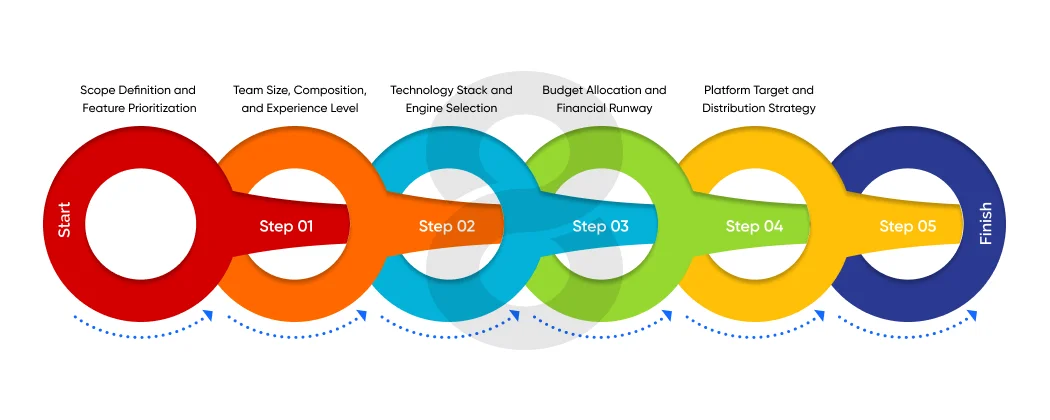
In addition to the categorical types of classifications, there are certain variables that have dramatic effects on the time it takes to make a video game. Knowledge of these factors allows for making good judgments of the timeline and proper planning of resources.
The table below outlines the key factors that influence the development schedule and their general impact:
| Factor | Impact on Timeline | Low Complexity Effect | High Complexity Effect | Mitigation Strategies |
| Scope & Features | Critical | .+20-30% timeline | .+100–200% timeline | Strict MVP definition, phased releases |
| Team Size | High | Solo: 3–4× longer | Large team: coordination overhead | Optimal sizing (8–12 core members) |
| Team Experience | Very High | Inexperienced: 2–3× longer | Veterans: faster by 40–50% | Hire senior leads, continuous training |
| Technology Stack | Moderate to High | Established engine: baseline | Custom engine: +1–2 years | Use proven commercial engines |
| Art Style | High | Simple 2D: baseline | Photorealistic 3D: 2–3× longer | Art direction early, asset reuse |
| Platform Targets | Moderate | Single platform: baseline | Multi-platform: +30–50% | Platform prioritization, shared codebase |
| Budget | Critical | Limited: slower pace | Well-funded: optimal velocity | Realistic budgeting, contingency funds |
| Scope Creep | Extreme | Managed: baseline | Uncontrolled: +50–150% | Change control processes |
Scope Definition and Feature Prioritization
One of the leading causes of late launches and overruns is scope creep, the constant increase of what was expected to be in the specifications and, hence, the budgets. Firm scope management, feature prioritization, MVP discovery, and content roadmaps will make sure that the timeline of the video game development is efficient and can be achieved.
Team Size, Composition, and Experience Level
Team architecture has a direct relationship with the development velocity and the mean game development time. The experienced game development firm, possessing specialized skills in terms of programming, design, and QA, finishes the projects in a shorter period. Proficient directors and producers reduce technical debt, avoid late-stage refactoring, and make the process of developing the video game smoother.
Technology Stack and Engine Selection
The choice of the appropriate engine and structures also has a great impact on the time to make a video game. Proprietary engines can add 1-2 years, and commercial engines such as Unity or Unreal expedite development. Unity is preferred for 2D and mobile, but Unreal is dominating high-fidelity 3D, which affects the timeline of game development.
Budget Allocation and Financial Runway
The size of the team, outsourcing, licensing of tools, and the total average time to develop the game are dependent on financial resources. The underfunded projects prolong the project since small teams are unable to cope with the workload. It is also true that budgetary planning influences Android and iOS app development cost, platform prioritization, and multi-platform strategy.
Platform Target and Distribution Strategy
The process of PC, console, and mobile development affects the timeline of the development of video games because it requires optimization of the game by the platform, control scheme, performance, and certification. Live-service models that deliver continual content, backend systems, and analytics integration extend further the development and post-launch operational process.
The global games market is projected to reach US$733.22 billion by 2030 (from roughly US$522.46 billion in 2025), reflecting a compound annual growth rate (CAGR) of ~7%.
Making a Video Game from Scratch: Navigating Common Challenges
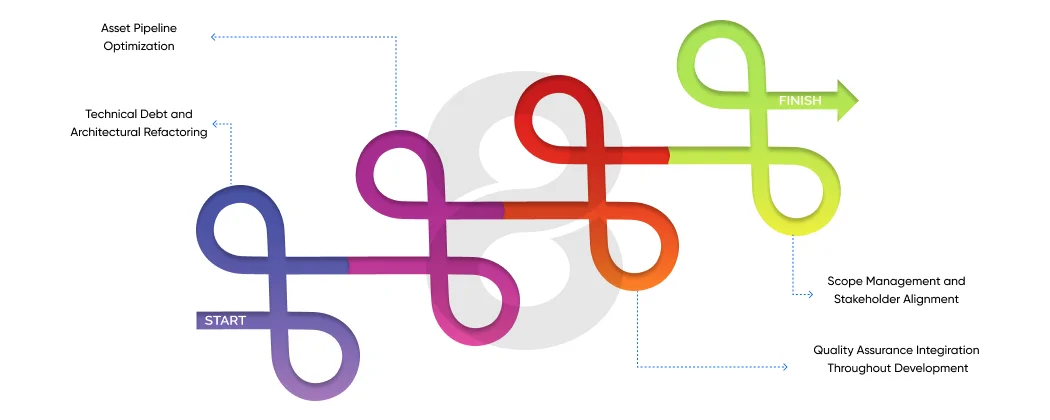
Embarking on making a video game from scratch introduces numerous obstacles that can derail schedules and compromise quality without proper mitigation strategies.
Technical Debt and Architectural Refactoring
Early architectural decisions form the foundation for all subsequent development. Poor initial architecture leads to technical debt, requiring costly refactoring. Such initiatives can pause feature implementation for months. Investing in robust architectural planning during pre-production prevents exponentially more expensive corrections during production
Asset Pipeline Optimization
Efficient asset creation workflows impact artist productivity and overall project velocity. Standardized naming conventions, version control, automated pipelines, and quality checkpoints prevent rework. Strategic outsourcing of character modeling, environments, or animation accelerates production timelines when internal teams face capacity constraints, optimizing the entire development cycle.
Quality Assurance Integration Throughout Development
Limiting quality assurance to post-production causes cascading delays. Continuous QA integration during production identifies bugs early, reduces debug complexity, and prevents compounding issues. Automated testing frameworks, continuous integration systems, and regular playtests maintain quality without introducing production bottlenecks.
Scope Management and Stakeholder Alignment
Misalignment between creative vision, technical feasibility, and stakeholder expectations stalls development. Regular milestone reviews, transparent communication, and clear approvals maintain alignment. Establishing firm scope boundaries with documented change request protocols prevents minor additions from collectively derailing project timelines.
Working with a Professional Game Development Company
Partnering with an established game development company offers substantial advantages for organizations lacking internal gaming expertise or requiring accelerated time-to-market.
Expertise and Specialized Talent Pools
Professional game development companies maintain diverse talent across programming, art, platforms, and genres, enabling rapid team assembly with matched skills. Institutional knowledge from numerous shipped titles ensures adherence to best practices, avoids common pitfalls, and applies proven problem-solving strategies, saving time and costs that inexperienced teams incur during the process of video game development.
Established Development Infrastructure
Mature studios operate advanced infrastructures, including version control, automated pipelines, project management platforms, proprietary tools, and QA frameworks, accelerating the video game development cycle. Relationships with platform holders, middleware providers, and certification authorities streamline processes that first-time developers face, optimizing workflow and improving efficiency across the game development timeline.
Risk Mitigation and Timeline Predictability
Experienced game development companies provide realistic timeline estimates based on historical data and risk assessment, improving schedule reliability. Techniques like technical prototyping, incremental milestones, and contingency planning buffer against common development disruptions, ensuring the average game development time aligns with expectations for high-quality projects.
End-to-End Development Capabilities
Full-service game development companies handle production from concept through post-launch support, ensuring unified quality and seamless workflow. Similarly, app development companies specializing in mobile gaming offer platform-specific expertise for touchscreen controls, device fragmentation, app store optimization, and monetization, streamlining the steps to make a video game.
Read More: How to Make a Video Game
Optimizing Your Video Game Development Timeline
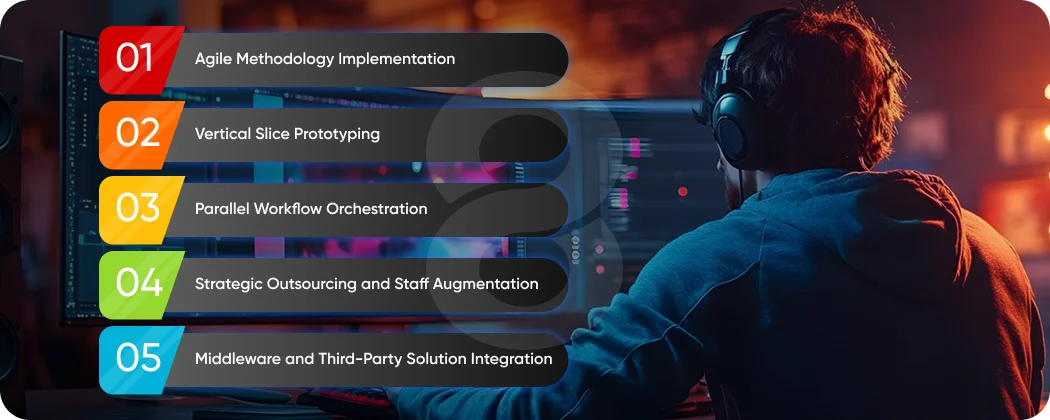
Strategic approaches can substantially compress average game development time without compromising quality or introducing unsustainable crunch conditions.
Agile Methodology Implementation
Agile frameworks featuring iterative sprint cycles, regular stakeholder reviews, and incremental feature delivery enable continuous progress validation and rapid adaptation to emerging challenges. Sprint retrospectives identify process inefficiencies, while daily standups maintain team synchronization and surface blockers before they escalate.
Vertical Slice Prototyping
Creating a vertical slice, a fully functional segment showcasing all major systems and production quality levels, early in development, validates feasibility and establishes quality benchmarks. This approach frontloads risk by exposing potential problems when flexibility for foundational changes remains highest.
Parallel Workflow Orchestration
Careful dependency management enables parallel execution across departments, maximizing team utilization while minimizing idle time waiting for predecessor tasks. For example, level designers can work on spatial layouts using proxy assets while artists create final production models.
Strategic Outsourcing and Staff Augmentation
Selectively outsourcing specialized or capacity-constrained work, such as concept art, 3D modeling, animation, localization, or quality assurance, prevents internal bottlenecks without permanent headcount expansion. This flexibility proves particularly valuable during production peaks requiring temporary workforce scaling.
Middleware and Third-Party Solution Integration
Leveraging commercial middleware for analytics, multiplayer networking, authentication, payment processing, and advertising integration accelerates development by providing battle-tested solutions rather than custom implementations. While introducing licensing costs, these solutions typically prove more cost-effective than equivalent development time investments.
Real-World Development Timeline Examples
Examining concrete examples provides a contextual understanding of how long does it take to make a video game across different scales and genres.
| Game Title | Developer | Development Time | Team Size | Budget (Est.) | Key Insights |
| Stardew Valley | ConcernedApe (Solo) | ~4 years | 1 developer | <$50,000 | Solo passion project, all aspects self-created |
| Undertale | Toby Fox | ~2.5 years | 1–3 developers | ~$50,000 | Minimal team, focused narrative experience |
| Celeste | Matt Makes Games | ~2 years | 3–5 developers | ~$100,000 | Small team, tight scope, excellent execution |
| Hollow Knight | Team Cherry | ~3.5 years | 3 developers | ~$150,000 | Kickstarted indie, extensive content |
| Cuphead | Studio MDHR | ~5 years | 12–25 developers | $6M+ | Hand-drawn animation caused timeline extension |
| Hellblade: Senua’s Sacrifice | Ninja Theory | ~3 years | ~20 developers | ~$10M | AA production with AAA-quality focus |
| A Plague Tale: Innocence | Asobo Studio | ~4 years | 40–50 developers | ~$10–15M | Mid-tier production, strong narrative |
| God of War (2018) | Sony Santa Monica | ~5 years | 200+ developers | $40–50M | Complete franchise reinvention |
| The Witcher 3 | CD Projekt Red | ~3.5 years | 250+ developers | $81M | Massive open-world RPG |
| Red Dead Redemption 2 | Rockstar Games | ~8 years | 1,600+ developers | $170–240M | Industry’s longest AAA development |
| Cyberpunk 2077 | CD Projekt Red | ~7+ years | 500+ developers | $174M+ | Extended timeline, problematic launch |
| Destiny | Bungie | ~4 years | 500+ developers | $140M+ | Live-service model complexity |
Indie Success Stories
- Stardew Valley: Solo developer Eric Barone invested approximately 4 years of full-time work, creating all programming, art, music, and design independently.
- Undertale: Toby Fox spent roughly 2.5 years developing this narrative-focused RPG with minimal team assistance.
- Celeste: Matt Makes Games allocated approximately 2 years with a small team creating this critically acclaimed platformer.
Mid-Tier Productions
- Hellblade: Senua’s Sacrifice: Ninja Theory developed this AA title over 3 years with a team of approximately 20 developers, demonstrating efficient focused production.
- A Plague Tale: Innocence: Asobo Studio required roughly 4 years with moderate team size, balancing quality and scope ambitions.
AAA Blockbusters
- God of War (2018): Sony Santa Monica spent approximately 5 years completely reinventing this franchise with a team exceeding 200 developers.
- The Witcher 3: CD Projekt Red allocated 3.5 years with a team of 250+ developers creating this massive open-world RPG.
- Cyberpunk 2077: Despite 7+ years of development, launch quality issues illustrated how extended timelines don’t guarantee polish without proper management.
The Future of Video Game Development Timelines
Looking at real-life cases gives one a situational conception of the time taken to create a video game at various levels and genres.
Artificial Intelligence and Machine Learning Integration
Procedural asset generation (and perhaps other content generation) with the help of AI, such as procedural asset generation, automated tests, intelligent NPC behavior, and adaptive difficulty systems, will probably condense some development stages but allow the scale of scope to be previously unimaginable.
Cloud-Based Development Infrastructure
Distributed development tools, real-time collaborative editing, and cloud-based build systems minimize geographical boundaries and allow access to talent around the world, possibly giving faster production by providing longer working-hour coverage.
No-Code and Low-Code Platforms
The abstracted development tool and visual scripting system make technical barriers easier, allowing designers and artists to deliver functionality without programmer intervention, and thus might shorten the small to mid-sized project timeline.
Cross-Platform Frameworks Maturation
The further development of engines such as the Unreal Engine 5 with Nanite as a virtualized geometry and Lumen as a global illumination allows a platform to optimize less work but allows visual quality that might have taken a significantly greater development investment.
8ration’s Expert Approach to Game Development

At 8ratio, we realize that making a video game is not only a timeline but a process of creativity, technology, and planning. Being one of the most popular game development companies, we will take clients through all phases of video game development, such as the ideation and prototyping phase, followed by production, testing, and support.
With the help of the advanced tools, skilled designers, and professional developers, we guarantee that every project will be of high quality and will optimize its efficiency. Regardless of the platform (mobile, console, or PC), our experience will help turn complicated concepts into engaging gaming experiences that players around the globe will love.
Final Thoughts!
To find out the length of time it takes to create a video game, it is important to thoroughly examine the scope, resources, technology, and capabilities of the team. Critical schedule estimations come because of a candid evaluation of the complexity of features, team experience, budget, and platform needs.
Effective game development strikes a balance between vision and feasibility of resource usage and schedule efficiency, with flexible quality criteria. Through them, you set your project to do well in the ever-competitive market in terms of commercial success.