


The global mobile application market is expected to grow from US$ 330 billion in 2025 to about US$ 1.25 trillion by 2035 (CAGR ~14.3%).
Cross-platform development has revolutionized the development of mobile applications, and Flutter remains at the forefront of the change. As almost half of all developers around the world use Flutter to develop their projects, the financial aspect of Flutter app development has become essential to businesses wishing to undergo the process of digital transformation.
Whether you are a startup owner who is only considering launching their first mobile application or a business with an established digital presence that is contemplating expanding into Flutter. Regardless of your intentions, this all-encompassing guide will take you through every part of the Flutter app development cost estimation in a way that is unmistakably clear and accurate.
Understanding Flutter App Development Costs: The Complete Picture
When companies make a query about “how much does Flutter app development cost?” They usually find out in the end that there is no answer. Depending on a wide range of factors, some of which are closely interdependent, the price of building a Flutter application can range between $30,000 for simple applications to significantly more than $300,000, depending on the level of enterprise-grade development.
| App Complexity Level | Key Characteristics | Timeline | Investment Range |
| Basic Flutter App | Standard UI components, core functionality, minimal integrations | 2-3 months | $30,000-$55,000 |
| Moderate Flutter App | Custom UI elements, third-party integrations, user authentication | 4-6 months | $55,000-$120,000 |
| Advanced Flutter App | Complex architecture, real-time features, advanced APIs, payment systems | 7-10 months | $120,000-$220,000 |
| Enterprise Flutter App | Custom infrastructure, microservices, advanced security, multi-platform deployment | 12-18 months | $220,000-$350,000+ |
The first way of estimating the cost of Flutter app development for your particular project is to understand their ranges.
Read More: eCommerce App Development Cost: Your Ultimate Guide
The 10 Critical Factors Influencing Flutter App Development Cost
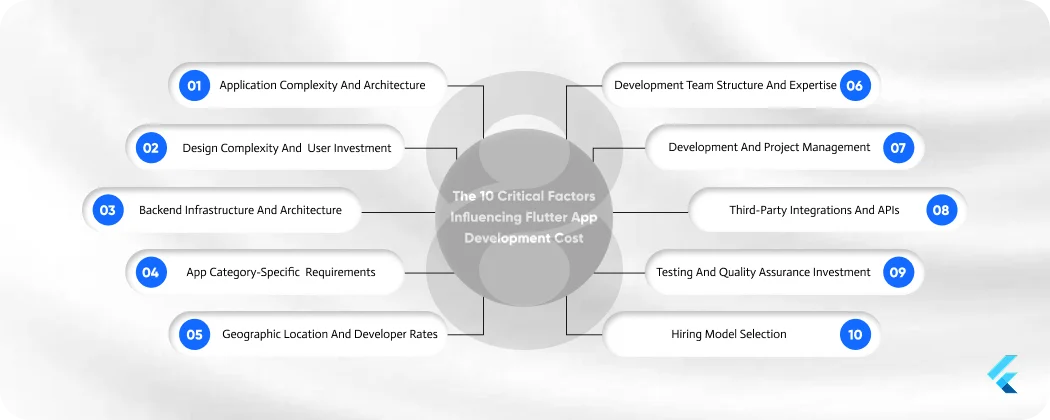
1. Application Complexity and Feature Architecture
The basis used to determine the cost of developing the Flutter app is the complexity of your app. This adds a ripple effect in the development time, testing requirements, and infrastructure needs with every added feature.
Basic App:
User registration, simple profiles, and one-way display of content are simple features that need little back-end logic and simple UI implementation. These attributes usually add up to $5,000-$15,000 to your total budget.
Mid-Complexity App:
Moderate functionality, including social media integration, push notifications, simple analytics, and content management systems, applies more advanced logic and third-party integrations, which will increase the cost of development by $15,000 to $40,000.
Advanced App:
Additional functionalities, such as real-time chat, video streaming, artificial intelligence-based suggestions, sophisticated payment, and geolocation, demand a highly developed backend architecture and testing, which can cost up to $40,000-$100,000 or more.
2. Design Complexity and User Experience Investment
Design has a direct effect on user acquisition, as well as retention, so it is an important factor in Flutter application development cost.
| Design Component | What’s Included | Investment Range |
| Pre-Design Strategy | User personas, competitive analysis, journey mapping | $1,500–$3,000 |
| UI Design | Visual interfaces, custom icons, brand elements | $3,000–$15,000 |
| UX Architecture | Wireframes, prototypes, usability testing | $5,000–$20,000 |
| Motion & Animation | Micro-interactions, transitions, animated elements | $2,000–$15,000 |
Not conducting pre-design research can result in an expensive redesign, and investing in an extensive UX architecture can decrease the amount of rework in development, as well as enhance user satisfaction.
3. Backend Infrastructure and Architecture
On the one hand, Flutter manages the frontend well, but on the other, most applications require strong back-end infrastructure, which severely influences the cost of developing an application in Flutter.
- Basic Backend Setup: Simple applications require basic server configuration, database setup, API development, and user authentication systems.
- Intermediate Backend: Apps with moderate complexity need scalable architecture, multiple third-party integrations, caching mechanisms, and more sophisticated data management.
- Advanced Backend Systems: Enterprise applications demand microservices architecture, real-time data synchronization, advanced security protocols, load balancing, and comprehensive monitoring systems.
- Cloud Infrastructure Considerations: Choosing between AWS, Google Cloud, or Azure affects both initial setup and ongoing costs. Serverless architectures can reduce costs for applications with variable usage patterns.
| Backend Level | Description | Estimated Cost (USD) |
| Basic Backend Setup | Simple applications requiring fundamental backend functionality | $10,000 – $25,000 |
| Intermediate Backend | Apps with moderate complexity | $25,000 – $60,000 |
| Advanced Backend Systems | Enterprise-level applications | $60,000 – $150,000+ |
| Cloud Infrastructure Considerations | Impacts both setup and ongoing costs | Varies depending on provider |
4. App Category-Specific Requirements
Application categories have different development difficulties that directly affect the Flutter app development costs.
- E-commerce Applications: These need the secure payment gateway integration, inventory management, order tracking, customer review systems, and, in many cases, integration with the already existing ERP systems.
- Social Media Platforms: Live chatting, uploading, and processing of media, social networks, notifications, and content management are major technical complexities.
- Healthcare and Telemedicine: The HIPAA compliance, patient data security, electronic health records, video consultation features, and the highly exhaustive standards of tests significantly add to expenses.
- On-Demand Service Apps: The systems of real-time GPS tracking, dynamic pricing algorithms, payment processing, driver/service provider administration, and rating systems involve complex development.
- Financial Technology Apps: Security that meets the banking level, financial policies, processing of transactions, biometric authentication, and broad testing contribute to the increase in costs.
- Educational Platforms: The interactive content delivery, tracking of progress, video streaming, assessment system, and learning analytics need to be thoughtfully designed.
| App Category | Estimated Cost (USD) | Key Features/Requirements |
| E-commerce | $80,000 – $200,000 | Payment gateway, inventory & order management, reviews, ERP integration |
| Social Media | $100,000 – $250,000+ | Real-time messaging, media processing, notifications, content moderation |
| Healthcare & Telemedicine | $120,000 – $300,000+ | HIPAA compliance, patient data security, EHR integration, video consultations |
| On-Demand Services | $90,000 – $220,000 | GPS tracking, dynamic pricing, payment processing, provider management, ratings |
| Fintech | $150,000 – $350,000+ | Banking-grade security, financial compliance, transactions, biometric authentication, testing |
| Educational Platforms | $70,000 – $180,000 | Interactive content, progress tracking, video streaming, assessments, learning analytics |
5. Geographic Location and Developer Rates
The cost to hire Flutter app developers will differ considerably depending on the region, which entails major budgetary concerns.
| Region | Hourly Rate Range | Quality Level | Communication |
| North America | $100-$250/hour | Excellent | Native English, same timezone |
| Western Europe | $80-$200/hour | Excellent | Strong English, minimal timezone difference |
| Eastern Europe | $50-$90/hour | Very Good | Good English, manageable timezone |
| Latin America | $40-$80/hour | Good to Very Good | Good English, compatible time zones |
| Asia (India, Pakistan) | $25-$60/hour | Variable | Moderate English, significant timezone gap |
| Southeast Asia | $30-$70/hour | Good | Good English, 12-hour timezone difference |
| Africa | $25-$55/hour | Variable | Good English, varied time zones |
Strategic Consideration: The lowest hourly rate doesn’t always mean the lowest total cost. Communication challenges, quality issues requiring rework, and project management overhead can offset rate advantages.
6. Development Team Structure and Expertise
With a proficient Flutter development team, the result would be timely delivery of the product, quality performance, and smooth user experiences. Prices depend on the experience, the number of people in the team, and the complexity of the project.
| Role | Number of Team Members | Hourly Rate | Responsibilities |
| Flutter Developers | 1-5 | $25-$150 | Build app features, architecture design, performance optimization, and mentorship. |
| UI Designer | 1-2 | $40-$100 | Creates visual interfaces, design systems, and cohesive app aesthetics. |
| UX Designer | 1-2 | $50-$120 | Designs user flows, conducts research, and builds interactive prototypes. |
| Backend Engineers | 1-3 | $50-$140 | Develop APIs, manage databases, implement server-side logic. |
| QA Engineers | 1-2 | $30-$80 | Perform manual and automated testing, create test cases. |
| Project Manager | 1 | $60-$130 | Coordinates team, manages timelines, communicates with stakeholders. |
| Business Analyst | 1 | $50-$110 | Defines requirements, creates documentation, bridges business and technical teams. |
| DevOps Engineer | 1 (if complex) | $60-$140 | Manages deployment pipelines, cloud infrastructure, monitoring, and CI/CD processes. |
7. Development Methodology and Project Management
The approach to development that you choose has a great influence on the timeline and Flutter application development cost.
- Waterfall Methodology: Traditional sequential approach with defined phases. Offers clear milestones but less flexibility for changes. Best for projects with well-defined requirements and minimal expected changes.
- Agile/Scrum Development: Iterative approach with 2-4 week sprints. Allows flexibility and regular stakeholder feedback. Typically adds 10-15% to development costs but dramatically reduces the risk of building the wrong product.
- Hybrid Approach: Combines waterfall planning with agile execution. Provides structure while maintaining flexibility. Popular for medium-to-large projects with experienced teams.
8. Third-Party Integrations and APIs
The cost of developing Flutter apps is highly dependent on third-party integrations and APIs since contemporary applications need to be able to integrate with external systems. Necessitating workflows, testing, and optimization per connection, depending on complexity, simple social logins through enterprise-grade integrations, each connection will define overall budget and development timelines.
| Integration Level | Estimated Cost (Per Integration) | Examples |
| Basic Integrations | $2,000 – $8,000 | Social logins, basic analytics, push notifications, simple maps |
| Intermediate Integrations | $8,000 – $20,000 | Payment gateways, advanced analytics, CRM tools, email marketing, cloud storage |
| Complex Integrations | $20,000 – $60,000+ | ERP systems, custom/legacy APIs, AI/ML services, blockchain, IoT connectivity |
9. Testing and Quality Assurance Investment
Thorough testing guarantees that your application will work perfectly on every device, which directly influences the satisfaction of the users and the costs of its maintenance.
- Manual Testing: Essential for user experience validation, edge case discovery, and platform-specific behavior verification.
- Automated Testing: Unit tests, integration tests, and widget tests reduce regression bugs and long-term maintenance costs.
- Performance Testing: Load testing, stress testing, and performance profiling ensure your app handles real-world usage patterns.
- Security Testing: Penetration testing, vulnerability assessment, and security audits protect user data and brand reputation.
- Device Testing: Testing across multiple device types, screen sizes, and OS versions ensures a consistent experience.
| Testing Type | Estimated Cost | What It Includes |
| Manual Testing | $5,000 – $20,000 | UX validation, edge case detection, platform-specific behavior testing |
| Automated Testing | $10,000 – $35,000 | Unit tests, integration tests, widget tests to prevent regressions |
| Performance Testing | $3,000 – $12,000 | Load testing, stress testing, performance profiling |
| Security Testing | $5,000 – $25,000 | Penetration testing, vulnerability assessments, security audits |
| Device Testing | $2,000 – $10,000 | Testing across device models, screen sizes, OS versions |
10. Hiring Model Selection
The model of hiring selection has a pronounced effect on the cost of development, control of the project, and speed of delivery, and thus, it is necessary to make sure that the choice of the type of engagement is consistent with the objectives of your project.
- In-House Development Team: A permanent department will give complete control and long-term dependability, but high wages, cost of operation, and continuous recruitment and training.
- Outsourcing to Development Agency: Agencies are more affordable, quicker, and provide specialized expertise, but because communication barriers exist and because direct control is not as pronounced, this can impact the coordination of the project.
- Staff Augmentation: Staff augmentation brings with it experienced developers and flexibility as well as scalability to current teams, yet it depends on well-established internal management and workflow processes.
- Freelance Developers: Freelancers offer affordable, scalable development of smaller tasks; however, quality, reliability, and scalability tend to differ significantly among individuals.
| Hiring Model | Cost Structure | Cost Range |
| In-House Development Team | Full salaries, benefits, equipment, and office space | $80,000–$180,000 per developer annually |
| Outsourcing to the Development Agency | Project-based or hourly | Typically 20–30% lower than in-house |
| Staff Augmentation | Hourly or monthly specialist rates | $4,000–$15,000 per developer monthly |
| Freelance Developers | Hourly or project-based | $30–$150 per hour |
Adoption of cross-platform and hybrid frameworks (like Flutter) is rapidly increasing, with many businesses shifting to cross-platform for faster time-to-market and cost savings.
Read More: How Much Does It Cost to Develop an Android App
Hidden Costs and Ongoing Expenses

There are hidden costs and recurring expenses in the Flutter lifetime budget. Though a start-up is attractive, long-term prosperity demands constant expenditure on maintenance, hosting, app store charges, compliance, and customer acquisition.
These recurrent costs guarantee performance, security, and scalability as more users are added to your user base. Such expenses are what should be properly planned to avoid budget surprises and maintain the quality of apps and business development.
| Category | Cost Range / Details | What It Includes |
| Post-Launch Maintenance & Support | 15–25% of initial cost yearly
Year 1: $10,000–$60,000 Year 2+: $8,000–$45,000 |
Bug fixes, OS updates, security patches, minor feature improvements |
| App Store Fees & Requirements | Google Play: $25 one-time
Apple Developer: $99/year Enterprise iOS: additional |
Publishing, updates, enterprise distribution |
| Infrastructure & Hosting | Basic: $50–$300/month
Medium: $300–$1,500/month Enterprise: $1,500–$10,000+/month |
Cloud hosting, databases, CDNs, scaling |
| Third-Party Service Subscriptions | Analytics: $0–$500/month
Push notifications: $0–$400/month Payment fees: 2.9% + $0.30/transaction Cloud storage: $0.02–$0.08/GB SMS/Email: variable |
Essential operational tools, messaging, storage, payments |
| Marketing & User Acquisition | ASO: $1,000–$5,000 initial + $500–$2,000/month
Paid installs: $2–$50 per user Content marketing: $2,000–$10,000/month |
User growth, retention, visibility |
| Compliance & Legal | Legal docs: $500–$3,000
GDPR/CCPA: $5,000–$30,000 Industry compliance: $15,000–$100,000+ |
Data protection, regulatory requirements, industry standards |
Strategic Cost Optimization Techniques
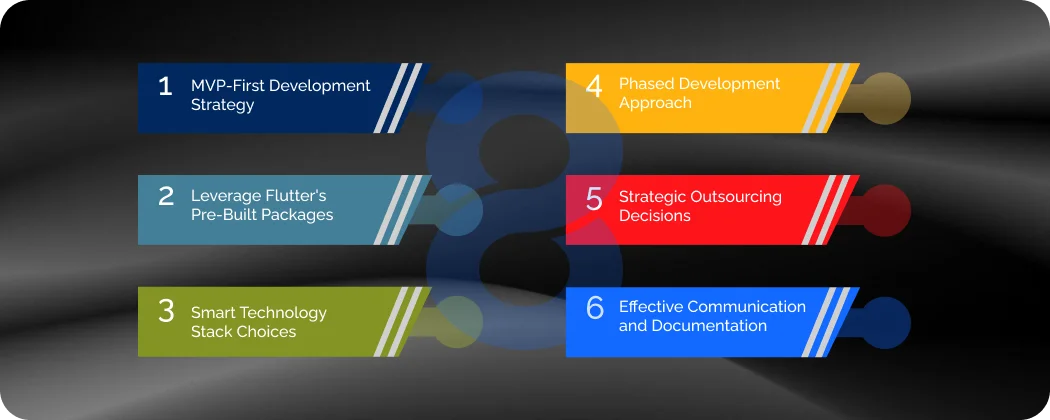
It does not mean that smart management of budget is all about compromises; it means being strategic about value creation. These established optimization strategies will allow you to cut the Flutter app development cost by 30-60% without feature loss, allowing both startups and businesses to create competitive applications with realistic budgets.
1. MVP-First Development Strategy
Start simple and prove your business idea first, then invest heavily. The MVP approach saves a company 40-60% of initial costs and makes it possible to turn a $120,000 project into a $45,000 application ready to enter the market. Prioritize core value and standard components, and use backend services such as Firebase to speed up time-to-market.
2. Leverage Flutter’s Pre-Built Packages
The ecosystem of Flutter provides thousands of battle-tested packages, which remove the need to reinvent the wheel. Tested state management, networking, authentication, and UI component solutions. The strategy will save $5000-$25000 per project, yet will be reliable, have shorter development processes, and have lower maintenance complexity with community-supported code.
3. Smart Technology Stack Choices
Choose the technologies that would ensure long-term efficiency and short-term savings. BaaS providers such as Firebase will save developers 50-70% on first-time development. Cupertino and Material Design 3 cut UI development by 30-40%. Share and merge codes across platforms with a goal of 85-95% reusability to maximize the productivity of the developers and minimize platform-specific bugs.
4. Phased Development Approach
Construct in stages and not at once. Launch with MVP within 3-4 months, make improvements to it, and optimize its performance after user feedback. This methodology decreases financial risk, allows revenue to be raised early, tests assumptions prior to high investment, and allows correction of the course during development.
5. Strategic Outsourcing Decisions
Keep business logic that is important under control, sourced, and standardized. Maintain own proprietary algorithms, sensitive data handling, and strategic planning. Implementation of outsourced UI, routine features, quality assurance, and documentation. This is the best hybrid solution that maximizes cost whilst safeguarding intellectual property as well as retaining competitive advantages in your market.
6. Effective Communication and Documentation
Spend $3,000-$10,000 on detailed documentation to avoid rework costs of up to $15,000-$50,000. Costly misunderstandings are eliminated by clear requirements, detailed wireframes, user stories, and acceptance criteria.
Effective documentation has the benefits of quickening the onboarding process, minimizing the ambiguity of the development, avoiding feature creep, and providing all stakeholders with a single vision during the project lifecycle.
Read More: How Much Does it Cost to Develop an iOS App
Red Flags: When Flutter Might Not Be Optimal
Although Flutter is effective in the majority of cases, some events can justify the consideration of other options:
- Heavy Platform-Specific Integration: Apps requiring deep integration with platform-specific features might benefit from native development
- Extremely Large Apps: Apps exceeding 100MB may face distribution challenges
- Bluetooth/IoT Complexity: While possible, complex Bluetooth or IoT implementations may be simpler with native code
- Existing Native Codebase: Organizations with substantial native code investments might find migration costs prohibitive
Read More: Mobile App Development Cost Breakdown
Partner with 8ration for Transparent Flutter Development
At 8ration, we’ve transformed countless ideas into market-ready Flutter applications across automotive, e-commerce, healthcare, fintech, and travel sectors. Our proven agile methodology combines strategic planning with transparent cost structures, ensuring you understand every investment dollar.
With development centers spanning North America, Middle East, and South Asia, we offer flexible engagement models customized to your budget and timeline. Our award-winning team doesn’t just build apps, we architect digital transformation solutions that scale with your business growth.
From MVP development starting at $30,000 to enterprise-grade applications, we deliver predictable costs, exceptional quality, and measurable ROI that positions your product for sustained market success.
“With nearly half of cross-platform developers choosing Flutter today, we’re betting on a framework that combines scalability, performance, and long-term stability.”
– Muhammad Rashid, CTO at 8ration
Final Thoughts!
The costs of Flutter app development cannot be understood only by average estimates since every factor that affects your project has to be taken into consideration. The simple apps cost between $30,000 to $55,000, whereas sophisticated enterprise systems cost more than $250,000-$350,000.
Budgeting is an undertaking that requires clear scope, planning, and selection of an appropriate development partner. Flutter is a cross-platform, efficient solution with a mature ecosystem, which provides 40-60% cost savings compared to native development. Flutter is versatile and ready to achieve your vision in 2026 and beyond, with either an MVP or a product of scale.