
The App Store Optimization Software Market is estimated to be valued at USD 38.1 billion in 2025 and is projected to reach USD 178.9 billion by 2035, registering a compound annual growth rate (CAGR) of 16.7% over the forecast period.
In the modern world that has become highly technological, it is not only about how to create an app on iOS, but about how to design an experience that appeals to millions of iPhone users around the globe. The Apple ecosystem is among the most revenue-rich in the mobile environment, boasting of above 1.56 billion iPhone users and over 1.3 trillion in App Store purchases. Therefore, how will you create an application that not only works but thrives?
At 8ration, we have assisted businesses in various industries to develop iOS apps that are not only aesthetically impressive but also technologically enhanced. Here is a guide to the level of expertise that will help you learn all the information about the way of how to make an app on iOS, which really makes a splash.
Understanding Why iOS Apps Matter in 2026 and Beyond
It is essential to know why the Apple ecosystem is still the best option for developers and businesses before getting into how to create an app on the iOS platform.
Users of Apple have a reputation for loyalty and engagement and greater purchasing power. In 2024 alone, the amount of money iPhone users spent on apps was over $140 yearly, much more than Android users spent. As the iOS market share will continue to rise to 2030, it is evident that investing in iOS development will guarantee the company access to a market segment with high standards in terms of software design, performance, and privacy.
Read More: How to Create an App for Your Business
As a developer, there has never been a better moment to learn how to create an app on iOS with the latest tools since Apple has been undertaking consistent research in the creation of technologies, such as Swift, SwiftUI, ARKit, and Core ML.
Step 1: Conceptualization: The Backbone of Every Great App
All successful iOS applications have a vision. Ask yourself:
- What issue will my app address?
- Who will use it and why?
- How can I make it different from what’s already out there?

At 8ration, we begin each project by carrying out an intense market research. Our activities include the study of user needs, competitor app analysis, and finding out which gaps exist in the market. This stage defines your future achievement in case you intend to develop an application on iOS.
Market Insight Example
Due to 2025, the productiveness and health-related iOS applications are some of the most popular to grow. It is possible to add AI or wearable-based functionality to boost engagement to a considerable degree.
Trick: Before writing even a line of code, use applications such as App Annie, Sensor Tower, or Apple Analytics to know what works in your niche.
Read More: How Much Does it Cost to Develop an App
Step 2: Selecting the appropriate Tech Stack
When learning how to create an app on iOS, technology selection defines everything, from performance to scalability.
Principles of iOS App Development
- Language: Swift (desirable) or Objective-C
- Frameworks: SwiftUI UI, Combine reactive, Core Data storage
- AR/AI Integration: ARKit, Core ML, and Create ML
- Testing and Automation: Xcode, XCTest, Fastlane, and Firebase Crashlytics
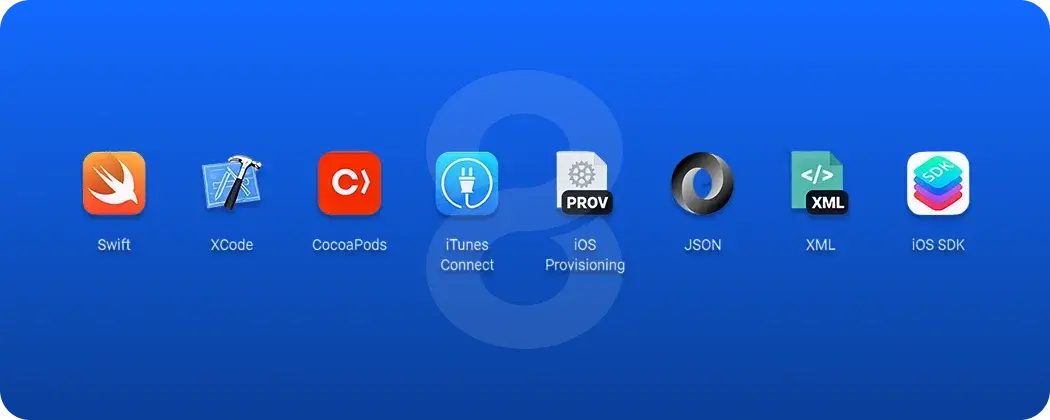
The Swift language of Apple is a powerhouse; it is fast, safe, and it is intuitive. SwiftUI, specifically, enables developers to make responsive UIs that can fit perfectly into various devices. And in case you are asking yourself how to create an app on iOS that is futuristic, you need to add AR or machine learning.
Read More: How to Create an App on Android
Step 3: Creating an Experience for the User
The user experience (UX) can be your guiding star in case you want to know how to create an app on iOS. The design philosophy of Apple is founded on simplicity, clarity and depth – and all successful applications of the iOS adhere to these rules. Design is not merely about colors or typography, but it is also about being intuitive and easy to the end consumer.

We are a human-first design at 8ration. Each transition and pixel must contribute meaning and eliminate friction. Your design must make a memorable experience to the users.
Here’s how to make that happen:
- Use the guidelines of Apple Human Interface (HIG): This will make your app look and feel native to iOS and it will adapt to any system change and gesture.
- Apply SwiftUI to UI Consistency: SwiftUI also supports live previews and adaptive interfaces on both iPhone and iPad as well as on Apple Watch or Vision Pro.
- Enhance Accessibility: Be sure to turn on text scaling, VoiceOver, and dynamic colors – Apple rewards inclusivity with, in turn, better user satisfaction.
- Micro-animations: Minor movement (such as transition between buttons and gestures) makes users even more delighted and ensures they have a high level of engagement.
Pro tip: Run your UI on a variety of different devices, using Xcode Simulator and real feedback, using TestFlight.
Keep in mind that learning to develop an app in iOS does not mean that you are writing code but you are creating an experience that should seem alive and responsive.
Step 4: Development – Transforming Ideas into Functionality
After you are ready with your designs, the next phase is the development phase, whereby your idea is converted into a real product. This is a very important phase and the proper approach will save you months of work.

We are at 8ration; an agile approach, where we focus on iteration, testing and refining. This is the process that you need to follow in case you are studying how to create an app on iOS:
Core Development Phases
- Environment Preparation: Download Xcode (Application IDE), configure simulators, and prepare your provisioning profiles with the help of your Apple Account.
- Backend Development: Firebase, AWS or a custom backend with Node.js/Python can be used, depending on your app.
- API Integration: Ensure that your APIs comply with the security and privacy standards of Apple.
- Database Setups: Core data and Realm or CloudKit can be used to achieve smooth data persistence.
- Application Logic and UI Integration: Consists of design resources and binds them to backend logic.
- Example: In the case of a fitness tracker, you can add Apple HealthKit to connect live health data of the user, or employ Core Motion to monitor physical activity accurately.
Bonus Tip: It is always good to modularize your code. It will assist you in scaling or reuse elements in the future when your application expands.
Step 5: Testing and Quality Assurance
The prettiest of apps will not work without appropriate testing. Getting to know how to build an app on iOS also involves getting to know how to test the same.

There is a high expectation among the users of Apple; they want to see apps that run perfectly, are loaded quickly and do not crash at all. In order to satisfy the specified requirements, test on different devices and OS versions.
Testing Strategies:
- Unit Testing: Test each functionality against expected results.
- UI Tests: XCTest provides the opportunity to imitate the user interaction.
- Beta Testing through TestFlight: Allow actual users to use your app to test it.
- Performance Monitoring: Firebase Crashlytics and Instruments are some tools that can monitor crashes and memory leaks.
- Automation Tip: Repetitive Tests Simplify continued integration and deployment (CI/CD) using Fastlane to automate repeatable tests.
Our motto is at the 8ration, test early, test often. This guarantees smoothness, friendliness and bug bug-free experience of your app at first sight.
App Store Optimization Software Market size was valued at USD 0.53 Billion in 2024 and is projected to reach USD 1.99 Billion by 2032, growing at a CAGR of 18.02% from 2026 to 2032.
Step 6: Launch and App Store Optimization (ASO)
That is not the end of knowing how to make an app on iOS; it becomes the real test when your app is available on the App Store. App Store Optimization (ASO) is vital to visibility, discoverability, and conversion rates.

Key ASO Components:
- Name and Title: Add your focus keyword (e.g. how to create an app on iOS) intuitively in the description or metadata of your app.
- Icon Design: Keep it simple and impressive – your icon is your introduction.
- Text in the App: This is a story that is focused not on features but the user benefit.
- Screenshots/preview Videos: Do not use mockups but show real app interaction.
- Ratings/ Reviews: Promote initial reviews – positive reviews make ranking easier.
Launch Checklist:
- Create hype using social media previews.
- Create an opening page to your application.
- Upload your app through App Store Connections and wade through the instructions on how to have your application reviewed by Apple.
On launching, keep in mind – the first 72 hours are critical in user engagement and ranking.
Step 7: Updates and User-Retention after the launch
The process of developing an app with iOS does not end with launch. Actually, this is the place where it really starts. Since it constantly evolves, gives new features, and receives feedback, it is these elements that make or break your app.

Long-Term Success Strategies:
- Gather Analytics: Collecting user behavior is possible with such tools as Firebase Analytics or Mixpanel.
- Proceed in Cycles: Add features that are a direct response to user pain.
- Push Notifications: Be judicious with them, make them relevant, have value.
- Connect With Customers: React to the comments posted on the App Store and create a following.
Research evidence shows that apps with new releases every 4-6 weeks retain users 35 percent better than non-releasing apps.
Pro Tip: To monitor the downloads, session time, and conversion rates, refer to the dashboard provided by Apple App Analytics.
Step 8: Monetization – Making Your App a Business
In case you want to earn money, but to know how to create an app on iOS is the main task, you will have to choose a suitable monetization approach. Apple users are also ready to pay more to have high-quality features, and this makes the iOS platform the best to monetize.

Common Monetization Models:
- Freemium Model: No charges on downloading the app, but get some in-app purchases with a subscription.
- Subscription Model: Best when it comes to content or productivity applications.
- Pay-to-Download: Ideal where the apps are of high value and they are niche.
- Ad-Based Revenue: Use in-app display ad or Apple Search Ads to generate revenue.
E.g.: Fitness applications such as Calm and Headspace have managed to combine the freemium and subscription business model and make millions of dollars each year.
Step 9: Building AI, AR, and Vision Pro Integration
Intelligent and immersive technology is the future of app creation in iOS. The latest versions of iOS apps allow developers to create hyper-realistic and customized experiences with the help of Apple Vision Pro and frameworks such as ARKit and Core ML.

Emerging Trends to Watch:
- AI-Based Recommendations: Customize user experiences with Core ML.
- AR Experiences: AR Kit is being used in retail, healthcare, and education applications to learn and shop in AR.
- Voice and Gesture Control: SiriKit and Siri Vision Pro gestures are added to be used to create futuristic experiences.
- IoT Integration: HomeKit gives apps the ability to control smart devices safely.
Being creative and innovative, you will be able to develop apps that will not only be appropriate today but will also be able to predict future requirements.
Step 10: Brands and Marketing Your iOS App
After launching your app, it is time to draw and keep users on board by branding and marketing. It is not just the secret of how to create an app on iOS, but the second part of the equation is how to get people to care about this application.
Branding Essentials:
- Consistency: Have a single tone, logo, and visual theme on all touchpoints.
- Storytelling: Demonstrate the human aspect of your app, how it assists people and not what it does.
- Social Media & Influencer Marketing: Work with creators within your niche to be exposed.
- Content Marketing: Compose tutorials, guides, and blog posts that contain your keyword, “how to build an app on iOS,” to enhance visibility.
- Email Campaigns: Keep your current users updated and offer them.
A robust brand and a devoted community make your app a success story to be enjoyed in the long term.
“An iOS app isn’t just code, it’s a seamless experience that connects users, solves problems, and brings ideas to life.”
– Muzamil Liaqat Rao, CEO of 8ration
Final Thoughts: The Future of iOS Apps
It is not only about how to create an app on iOS anymore; it is about how to innovate, understand the user, and how to be able to scale it up long-term. The iPadOS ecosystem is constantly developing, and there are new features, such as SwiftUI, Vision Pro, and AI solutions, redefining the possibilities.
At 8ration, our specialists feel that a successful iOS application is a combination of images, functionality, and price. As a budding developer or the owner of a business, you are successful when you create experiences, not interfaces.
In Summary:
- Begin with a powerful concept based on user requirements.
- SwiftUI and ARKit are examples of modern technologies used to build.
- Test until you develop, and then go!
- Do not stand still; constantly develop with feedback.
- Operate above coding – aim at influence.
Adhering to these principles, you will not only know how to create an app on iOS but also how to develop an app that will shine, grow, and thrive in the dynamic digital world.