


The mobile app development market is expected to experience a high growth rate in the upcoming decade, as one of the estimates shows an increase in the global mobile apps development market of about 94.4 billion dollars in the year 2024 and an increase of about 988.5 billion dollars in the year 2035 (23.8 percent CAGR) due to the adoption of smartphones and the need to have apps in the enterprise.
Companies are yet to discover the full use of mobile apps since they are ready to spend and provide customers with quick, smooth, and tailored online engagements. Nevertheless, the apps do not just fall on a silver platter and require a company of well-organized professional mobile app developers, well-organized roles, well-coordinated teamwork, and a plan. The right people are to be taken when a business wants to implement a rich, scalable and user-friendly application.
It is so all-encompassing that we are breaking down everything you need to know about building a team of mobile app creators and discussing in the most significant roles, cost estimates, forms of recruitment, the salary of an app developer, and tricks that have been tested and tried by businesses to bring in the right talent.
Why Your Business Needs a Structured Mobile App Development Team
An efficient mobile app development team will make sure that your app is stable, secure, scalable, and business-focused. No matter what app you are building, it can be eCommerce app, EV charging app, fintech mobile solution, or enterprise software, you require individuals who can:
- Understand customer needs
- Ideas to UX-supported features
- Develop clean, stable, and scalable code
- Test the app thoroughly
- Assure of performance and security
- Promote and support the app post-launch
Without structured roles and experience, apps experience lag time, bugs, cost overruns, or failure. These issues can be addressed by having a committed mobile app development team, which will make sure that there is an experienced person in charge of every duty.
Read More: How to Create an App on Android: Step-by-Step Guide for 2026
Key Roles in a Mobile App Development Team
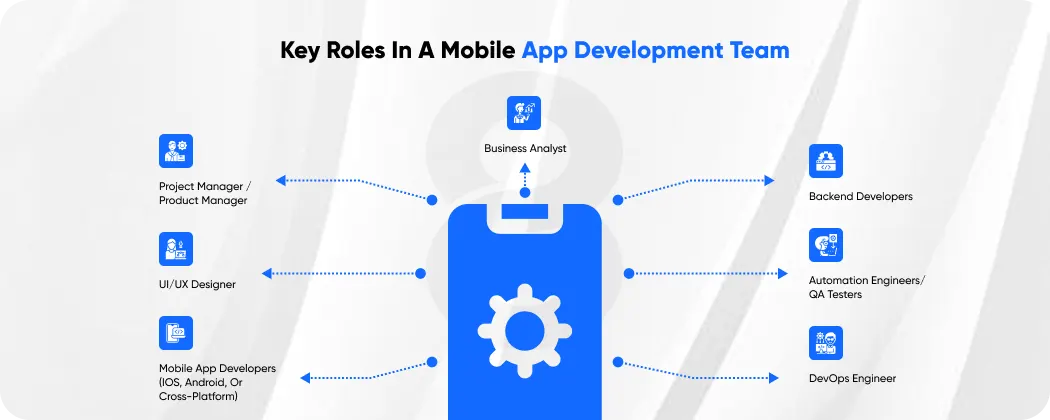
The typical structure of a full mobile app development team helps strategists, designers, developers, testers, project managers, and deployment engineers. The following are the key functions to be put into consideration by any business.
1. Project Manager / Product Manager
The app development is a lifecycle that is led by the project manager. They collect specifications, manage the interactions among teams, keep schedules, communicate, and deliver.
Responsibilities:
- Determine project roadmap and milestones
- Enhance business objectives with the functionality of the app
- Control cost, schedule, materials
- Make the designer and developers coordinate well
- Monitor the progress and quality of deliver
This position ensures that the mobile app development department is in order of production and in line with the business objectives.
2. UI/UX Designer
A designer influences the visual identity of the app, the flow, and the user experience. Excellent software design result in more engagement, retention, and conversion.
Key Tasks:
- Developing wireframes and prototypes
- Developing easy-to-use layouts and navigation
- User research and testing
- Ensuring brand consistency
The success of mobile apps depends on how users feel about the app, and hence the importance of UI/UX in your mobile app development team.
3. Mobile App Developers (iOS, Android, or Cross-Platform)
Designs and requirements are turned into operating mobile applications by developers.
- iOS Developers: Write Swift, Objective-C and take Apple Human Interface Guidelines.
- Android Developers: Code in Kotlin, Java and follow Google material design standards.
- Cross-Platform Developers: Develop applications on both platforms using a single codebase with Flutter, React Native, or Xamarin. Developers do the heavy workload so that your application works on platforms and is stable.
4. Backend Developers
The backend engineers are the ones who create the server-side architecture, such as user authentication, APIs, databases, cloud software development, and app logic.
Responsibilities:
- API integration
- Database administration (SQL/ NoSQL)
- Cloud computing and infrastructure
- Security implementation
- Performance monitoring
It has a robust backend that makes your application not fail to scale to high traffic.
5. Automation Engineers/QA Testers
Quality assurance engineers will find the bugs, performance, and security holes, and fix them prior to the release of the app to your users.
Responsibilities:
- Functional testing
- Security testing and performance testing
- Automation test scripting
- UI/UX testing
- Interoperability between devices
Reliability ensures that your mobile app development team is complete by having a good QA team.
6. DevOps Engineer
A DevOps specialist does the automation of deployment, CI/CD pipelines, and infrastructure monitoring.
Responsibilities:
- Uninterrupted integration and delivery
- Deployment automation
- Monitoring app performance
- Scaling infrastructure
- Cloud resources maintenance
This role provides comfortable releases and less downtime.
7. Business Analyst
A business analyst refers to links between customer needs and technical solutions. They do the analysis of requirements and translate them into documents that inform developers.
Key Tasks:
- Requirement gathering
- Market research
- Competitor analysis
- User behavior insights
- Documentation preparation
They aid in the refinement of the vision of the app into action.
Read More: How to Make an App that Makes Money
The Unseen Challenges Web Teams Face When Building Mobile Apps
Most organizations do not recognize the complexity involved in mobile app development and think that since they can develop websites, they can develop apps. This is a false assumption that comes at a high price, as mobile development brings unfamiliar issues that web teams do not expect. Common review challenges are:
1. Metadata Requirements
The rules of the App Store of Apple and Google Play are strict and constantly changing. New mobile teams are prone to rejection cycles, which can take weeks to launch. Some common challenges are:
2. Guidelines Materials
Promotion materials, descriptions, and images of apps must be formatted accurately. Any discrepancy or deviation in guidelines leads to rejection.
3. Privacy Policies
The two stores need elaborate privacy disclosures and tracking records. Lack or unclear statements are instantly discarded.
Review Timelines
- Apple: 1-7 days
- Google Play: Instant to a few weeks
One rejection will restart the process, resulting in significant delays.
4. Guideline Interpretation
The policies tend to be vague. Experienced mobile teams understand the way in which reviewers actually interpret rules and how to not enter into rejection loops.
Platform-Specific Design Requirements
The expectations of the iOS and Android app designs are fundamentally different. This is something that web teams do not always consider, and so the apps are sensed to be off or unpolished. Major Design Differences:
1. Navigation Patterns
- iOS: lower-bottom tabs, swipe
- Android: menu of hamburgers, Material Design framework
These patterns ought to be ignored, as it makes the app look unnatural.
2. Typography & Spacing
There is a system of each platform:
- iOS: San Francisco
- Android: Roboto
Spacing scales differ too. A web design that appears alright on the web will appear unprofessional on the mobile.
3. Interaction Feedback
iOS and Android differ in haptic feedback, animation curve, and transition styles. It is the instant feeling in the user when something feels wrong.
The teams without mobile design experience usually design web apps in native wrappers, which are perceived by users as of low quality.
Device Fragmentation & Testing Complexity
Compared to the small number of browsers used in web development, mobile has to be tested in a gigantic ecosystem. Testing challenges include:
1. Device Configurations
Different:
- Screen sizes
- Pixel densities
- Hardware capabilities
2. Performance Variations
Your app must work on:
- High-end flagship devices
- Low-end phones with low RAM.
3. OS Version Fragmentation
- Particularly in Android, where 5+ OS versions are typical.
4. Mobile-Specific Edge Cases
Web teams rarely consider:
- Interruptions (notifications, calls)
- Background/foreground state processing
- Battery usage
- Memory constraints
Such problems have devastating impacts on the performance of apps.
Read More: 20 Best Mobile App Development Companies in the USA
Release Management Orchestration
There is no way to deploy mobile apps in the simplest manner compared to updating a site.
Mobile release challenges:
1. Multi-Platform Coordination
iOS and Android releases are to be coordinated, whereas iOS reviews cause instability.
2. Staged Rollouts
Best practice:
5% – 25% – 50% – 100%
This identifies invisible problems at an early stage.
3. Rollback Limitations
Web rollbacks are instant. Mobile rollbacks require:
- New build
- New submission
- User update
4. Version Compatibility
Your backend should be able to support multiple versions of your apps since users do not update immediately.
5. Emergency Hotfixes
Bugs of issues of a critical nature demand immediate review requests; they might or might not be approved within a short time at Apple.
Those teams that do not practice mobile release usually attempt to use web workflows that do not happen in mobile settings.
What Is the Ideal Team Size for a Mobile App Development Project?
The number of team members would be determined by the complexity of the project:
- Small App (Basic MVP): 5 to 7 team members
- Medium App (Booking, Social Apps, Ecommerce): 8 to 12 team members
- Enterprise, Healthcare, Fintech (Large-Scale App): 12 to 20 team members
With the complexity of your project, a properly organized mobile app development team expands.
“A great mobile app development team doesn’t just write code, it engineers experiences, anticipates user needs, and turns business vision into digital reality.”
– Muzamil Liaqat Rao, CEO at 8ration
Understanding App Development Costs
Businesses always fall under the cost priority. The cost of mobile app development depends on:
- App complexity
- Platform (iOS, Android, or both)
- Technology stack
- Where your development team is based
- The level of developers’ seniority.
- Integrations (AI, GPS, payments, streaming, IoT, and so on)
To make your estimation easier, we will divide the common app developer salary scales and team cost structures.
App Developer Salary Breakdown (Global Overview)
The salary of the app developer varies according to location and skills. Below are average ranges:
| Role | United States (USD / year) | Europe (EUR / year) | Asia (USD / year) |
| Mobile App Developers | $95,000 – $150,000 | €45,000 | $8,000 – $25,000 |
| Backend Developers | $100,000 – $160,000 | €50,000 – €90,000 | $10,000 – $30,000 |
| UI/UX Designers | $75,000 – $120,000 | €35,000 – €65,000 | $7,000 – $20,000 |
| QA / Test Engineers | $60,000 – $100,000 | €30,000 – €55,000 | $6,000 – $18,000 |
Recruiting internationally enables organizations to streamline their budget based on the aspect of the preferred location of the team.
Mobile App Development Team Cost (Complete Project)
The approximate number of people to hire in this case is the following:
| App Type | Timeline | Cost (USD) |
| Basic App | 3 – 6 months | $20,000 – $50,000 |
| Medium App | 6 – 10 months | $50,000 – $150,000 |
| Advanced App | 10 – 18 months | $150,000 – $500,000 |
Factors influencing cost:
- Third-party integrations
- AI or ML features
- Real-time functionalities
- Security standards
- Database size
- Custom dashboards
- Car or IoT integrations
Thorough planning helps you manage your budget more effectively.
According to a report:
The valuation of the mobile application development market size of USD 145.05 billion in 2025 is a starting point to reach USD 553.57 billion in 2033 with a CAGR of 18.25% during the period of 2026-2033.
Read More: How Much Does it Cost to Develop an App
How to Hire the Right Mobile App Development Team: Proven Tips
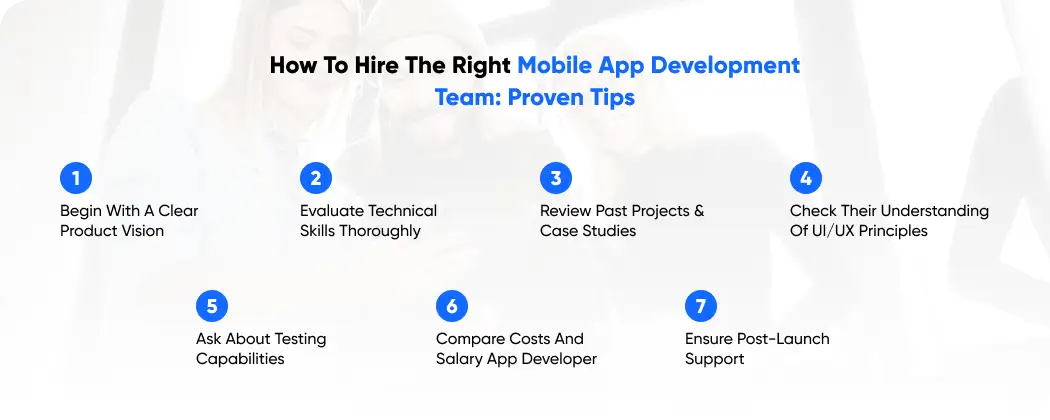
The process of identifying the right people is also important as the development itself. These are steps that should be followed to recruit the best talent in your project.
1. Begin With a Clear Product Vision
- Purpose of the app
- Features
- Target users
- Business goals
- Budget and timeline
A solid base makes your mobile app development team realize clearly what is expected of them.
2. Evaluate Technical Skills Thoroughly
Test the team’s expertise in:
- Authentic development (Swift, Kotlin)
- Cross-platform developer (Flutter, React Native)
- Backend (Node.js, .NET, Python) technologies.
- API integration
- CI/CD pipelines
- Cloud infrastructure
3. Review Past Projects & Case Studies
Strong portfolios indicate:
- Technical depth
- Problem-solving ability
- Capability to provide quality products
- Experience in your industry
This will avoid the employment of inexperienced developers.
4. Check Their Understanding of UI/UX Principles
There is no perfect code that can resolve bad user experience. Make sure that your team values:
- Accessibility
- Simplicity
- Fast navigation
- Visual consistency
The team developing your mobile apps must include some UI/UX designers possessing current day design skills.
5. Ask About Testing Capabilities
QA is essential. Look for teams that offer:
- Manual testing
- Automation testing
- Security testing and performance testing
- Beta testing
- Testing of compatibility of devices
An excellent application has to be tested on various devices and operating systems.
6. Compare Costs and Salary App Developer
Ensure you evaluate:
- Hourly rates
- Monthly retainers
- Hidden costs
- Long-term maintenance
- Licensing fees
An economical team is one that balances the cost against competence.
7. Ensure Post-Launch Support
A good team offers:
- Bug fixes
- OS updates
- Feature enhancements
- Performance optimization
Applications should be updated regularly to make them competitive.
Find Your Next Mobile App Development Team With 8ration

Your mobile app development team is your success in the development of your app. By employing people who know strategy, design, code, software testing, and deployment, you are minimizing risks and accelerating delivery. It could be the salary of an app developer, a long-term product roadmap, or the right hiring model that depends on the choice of the right team, which will determine your digital success.
In case you require a completely committed, scaled, and seasoned mobile app development group, you can collaborate with 8ration to create high-performance mobile apps that match your industry requirements: automotive, fintech, ecommerce, healthcare, travel, and the others.
Our apps are user-friendly, infinitely scalable, and rapidly grow your business.