



The global e-commerce market size accounted for USD 18.77 trillion in 2024 and is expected to be worth around USD 75.12 trillion by 2034, at a CAGR of 14.88% from 2025 to 2034.
The creation of apps like Temu and Shein has turned out to be a significant aspiration for entrepreneurs, eCommerce startups, and product founders who wish to develop high-growth online shopping ecosystems through advanced software development. Both giants massacred the whole mobile commerce ecosystem through aggressive pricing, high-speed logistics, sophisticated personalization, and addictive apps.
I will also take you through all the steps you have to complete to create apps like Temu and Shein, their architecture, their UX, their logistics, their AI-driven personalization, their marketing automation, their growth loops, their supplier management, their cost system, their team formation, and their future-proof scaling. If you are exploring e-commerce app development, understanding these platforms provides invaluable insights into building scalable, user-centric shopping apps that can compete in today’s fast-moving market.
The blog has been written in a simple and easy-to-understand format to enable the local readers to follow it without technical issues. Let’s begin.
Read More: How Much Does Shopify Cost – Pricing, Plans & Features Explained
Why Apps Like Temu and Shein Took Over the World
It is not difficult to see that the development of apps like Temu and Shein indicates one thing:
E-commerce, as it is traditionally done, is slow:
Hyper-personal shopping applications with mobile-first and AI-powered modes are the winners.
Customers want:
- Low prices
- Endless variety
- Fast delivery
- Gamified shopping
- Personalized recommendations
- Trustworthy returns
- Seamless app experience
No one interpreted this attitude more than Temujin and Shein. They constructed environments that are enjoyable, addictive, and gratifying.
Quick Comparison Chart
Feature |
Temu |
SHEIN |
| Product Range | Very High (all categories) | High (fashion-focused) |
| Prices | Ultra-Low | Low |
| App Experience | Gamified (coins, spins, rewards) | Personalized (smart feed, style-based) |
| Supplier Network | Global, multi-country | China-centric (large manufacturing base) |
| Delivery Speed | Fast (global warehousing expansion) | Medium-Fast (optimized China → global) |
| AI Recommendations | Strong | Very Strong (fashion-focused AI) |
| Market Strategy | Aggressive pricing + rapid expansion | Trend-driven fast fashion + high retention |
| User Base | Very Rapid Growth (global) | Strong Gen-Z and young demographics |
| Category Strength | General marketplace | Fashion & lifestyle |
Apps such as Temu and Shein are winning due to their combination of AI, supply chain efficiency, and a gamified user experience with fast-moving experimentation.
How Apps Like Temu and Shein Earn Money: Revenue Streams Explained
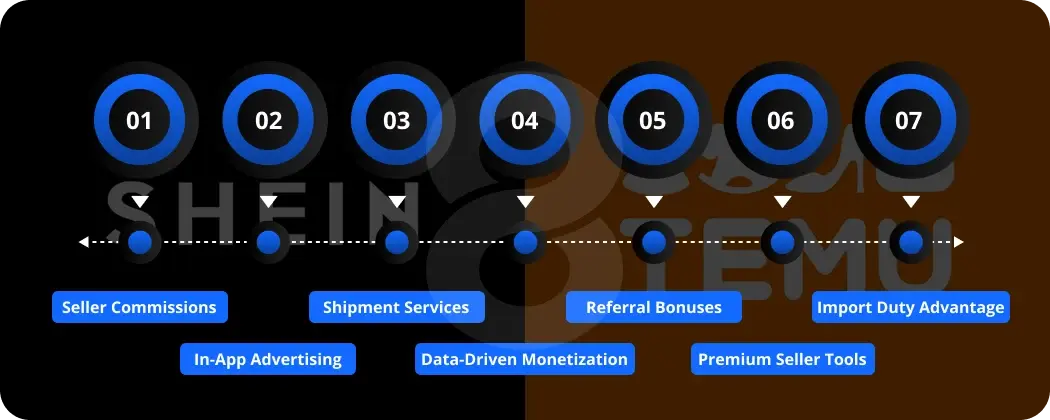
Such apps as Temu and Shein have rapidly become giants in e-commerce through the use of innovative monetization techniques. Now, how do these platforms make money?
1. Seller Commissions
Merchants have to pay a percentage to apps such as Temu and Shein on each sale. Commission rates are rather low in comparison with classic marketplaces, but the volume of transactions is high enough to guarantee that it is a substantial source of revenue.
2. In-App Advertising
Just like the case with Amazon ads on its marketplace, such applications as Temu and Shein also have sponsored posts, featured ads, and targeted post placements. Merchants are ready to pay a high price to position their products first and foremost to be seen.
3. Shipment and Fulfillment Services
Although this free delivery is often advertised, websites such as Temu and Shein make use of express delivery charges and bulk purchase deals as well as delivery services. They offer warehousing and fulfillment services to sellers, generating more sources of income.
4. Data-Driven Monetization
Others, such as Temu and Shein, are based on AI-based applications to collect data on shopper behavior to enhance product recommendations. This will enable merchants to do very specific ad campaigns, for which they would pay a premium.
5. Affiliate/Referral Bonuses
With the collaboration of influencers and referral programs, such applications as Temu and Shein transform customers into a viral sales team. Referral bonuses can be used to stimulate organic growth.
6. Premium Seller Tools
Since these apps are becoming more popular in the world, they provide merchants with paid access to analytics, inventory machinery, and faster shipping technology. The premium features assist local vendors in maximizing their sales and platform revenue.
7. Import Duty Advantage
Such applications as Temu apply the de minimis rule to shipments of less than $800 in the U.S. This saves on importation costs, secures profit margins, and leaves products affordable to consumers.
Summary:
The apps such as Temu and Shein are flourishing with the integration of merchant fees, advertising, logistics, AI-based data, referral programs, and premium tools that create a sustainable and multi-channel revenue system. They continue to lead the competition in the e-commerce arena because of their capacity to combine data and monetization.
Core Pillars of Building Apps Like Temu and Shein
These six pillars need to be mastered to create apps like Temu and Shein:
- Mobile-Optimized Mobile App Experience
- AI-Powered Personalization
- Mega-Level Supplier Integration
- Intelligent Logistics and Fulfillment Control
- Forceful User Acquisition Models
- Real-Time Analytics and Operational Visibility
All of them contribute to the retention of millions of customers every day.
Read More: Top 10 Mobile Apps for Businesses and How to Launch Your Own App
App Structure Blueprint for Apps Like Temu and Shein
In this part, you receive the stepwise blueprint of the architecture applied by large, high-scale applications.
1. Frontend Architecture (User-Facing)
Applications such as Temu and Shein need:
- Ultra-fast rendering
- Seamless browsing
- Zero-lag scrolling
- Smooth product switching
- Offline caching
- Smart image optimization
Recommended Technology Choices:
Layer |
Tech |
Details |
| Mobile Frontend | React Native, Flutter | Cross-platform mobile app development |
| Web Version | Next.js | High-performance SSR/ISR framework |
| State Management | Redux Toolkit, MobX | Scalable app-wide state handling |
| Image Optimization | Cloudflare Images, Imgix | Real-time compression, resizing & CDN delivery |
| Caching | Service Workers, Edge Caching | Offline support + ultra-fast asset delivery |
The objective is to ensure that the user spends as much time as possible in the app and that pages open almost immediately.
2. Backend Architecture
Your backend must have the capacity to support:
- Millions of requests in a minute
- Flash sales
- Supplier uploads
- Real-time recommendations
- Dynamic pricing
- Massive analytics
Best Backend Stack for Apps Like Temu and Shein
- API Gateway (Kong / APIGW)
- Authentication Service
- Product Service
- Pricing Service
- Recommendation Engine
- Search Engine (Elastic)
- Order & Cart System
- Shipping & Tracking System
- Payment Service
- Supplier Portal Service
- Notifications Service
All these services are independent and run on a microservices architecture, which means that they can scale quickly.
Main Aspects of Creating Apps such as Temu and Shein
The following is the list of features that you should have.
1. Personalized Home Feed
- AI product suggestions
- Trending items
- Seasonal deal cards
- Personalized sections
It is among the largest reasons why users remain loyal to apps like Temu and Shein.
2. Gamified Shopping Loops
Temu relies on intensive gamification, such as:
- Rewards for daily login
- Lucky draws
- Spin-the-wheel coupons
- Referral bonuses
- Limited-time missions
These strategies make the user extremely engaged. The following is a basic example of an engagement growth chart:
Key Features that Drive Engagement
To maximize user satisfaction and retention, it’s essential to understand the key features that make software engaging, reliable, and seamless.
Personalized Home Feed
AI studies the actions of the user to show trending products, personalized offers, and in-season offers. Personalization will maintain the attention of the users and induce a high conversion rate of up to 40%.
Gamified Shopping
Gamification for Temu is utilized to ensure activity is encouraged daily. The user can gain coins, win spin-the-wheel games, and do missions to get a discount. This is a plan that ensures that users come back to it daily.
AI Search and Smart Filters
The search powered by AI makes sure that the products are discovered by the user as fast as possible, with the help of typing a word incorrectly or a general query. Search and style matching algorithms improve discovery.
Seamless Checkout
Single-tap payments, multi-currencies, and buy-now-pay-later options alleviate the pain of purchase. Seamless checkout experiences and flexible payment methods significantly boost customer satisfaction and repeat usage.
Supplier Dashboard
The suppliers can use a special portal to control stock and post products and analytics, which helps maintain a steady operation on a large scale. This centralized system enables better decision-making and enhances overall supply chain efficiency.
Logistics Strategy & Fulfillment
Logistics is a differentiator for apps like Temu and Shein. An effective network of logistic operations will result in timely shipments at a low cost of operation.
Aspect |
Strategy |
Details |
| Multi-Warehouse Network | Regional hubs and global warehouses | Faster delivery with distributed fulfillment |
| AI Route Optimization | Optimized packing, carriers & delivery routes | Reduces delays and shipping costs |
| Returns Processing | Local centers & instant refund systems | Easy returns with printable labels |
| Demand Forecasting | Predictive stocking using trends & history | Reduces out-of-stock and overstock issues |
Growth Loops and Marketing Strategy
- Viral Loops: Discounts on sharing, referral bonuses, social proof
- Predictive Deals: AI-generated flash offers
- Gamification Loops: Coins, daily missions, and rewards make people use it regularly.
Such loops will make sure that the new users are converted quickly and the old ones are not bored.
Cost & Team Structure
The development of such an app is time-consuming and expensive due to the quality of the workforce and the amount of investment needed.
Component |
Estimated Cost |
| Mobile App Development | $40,000–$120,000 |
| Backend Microservices | $80,000–$250,000 |
| AI Integration | $50,000–$200,000 |
| Supplier Dashboard | $20,000–$50,000 |
| Operational Costs | $5,000–$50,000/month |
| Marketing & Acquisition | $20,000–$250,000/month |
The mobile and backend developers, AI engineers, UI/UX designers, QA specialists, and product managers are included in the team structure.
Scaling and Future-Proofing
Apps like Temu and Shein, to maintain millions of users, are built on cloud-based infrastructure, database sharding, load balancing, and edge caching. In real-time, the stability of operation is ensured with tools such as Datadog and Grafana. The predictive AI models forecast traffic spikes, so the app will continue to react to flash sales.
According to a report:
The global m-commerce market size was USD 424.23 billion in 2025, and the market is projected to touch USD 3620.21 billion by 2034, exhibiting a CAGR of 26.91% during the forecast period from 2025 to 2034.
How to Build a Multi-Vendor Online Shopping App Like Temu: A Complete Process
Constructing an online shopping platform with multiple vendors, such as Temu, is not that simple, yet it can be done with a well-planned strategy. The following is a roadmap for developing apps like Temu and Shein in 2026 and beyond.
1. Niche Identification and Market Research
This is before development, when you should know what your target is and what product categories will create demand. Applications such as Temu and Shein specialize in a broad product spectrum, although numerous successful startups have a niche, like fashion, electronics, or home products. Compare competition applications, analyze the pricing models, and determine market gaps.
2. Defining Features and Vendor Ecosystem
A multi-vendor application needs a thoroughly developed system of vendor onboarding. Vendors should be able to:
- Register quickly
- Post products that have long descriptions and images
- Manage inventory
- Track orders and returns
- Breaking down the doors
Your platform must also have buyer-centric experiences such as custom feeds, wishlist capabilities, search and filter, gamified interaction, and one-tap checkout.
3. Technology Stack Selection
The choice of the tech stack is essential to performance and scale. The recommended technologies are:
Layer |
Technology |
| Mobile Frontend | React Native / Flutter |
| Web Version | Next.js |
| Backend | Node.js / Python / Java |
| Database | PostgreSQL / MongoDB / Redis |
| Search Engine | Elasticsearch |
| Payment Gateway | Stripe / PayPal / Local options |
| Cloud Hosting | AWS / Google Cloud / Azure |
Microservices architecture means that such features as product management, orders, payments, and AI recommendations scale independently.
4. Designing App Architecture
There should be three basic modules in your app:
- Buyer App: To browse smoothly, have customized suggestions, and play to win.
- Vendor Dashboard: To control products, pricing, and inventory.
- Admin panel: To oversee the general performance, hire vendors, logistics, and analytics.
To sustain a competitive edge, Temu has an architecture that is fast, reliable, and incorporates AI.
5. AI-Powered Personalization and Gamification
Applications, such as Temu and Shein, are based on AI, and they depend on it highly.
- Personalized home feeds
- Dynamic pricing
- Visual search
- Trend prediction
Daily spins, coins, limited-time offers, and referral incentives are built into the gamification tactics to increase user retention and user activity. This will be a combination that keeps users coming back daily; hence, the sales volume will grow but without huge marketing spending.
6. Supplier Integration and Logistics
Multi-vendor applications require a smart logistics system:
- Fast shipping, regional warehouses
- Artificial intelligence route optimization
- Returns management
- Supplier demand forecast analytics
Multi-vendor platforms can replicate the low-cost delivery model at Temu by going directly to manufacturers and predicting inventory and deliveries.
7. Payments, Security, and Compliance
Make sure that your application accepts various methods of payment: credit cards, digital wallets, BNPL services, and local currencies. Non-negotiable is security and compliance. Install end-to-end encryption, PCI-DSS, and semi-periodic security audits to secure the data of users and vendors.
8. Testing, Implementation, and Continuous Improvement.
Do a lot of testing, such as functional, load, performance, and software security testing. After launching, monitor real-time analytics to monitor engagement, sales, and retention. Keep on updating the app according to the feedback and trends of the market.
9. Growth Strategy and Marketing
In the marketing of multi-vendor apps, the two-facet approach is necessary:
- Vendor Acquisition: Reward, analytics data, and onboarding ease to gain vendors.
- User Acquisition: Utilize influencer marketing, gamification campaigns, flash sales, and referral programs to acquire and maintain buyers.
Through these steps, entrepreneurs will be able to come up with apps like Temu and Shein that are scalable, interactive, and lucrative. Making a multi-vendor online shopping application is not simply a matter of tech but rather creating an ecosystem where all vendors, purchasers, and logistics work effectively, and all through the use of AI and gamification to get the maximum engagement.
Scalable App Development: The Key to eCommerce Expansion
The ability of a mobile application to scale is the key to success in the rapidly developing e-commerce market. With the increase in the number of users, product lines, and the amount of transactions per transaction, your app should be in a position to curb these demands without affecting performance. Applications such as Temu and Shein have succeeded due to the ease with which their platforms can be scaled to offer smooth and continuous shopping experiences even when the traffic is at its highest point.
Cloud-Based Solutions
Scalability is based on cloud infrastructure. Amazon Web Services (AWS), Google Cloud Platform (GCP), and Microsoft Azure are platforms that offer flexible resources that can be automatically scaled up or down as the real-time demand fluctuates. It is an elasticity that guarantees the user experience is constant even in the case of a flash sale or a viral promotion. Cloud solutions also facilitate worldwide access, and so apps like Temu and Shein can have several regional data centers to minimize delays and enhance loading time.
Managing Databases
The management of databases is essential in storing and analyzing the continuously increasing consumer and product data used in e-commerce applications. A database that can be scaled horizontally would be good for managing large data. Relational databases like MySQL or PostgreSQL are suitable for structured data like orders and user profiles, and NoSQL databases like MongoDB or Cassandra are suitable for unstructured data like browsing history and user behavior patterns. With the adoption of these database strategies, multi-vendor applications will be able to handle large volumes of data without suffering slow speed or the risk of shutting down.
Performance Optimization
Retention and conversion rates are directly related to performance. Applications such as Temu and Shein spend a substantial sum of money on optimization to make sure that their websites are fast and responsive. Key practices include:
- Minimization of loading times with lightweight application bundles, optimized images, and streamlined caching methods.
- Carrying out rigorous testing and debugging to reduce crashes and downtime.
- Reliance on Content Delivery Networks (CDNs) to streamline content delivery at a higher speed around the world.
- Adopting asynchronous programming to provide user-friendly and responsive interaction.
Considering these points, scalable e-commerce apps are capable of ensuring a smooth operation even in the case of heavy traffic, which results in a stable user base that will continue to visit.
Temu App Cost: What It Takes to Build a Similar Shopping App
The development of such a mobile shopping application as Temu demands proper resource distribution, both time- and cost-wise. The prices differ greatly based on the complexity, features, and individualization. Applications such as Temu and Shein invest in artificial intelligence-based suggestions, games as their interface, multi-supplier support, and more complex analytics, which, of course, entail more advanced development solutions.
Here’s an overview of estimated costs, development timelines, and key features:
App Type |
Estimated Cost |
Development Timeline |
Key Features |
| Basic Shopping App | $25,000 – $80,000 | 2 – 5 months | Product listings, search, cart, basic checkout |
| Mid-Tier Shopping App | $85,000 – $150,000 | 5 – 9 months | Advanced filters, secure payments, order tracking, and user profiles |
| Advanced Shopping App | $150,000 – $250,000+ | 9+ months | AI recommendations, multi-vendor support, loyalty programs, and real-time analytics |
Shein App Cost: A High-Scale Fashion & Shopping App
To create an application such as Shein, proper planning and budgeting are required since it is a combination of fast fashion driven by trends, AI-driven personalization, and global logistics. Other applications, such as Temu and Shein, that use sophisticated technology and easy-to-use interfaces, as well as multi-region applications, and these factors affect the development cost as well as the time frame.
Development of an app similar to Shein would cost in accordance with how complex the features, AI personalization, support of multiple vendors and gamification, and analytics are. However, a simple shopping application can be cheap, whereas more advanced functions that characterize Shein cost a higher budget and development schedule.
The main features that influence the cost are:
- AI Recommendation Engine: Customized fashion feeds, predictive trends, and smart suggestions are the tasks that demand high-level machine learning.
- Global Supply Chain Integration: Intelligent inventory, regional warehouse, and shipping optimization have effects on the complexity of the backend.
- Gamification Elements: Daily check-ins, points, and referral bonuses would enhance the engagement, but they would need more UI-UX design and back-end logic.
- Multi-Vendor Functionality: The multi-vendor support would involve a vendor dashboard, analytics, and product upload capabilities.
- Analytics & Reporting: Sales, customer behavior, and inventory real-time dashboards assist in making business decisions.
The following is a more detailed development cost and schedule of an app like Shein:
App Type |
Estimated Cost |
Development Timeline |
Key Features |
| Basic Fashion App | $30,000 – $90,000 | 2 – 5 months | Product listings, category pages, search, cart, basic checkout |
| Mid-Tier Fashion App | $95,000 – $170,000 | 5 – 9 months | Advanced filters, secure payments, order tracking, user profiles, social sharing |
| Advanced Fashion App | $180,000 – $300,000+ | 9+ months | AI recommendations, multi-vendor support, gamification, loyalty programs, trend prediction, and real-time analytics |
The creation of apps like Temu and Shein, particularly those that target the fashion industry, such as Shein, is more expensive than the creation of generic shopping apps because of the sophistication of the AI, customization, and international shipping. Nevertheless, a direct resulting outcome of these investments is the increased engagement, improved retention, and high ROI over the long run.
When planning feature selection, with emphasis on scalability and the utilization of cloud-based solutions, the entrepreneurs will be able to develop fashion e-commerce applications that will compete with Shein on a global level.
Read More: eCommerce App Development Cost – Your Ultimate Guide for 2026
Your Dream E-commerce App Starts Here
We make sure that your app not only attracts users but also makes them return every day by designing a smooth, mobile-first experience and adding AI-powered personalization and gamified shopping loops to it. The team helps us build the scale of apps like Temu and Shein (we have a multi-vendor setup as well as real-time analytics), so you can focus on growing your brand, and we will handle the technology.
Through 8ration, the construction of a profitable online shopping platform becomes easy, quick, and economical. We are using industry knowledge, scalable architectures, and time-tested growth strategies to bring to life apps that are distinguishable in the current competitive e-commerce landscape. It could be dynamic pricing, customized suggestions, or worldwide logistics; we assist you in building apps like Temu and Shein that are ready to maximize the level of engagement, retention, and revenue on the first day.