


The global mobile games market revenue is forecast to reach around US$67.8 billion in G7 countries in 2025, with a projected CAGR of ~5.3% (2025–2030).
The mobile gaming industry has witnessed unprecedented growth over the past decade, with billions of users worldwide engaging with games daily. Whether you’re an indie developer or a seasoned studio, selecting the best game engines for mobile is a crucial first step to bring your creative vision to life.
The right engine not only streamlines development but also ensures your game performs optimally across multiple platforms. In this article, we explore the most efficient, versatile, and widely used game engines that can transform your game idea into a market-ready mobile experience.
Understanding Mobile Game Development Tools
Before diving into specific engines, it’s important to understand what makes a game engine suitable for mobile development. Mobile game development tools are designed to handle the unique constraints of smartphones and tablets, including:
- Limited processing power compared to PCs or consoles
- Diverse screen sizes and resolutions
- Varying operating systems, such as Android and iOS
- Touch-based controls and sensors
The best engines for games address these challenges by providing optimized rendering pipelines, physics engines, and user-friendly interfaces. Moreover, they often include asset management tools, scripting environments, and cross-platform capabilities, allowing developers to deploy games to multiple devices without rewriting code from scratch.
Read More: How to Hire the Best Game Development Team
Key Features to Look for in the Best Game Engines for Mobile
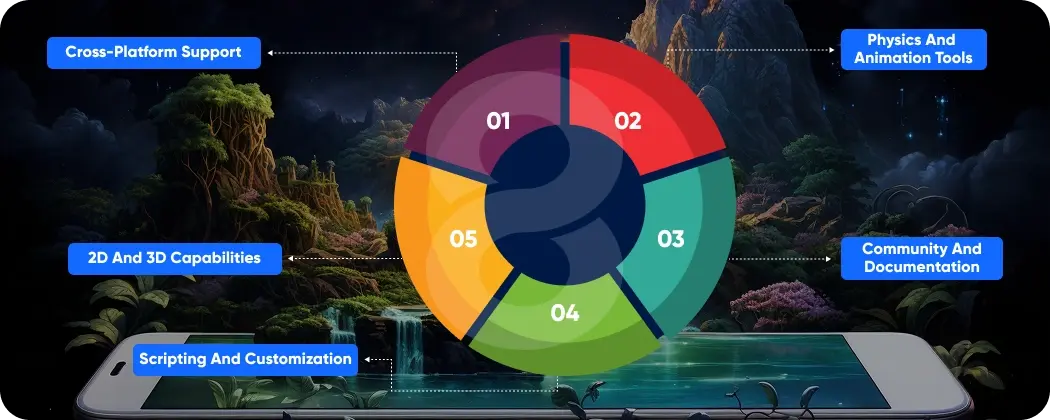
Choosing the best engine for mobile games requires evaluating several technical factors. Here are the critical features to consider:
Cross-Platform Support
Mobile games often need to run seamlessly on Android and iOS. Engines that support mobile cross-platform development enable developers to write code once and deploy it everywhere.
2D and 3D Rendering Capabilities
Depending on your game concept, you may need advanced 3D rendering or efficient 2d game engines for Android. Engines with strong graphics pipelines allow you to create visually compelling experiences.
Scripting and Customization
A flexible scripting environment ensures that your game logic, AI behavior, and user interactions can be tailored precisely. Popular scripting languages include C#, JavaScript, and Python.
Physics and Animation Tools
Realistic physics and smooth animations enhance gameplay immersion. Integrated physics engines reduce the need for external plugins.
Community and Documentation
Engines with extensive communities, tutorials, and documentation make problem-solving faster and more efficient, especially for indie developers.
Why Choosing the Right Mobile Game Engine Matters
Before exploring the best engines for games, it’s important to understand why the choice is so impactful. Mobile gaming ecosystems are highly competitive. Optimization, performance, memory usage, physics behavior, touch input responsiveness, and cross-platform deployment all fluctuate drastically depending on the engine you are using.
A powerful engine influences several aspects:
- Rendering efficiency: Smooth 60 FPS+ gameplay on low-end Android devices
- Build size optimization: Lower APK/IPA file sizes
- Cross-platform mobile game development: Smooth export to both Android and iOS
- Support for ads and monetization: In-app purchases, ad frameworks, analytics
- Asset pipeline: Handling 2D/3D assets with minimal compression loss
- Scripting support: C#, C++, Python-like scripting, GDScript, JavaScript, etc.
- Scalability: Ability to expand the game from a small prototype to a complex system
With these fundamentals in mind, let’s analyze the engines that dominate mobile game development in 2026 and are expected to lead into 2027.
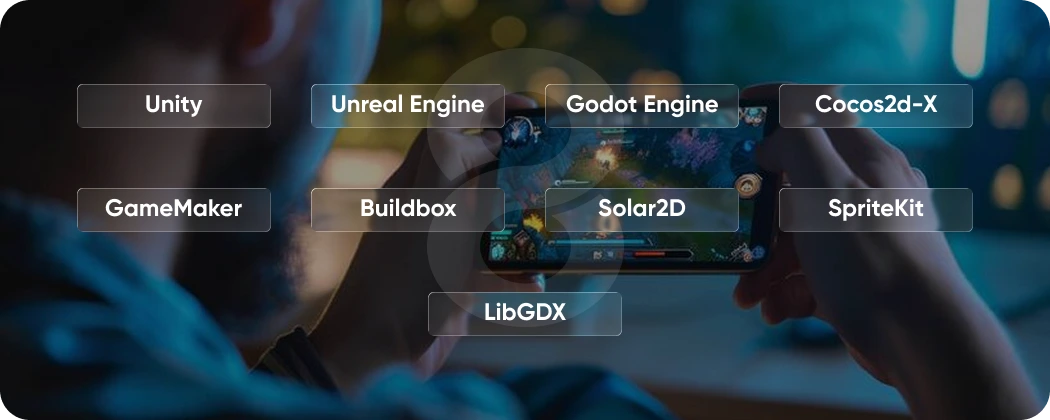
9 Best Game Engines for Mobile Game Development
1. Unity
Unity is one of the best game engines for mobile, used by over half of all mobile games worldwide. It is a powerhouse for both 2D and 3D game development thanks to its robust feature set, cross-platform capabilities, and massive ecosystem.
Key Features of Unity
- Multi-platform publishing for Android, iOS, Windows, WebGL, and consoles
- Strong C# scripting API with extensive documentation
- Dedicated 2D tools, including Tilemap, Sprite Shape, and 2D Physics
- Advanced 3D rendering pipelines: Built-in, URP, and HDRP
- Massive library of assets through Unity Asset Store
- Optimization tools such as Profiler, Frame Debugger & Memory Analyzer
Unity is highly popular among developers exploring mobile cross-platform game development, thanks to its streamlined build system and flexible workflow. If you’re building mobile app game development projects with complex mechanics, Unity stands out as a go-to solution.
Best For
- 2D and 3D game creators
- Hyper-casual, action, strategy, simulation, and RPG games
- Indie developers and mid-sized studios
Strengths
- Great community support
- High-quality learning resources
- Smooth Android and iOS deployment
- Thousands of mobile-friendly plugins
Who Should Avoid It
If you need an extremely lightweight engine for simple 2D Android games, Unity may feel heavier than necessary.
2. Unreal Engine
Unreal Engine is traditionally known for its cinematic-level graphics and AAA game development heritage. While it is heavier than Unity, it’s still among the best engines for mobile games for developers building visually rich titles that require realism and advanced physics.
Key Features of Unreal Engine
- High-end real-time rendering with Nanite and Lumen
- Blueprint visual scripting for code-free development
- Full C++ access for advanced customization
- Advanced physics simulation using Chaos
- Enhanced animation systems for realistic character movement
Although Unreal shines more in 3D, several mobile games benefit from its performance-oriented architecture, especially shooters, racing games, and RPGs.
Best For
- Developers building premium-quality 3D games
- AR/VR-based mobile gaming
- Resource-heavy projects
Strengths
- Realistic visuals
- Professional-grade tools
- High-performance simulation
Limitations
- Steep learning curve
- Heavy on system resources
3. Godot Engine
Godot has gained massive popularity due to its open-source nature and lightweight architecture. It’s considered one of the strongest open-source game engines for Android development options today.
Core Features
- 2D-first engine architecture, delivering pixel-perfect rendering
- Support for 3D development (rapidly improving)
- GDScript, a Python-like scripting language
- Visual scripting for beginners
- Export templates for Android and iOS
- Extremely small build sizes
If you’re trying to build lightweight, fast, and efficient games for mobile, Godot is competitive with commercial engines.
Best For
- 2D games
- Small-to-mid-level projects
- Developers seeking freedom from licensing and royalties
Strengths
- Fast iteration
- Clear documentation
- Completely free (MIT License)
Limitations
- 3D capabilities are not yet optimized for heavy mobile games
Godot is excellent for experimenting with Android game engines, 2d Android game engine tools, and lightweight exports.
4. Cocos2d-x
Cocos2d-x stands out as one of the top 2d game engines for Android and iOS. It is widely used in Asia and is known for powering games like Clash of Kings and Dragon City.
Key Features
- Written in C++ with bindings for JavaScript and Lua
- Cross-platform deployment
- Lightweight runtime, perfect for low-end devices
- Excellent for tile-based and sprite-based games
- Integrated physics and animation tools
Cocos2d-x is preferred by developers who want complete control over performance and memory. If you’re building high-speed 2D games, this engine is a killer option.
Best For
- Hyper-casual games
- Mobile puzzle and arcade games
- Developers needing maximum performance
Strengths
- Open-source
- Fast rendering
- Low system footprint
Limitations
- Not suitable for large-scale 3D projects
According to Statista, analysts anticipate the mobile gaming market size worldwide will continue to grow through 2030, driven by smartphone adoption, 5G rollout, and rising demand for cross-platform titles.
5. GameMaker Studio
GameMaker Studio is extremely beginner-friendly yet powerful enough to build bestselling titles. It stands among the best mobile game development software for creators who prefer simplicity without sacrificing capability.
Key Features
- Easy drag-and-drop interface (GML Visual)
- Full scripting through GML (GameMaker Language)
- Fast mobile deployment for Android and iOS
- Built-in animation tools
- Support for ads, in-app purchases, and analytics
GameMaker enables even non-programmers to start building games quickly.
Best For
- Indie creators and beginners
- 2D game development
- Casual and arcade-style gameplay
Strengths
- Simple learning curve
- Accessible UI
- Good performance
Limitations
- Not ideal for 3D games
6. Buildbox
Buildbox has become one of the leading mobile game development tools for no-code game creators and indie developers. With a drag-and-drop interface, you can create mobile games without writing a single line of code.
Core Features
- Visual logic workflow
- Animation tools
- Template-based development
- Pre-designed assets and UI components
Monetization features built in
Best For
- Hyper-casual game creators
- Beginners
- Prototyping game ideas quickly
Strengths
- Fast prototyping
- No coding required
- Good for iterative design
Limitations
- Limited flexibility
- Not suitable for advanced mechanics
Read More: What Are the Main Stages of Video Game Development
7. Solar2D (formerly Corona SDK)
Solar2D is a Lua-based engine designed for fast development cycles and small APK sizes. It is ideal for Android game engines focused on 2D environments.
Key Features
- Lua scripting for rapid development
- Real-time simulation environment
- Lightweight, optimized build system
- Native performance
Best For
- 2D puzzle games
- Educational games
- Ad-based mobile games
8. SpriteKit (for iOS)
SpriteKit is Apple’s native 2D game development framework designed specifically for high-performance iOS gaming. Seamlessly integrated with the Apple ecosystem, it leverages Swift and Metal APIs to deliver smooth rendering, realistic physics simulation, and efficient animation workflows, making it ideal for building polished, platform-optimized mobile gaming experiences.
Key Features
- Apple-optimized rendering
- Swift support
- Physics simulation
- Integrated tools for animations and particles
Best For
- iOS-exclusive games
- Apple ecosystem developers
Strengths
- Excellent performance
- Lightweight
- Perfect for 2D iOS games
Limitations
- No Android support
9. libGDX
libGDX is a powerful Java-based framework widely recognized as one of the leading game development tools for Android, enabling developers to create high-performance, fully customized games across mobile, desktop, and web platforms while retaining complete control over architecture and optimization.
Key Features
- Cross-platform support (Android, iOS, Desktop, Web)
- High-performance rendering
- Extensive documentation
- Strong community
Best For
- Developers who prefer custom-coded engines
- Technical users
Read More: How to Make a Video Game
Comparison Table: Which Engine Should You Choose?
This comparison table highlights leading mobile game engines by functionality, complexity, and platform support, helping developers quickly identify the most suitable engine based on project scope, technical skills, and performance requirements.
| Engine | Best For | Difficulty Level | Type | Open Source | Platforms |
| Unity | All genres | Medium | 2D/3D | No | Android, iOS, more |
| Unreal | High-end 3D | Hard | 3D | No | Android, iOS |
| Godot | 2D & lightweight 3D | Easy | 2D/3D | Yes | Android, iOS |
| Cocos2d-x | High-performance 2D | Medium | 2D | Yes | Android, iOS |
| GameMaker | Simple 2D | Easy | 2D | No | Android, iOS |
| Buildbox | No-Code | Very Easy | 2D | No | Android, iOS |
| SpriteKit | iOS 2D | Medium | 2D | No | iOS |
| libGDX | Java-heavy dev | Medium | 2D/3D | Yes | Android, iOS |
Choose the Best Mobile Game Engine with 8ration
At 8ration, every groundbreaking game begins with the right technological foundation, which is why we help creators turn ideas into immersive, scalable, and visually compelling mobile gaming experiences.
With our expertise in advanced game engines, cross-platform frameworks, and performance-optimized development workflows, we empower startups, enterprises, and studios to build mobile games that stand out in a crowded marketplace.
Our approach blends technical precision with innovative design, ensuring seamless gameplay, fast rendering, intuitive controls, and long-term scalability. Backed by a skilled team and industry-leading tools, 8ration transforms ambitious concepts into polished mobile game products ready to thrive on any platform.
“By embracing flexible, cross-platform mobile game development tools, 8ration will deliver games that run smoothly on Android and iOS alike.”
– Muzamil Liaqut Rao, CEO at 8ration
Final Thoughts!
The mobile gaming ecosystem is more competitive than ever, and choosing the best game engines for mobile will significantly shape your game’s performance, scalability, user engagement, and long-term success.
Whether you’re an indie developer interested in lightweight 2d game engines for android, or a studio aiming to create a sophisticated 3D experience using the best engine for mobile games, the tools highlighted above will guide you toward the right decision.
Unity and Unreal dominate the industry with their robust ecosystems, while Godot and Cocos2d-x offer open-source flexibility. Similarly, Buildbox, SpriteKit, and Flame serve niche groups with unique workflows. Ultimately, the goal is to match your game’s requirements with the right technology, because the engine you choose is the foundation that transforms your vision into a playable reality.