

The global video game market size was estimated at USD 298,981.7 million in 2024 and is projected to reach USD 600,740.5 million by 2030, growing at a CAGR of 12.2% from 2025 to 2030.
A game takes a lot more than a good storyline and inspiration to make it successful. It requires a powerful game development team, a defined procedure, appropriate creative direction, and disciplined implementation across various disciplines. All the successful launches, be they mobile games, video games, or web3 game development experiences, are products of a team that knows its job, operates as a team, and has a defined production process.
In the current competitive market, it takes special talent to take a game from the idea to launch, like designers, programmers, artists, producers, testers, and marketers. It is not just a strong game development team that performs the tasks; it forms the basis of innovation, performance, scale, and involvement of players.
Why the Right Game Development Team Matters

The effectiveness of any game development team has a direct impact on the creativity of the game, its technical quality, performance, and success in the market. With the growth of the gaming industry, which is projected to hit more than 300 billion dollars by 2030, the sophistication in the creation of modern-day games has increased. Cross-platform optimization, immersive storytelling, multiplayer networking, and multidisciplinary expertise is now required in gaming.
Studios building the experience of a blockbuster have a team structure, which allows all components of the game, such as gameplay mechanics, visual effects, and code architecture, to be developed with the appropriate skills at the appropriate stage. Such companies that labor on technologies like Unreal, Unity, Godot, or proprietary engines are highly reliant on high-performing teams that execute concepts with accuracy.
Read More: How to Make a Video Game – Launch Your First Game
Basic Divisions of a Game Development Team
Following is a detailed dissection of the functions, tasks, and aims of every department within a game development team. These areas also show their collaboration, starting with the concept to after-sales support.
1. Game Producers and Project Managers
A successful game development team must have great leadership. Planning, scheduling, team coordination, and resource allocation are controlled by the producers and the project managers.
They make sure that creative vision and technical implementation are in line.
Primary Responsibilities
- Establish the vision, objectives, and the roadmap for the production of the game
- Assign resources in departments
- Ensure milestones are met
- Artists, developers, and coordinative designers
- Can control budgets and timeframes
- Support the process of communication amongst the stakeholders
A good producer also makes sure that all the departments, such as gameplay programmers and environment artists, are not working in separate parts but rather in unison throughout the development process.
2. Game Designers: Creation of Playability and Experience
Game designers construct the framework of the experience. They create game mechanics, systems, controls, level layouts, and core loops.
Designer Profiles in a Game Development Team
- Game/Gameplay Designer: develops mechanisms, rules, player progress, and development
- Level Designer: Organizes missions, maps, linings
- UX/UI Designer: Designs interfaces and HUDs, menus
- Narrative Designer: Composes storyline, characters, dialogues
- Systems Designer: Difficulty, rewards and progression
Responsibilities
- Writing game development documentation (GDDs)
- Designing prototypes and gameplay processes
- Adjusting difficulty scales
- Ensuring player engagement
- Development of the user interface and design interaction
In complex projects such as Unreal game development, the designers and the developers are close to each other so that the mind can easily transfer into the game.
3. Developers and Programmers: The Core Logic
The game development team is highly technical and consists of programmers. They apply mechanics, create systems, assemble assets, and make sure that the game works on devices and platforms.
Main Roles in the Art Department
- Gameplay Programmers: Apply motion, fighting, physics, and interactions
- Engine Programmers: Adjust or improve the game engine
- AI Programmers: Design NPC behavior, pathfinding, and dynamic reaction
- Network Programmers: Do matchmaking, multiplayer servers, and lobbies
- Tools Programmers: Create artists’ and designers’ utilities
- UI Programmers: Script interfaces, HUD elements
Responsibilities
- Coding optimized and scalable code
- Incorporation of assets and animation
- Creation of gameplay mechanics
- Management of performance optimization
- Debugging and fixing errors
- Working with designers to make the ideas a reality
Most studios require good C++ game development, particularly at an engine level of optimization and high-performance game systems.
4. Artists and Visual Creators
A game is made visually breathtaking due to the creative genius behind it. This department is the one that converts ideas into characters, settings, animation, and VFX.
Key Art Department Positions
- Concept Artists: Produce initial images, themes, and character concepts
- 3D Artists: Model figures, props, and settings
- 2D Artists: Make illustrations, textures, UI graphics
- Animators: Make characters and landscapes move
- VFX Artists: Create effects of explosions, spells, particles
Key Responsibilities
- Building visual assets
- Making the game have a similar style
- Designing UI layouts
- Making simulated experiences pleasant using animation and detail
- Creation of marketing images
Those teams that create stylized mobile titles tend to utilize 2D game development workflows, whereas those studios that prefer to create realistic environments rely on specialized 3D game development pipelines.
5. Sound Designers Composers
Sound is an important element in immersion. It is enhanced by SFX and music that bring emotion, intensity, and atmosphere.
Responsibilities
- Composition of sound effects (footsteps, gunfire, environment sounds)
- Composing background music
- Timing audio to the game events
- Mixing and optimizing audio
Good audio direction will create memorable gaming experiences, which can be alive and responsive.
6. Quality Assurance Testers and Engineers
No game is successful without intensive testing. QA is the assurance of polish, stability, and a smooth playing experience.
Types of Testing
- Functional testing
- Performance testing
- Compatibility testing
- Regression testing
- Usability testing
- Multiplayer testing
QA Responsibilities
- Detecting bugs
- Ensuring gameplay balance
- Issues reporting to developers
- Checking fixes in new releases
As online experiences become popular, multiplayer game development relies too much on QA to check the matchmaking, latency, scalability, and server stability.
7. Marketing and Community of Games
An effective game development team comprises professionals who will promote the game, hype it, handle expectations of the community, and ensure adoption before and after launching.
Responsibilities
- Creating a marketing roadmap
- Producing trailers, teasers, and screenshots
- Social media community management.
- Tracking user feedback
- Managing PR and press relations
“A great game is not built by a single genius; it is crafted by a game development team where creativity, technical skill, and collaboration come together to turn ideas into immersive experiences.”
– Muzamil Liaqat Rao, CEO at 8ration
Advanced Specialized Teams in Modern Game Development
The development of modern games involves more departments that deal with new technologies such as blockchain, Web 3, artificial intelligence, metaverse systems, and real-time multiplayer networking.
1. Web3 and Blockchain Developers
With the trend of gaming moving towards digital ownership and decentralized ecosystems, studios are taking on blockchain experts.
Responsibilities
- Smart contract development
- NFT integration
- Player-owned asset systems
- Marketplace and blockchain wallet integrations
- Secure transaction layers
Companies that provide blockchain game development services assist in the development of the next generation of in-game experiences using token economies and programmable digital assets.
2. Web3 Game Architects
Blockchain is not the only Web3. It consists of decentralized identity, metaverse features, and cross-platform virtual economies.
Responsibilities
- Designing tokenomics
- Developing decentralized ecosystems
- Incorporating secure wallet systems
- Transaction of decentralized server architecture
Web3 game development studios introduce expertise that combines gaming with the real-world economy and novel types of digital property ownership.
3. Machine Learning Specialists and AI Developers
AI has now improved the gameplay, personalization, analytics, and procedural content generation.
Responsibilities
- NPC behavior systems
- Prediction models and analytics of players
- Procedural level generation
- Adjustment of difficulty in real time
- Chatbot integration
- Adaptive gameplay reinforcement learning
More game studios are using AI game development to create smarter, more responsive game worlds.
The video game market is estimated to be valued at USD 292.4 billion in 2025 and is projected to reach USD 977.4 billion by 2035, registering a compound annual growth rate (CAGR) of 12.8% over the forecast period.
How All Departments Work Together
An effective game development staff works like a machine that is well-engineered. Every department helps in providing support to another, and communication is a must at every level:
- Pre-Production: The concept is developed by creators: designers, producers, and writers.
- Production: The game is constructed by artists, programmers, animators, and sound departments.
- Testing: QA will check the functionality of the game.
- Launch: The marketing departments market the game to people around the world.
- Post-Launch: Bug fixes, live ops, and new content are handled by the developers and live ops teams.
Games developed with tools such as Unity, Unreal, or in-house engines are based on such a system of cooperation.
The pipeline with workflows to Unreal game development comprises blueprint scripting, asset optimization, light workflow, and real-time rendering. Similarly, in C++ game development, engineers are involved in memory management, performance tuning, physics integration, and engine-level customization.
Stages of the Game Development Process
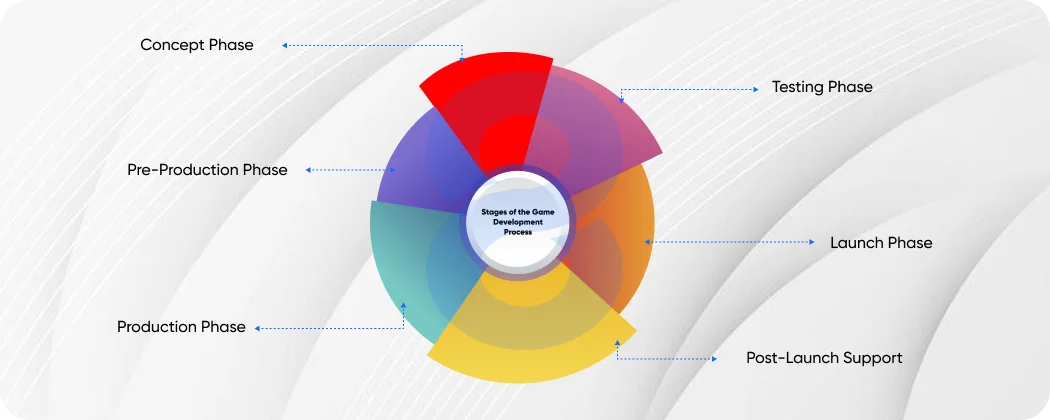
| Stages | Departments Involved |
| Concept / Pre-Production | Designers, Producers, Writers |
| Production | Developers, Artists, Animators, Sound Designers |
| Testing | QA Testers, Developers |
| Launch | Marketing, Developers |
| Post-Launch Support | Developers, Live Ops, Marketing |
Read More: Guide to the Stages of Video Game Development
Why a Strong Game Development Team Determines Success
The reason why a successful game development team can be determined. An experienced team of game developers would guarantee:
- Higher player engagement
- Stronger performance
- Better storytelling
- Seamless gameplay
- Fewer bugs
- Faster production cycles
- More innovation
Hire Your Next Game Development Team with 8ration

Every memorable game contains a powerful game development team as its staple ingredient. From the initial idea drawings to after-release support, all the professionals have an essential contribution to the player experience. The demand to have qualified game development teams in the future is increasing as technology keeps changing to accommodate trends such as AI-driven tools, decentralized gaming, and immersive 3D environments.
Regardless of whether a studio is developing a high-end AAA game, a Web3 ecosystem, a multiplayer mobile game, or a game based on a blockchain-driven economy, success will always be based on the effectiveness of the team working together, performing, and being innovative. At 8ration, we are experts in building high-performing game development teams that deliver innovation, technical excellence, and player-focused experiences