

The mobile application market is on its rocketing path until 2026, and the world market is set to reach over $1.1 trillion by 2034. This has prompted businesses across the globe to scramble to have their presence on the Apple high-end platform. Nevertheless, there is one important question that company founders, startups, and businesses must have in common: how much does it cost to create an iOS application?
The awareness of the financial investment in the development of iOS apps is beyond numbers. It is all about planning, technical architecture, and allocation of resources, which determines the success of your project. There is no difference between developing a minimal viable product (MVP) to gauge demand in the market or creating an expensive enterprise application with advanced AI; sustainable digital change is based on budget planning.
The guide breaks the myth of how much it costs on average to create an iPhone application, including the complexity of the design, feature integration, the location of the team, and the maintenance after launch. We also give you practical plans for maximizing investment without affecting quality to place you in a position to make informed decisions about iOS development in 2026.
Read More: Top 10 Mobile Apps for Businesses
Calculator Formula for Average iOS App Development Cost in 2026
To create the precise budget of your iOS project, you have to begin by getting acquainted with the main computation rule that is applied by specialists. The primary formula remains:
Total iOS App Development Cost = (Development Hours × Hourly Rate) + Overhead Expenses
This incorporates discovery hours, UI/UX hours, development hours, testing hours, and deployment hours, and hourly rates fluctuate based on location and skill. A perfected model is more enlightening:
iOS App Cost = (UI/UX Design Hours + Development Hours + Testing Hours) × Regional Hourly Rate + API Integration + Infrastructure + Maintenance
The real cost of development of iOS applications is determined by complexity, features, security, and scalability. MVPs can take 400-800 hours, and enterprise applications can take more than 2,000 hours. Another 15-20% of the total is made up of overheads, developer programs, cloud services, third-party tools, and contingencies.
iOS App Development Cost Breakdown: Key Factors
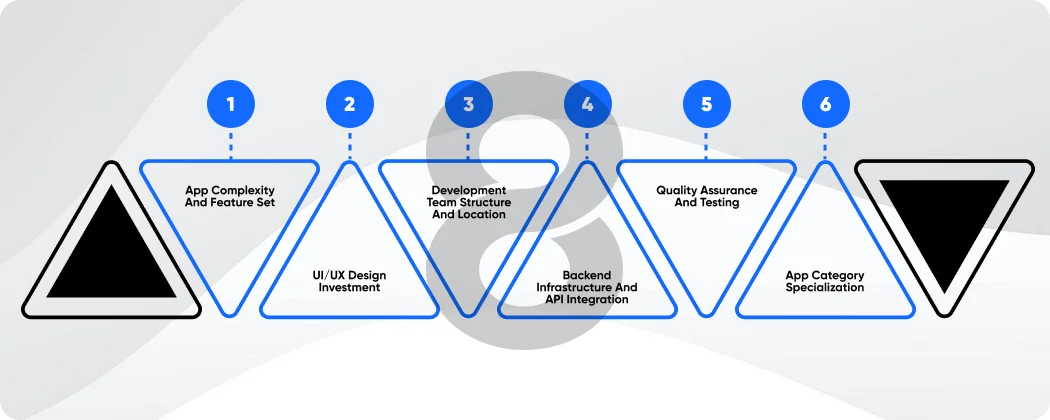
To calculate the cost of developing an iPhone application, it is necessary to take into account a complex of variables related to each other. All these factors play a different role in your total investment, and knowing these factors allows you to make a strategic decision that will not only place quality, usability, and budget limitations in a balanced manner.
1. App Complexity and Feature Set
The most important cost determinant is the degree of your iOS application. There are three major types of complexities in applications:
Basic iOS Apps:
These simplified solutions have basic features, such as user authentication, basic data display, simple navigation patterns, and common UI components. Basic apps are suitable for MVPs and proof-of-concept projects and only take 2-4 months of development time with minimal backend infrastructure.
Medium Complexity Apps:
Mid-level applications combine custom user interface components, third-party APIs, real-time synchronization, complete user management, push notifications, and moderate complexity. The projects typically require 4-8 months and require senior developers with experience in the latest iOS development technologies, such as SwiftUI and Combine.
Enterprise-Grade Complex Apps:
Advanced solutions with AI/ML connectivity, AR, sophisticated data visualization, real-time collaboration, high-level security measures, and large-scale backend architecture. The desirable development timeline protrudes past the 8 months and requires expert knowledge in various fields of technical expertise.
Category |
Estimated Cost |
Timeline |
| Basic iOS Apps | $10,000 – $30,000 | 2–4 months |
| Medium Complexity Apps | $30,000 – $100,000 | 4–8 months |
| Enterprise-Grade Complex Apps | $100,000 – $300,000+ | 8+ months |
2. UI/UX Design Investment
The quality of visual design has a great impact on user interaction, retention rates, and the general success of the application. iPhone design involves a number of critical stages in developing an app, starting with the first research and ending with the integration of the final brand.
As such, overall design costs are between $8,500 to $62,000, based on the need to customize and align with brand positioning. Applications focusing on the high-end market scenes will often use 20-25% of the overall budget towards outstanding user experience design as the source of competitive differentiation.
Design Phase |
Cost Range |
Key Deliverables |
| Research and Strategy | $500 – $2,000 | Competitive analysis & planning |
| Prototyping | $1,000 – $5,000 | Low-fidelity sketches |
| Visual Design | $5,000 – $40,000 | High-fidelity mockups & icon creation |
| Branding Integration | $2,000 – $15,000 | Logo refinement & typography selection |
3. Development Team Structure and Location
The geographic location of your development team will have an extremely significant effect on iPhone app development cost, with the hourly cost differing by as much as 400% across regions. As much as North American developers charge a premium rate, Eastern Europeans and South Asians can provide superior value without having to compromise on quality.
The appropriate choice of location ensures that the processes are highly cost-effective and, at the same time, the technical aspect and communication level remain excellent across your entire project lifecycle.
Region |
Hourly Rate |
Key Advantages |
|
North America |
$100 – $250/hour |
Premium talent, advanced expertise, timezone alignment |
|
Western Europe |
$80 – $180/hour | High quality, strong communication, and EU market knowledge |
|
Eastern Europe |
$40 – $100/hour |
Excellent value, skilled developers, European timezone |
|
Middle East |
$50 – $150/hour |
Growing expertise, competitive rates, and regional insights |
| South Asia | $20 – $60/hour |
Cost-effective, large talent pool, 24/7 development cycles |
4. Backend Infrastructure and API Integration
Contemporary iOS applications do not often work on their own. Instead, they need strong backend systems in terms of data management, user authentication, business logic processing, and third-party integration services. The cost of backend development depends on:
Thus, the total affordable iOS app development costs are between $13,500 to $90,000. Backend solutions will add to the total cost.
Backend Component |
Cost Range |
Best For |
|
Custom Backend Development |
$10,000 – $60,000 | Complex apps requiring unique business logic |
|
Backend-as-a-Service (BaaS) |
$2,000 – $15,000 | MVPs and apps with standard backend needs |
|
Payment Gateway Integration |
$1,000 – $5,000 |
E-commerce and transaction-based apps |
| Third-Party APIs |
$500 – $10,000 per integration |
Apps requiring external service connectivity |
5. Quality Assurance and Testing
Rigorous testing guidelines guarantee that your app will have impeccable execution on Apple’s various device ecosystems. Costs of testing normally represent 15-25% of the total cost of development:
Testing Type |
Cost Range (USD) |
Why It Matters |
| Functional Testing | $2,000 – $10,000 | Ensures core functionality meets requirements |
| Performance Testing | $1,500 – $8,000 | Smooth user experience under various conditions |
| Security Testing | $2,500 – $12,000 | Protects user data and prevents security breaches |
| Device Compatibility Testing | $1,000 – $5,000 | Ensures consistent experience across Apple ecosystem |
| User Acceptance Testing (UAT) | $1,000 – $4,000 | Validates app meets actual user needs before launch |
6. App Category Specialization
The categories of applications require different technical solutions and a different cost structure according to the specialized needs. Developing an iPhone app can cost an average of differing amounts depending on industry-specific/compliance features and technical complexity.
App Category |
Cost Range |
Core Features Required |
Development Time |
| E-commerce Apps | $40,000 – $150,000 | Payment integration, inventory management, | 4–9 months |
| Social Networking | $50,000 – $200,000 | Media sharing, content feeds | 6–12 months |
| On-Demand Services | $45,000 – $180,000 | GPS tracking, payment processing | 5–10 months |
| Healthcare Apps | $60,000 – $250,000 | HIPAA compliance, EHR integration, | 6–14 months |
| FinTech Applications | $70,000 – $300,000 | Banking-grade security, regulatory compliance | 7–15 months |
| Gaming Apps | $30,000 – $500,000+ | 3D graphics, and in-app purchases | 6–18 months |
| Education Apps | $25,000 – $120,000 | Content management, progress tracking, | 4–8 months |
As an example, the security of fintech applications needs to be banking-grade, and gaming applications need advanced graphics engines and multiplayer infrastructure. The knowledge of these category-specific cost ranges will help you plan your budget in a realistic manner, which is in accordance with your industry’s technical requirements and user expectations.
Hidden Cost of iOS App Development
Other than the development cost as mentioned, other costs are not evident, but they have a significant effect on your overall cost of investing in developing iOS applications. The ability to identify these unseen costs allows for predicting budgets more precisely and avoiding unpleasant budget surprises when carrying out a project.
Testing Type |
Cost Range (USD) |
Why It Matters |
| Functional Testing | $2,000 – $10,000 | Ensures core functionality meets requirements |
| Performance Testing | $1,500 – $8,000 | Smooth user experience under various conditions |
| Security Testing | $2,500 – $12,000 | Protects user data and prevents security breaches |
| Device Compatibility Testing | $1,000 – $5,000 | Ensures consistent experience across the Apple ecosystem |
| User Acceptance Testing | $1,000 – $4,000 | Validates app meets actual user needs before launch |
Thus, we have drawn up a full list of all these latent requirements to make sure that you do not miss any important points when creating your iPhone app. These are constant costs that should be considered in Smart budgeting.
Brief Analysis of Android vs iOS App Development Cost
Knowledge of platform-specific cost differentials would facilitate strategic decisions on multi-platform development strategies. Although the two ecosystems have their own distinct benefits, there are certain idiosyncratic features in the development cost of an iOS application that are not synonymous with Android development.
Development Time Considerations
Swift, concise syntax, standardized device specifications, and simple design principles usually demand 10-15% less developer time on iOS applications. This makes it efficient in testing and decreases development costs and time-to-market.
Device Fragmentation Impact
The ecosystem controlled by Apple comprises just 20-30 working devices, whereas Android developers have to cater to thousands. Such fragmentation requires much more comprehensive QA, and to test Android, it takes about 30-40% of the resources and time that iOS does.
Design and Development Standards
iOS applications follow Apple’s interface guidelines, leaving a transparent design standard to simplify the decision-making process. Android, on the other hand, has less rigidity and requires more time to make a choice related to customization. Furthermore, iOS users are showing greater demands towards refinements and polish, which may push the cost of design.
Monetization Performance
iOS users have become increasingly bigger spenders, being an average of 2-3 times more revenue per user (ARPU) in most markets. This economic success usually warrants greater investment in the development of iOS-first solutions, especially of apps based on high-priced structures or in-app purchase monetization.
Long-term Maintenance Costs
Android system fragmentation and variation of the OS version make compatibility a constant issue, with 20-30% higher long-term maintenance costs than iOS. Moreover, iOS users upgrade to new OSs much faster (70%+ upon their introduction), which simplifies the technical aspect of compatibility and makes it less likely to add technical debt.
Read More: How Much Does it Cost to Develop an App
Exceptional Tips To Reduce The Average iOS App Development Cost
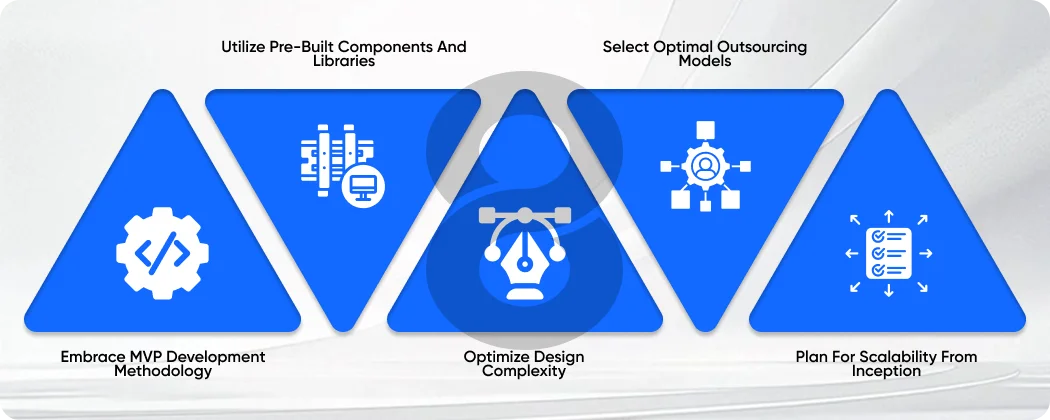
Planning and making informed decisions allow achieving a high level of cost optimization without impacting the quality of applications or user experience. These are some of the best approaches to ensure that your development budget is used to the maximum and also to ensure that you remain competitive in the market.
1. Embrace MVP Development Methodology
A Minimum Viable Product, starting with core features, is aimed at meeting the key user needs. Delaying secondary functionality saves up to 40-60% in cost, lowers time-to-market, and allows making data-driven decisions when prioritizing future features based on actual user feedback.
2. Leverage Cross-Platform Frameworks Strategically
Flutter or React Native enable open-source cross-platform frameworks that make it possible to use code across iOS and Android and save up to 30-40% of development expenses. Before adopting, evaluate trade-offs between performance, native feature access, and long-term maintainability to ensure that the approach meets your project objectives.
3. Utilize Pre-Built Components and Libraries
Open-source libraries or SDKs (authentication, payments, analytics, and UI components) should be used instead of developing all features in-house. This methodology saves 20-35% in development time, as the solutions it uses are mature and only need a little customization, yet they are reliable and efficient.
4. Optimize Design Complexity
Outstanding design brings about differentiation, whereas exorbitant complexity raises the cost of development and upkeep. Focus more on the usability and less on the ornamentation, use standard iOS elements, and apply custom animations only when they have a meaningful contribution to the user experience, weighing between the aesthetics and practical limitations.
5. Select Optimal Outsourcing Models
The decision with regard to strategic outsourcing has a tremendous influence on project economics. Take into consideration the following winning strategies:
- Dedicated development team: Best for long-term projects requiring extensive collaboration
- Fixed-price contracts: Ideal for well-defined projects with minimal scope uncertainty
- Hybrid models: Combining in-house product management with outsourced development execution
- Nearshore partnerships: Balancing cost efficiency with convenient time zone alignment
6. Implement Agile Development Practices
Agile methodology involves using iterative cycles, frequent feedback, and adaptive planning as ways of reducing wastage. This minimizes unnecessary engineering of features, troubleshooting at an early stage, and resource optimization, making it 15-25% more cost-effective than the conventional waterfall methods.
7. Plan for Scalability from Inception
Early investment in scalable backend hardware and architecture modularity and performance optimization helps avoid expensive rewrites in the future. Though this sounds counterintuitive to begin with, growth planning will make sure that your efficiency will be efficient in the long run, which will decrease your technical debt and cost significant amounts of money as the number of your users grows.
Read More: How to Create an App on Android
Benefits of Choosing iOS App Development Over Android
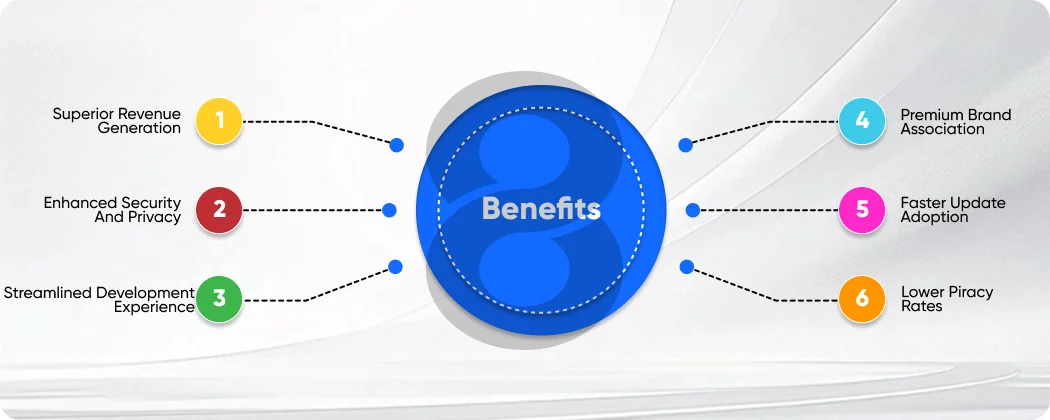
Although the global market share of Android is huge, iOS development has strong arguments that can be used in the concentrated investment of many businesses, especially those aiming at the high-end market segments, and the best monetization performance.
Superior Revenue Generation
iOS users spend more constantly in the monetization frameworks. The in-app purchase conversion is 2-3 times better than Android, subscription retention is 25-40% higher than Android, and iOS users are more prepared to use premium apps in contrast to using free ones only.
Enhanced Security and Privacy
The stringent app review procedures, the compulsory security measures, and the privacy-focused ecosystem offer the company better protection of the data than the Android platform, which is more open-minded. In applications where the user data is sensitive, or financial transactions or health data are to be handled, the security features of iOS have a beneficial impact on lowering the liability and winning the confidence of the users.
Streamlined Development Experience
The standardized environment, intensive documentation, and mature toolchain make Apple faster and less frustrating to develop. The debugging in Xcode, UI tools in Interface Builder, and beta distribution in TestFlight enhance productivity, which contributes to the improvement of the efficiency of the developers, who report being more productive, streamlining their work processes, and having an increased job satisfaction with the technologies of iOS.
Premium Brand Association
The association of the iOS platform communicates quality, sophistication, and premium positioning that builds general brand perception. In the context of companies that appeal to high-income groups, a B2B enterprise client, or luxury markets, the iOS-first approach is more conducive to overall brand positioning and customer demands.
Faster Update Adoption
The users of iOS change to newer OS versions incredibly fast, and more than 70-80% of users use them within months after launch. This fast upgrade cycle allows developers to access new platform features earlier, minimizes the burden on backwards compatibility, and makes quality assurance less expensive than fragmentation of Android version distribution.
Lower Piracy Rates
Apple has had a closed ecosystem and App Store gatekeeping, which has greatly minimized application piracy relative to Android. In applications where the revenue stream depends on paid downloads or freemium monetization structures, the piracy resistance offered by iOS is better than Google Android.
Read More: How to Create an App on iOS that Stands Out
8ration: Your Strategic Partner for Cost-Effective iOS Excellence
At 8ration, we understand that exceptional iOS applications require more than technical proficiency; they demand strategic thinking, user-centric design, and pragmatic cost optimization. As a leading digital transformation company with proven expertise across North America, the Middle East, and South Asia, we’ve engineered iOS solutions for startups validating revolutionary concepts and enterprises scaling established platforms.
Our Approach to Transparent iOS Development
Unlike competitors obscuring costs behind vague estimates, we provide comprehensive project scoping that identifies every cost component upfront. Our discovery process examines your business objectives, technical requirements, user expectations, and budgetary constraints to architect solutions that maximize value within your investment parameters.
Proven Track Record Across Industries
Our portfolio spans diverse sectors, including fintech, healthcare, e-commerce, logistics, and entertainment. Whether you’re building consumer-facing applications requiring exceptional UI polish or enterprise solutions demanding robust security and integration capabilities, our multidisciplinary teams possess the specialized expertise your project demands.
Flexible Engagement Models
We recognize that one size doesn’t fit all in software development. Therefore, 8ration offers multiple engagement models tailored to your specific circumstances:
- Fixed-price projects: Ideal for well-defined scopes with minimal uncertainty
- Dedicated development teams: Perfect for ongoing product development requiring extensive collaboration
- Staff augmentation: Complementing your existing team with specialized iOS expertise
- Consulting services: Strategic guidance for complex architectural decisions
Technology Excellence Meets Business Pragmatism
Our iOS developers remain at the forefront of platform evolution, mastering Swift, SwiftUI, Combine, and emerging frameworks while maintaining a pragmatic focus on business outcomes rather than technology for its own sake. We recommend solutions that drive measurable results: increased user engagement, higher conversion rates, reduced operational costs, and accelerated market growth.
“The most expensive iOS app isn’t the one with the highest development cost; it’s the poorly built one requiring constant fixes.”
– Muzamil Liaqut Rao, CEO, 8ration
Final Thoughts!
Determining the cost to develop an iOS app in 2026 requires a comprehensive understanding of technical requirements, strategic priorities, and long-term business objectives. iOS development investment ranges from $10,000 for basic MVPs to $300,000+ for enterprise solutions, with numerous variables influencing final costs.
The most successful applications balance budgetary pragmatism with user experience excellence and strategic differentiation. By implementing the optimization strategies outlined above while partnering with experienced teams like 8ration, businesses position themselves for sustainable competitive advantage. Start your iOS development journey today with 8ration as your trusted partner for digital transformation excellence.