


The global artificial intelligence market size was valued at USD 428.00 billion in 2022 and is projected to reach USD 2,025.12 billion by 2030, exhibiting a CAGR of 21.6% during the forecast period.
AI has become the foundation of modern business innovation. By 2026, enterprises in any industry, such as healthcare and finance, retail and logistics, and others, are looking forward to the implementation of AI in their work. Regardless of whether you want to automate your internal operations, transform customer experience, or create new AI-based products, it is necessary to understand how to build an artificial intelligence.
This is a complete tutorial on how to create an AI: planning, data preparation, model selection, development, deployment, and future trends. Using these principles, you can create an AI that is scalable, secure, and business-oriented.
Understanding AI in 2026
The idea of artificial intelligence has ceased to be about predictive analytics and simple machine learning. Modern AI in 2026 encompasses:
- Generative AI: The one that can produce text, images, audio, and video
- Chatbots and voice assistants: Advanced conversational AI
- Vision AI: Advanced object detection and image recognition
- Autonomous AI Agents: Fully autonomous decision-making systems
- Edge AI: AI programs that run on local devices to achieve speed and privacy
The first step when you think about how to make an artificial intelligence is the definition of the type of AI that is appropriate for your company. This choice defines what you need to know in terms of data, technical stack, and staffing.
Defining Your AI Purpose
Crafting AI in the absence of a purpose may result in waste. Before development, ask:
- What problem should AI solve?
- What is the business purpose it will serve?
- What do we already have in the way of datasets?
- How will we measure success?
When an AI has a clear purpose, it is the basis of all decisions that will be made. As an illustration, an e-commerce firm may set its AI objective as “Develop an AI that will automate personal product recommendations, which will boost conversion rate by 20% in six months.”
By setting this clarity, it will make sure that your AI program is tied to what your business is able to quantify, and it will also minimize risks when developing it.
Choosing the Right AI Type
There is a large variety of types of AI, and companies need to choose the one that suits their work best. The decision has a direct influence on the way of creating an artificial intelligence.
Most organizations focus on:
- Predictive AI: Relies on previous data to determine trends, demand, or risks. Typical in finance, logistics, and healthcare
- Generative AI: It is used to generate content, code, images, or speech. Frequently used in marketing, design, and software development
- Chat AI: Powers voice and chatbots, improving customer support
- Vision AI: Identifies objects or quality in images or videos or medical imaging
- Autonomous AI Agents: Perform workflows or schedule work on its own
The type of AI you choose will ensure that the development of AI depends on the goals of your company.
Data: The Core of AI
All AI is still based on data. Approximately 90 percent of how to make an artificial intelligence is in the gathering, cleaning, and preparing of the data.
Sources of data include:
- CRM, ERP, and POS are internal systems
- Interactions and transaction histories of customers
- Open repositories and public datasets
- Scraped information (compliance issues)
Appropriate preparation entails eliminating duplicates, standardization, missing values, and annotation of the data used, to was learned under supervision. The generation of synthetic data in 2026 also allows the generation of strong AI models based on limited datasets of companies.
Key Insight: While a large team may be ineffective with low-quality data, a small team can be effective with high-quality data. Data integrity is always the first thing to be considered.
AI Development Approaches in 2026
Businesses tend to take three approaches to the learning process of how to make an artificial intelligence:
Pre-trained AI
Pre-trained models can be deployed quickly by utilizing existing AI structures. They are GPT-5, Gemini 3, Claude 4, and Llama 4. AI chatbot development, content generation, and internal knowledge assistants are the best models to use. They can be tuned to domain-specific tasks by companies with relatively small investments.
Fine-Tuning Foundation Models
Fine-tuning is a step of pre-trained model adjustment using your company-owned data. This technique is cost-effective and performance-wise. It is particularly widely used in healthcare, finance, and legal applications where the domain knowledge is critical.
Building AI from Scratch
This strategy is very expensive and resource-intensive; it needs millions of data points, high-performance GPUs, and a research team. The only reason why the companies pursue this option is that they require complete proprietary models in delicate or competitive applications.
Technical Stack for AI Development

By 2026, the technical environment will provide numerous options in terms of constructing AI effectively:
- Programming Languages: Python, Rust, Go, C++, JavaScript
- Frameworks: TensorFlow 3.0, PyTorch 3.0, JAX, Keras, Hugging Face Transformers
- Cloud Platforms: AWS Bedrock, Google Vertex AI, Azure OpenAI, Meta AI Cloud
- Tools: MLflow, Kubeflow, Weights and Biases, Neptune.ai
- Vector Databases: Pinecone, Weaviate, Qdrant, Chroma, Milvus
The correct mix of frameworks and platforms will make your AI creation scalable and maintainable.
How to Make Artificial Intelligence: Step-by-Step Guide
Understanding the full workflow helps companies implement AI successfully:
- Define the problem clearly: Specify what success looks like.
- Collect and clean data: Include internal, external, and synthetic sources.
- Select the model: Choose between predictive, generative, vision, or agent-based AI.
- Train or fine-tune: Use modern ML pipelines and monitoring tools.
- Evaluate performance: Assess metrics like accuracy, precision, recall, and latency.
- Build the application layer: Integrate AI into web, mobile, or internal dashboards.
- Deploy and scale: Use containerization, Kubernetes, and cloud GPU resources.
- Monitor and optimize: Continuously track drift, errors, and real-world performance.
This structured approach ensures a clear path from concept to deployment.
As per a report:
Based on the 27.7% compound annual growth rate (CAGR) from 2025-2030, the market will grow from $244 billion in 2025 to approximately $312 billion in 2026.
How Much Will Artificial Intelligence Cost in 2026
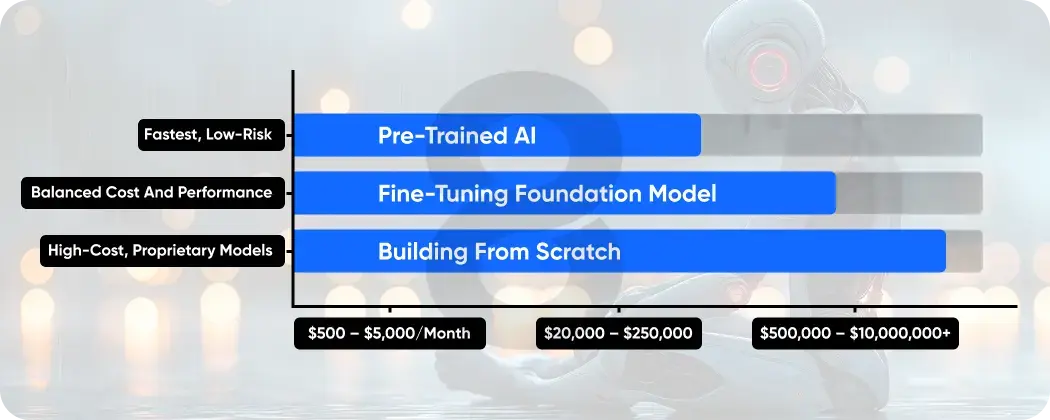
AI development costs vary widely based on approach, scale, and complexity. The table below summarizes typical ranges:
Approach |
Typical Cost Range |
Notes |
| Pre-trained AI | $500 – $5,000/month | Fastest, low-risk |
| Fine-tuning Foundation Model | $20,000 – $250,000 | Balanced cost and performance |
| Building from Scratch | $500,000 – $10,000,000+ | High-cost, proprietary models |
Graph-Style Representation of Cost:
Team Composition: Building the Right AI Dream Team

Creating an AI system in 2026 will not only be a matter of technology but also a matter of people who will make it happen. It is essential to get the right team together when you know how to make an artificial intelligence. A balanced team makes your AI meaningful to business, ethical, and achieves a quantifiable difference. The essential roles include:
AI Product Manager
This individual is the one who fills the gap between business strategy and AI development. They state the project goals, give priority to features, and make sure that the AI system can provide quantifiable ROI. The other aspect of a good AI product manager is to monitor progress, manage resources, and deliver it on time.
Machine Learning Engineer
They are the creators of your AI model. ML engineers come up with architectures, bring algorithms to life, and make models performance-optimized. Another field of multimodal AI engineering is done in 2026, when engineers create systems that comprehend text, audio, video, and structured data at the same time.
Data Scientist
Good data is essential in the success of your AI. A data scientist works with data, identifies useful patterns, and develops features that enhance the performance of the model. They also check model predictions, making your AI work.
Data Engineer
Every AI system has a powerful data pipeline. These pipelines are created and maintained by data engineers, who make sure that data flows continuously between the source and the model. They process high amounts of structured and unstructured information, clean and transform data, and make it available to the AI team.
Prompt Engineer
Another modern yet important position in 2026. Instead of just being trained on your company, prompt engineers are designed with your company in mind and tailored to your needs. They are capable of drastically enhancing the accuracy and the quality of AI, even without retraining the whole model.
MLOps Engineer
MLOps engineers make sure that your model works well in production after being trained. They deal with deployment, scaling, monitoring, and automatic retraining. They, too, have version control and are able to integrate smoothly with your software stack.
Software Engineer
These engineers create the application layer, which is the one with which people interact. They incorporate AI models in websites, mobile applications, internal dashboards, and APIs, which are smooth to use and perform.
AI Safety & Compliance Officer
There is no compromise on regulatory compliance and ethical use of AI. This role is to make certain that your AI is local and international, without any biases, and is transparent. They also put up measures to avert misuse or unintended consequences.
By having this team available, your company would be able to approach all the fields of AI development, including ideation and training, deployment, monitoring and building AI-powered voice assistants. Although you may not be able to afford a complete staff, it may be beneficial to outsource specialized positions to ensure your quality results.
Security, Ethics, and Compliance: A Non-Negotiable Foundation

Having AI will have nothing to do with functionality by 2026, but rather trust. Organizations that do not comply with security and compliance criteria may end up paying fines, being damaged in terms of reputation, and even facing legal actions. The nature of your AI, the way you intend to build an artificial intelligence, should be thought through in terms of ethical and secure practices, which should be considered many years in advance.
Key considerations include:
- Transparency: How your AI makes decisions should be transparent. The stakeholders should be aware of the logic behind predictions or recommendations.
- Bias Reduction: AI models are a reflection of the information with which they are trained. To have an ethical AI, it is necessary to actively identify and rectify biases in order to deliver equitable results.
- Data Privacy: The companies are required to adhere to GDPR, HIPAA, and other domestic laws and regulations and make sure that the customer’s or sensitive information is never released.
- Explainability: Models should explain every decision, particularly in such sectors as healthcare and finance. Regulatory authorities tend to require such accountability.
- Continuous Monitoring: Ethical control is not limited to deployment. AI integrity is important to monitor misuse, unforeseen actions, or drift.
This way, through these principles, companies will be reliable, gain customer confidence, and minimize risks related to AI implementation.
Future AI Trends That Will Shape Your Strategy

It is a dynamic future of AI in 2026. With the knowledge of future trends, companies make better decisions and remain competitive when they learn how to make an artificial intelligence.
Multimodal AI
Multimodal AI is capable of comprehending and creating content in the fields of text, pictures, video, and audio. Think about a virtual assistant, which can read all of your emails, analyze photographs and summarize video calls as actionable tasks. Multimodal AI companies are able to acquire new levels of insights and efficiency.
On-Device AI
Edge AI is now mainstream. Directly executable models on hardware such as smartphones or IoT systems will minimize time lag, increase privacy, and decrease reliance on cloud computing systems. This is particularly relevant in those industries where the speed and security of data are paramount, like health care and money.
AI Agents
Independent AI agents can execute tasks end-to-end. By the year 2026, AI is able to perform some of the more complicated tasks, such as scheduling, responding to customer inquiries, administering stock, and even producing reports to the business without human efforts. Those companies that employ agents save in operation and expand quicker.
Industry-Specific AI
Specific AI models that are specific to industries are substituting generic solutions. Retail AI is aimed at personalization and inventory management, and finance AI is aimed at fraud detection and risk assessment. The construction of industry-specific AI allows companies to acquire more insight and accurate predictive abilities.
Proprietary Small Models
Instead of massive AI models, several businesses in 2026 rely on smaller and proprietary models. These are cheaper, faster and customizable, and they provide privacy to the data. Small models have a tendency to perform equally well as large models in specialized areas.
Neural-Symbolic AI
Neural-symbolic AI combines neural networks and logical reasoning to enhance decision-making, interpretability, and efficiency. It enables models to learn patterns based on data after following the rules of the structure to bridge the divide between classical and modern machine learning.
Through these trends, companies can be able to develop AI systems that are relevant and adaptable in the next decade.
Challenges and How to Overcome
The development of AI is problematic even in the context of breakthrough technology. Firms should not expect success without challenges in finding out how to make an artificial intelligence.
- Data Limitations: Data is not clean enough in many companies. Solution: train models using synthetic data or boost existing data.
- High Costs: AI development may not be cheap. Solution: begin with pre-trained or fine-tuned models to reduce costs without lowering the results.
- Slow Model Inference: Large models can be slow in production. Solution: quantize, prune or accelerate models with a GPU.
- Complexities of Integration: AI has to cooperate with the existing systems. Fix: use orchestration tools, APIs, and vector databases to facilitate integration.
- Low Accuracy: Unreliable outputs are achieved when poorly trained models are used. Remedy: enhance the quality of data, advance feature engineering, and use robust evaluation.
Those companies that take these challenges into consideration early in time, enjoy a huge competitive edge.
Conclusion: Your Artificial Intelligence Adventure Begins

Knowing how to create an artificial intelligence in 2026 is a special chance to companies as it provides them with an opportunity to automate processes, discover insights, and create a competitive advantage. Technology is not in its early stages and tools are available and frameworks are made to be deployed quickly.
By combining:
- Multi-disciplinary and skilled staff
- Prepared and quality data
- AI models carefully chosen
- Adherence to ethical and regulatory requirements
- Proactive utilization of the AI trends
In 2026, AI will cease to be the preserve of big tech; it will become a strategic requirement. The companies that know how to create an artificial intelligence nowadays will become the leaders tomorrow.
Start your AI journey now with 8Ration’s AI development services, define clear objectives, and transform your company into an intelligent enterprise capable of innovation, efficiency, and sustainable growth.