



The global software testing market was valued at around USD 14,500.75 million in 2024, and analysts project it will reach about USD 28,500.85 million by 2032, a compound annual growth rate (CAGR) of ≈ 8.9% between 2025 and 2032.
The modern digital world is highly dynamic and fast-paced, and now, the quality of software is the only factor that determines the success of a business or its demise. Customers do not have a limit to choices. New features are shipped by competitors every week. The world is changing every month due to technology. That is why it is important to learn what is QA testing in software is for every company, be it a startup that wants to develop its MVP or a company that has to handle a complex ecosystem involving a variety of platforms. Industries such as automotive, fintech, logistics, healthcare, e-commerce, and travel rely heavily on robust QA practices to ensure seamless user experiences and maintain trust.
Quality Assurance is not merely a department. It is not something you do at the end of product development. It is a kind of attitude, a practice, and a lifelong effort to create trusted digital products. At 8ration, we assist companies in the adoption of QA as a strategic driver and not as a last thing to do. We do not respond to problems, but we prevent them. We do not make patchwork fixes; we lay strong foundations. And we do not launch products into the market but equip them with the prospects of long-term success with the help of organized quality assurance procedures.
Read More: 20 Popular Software Development Life Cycle Models You Should Know
Understanding What QA Testing in Software Really Means

When teams pose the question, “What is QA testing in software?” they tend to think it is just finding bugs. However, the actual QA is much more than bug detection. QA makes sure that all of your system, code, design, architecture, integration, performance, usability, scalability, and reliability are all operating as intended. It endorses the product planning during the development, during the deployment, and during the software maintenance and support.
Real QA includes more profound questions:
- Is the software being used according to the business needs?
- Do all features act rationally and consistently?
- Scalability with a rapid increase in user traffic?
- Will the product break during real use?
Do all integrations, workflows, APIs, and user paths work flawlessly?
This is what makes good digital products and weak products. QA does not hope that issues will emerge; instead, it predicts all risks. It verifies all of it: software design, system logic, workflows, performance layers, network dependency, data flows, microservices, and all software integration points. A poor QA process will result in unpredictable releases. A powerful QA process establishes forecasted excellence.
Why QA Testing Is Critical for Business Success
Appealing software that breaks down at the time of need cannot stand the test of time in the market. Customers abandon their websites as soon as they encounter bugs, crashes, slowness, or incoherent flows. Once trust is lost, the brand is hurt. It is 10 times more expensive to fix problems when they occur in the field as opposed to when they occur in QA.
That is why the firms that are seeking what is QA testing in software is finally understanding that QA is not a cost, it is insurance. It safeguards the time of development and protects the customer relationships. It cushions the growth of the business in the long term. In the absence of QA, software is prone to vulnerability, unpredictable, and costly to maintain.
By investing in quality assurance, you will be able to get:
- Stable releases
- Faster time-to-market
- Lower development costs
- Increased customer satisfaction
- Stronger brand trust
- Scalability of products over the long term
At 8ration, we integrate QA to all phases of your development lifecycle, starting with your idea validation, continuing with architecture verification, moving on to your coding, then to your cloud software development, to your pre-release testing, and then with continued improvement via maintenance and support. That is how we will turn software into solid digital products that the users are fond of.
The Difference Between QA and Software Testing

To really know what is QA testing in software is, one should know the distinction between QA and software testing. These terms are not interchangeable, as many businesses tend to use them interchangeably.
Quality Assurance (QA)
QA is a strategic process. It aims at eliminating defects through the enhancement of processes, documentation, planning, communication, design, architecture, and workflows.
Software Testing
Testing emphasizes on detection of defects through the running of test cases, scenarios, and automation scripts.
In simple terms:
- QA builds quality
- Testing verifies quality
A combination of the two gives you a product that is of premium quality, stable, fast, and easy to use. Our strategies are a combination of QA plans and effective software testing approaches that guarantee accuracy in prevention and accuracy in detection, so no one can slip through.
Read More: Top 10 Mobile Apps for Businesses
Where QA Fits Into the Software Development Lifecycle
The last step is not QA, but rather it is an ongoing presence throughout the entire SDLC. Quality assurance is useful to every stage since all the stages have the ability to cause or even stop problems.
In the analysis of requirements, QA verifies intelligibility, feasibility, and logic. In software design, QA is used to make sure that the architecture is made to be reliable and performs well. Our QA works in tandem with the engineers to minimize defects as a source. QA checks on module-to-module communication in the case of integration and flawless custom API development. QA is used during deployment to ascertain that the system is stable. And in maintenance & support, QA makes sure that the new updates do not introduce a feature that will break.
Deep Dive Into Types of QA Testing
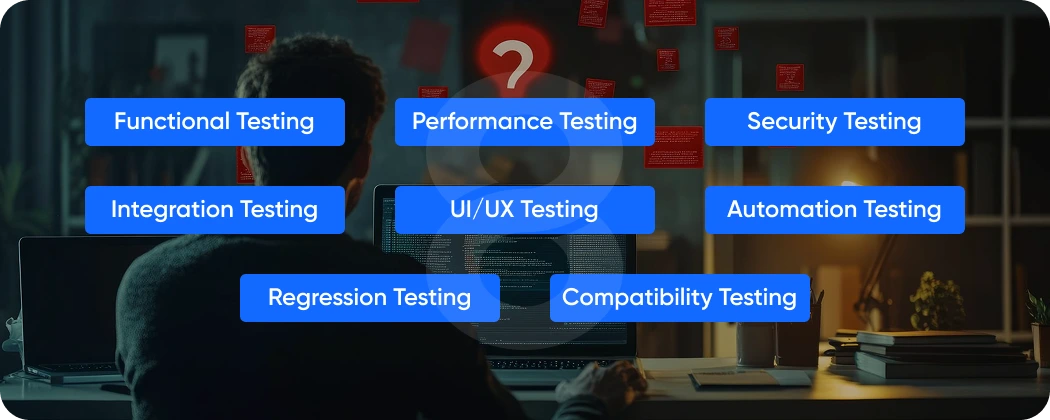
At this point, we will go into greater detail with the testing types and continue to make the blog bulky, informative, and full of keywords.
Functional Testing
Functional testing ensures that each functionality works as intended. It verifies user paths, user inputs, user outputs, user verifications, and user patterns. Good functional testing guarantees stability during real-world usage.
Performance Testing
Performance testing is what will make sure that your product remains responsive and fast at peak load, at high traffic, and in other challenging operations. This is mandatory in e-commerce apps, fintech, healthcare, entertainment, and massive apps.
Security Testing
Security testing secures your information, users, and business. It reveals the weaknesses in authentication, authorization, encryption, sessions, and APIs, which are particularly critical in industries with sensitive data.
Integration Testing
Integration testing is a test to ensure that each and every module does not contradict another. This is important where there are third-party services, microservices, or custom workflows that need complex software integration.
UI/UX Testing
UI/UX testing makes the experience non-erratic and smooth, and professional. The smallest usability problem will send users away.
Automation Testing
Agile teams working with frequent releases can be significantly faster to test, particularly with automation.
Regression Testing
Regression testing is used to make sure that new updates do not introduce failures to current functionality, a fundamental safeguard in product development and continued feature addition.
Compatibility Testing
Checking compatibility checks browsers, devices, resolutions, OS versions, and hardware variations in order to guarantee the same performance everywhere. And all these categories constitute the actual meaning of what is QA testing in software.
According to Global Growth Insights, broader estimates for the QA & testing‑services space are even more aggressive: some reports show growth from about USD 46.9 billion in 2024 to roughly USD 187.5 billion by 2033.
Read More: How Much Does it Cost to Develop an iOS App?
The 8ration Approach: How Our QA Experts Will Make Products Better
We empower the whole development system in your organization at 8ration with strategic quality assurance. We examine requirements, recreate workflows, test architectural healthiness, test all points of software integration, enhance code reliability, and provide end-to-end flawless functionality.
Your development team collaborates with our QA specialists in order to make sure that every feature is stable, every single integration is safe, every single function is predictable, and every single release will be smooth. We avoid serious failures way before production.
Here are some of the ways we help improve your product quality:
- We engage QA in requirement gathering, preliminary UX planning, and software design meetings.
- We enhance stability through continuous testing, manual and automated test cycles are run during the development process.
- We secure your integrations and all connections, internal and third-party, are tested with deep integration and custom API development reviews.
- We strengthen scalability and performance, load, stress, and optimization tests make sure that your system grows without many failures.
- We support long-term success throughout the maintenance and support, our QA team is kept active to make sure all the updates are stable.
Reasons Why QA Testing Saves Money and Time
- Reduces development rework
- Avoids failures after the launch
- Lowers customer complaints
- Minimizes downtime and failures
- Increases product longevity
Common Mistakes QA Prevents
- Broken workflows
- Slow user experience
- Security loopholes
- Faulty API responses
- Unstable integrations
Critical QA Deliverables Your Business Receives
- Test plans
- Test cases
- Automation suites
- Bug reports
- Release quality reports
QA Tools & Technologies

Current software QA testing is based on a combination of both manual and automated tools to promote efficiency, precision, and scaling. The appropriate tools facilitate the early detection of defects, lessen human involvement, and assist in higher software testing plans. Key tools include:
Automation Tools:
- Selenium, Cypress, Appium – to automate functions and UI.
- TestComplete, multi-platform testing.
Performance Testing Tools:
- JMeter, LoadRunner, and Gatling to test load, stress, and response time.
Bug Tracking & Collaboration:
- Jira, Bugzilla, and Azure DevOps, issue tracking, task assignment, and tracking.
CI/CD Integration Tools:
- Jenkins, GitHub Actions, and GitLab CI inject testing into the auto-deploy.
API & Integration Tools:
- Postman: To test API development through custom API development
- SoapUI: To manage complicated API workflows
- BrowserStack: To test cross-browser compatibility
With a combination of these tools and a well-organized QA process, one can have solid software that will work reliably in production and software that supports software integration and cloud software development activities.
Common QA Challenges
Regardless of the ideal QA procedures, teams still face issues that may affect the quality of software. These challenges should be identified to ensure proactive management:
- Complex Integrations: Various modules, APIs, and third-party systems make the testing more difficult.
- Scarcity: Scarcity of resources can be in the form of tight deadlines, small teams, or a lack of expertise in QA.
- Quick Release Processes: Agile and CI/CD pipelines require constant QA and allow very limited time to spend.
- Balancing Manual and Automation Testing: How to select what to automate without reducing the coverage.
- Gaps in Test Coverage: This is to make sure that every edge case and user scenario is covered.
- Environment Variability: The variations in devices, browsers, operating systems, or network conditions may create unforeseen bugs.
To deal with these problems, there should be strategic planning, proper software consulting, and qualified QA teams that can scale the processes within product development trends.
“Software testing isn’t just about finding bugs; it’s about building confidence, ensuring reliability, and shaping a product that users can trust.”
– Muzamil Liaqat Rao, CEO of 8ration
ROI and Cost Savings from QA
Investment in quality assurance software testing is fruitful in terms of saving money and minimizing risk, and time to market. The appropriate QA can have quantifiable ROI in several ways:
- Fewer Post-Release Defects: It is 10x more expensive to fix after a system has been launched than to fix it during development.
- Reduced Support Costs: Reduced bugs will mean reduced customer complaints and support tickets.
- Accelerated Product Development: The rapid product development will ensure that delivery schedules are met.
- Higher Customer Retention: Bug-free, reliable software generates faith and loyalty.
- Maintenance and Support: Products that are well-tested need fewer maintenance and support efforts and costs.
Through QA embedded in the software design, software integration, and cloud software development, the businesses would save money, as well as enhance the overall quality and performance of the software.
Emerging Trends in QA
The QA is also continuously changing to match the current trends in software development. Key trends include:
- AI-Based Testing: Artificial intelligence identifies places of defects and creates intelligent test cases.
- Continuous Testing: Part of CI/CD pipelines to give real-time feedback.
- Cloud-Based QA: Scale testing of distributed systems in many environments.
- Microservices & API Testing: A stable communication in a service-oriented, modular architecture.
- Shift-Left QA: The testing will begin earlier in the SDLC to avoid defects instead of merely detecting them.
- Automation Growth: More automation to manage repetitive work and release teams to do complex validation.
These trends make software testing more effective and efficient and allow the development of products in high quality and at scale.
Read More: 50 Best IT Business Ideas for Startups to Inspire Your Next Venture
Level Up Your QA: Hire Your Next Software Tester From 8ration

QA is not a step in software development; it is a strategic requirement. Software QA testing is important in order to make sure that the products are stable, reliable, secure, and scalable. Overcoming the challenges, utilizing modern tools, and implementing the new tendencies, businesses will attain quantifiable ROI and sustainable product prosperity.
You can rely on 8ration in case of professional QA testing or software testing service. We incorporate QA in web development, software integration, product development, custom API development, cloud software development, and maintenance and support to make sure that your product fulfills your users’ expectations and will do much more. The future of QA today is to invest in 8ration to have a lesser number of defects, quicker delivery, and a robust and reliable software product.