


MVP development cost in 2026 runs between $10,000 and $150,000. A lean web build with one working feature starts around $10,000. A mid-complexity product with accounts, payments and a real design system usually lands between $30,000 and $80,000. Anything carrying AI features, live data or compliance obligations climbs past $80,000 and can reach $150,000 before you have shipped version two.
That range is wide because “MVP” is not a size. It is a decision about how little you can build and still learn something true. Two founders can use the same word and mean products that differ by a factor of ten in price.
The stakes behind that decision are well documented. CB Insights analysed 431 venture-backed companies that shut down after 2023 and found poor product-market fit behind 43% of them, with running out of capital showing up in 70% of cases as the point where the story ends rather than where it went wrong. An MVP exists to find that answer before the money is gone, which makes the size of the cheque you write for it a strategic question rather than a procurement one.
This guide breaks the number down by tier, by development stage, by industry and by region. It covers what AI features add, what compliance adds, what you will still owe after launch, and where founders reliably underprice the work.
How Much Does an MVP Cost in 2026
Most MVPs fall into one of three tiers. Find yours before you talk to anyone about a quote, because the tier decides the conversation.
| MVP Tier | Typical Cost | Build Time | What You Get |
|---|---|---|---|
| Lean MVP | $10,000 – $30,000 | 4 to 8 weeks | One core feature, basic authentication, a single platform (usually web), template-led design. Enough to put in front of fifty users. |
| Mid-Complexity MVP | $30,000 – $80,000 | 8 to 16 weeks | Several connected features, user accounts, payments, an admin panel, custom UI, cross-platform mobile or one native app. |
| Complex MVP | $80,000 – $150,000+ | 16 to 28 weeks | AI features, real-time data, regulated workloads, integrations with existing enterprise systems, or two native mobile apps built separately. |
Agencies do not price features. They price hours. A mid-complexity MVP development project runs roughly 900 to 1,400 hours across product, design, engineering and QA. Take 1,000 hours as a working figure. At an Eastern European blended rate of $45 an hour that is $45,000. The same scope through a US agency at $120 an hour is $120,000. The product did not change. Only the rate card did.
This is the part founders find hardest to accept, and it is also the most useful thing to know before the first call. If a quote surprises you, ask for the hour count before you argue about the price. The hours tell you whether the agency understood your scope. The rate tells you where they sit.
You can pressure-test your own number with the software development cost calculator before you brief anyone.
What Is an MVP and Why Does It Drive Your Budget
A minimum viable product is the smallest build that delivers real value to early users and produces a usable answer about demand. It exists to test an assumption cheaply, not to be a small version of the finished thing.
The reason this definition controls your budget is that the word has drifted. In 2026 plenty of products marketed as MVPs ship with AI recommendations, live dashboards and third-party integrations on day one. Those are not lean builds. They are early-stage products wearing a lean label, and they are priced accordingly.
Where you draw that line changes four things at once:
- A tight feature list means money goes to the features that carry your riskiest assumption instead of being spread thin across a wish list.
- Every additional feature adds engineering hours and QA hours, and QA is the one people forget to count.
- A founder who can explain why the build costs $60,000 rather than $200,000 is describing a plan. One who quotes a range they got from a blog is describing a hope.
- Architecture shortcuts taken to hit a launch date come back as rework, usually within nine months.
Read More: How Much Does it Cost to Build an App Like Amazon
MVP Cost Breakdown by Development Stage

A $50,000 MVP does not spend $50,000 on code. Between 35 and 45% of the budget goes to work that happens before or after anyone builds a feature, and that share is where most estimates go wrong.
| Stage | Share of Budget | On a $50,000 MVP | What It Covers |
|---|---|---|---|
| Discovery and scoping | 5 – 10% | $2,500 – $5,000 | Feature list, user flows, technical approach, estimate |
| UX and UI design | 10 – 15% | $5,000 – $7,500 | Wireframes, clickable prototype, design system, final screens |
| Frontend development | 20 – 25% | $10,000 – $12,500 | Screens, state handling, API wiring, responsive behaviour |
| Backend and API | 25 – 35% | $12,500 – $17,500 | Business logic, database, authentication, integrations |
| QA and testing | 10 – 15% | $5,000 – $7,500 | Manual passes, automated regression, device testing |
| DevOps and deployment | 5 – 10% | $2,500 – $5,000 | Environments, CI/CD, monitoring, app store submission |
| Project management | 8 – 12% | $4,000 – $6,000 | Sprint planning, client reporting, scope control |
Founders cut discovery first because it produces no visible output. It is also the cheapest place to change your mind. A feature that gets removed during scoping costs a conversation. The same feature removed in week nine costs the design, the build, the tests and the rework of whatever it touched.
The other line people quietly delete is QA. It is a false saving. Bugs found after launch cost several times what they cost during the sprint that introduced them, and early users who hit them do not come back to check whether you fixed it.
Important Factors that Influence the Cost of Developing an MVP
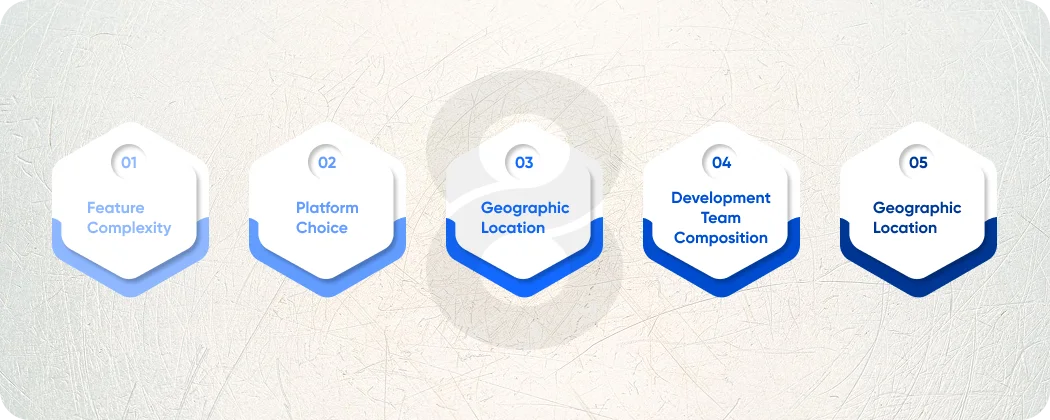
Knowing the aspects that affect the cost of MVP development is paramount to the executive intending to launch. These aspects are the complexity of features, platform selection, design specifications, staffing, and location.
1. Feature Complexity
One of the largest cost drivers is the size of your MVP features. A simple MVP may only have simple login features and content display, whereas a more elaborate MVP may incorporate AI-powered recommendations, real-time information, and sophisticated analytics.
| Feature Type | Complexity | Estimated Cost Impact |
| Basic | Login, registration, and content display | Low |
| Moderate | User profiles, notifications, and payments | Medium |
| Advanced | Real-time collaboration, AI, analytics dashboards | High |
2. Platform Choice
Platform is the second largest lever after feature count. Web only is the cheapest way to reach users. Building two native mobile apps roughly doubles the mobile portion of your budget, and cross-platform development sits between the two at a 30 to 40% saving over native for most consumer products.
| Platform | Pros | Cons | Cost Impact |
|---|---|---|---|
| Web Only | Single codebase, no app store review | Limited mobile reach, no push notifications on iOS web | Low |
| iOS or Android | Full native performance on one platform | You are guessing which half of your market to serve | Medium |
| Dual Native | Complete mobile coverage | Two codebases, two QA cycles, two release processes | High |
| Cross-Platform (Flutter, React Native) | Shared codebase, one team | Small performance gap on animation-heavy interfaces | Medium |
Pick the platform your riskiest assumption lives on. If you are testing whether people will pay for a service, a web app answers that. If the product only makes sense with a camera and location running in the background, mobile is not optional.
3. UX and UI Design Quality
Design usually takes 10 to 15% of an MVP budget, and it is the line item that decides whether the rest of your spend produces usable feedback. A confusing product returns data about your interface rather than your idea.
You do not need a bespoke design system at this stage. You need clear flows, a consistent component set and screens a stranger can use without a walkthrough. Template-led design keeps this near the bottom of the range. Original visual identity work, custom illustration or motion pushes it toward the top and beyond.
4. Development Team Composition
One of the most important aspects that determines the cost, timeline, and quality of the MVP is the composition of your development team. Various team arrangements present varying degrees of cost, control, and coordination as a result of their respective drawbacks:
| Team Type | Pros | Cons | Cost Impact |
| Freelancers | Low cost, flexible | Less coordinated, potential delays | Low |
| Agency | Professional, structured | Higher upfront cost | Medium |
| In-House | Full control, direct oversight | High overhead, long-term commitment | High |
| Hybrid | Balanced approach, scalability | Requires management and coordination | Medium |
5. AI Features and What They Add
Generative AI features add roughly 15 to 30% to a build budget. The model call itself is the cheap part. The cost sits in data preparation, evaluation harnesses, guardrails and the retry logic you need when the output is wrong in front of a customer.
A thin layer over a hosted model, meaning a chat interface with prompt engineering and no private data, adds around $8,000 to $20,000 to a mid-complexity MVP. Retrieval over your own documents, which means embedding pipelines, a vector store and relevance testing, runs $20,000 to $50,000. Fine-tuning on proprietary data or building agent workflows that take actions in other systems starts around $60,000 and has no useful ceiling.
Then there is inference cost, which is operating expenditure rather than build cost and gets left out of nearly every estimate. Token spend scales with usage, so a successful launch raises your monthly bill. Model it per active user before you launch, not after.
The same technology cuts the other way on delivery. Teams using AI coding assistants with proper review are removing 10 to 20% of engineering hours on routine work. That saving only materialises with code review discipline in place, and AI development work still needs a human accountable for what ships.
6. Geographic Location
Where your team sits changes the total more than almost any scope decision you will make. The same 1,000-hour build costs about $45,000 in Eastern Europe and about $120,000 in North America.
| Region | Blended Hourly Rate | Typical MVP Cost | Trade-off |
|---|---|---|---|
| North America | $100 – $200 | $80,000 – $150,000 | Fastest communication and deepest senior bench, at the highest rate on the market |
| Western Europe | $60 – $120 | $50,000 – $110,000 | Strong engineering standards, longer hiring lead times |
| Eastern Europe | $35 – $70 | $30,000 – $70,000 | Well-established outsourcing market, partial time zone overlap with the US |
| South Asia | $20 – $45 | $18,000 – $55,000 | Largest talent pool and lowest rates, needs more definition up front |
| Southeast Asia | $20 – $45 | $18,000 – $50,000 | Similar economics to South Asia, smaller senior pool |
| Latin America | $30 – $60 | $25,000 – $65,000 | Overlapping US working hours, quality varies more by firm than by country |
Rate alone is a poor selection criterion. A cheaper team that needs three rounds of clarification per feature can cost more in elapsed weeks than a team charging twice as much and shipping to a brief. Look at how a vendor handles ambiguity in your first scoping call, because that is the behaviour you are buying.
MVP Development Cost by Industry
Two products with identical feature counts can differ by $60,000 because of the rules they operate under. Compliance, integrations and trust mechanics are priced into the build long before anyone writes a feature.
| Product Type | Typical MVP Cost | What Pushes It Up |
|---|---|---|
| SaaS dashboard | $25,000 – $60,000 | Multi-tenant architecture, role permissions, subscription billing |
| Two-sided marketplace | $35,000 – $75,000 | Separate buyer and seller flows, payment escrow, reviews, dispute handling |
| Fintech app | $50,000 – $150,000 | PCI-DSS scope, KYC and AML checks, banking API integration, audit trails |
| Healthtech app | $60,000 – $160,000 | HIPAA infrastructure, encryption at rest, audit logging, business associate agreements |
| On-demand or delivery | $40,000 – $90,000 | Live tracking, a second app for drivers, dispatch logic, ongoing maps billing |
| AI-first product | $40,000 – $120,000 | Data preparation, evaluation, guardrails, inference cost at scale |
| Content or media app | $20,000 – $45,000 | CMS, subscription management, offline access, rights handling |
Regulated categories are the ones founders underestimate most. A fintech MVP carrying PCI-DSS obligations is not a consumer app with a payment screen bolted on, and a healthcare product handling patient data cannot defer its security work to version two. In both cases the compliance layer is scoped alongside the features, not after them.
If your product is a SaaS platform with no regulatory exposure, you have more room to move. Use it on validation rather than on features.
Tech Stack Requirements for MVP Development
One of the most important decisions to be made when managing the MVP development cost is the choice of the tech stack. Your stack sets how fast the team can build and how far the product can stretch before it needs rewriting. Choosing the appropriate tools will be a way of ensuring that your minimum viable product cost will be optimized to the extent that it will still be able to provide value to early users.
MVP does not necessitate the use of an enterprise-grade architecture. Rather, it should favour build speed and reliability over architectural ambition. The following is a list of the common layered tech stack that is used to develop MVPs:
1. Frontend Development
The interface is the component that your users see. An early response and feedback rely heavily on a clean and responsive interface.
Popular Frontend Technologies:
| Technology | Use Case | Cost Consideration |
| React.js | Web apps with interactive UI | Medium – fast development, reusable components |
| Angular | Large-scale web applications | Medium – slightly steeper learning curve |
| Vue.js | Lightweight web apps | Low – faster development, easy to maintain |
| Flutter | Cross-platform mobile apps (iOS & Android) | Medium – single codebase reduces MVP app cost |
| React Native | Cross-platform mobile apps | Medium – reusable code for both platforms |
2. Backend Development
The backend is used to perform business logic, database communication, authentication, and integrations. A scalable backend is needed for future development and after launch development.
| Technology | Use Case | Cost Impact |
| Node.js | Real-time applications, REST APIs | Medium – fast development, large ecosystem |
| Python (Django / Flask) | Data-driven apps, AI/ML integration | Medium – suitable for complex logic and prototypes |
| Ruby on Rails | Rapid web app development | Medium – speeds up development of MVPs |
| PHP (Laravel) | Simple web apps | Low – easy deployment, large hosting support |
| Java / Spring Boot | Enterprise-grade MVPs | High – robust but higher minimum viable product cost |
3. Database Layer
This database includes user information, content, and application logic. Scalability and speed require that the appropriate database be selected.
| Database | Use Case | Cost Impact |
| MySQL / PostgreSQL | Structured relational data | Low to Medium |
| MongoDB / Firebase | Flexible, NoSQL, ideal for dynamic MVPs | Low to Medium |
| SQLite | Lightweight MVP prototypes | Very Low |
| AWS RDS / Cloud SQL | Scalable managed databases | Medium – cloud hosting costs included |
4. Cloud Infrastructure & DevOps
Even a minimum viable product will demand hosting, deployment, and scaling. Reliability is guaranteed with light initial investments in the case of cloud infrastructure.
| Technology | Use Case | Cost Consideration |
| AWS / Azure / Google Cloud | Scalable cloud hosting | Medium – pay-as-you-go reduces the upfront MVP development cost |
| Docker / Kubernetes | Containerization and deployment | Medium – supports rapid scaling |
| CI/CD Tools (Jenkins, GitHub Actions) | Automated testing & deployment | Low to Medium – reduces bugs and cost to build an MVP |
MVP Development Cost Optimization Strategies
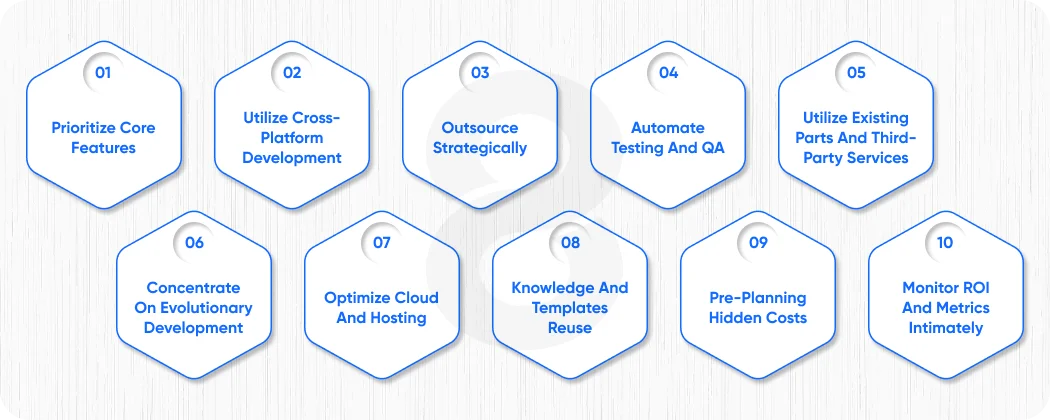
It is not only that a successful launch of MVP needs budgeting, but it also needs strategy, good technology decisions, and execution. Executives with knowledge on how to make the most of MVP development costs will be able to prove their business concepts in short durations and minimize financial risk. These are some of the actionable strategies in detail:
1. Prioritize Core Features
This is one of the best means of minimizing MVP app cost, as only those features that give maximum value to early users should be considered. Do not put all the nice-to-have features in the initial release.
- List 3-7 business essential functions that prove your business hypothesis.
- Adopt feature prioritization methods such as the MoSCoW method (Must-have, Should-have, Could-have, Won’t-have).
- Defer non-essential features to subsequent iterations or post-launch improvements.
By prioritizing the main features, the cost of developing an MVP is not very high, and the time-to-market is shorter.
2. Utilize Cross-Platform Development
The cost of developing an MVP may be doubled when native apps for both iOS and Android are built independently. Flutter and React Native are cross-platform frameworks that can run on either platform.
Benefits:
- Reduced development hours
- Platform consistency in user experience
- Less difficult to maintain and update
Impact: Cross-platform approach enables a decrease in the total cost of MVP by 20-40 percent and is therefore a perfect solution for start-ups and cost-conscious executives.
3. Outsource Strategically
One of the sure methods of minimizing the cost of a minimum viable product and still maintaining quality is combining an in-house strategy and offshore development teams.
- Keep core product vision, feature prioritisation and UX decisions in-house
- Outsource the backend development, QA testing, or cloud setup to trusted offshore teams
- Apply agile techniques to achieve close interaction and speedy iteration
Example: Eastern Europe or South Asia Development team could cut labor expenses by half or 70 percent of what it would cost in North America and still deliver high-quality results.
4. Automate Testing and QA
Quality assurance is where MVP budgets quietly bleed. Running every regression pass by hand costs more each sprint than the automation would have cost once, and the bill compounds as the feature count grows.
- Build automated regression coverage for the workflows that would embarrass you if they broke
- Run tests on every commit through a CI/CD pipeline so failures surface in hours rather than at release
- Automate the repetitive paths first, meaning login, payment and form submission
Automated software testing shortens release cycles and keeps post-launch bug fixes off your roadmap. It will not catch design problems, so keep a human pass on anything a user actually looks at.
5. Buy Instead of Building
Every module you buy is engineering time you do not pay for. Payments, authentication, notifications and analytics all have mature providers, and none of them are where your product wins.
- Use Stripe for payments, Auth0 or Firebase Auth for identity, Twilio for messaging, and a hosted analytics tool rather than a custom one
- Pull open-source component libraries for UI, charts and data tables
- Start on managed cloud infrastructure instead of provisioning servers
Read the pricing pages before you commit. Several of these tools are close to free at MVP volume and get expensive at exactly the point where you are growing, which is a conversation worth having in month one rather than month ten.
6. Ship in Iterations
Use an iterative and agile approach in developing the MVP. Start with basic functionality and develop, get feedback, and repeat.
- Minimizes wasted work on those features that are not desired by the users
- Avoids over-engineering and controls MVP app cost
- Enables quick adaptations to the trends and user behavior of the market
Scenario: User registration and posting can be the initial feature of a social networking MVP, followed by messaging, notifications, and analytics at subsequent iterations.
7. Optimize Cloud and Hosting
Minimum viable product cost can have a hidden cause in cloud infrastructure. To optimize:
- Begin with pay-as-you-go cloud services to minimize the initial expenses
- Use serverless where the workload fits (AWS Lambda, Firebase Functions) so you pay for actual requests instead of idle servers
- Track resource consumption to prevent sudden spikes in billing
Impact: The effective use of clouds will guarantee scalability without a significant increase in the cost of developing an MVP.
8. Reuse What You Already Have
In case there is previous experience or templates to be used by your team:
- Frontend and design acceleration, and use ready-made UX/UI elements
- Reuse backend modules to perform authentication, notification, or processing of data
- This cuts build time and gets you to a testable version sooner.
9. Budget for the Line Items Nobody Quotes
Agency quotes cover the build. They rarely cover the things that stand between a finished build and a live product, and those add up to real money.
| Item | Typical Cost | When It Hits |
|---|---|---|
| Apple Developer Program | $99 per year | Before your first iOS submission |
| Google Play Console | $25 one time | Before your first Android release |
| Terms of service and privacy policy | $500 – $3,000 | Before launch, and required by both app stores |
| Domain, SSL and email | $100 – $500 per year | Week one |
| Third-party API subscriptions | $50 – $2,000 per month | Scales with your usage, not your headcount |
| Cloud hosting | $100 – $1,500 per month | Rises the month you succeed |
| App store rejection cycles | 1 to 3 weeks of elapsed time | First submission, more often than founders expect |
Technical debt is the other invisible line. Shortcuts taken to hit a launch date are a loan against version two, and the interest is paid in rework. Some of that is a reasonable trade. Deciding which shortcuts you are consciously taking, and writing them down, is the difference between debt and a mess.
10. Track Return Before You Spend Again
Last but not least, never spend a dollar without considering the return on investment (ROI):
- Measures user engagements, retention, and feature adoption
- Determine what to expand upon actual usage data, and not an assumption
- This methodology will mean that expenditure to develop an MVP is translated into meaningful insights and not a waste of money
11. Consider Low-Code for the Validation Layer
Not every assumption needs custom code to test. If your riskiest question is whether people will pay, a low-code or no-code build can answer it for $3,000 to $15,000 and in two to five weeks.
The trade-off is real. Low-code platforms limit how far you can customise, charge per user as you grow, and become expensive to migrate away from once you have data and traffic on them. That is an acceptable price for finding out you were wrong. It is a bad foundation for a product you already know works.
The usual pattern is a low-code build to validate demand, then a custom rebuild once the answer is in. Founders who treat the first version as disposable make that transition cleanly. Founders who fall in love with it spend a year fighting the platform.
Post-Development Factors That Affect MVP Cost and Success
The introduction of MVP is not the end. Numerous startups and projects of enterprises do not anticipate the post-development expenses, which could greatly affect the MVP development cost, the cost to create an MVP, and the ROI in general. It is also important to plan post-launch activities correctly to make sure that your product will be operational, secure, and scalable, and will provide value to the first users.
These are the factors in post-development that executives must consider in detail:
1. Technical Support and Maintenance
Maintenance is a continuous post-launch process that ensures your MVP remains intact and functions according to specifications, as well as adapts to new conditions.
Key Maintenance Activities:
- Bug Fixes: An MVP that is tested properly can still have unpleasant surprises. The bugs may appear because of the differences between devices, their updates, or the behavior of the user.
- OS and Platform Updates: iOS and Android update regularly, and this may create compatibility issues. Ensuring the smooth running of the app with each release of the OS will provide the users with a smooth run.
- Performance Optimization: Backend servers can be optimized as user loads increase to ensure they can cope with the load.
Cost Implications:
Annual maintenance runs 15 to 25% of the original build cost. A $50,000 MVP therefore carries $7,500 to $12,500 a year in software maintenance before you add a single feature. Skipping it is a saving on paper only. Broken builds after an OS update produce refund requests and one-star reviews, and both are more expensive to fix than the patch would have been.
2. Collecting Feedback and Acting on It
An MVP is mostly a learning process, and feedback from feedbacks of users is fuel for product enhancement. When it has been launched, feedback should be collected and responded to systematically.
Activities to Budget For:
- Feedback Channels: via email surveys, in-app notifications, or outreach on social media.
- Analytics Review:Track engagement, retention and drop-off points using Google Analytics, Mixpanel or Firebase.
- Iterative Improvements: Develop UX/UI, add needed features, or eliminate those that are not performing well.
Scenario: An MVP of a fitness application indicates that customers leave the application after the initial workout because of poor navigation. User flow iteration can be effective at reducing churn, though there is an extra upfront investment necessary, usually 5-10 percent of the original MVP.
The executives should invest in constant iteration because failing to pay attention to feedback eliminates the point of creating an MVP.
3. User Acquisition and Marketing
Even a technically sound MVP will fail as long as people do not learn about it. Marketing is also a significant component of the cost of MVP development after development.
Critical Marketing Processes:
- Paid Campaigns: Get the initial support first. Google Ads, Facebook Ads, and LinkedIn Ads.
- Influencer Marketing: Join forces with the influencers of the industry to obtain both reputation and outreach.
- App Store Optimization (ASO): make the app stores aware of your presence.
- Email Campaigns and Retargeting: Early users are obtained, and churn is decreased.
- Price: The marketing for the MVP can vary from $2000 to $20000, depending on the target audience and size.
Hint: CAC (Customer Acquisition Cost) vs. LTV (Lifetime Value): this ratio should always be a priority, as it is the only way to ensure that marketing costs are justified.
4. Reporting, Monitoring, and Analytics
It is important to gather data after launching in order to know the performance of your MVP. Analytics are used to understand which attributes are engaging and discover where to improve.
Tools and Activities:
- User Behavior Tracking: Heatmap, recording of sessions, funnel analysis.
- Bug tracking/Crash tracking: For example, Crashlytics or Sentry will notify a developer about problems in real-time.
- KPI Dashboards: Monitor such metrics as daily active users (DAU), retention rates, and conversion rates.
- Cost Consideration: Analytics tooling runs $500 to $5,000 a year depending on volume. This should be viewed as an investment that can help in eliminating future development wastage by the executives.
5. Customer Service and Interaction
Post-launch support is essential for retention and to guarantee that the MVP gathers reasonable feedback.
Key Activities:
- Technical support, via email, chat, and call
- Efficient churn prevention through speedy fixes of technical problems
- Beta testing and interaction with users to get feedback on new features
Pricing: A small support team or the services of an outsourced support may cost between $1,000 and $5,000 per month, depending on the number of users.
Sample: In the case of a food delivery MVP, customers who have the problem of payment or order delays can be retained by immediate assistance.
6. Security and Compliance
Compliance is not a post-launch task for regulated products. It is a build cost that gets designed in from the first sprint, and the amount depends entirely on which regime you fall under.
| Requirement | Added Cost | What It Buys |
|---|---|---|
| Baseline security (unregulated) | $3,000 – $10,000 | Encryption in transit and at rest, secure authentication, dependency scanning |
| GDPR | $5,000 – $20,000 | Consent handling, data export and deletion, processing records, DPA reviews |
| PCI-DSS | $15,000 – $50,000 | Scope reduction through a payment provider, network segmentation, annual assessment |
| HIPAA | $20,000 – $80,000 | Audit logging, role-based access, encrypted storage, business associate agreements, documented policies |
| SOC 2 Type I | $20,000 – $60,000 | Control design, evidence collection, auditor fees, usually driven by enterprise buyers |
Two practical notes. Using Stripe or a similar provider keeps most card data out of your systems and cuts PCI scope dramatically, which is why almost no MVP should be storing card numbers. And SOC 2 is rarely worth starting before an enterprise customer asks for it, because the clock on your first audit period starts when you begin, not when you need it.
A breach at MVP stage does more damage than the compliance work costs. You lose the early users whose feedback the whole exercise depends on, and they are the hardest cohort to replace.
7. Scalability Planning
Even MVPs have to be ready to expand in case the initial validation is triumphant. Scalability planning is useful in lowering the cost of MVP apps in the future and avoiding downtime.
Key Considerations:
- Implement scalable cloud infrastructure (AWS, Azure, Google Cloud)
- Maximize backend code with multiple users
- Architecture of the plan database to support increasing data volumes
Cost Impact: Scalable architecture can be added at an initial investment of $1,000 -10,000, but it will save a lot of money in the case of rapid expansion.
8. Post-Launch Feature Work
After the MVP proves the idea correct, the executives usually invest in upgrades to ensure that it is more usable and used by more people.
Potential Enhancements:
- AI-driven recommendations or personalization
- Live chat and team collaboration features
- Payment, subscription or loyalty modules
- Multi-language support for international users
Cost: Costs can be between $5,000 and $50,000 and above, depending on complexity.
Rank these against post-launch usage data. Anything you cannot tie to observed behaviour can wait.
9. Post-Development Cost Summary Table
| Post-Development Factor | Cost Range (USD) | Key Notes |
| Maintenance & Bug Fixes | $7,500 – $12,500/year | Includes OS updates, performance optimization |
| User Feedback & Iteration | $2,000 – $10,000 | Iterative improvements based on real user data |
| Marketing & User Acquisition | $2,000 – $20,000 | Paid ads, influencer campaigns, ASO |
| Analytics & Monitoring | $500 – $5,000 | Tools for tracking user engagement and app health |
| Customer Support | $1,000 – $5,000/month | Email, chat, or call support for early users |
| Security & Compliance | $2,000 – $15,000 | Encryption, regulatory compliance, vulnerability management |
| Scalability Planning | $1,000 – $10,000 | Cloud setup, backend optimization |
| Feature Enhancements | $5,000 – $50,000+ | Optional features based on validated feedback |
Hiring an MVP Development Company
A typical agency engagement runs 8 to 20 weeks and costs $30,000 to $120,000, billed either as a fixed price against a locked scope or as a monthly rate for a dedicated team. What that buys is a product manager, a designer, two to four engineers and QA coverage, working to a feature list signed off before anyone opens an editor.
Fixed price suits founders who know exactly what they want and will not change it. You pay a premium for the certainty, because the agency prices in the risk of being wrong about the estimate. Time and materials suits products where the scope will move as you learn, which describes most honest MVPs. Ask for a capped estimate with a change process rather than an open-ended contract.
The question worth asking on a first call is not what it costs. It is how many hours the agency thinks the work takes and why. A vendor who answers that clearly has understood your product. One who quotes a price with no hour count behind it has priced a category, not your build.
At 8ration we scope MVPs the same way, whether the product is a marketplace, a regulated fintech tool or a custom software build for an existing business. The work is:
- Cutting the feature list down to what tests your riskiest assumption
- Building on a stack that will not need replacing if the idea works
- Keeping the post-launch budget intact so you can act on what you learn
If you want a number before you commit, bring us a rough feature list and we will come back with an hour estimate and a range you can take to a board.