



Every kickoff meeting for a new game ends up at the same question. The team has to decide which engine to use. Somewhere in that conversation someone says Unity, because almost everyone has heard of it and plenty of people in the room have already shipped on it.
That reputation is earned. The unity game engine sits under a huge slice of the games people actually open every day, especially on phones. Picking it for a business, though, is a different thing from a hobbyist downloading it on a Saturday.
You’re committing a budget, a team, and a multi quarter roadmap to a set of tradeoffs that look invisible in the demo reel and very real about eighteen months in.
This guide is written for the person who has to sign off on that decision. It covers what Unity is genuinely good at and what it really costs once you count the parts nobody quotes upfront. The rest shows where the engine sits in a real build and when you should quietly walk to a different one instead.
What the Unity Game Engine Actually Is (and Why Businesses Keep Picking It)
Strip away the marketing and Unity is three things bolted together. At the core sits a real time rendering engine. Around it runs a visual editor where designers and developers work side by side.
On top of both sits a wider ecosystem of asset store content, analytics, and monetization and multiplayer services. You write gameplay in C#, drag scenes together in the editor, and press a button to build for a long list of devices.
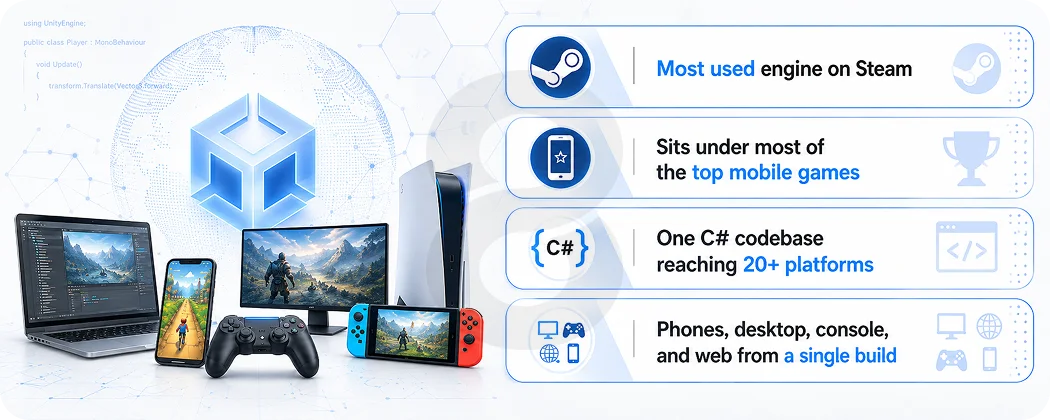
The reason it dominates business conversations is reach. In 2024, 51 percent of games backed by Unity released on Steam, and it sits under most of the top mobile games too.
That’s one engine sitting on most of the phones people actually carry, all from a single C# codebase that also reaches desktop and console. For a company trying to ship once and sell everywhere, the math is hard to argue with.
It scales down and up. A two person team can prototype a hypercasual loop in a week. On the other end, a larger studio shipped Hollow Knight: Silksong on it in 2025. That range is exactly why unity game development became shorthand for “the safe choice” inside a lot of product teams.
You can hire for it, you can find tutorials for it, and you can build a game that runs across platforms without rewriting it three times.
Safe choice doesn’t mean free choice, though. And it doesn’t mean right for every project. Both of those things are where the real decisions live.
Where Unity Fits in Real Game Development Pipeline
Most engine debates online are noise. What matters for a business is how the tool behaves across the whole build, not how a launch trailer looks. A commercial game moves through a handful of stages, and Unity shows up differently in each one.
Discovery and pre production
Before anyone writes a line of code, somebody has to figure out what the game even is and who it’s for. The other big question is whether it can make money. Unity has almost nothing to do with any of that, and that’s the point. This stage is about scope, target platform, and a rough budget. Picking the engine too early, before the design is stable, is one of the more common ways studios burn their first month.
Prototyping
This is where Unity earns its reputation. You can stand up a playable loop fast, test whether the core idea is fun, and throw it away if it isn’t. Quick iteration is the whole game at this point. A prototype or vertical slice usually takes six to ten weeks, and Unity’s editor is built for exactly that kind of messy, fast experimentation.
Production
This is the long middle of the project. It runs on art, audio, and the thousand small systems and fixes that turn a prototype into a product. Unity’s component setup lets designers and engineers work in parallel, which keeps a mid sized team moving. Technical debt also piles up here if nobody owns performance early, so the better teams set a performance budget before production rather than after.
Testing and launch
The final stretch is quality assurance, platform certification, and store submission. Unity builds for over 20 platforms, but each one has its own rules, and console certification in particular eats time people forget to plan for.
A Unity launch rewards the same discipline you put into shipping mobile apps. That means staged rollouts, crash monitoring, and testing on the devices players actually own.
A mobile MVP usually runs three to five months end to end. Cross platform or live service games can take six to twelve months or more. The delays almost never come from the engine. They come from scope changes and optimization that got pushed to the end.
Read More: What Are AAA Games? Breaking Down the Biggest Titles in Gaming
What It Actually Costs to Build With Unity

The license is the cheap part. Unity Personal is free until your game’s revenue or funding crosses $200,000, and a lot of indie and early stage projects never leave that tier. After that you move to paid seats, and the numbers below are where finance teams should start.
Plan |
Who it’s for |
Revenue or funding ceiling |
Price per seat, per year |
|---|---|---|---|
| Personal | Solo devs, small teams, learning | Under $200,000 | Free |
| Pro | Commercial teams, growing studios | $200,001 to $24,999,999 | $2,200 |
| Enterprise | Large studios, big budgets | $25,000,000 and above | Custom (rose 25% in 2025) |
The trap is reading that table and thinking the seat price is the cost. It isn’t, and not by a little. A working Unity team is salaries before anything else. You are paying engineers and artists, designers and QA.
After that come asset store purchases and third party plugins, then analytics and ad mediation. Add server costs for anything multiplayer and a live operations crew if the game keeps running after launch. The engine fee ends up the smallest line on the page.
Then there’s the part every Unity guide skips. In September 2023 Unity announced a Runtime Fee that would charge developers per install once a game passed certain thresholds. The community revolt was immediate, the CEO left, and by September 2024 the company had cancelled the fee entirely and gone back to seat based subscriptions.
That was the right call. But the whole saga is a reminder that your cost structure partly lives in someone else’s terms of service, and those terms can change. Read them before you commit a multi year project, and keep watching after.
Want a quick way to estimate a game build budget before you talk to anyone? That’s a better first step than guessing from a pricing page, because the engine line is the part that barely moves.
One more cost surprises finance teams. The bill doesn’t stop at launch. A game that keeps running needs servers, regular content updates, and a team to read the analytics and act on them. Plan the first year after release the same way you plan the build.
For a live title, that year is often where the larger share of the spend and the revenue actually sits. Studios that budget only to the launch date tend to ship a game they can’t afford to keep alive.
Unity vs Unreal and the Rest of the Field
People online will argue Unity versus Unreal all day, and most of that noise has nothing to do with running a business. The two barely go after the same projects anyway. They’re built for different kinds of games.
Factor |
Unity |
Unreal |
|---|---|---|
| Best fit | Mobile, 2D, mid budget 3D, cross platform | Photoreal AAA, high end console and PC |
| Language | C# | C++ and Blueprints |
| Learning curve | Gentler, easier to hire for | Steeper |
| Mobile performance | Strong, lightweight builds | Heavier, improving |
| Cost model | Seat based subscription | Royalty after a revenue threshold |
| Asset ecosystem | Very large | Large and growing |
For a phone game that needs to iterate fast and run on cheap hardware, Unity is almost always the right call. But when the whole pitch is photoreal visuals on a beefy console, Unreal usually wins, and the numbers bear that out. Unreal’s virtual production tools sit behind a majority of Hollywood blockbuster effects work, which tells you where its strengths point.
Godot deserves a mention too. It’s free and open source, and it takes no cut of your revenue. Smaller teams have been picking it up more and more. If you’re a tiny indie with zero budget, it’s the right option. A business that needs a deep talent pool, a mature asset store, and predictable support will still find Unity has the edge that matters.
The honest version: don’t pick an engine because of a forum argument. Pick it because of your platform, your team’s existing skills, and what the game actually has to do.
There’s also a hiring angle that gets ignored in these comparisons. C# developers are everywhere, and Unity talent is some of the easiest to find and onboard in the whole industry. Unreal’s C++ engineers cost more and take longer to recruit.
For a company that has to staff a team in a hurry, or replace someone who leaves mid project, that talent pool is a real and underrated reason the unity game engine keeps winning commercial bids.
Read More: Ideas for Game Development: How Businesses Can Enter the Gaming Market
Where Unity Projects Go Sideways for Businesses
The engine rarely fails a project. People and planning are what fail it. After enough builds, the same handful of mistakes show up repeatedly, and most of them have nothing to do with code.
Treating the demo as the timeline
A polished prototype lies to you. It runs at sixty frames, looks great, and feels nearly done. Then production starts, and the real work turns out to be ninety percent of the calendar. That work is edge cases, content volume, and endless optimization.
Teams that scope from the demo instead of the full build are the ones crunching three weeks before launch. The unity game engine makes the first ten percent feel easy, which is exactly the trap.
Ignoring performance until it’s a crisis
Mobile is an unforgiving platform. A build that flies on a developer’s high end test phone can crawl on the mid range Android device most of your players actually own. Performance is not a final polish step.
It’s a budget you set in pre production and defend the whole way through. The studios that skip this end up rewriting systems late, when changes cost the most.
Hiring for the engine instead of the genre
Knowing Unity is not the same as knowing how to ship a free to play mobile game, or a multiplayer title, or a live service economy. The genre carries most of the hard problems.
A team strong in unity game development but new to live operations will still struggle with retention, monetization, and the analytics loop that keeps a game alive past launch week.
Building alone when the budget says otherwise
Smaller companies often try to staff a full game team in house. Then they stall on the first specialist gap. It might be multiplayer netcode, a console port, or a backend that won’t scale.
Bringing in a partner for the parts your team hasn’t shipped before is usually cheaper than learning them on a live deadline. That’s the case for working with people who have already made these mistakes on someone else’s clock.
None of this is a knock on Unity. It’s a knock on treating any engine as a shortcut past the actual hard parts of making a game. Unity is a good tool. The discipline around it is what separates a launch from a write off.
AI, Live Operations, and Where Unity is Heading
Two shifts are reshaping unity game development right now, and both have budget implications.
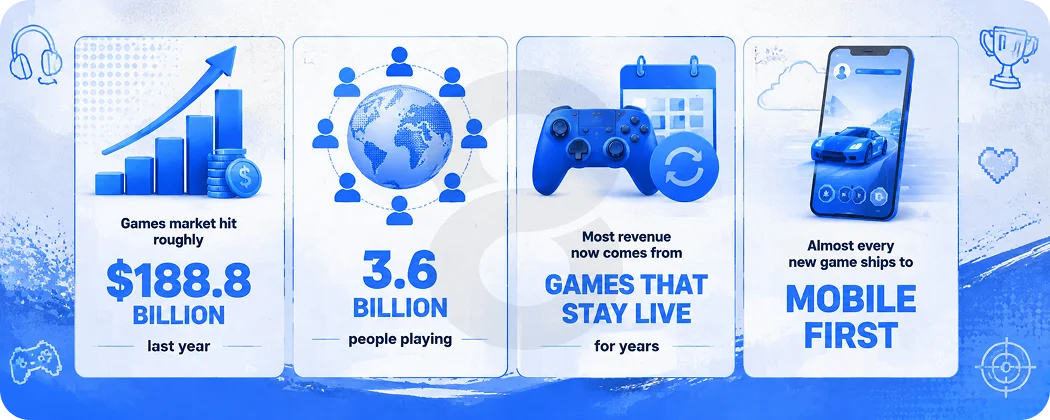
The market hit roughly $188.8 billion last year, with about four billion people playing. Most of that money now comes from games that stay live for years. They keep going on content drops, live events, and game economies that need constant attention.
And almost everyone ships to mobile first these days, where retention and steady updates decide whether a game makes money or quietly dies in its first week. Unity’s whole service stack leans into this, which is a big reason it stays sticky for commercial teams.
About 90% of developers launch their newest games on mobile first, where retention and live updates decide whether a title makes money or quietly dies in week one. Unity’s services lean hard into this, which is part of why it stays sticky for commercial teams.
The second is AI inside the toolchain. Unity 6 added AI assisted workflows for asset generation and repetitive editor tasks, and the company keeps extending platform support, with Unity 6.3 LTS backed through late 2027. None of this replaces a team. It shortens the boring parts of the loop so the team spends more time on the parts players actually feel.
Some teams build smarter systems into their games. Think dynamic difficulty, procedural content, and NPC behavior. That work overlaps heavily with the broader AI systems a product team might already be building elsewhere. The skills transfer, which makes Unity a sensible home for studios that want games and intelligence in the same stack.
Read More: How Long Does it Take to Make a Video Game
How 8ration Approaches Unity Game Development
Plenty of agencies will say yes to any engine and any genre. That eagerness is a red flag. The teams worth hiring are the ones who tell you when Unity is wrong for your project before they take your money.
8ration’s game team treats the engine as a means, not the point. The first conversation covers platform and audience, business model and budget. That’s the same discovery work that goes into any serious build.
Only after that does the Unity decision get made, because choosing the tool before the design is locked is how projects drift. From there it’s the usual path through prototyping and production, then QA and launch. What’s different is that performance and retention get baked in from day one, not bolted on in a panic the week before the deadline.
Games rarely live alone, so the same group also builds the custom software around them. That covers the backend and dashboards, the payment flows and the analytics that keep a launch from stalling on infrastructure nobody scoped. End to end, that view is the difference between a tech demo and a product that earns.
Unity is worth choosing only when it fits the game and the business behind it. When it does, the work behind it should hold up as a real product long after launch.