


Most conversations about the future of mobile sound impressive until you actually sit down and try to build something. Everyone talks about AI, personalization, automation, seamless experiences, and a bunch of other things that look good in a pitch but do not really explain what is changing inside real products.
Because if you look closely, nothing is “suddenly changing.” The shift has been happening slowly, and now it is just harder to ignore. Users expect more, tolerate less, and move on faster. That is the real story behind most mobile app development trends right now.
And if an agency is still building apps the same way they did even two or three years ago, the product might still work, but it will feel behind very quickly. That is usually where the problem starts.
The Real Shift Nobody Talks About Properly
The biggest change is not technical. It is behavioral. People do not open apps to “use features” anymore. They open apps to get something done quickly without thinking too much. That difference sounds small, but it completely changes how products should be built.
Because now:
- If something takes too long, it feels broken
- If something is unclear, it feels frustrating
- If something requires effort, it gets ignored
This is where mobile app development trends start making sense.
They are not about adding new layers. They are about removing friction that should not exist anymore.
At 8ration, this is handled by focusing on user behavior first and features second, which sounds obvious but is still something most teams get backwards.
AI Is Not a Trend Anymore, It Is Quietly Becoming the Backbone
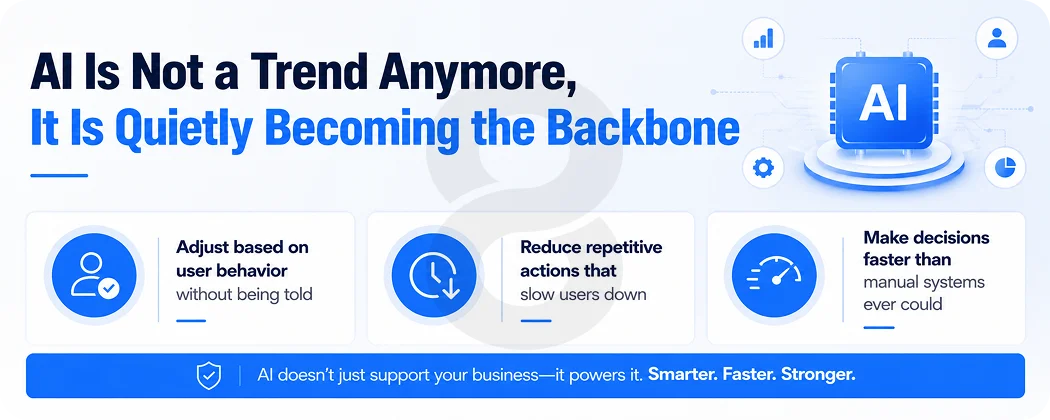
A lot of teams are still treating AI like a feature you add once the app is already built. That approach is already outdated. The more relevant approach now is building systems where intelligence is part of how things work from the start.
Through proper AI development, apps are now able to:
- Adjust based on user behavior without being told
- Reduce repetitive actions that slow users down
- Make decisions faster than manual systems ever could
And with structured AI integration, this is happening in the background without making the product feel complicated.
That is one of the most important mobile app development trends, but also one of the most misunderstood.
At 8ration, AI is not treated as an add-on. It is built into workflows early, which is why the product feels smoother instead of heavier.
Read More: Mobile App Designs for Inspiration: 7 Trends Redefining User Engagement in 2026
Performance Is Now a User Expectation, Not a Bonus
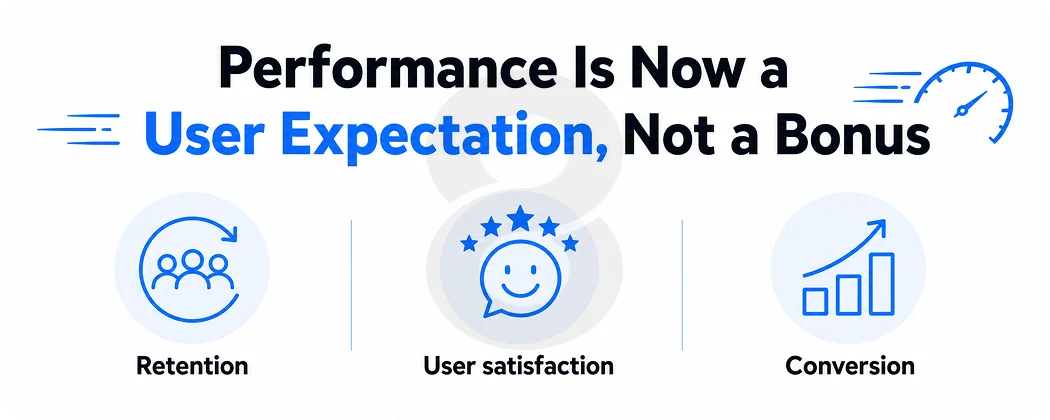
There was a time when performance improvements were considered optimization work. Now they are basic expectations. If an app loads slowly, lags, or behaves inconsistently, users do not wait around to see if it improves. They leave. This is why performance has become one of the most critical mobile app development trends, even though people do not always talk about it directly.
It connects directly to:
- Retention
- User satisfaction
- Conversion
And it is deeply tied to how well the software development side of the product is handled from the beginning. At 8ration, performance is treated as a design decision, not just a technical fix, which helps avoid problems before they even show up.
Apps Are No Longer Isolated Products
This is another shift that a lot of teams underestimate early. Apps do not exist on their own anymore.
They are part of a larger ecosystem that includes:
- Web platforms
- Internal systems
- Third-party tools
- Data layers
That means mobile app development cannot be handled in isolation. It needs to connect properly with everything around it.
If it does not, you start seeing:
- Data mismatches
- Slow workflows
- User confusion
This is why system-level thinking is becoming a key part of mobile app development trends.
Enterprise Apps Are Finally Catching Up to Reality
For a long time, enterprise apps were allowed to be slow, clunky, and difficult to use. That is not acceptable anymore. Because the same people using those apps are also using highly optimized consumer products every day. That expectation carries over. This is why enterprise app development is evolving so quickly.
Now the focus is shifting toward:
- Cleaner interfaces
- Faster workflows
- Lower learning curves
- Better usability
This is one of the more practical mobile app development trends, because it directly affects how efficiently businesses operate. At 8ration, enterprise products are treated with the same UX standards as consumer apps, which improves adoption without forcing extra training.
Read More: Top Custom Enterprise App Development Companies
Simplicity Is Becoming More Valuable and Harder to Achieve
This is where things get slightly uncomfortable for most teams. Because adding features is easy. Removing unnecessary complexity is harder. But that is exactly where the value is.
One of the most overlooked mobile app development trends is the shift toward simplification. Not minimal design. Actual simplification of how things work. Because if users have to think too much, the system is already doing something wrong.
What Is Actually Changing in Mobile Products
Area |
What Used to Matter |
What Matters Now |
| Features | More features | Relevant features |
| AI | Optional | Embedded |
| Performance | Technical metric | User expectation |
| UX | Nice to have | Critical |
| Systems | Separate | Connected |
Real-Time Is Replacing Delayed Systems
Users are no longer comfortable waiting for updates. They expect things to happen instantly. Whether it is data updates, notifications, or system responses, delays now feel like errors. This shift toward real-time systems is one of the fastest-moving mobile app development trends right now.
It affects:
- User trust
- Decision-making speed
- Operational efficiency
At 8ration, real-time architecture is built into backend systems early, which helps maintain consistency under real usage conditions.
Security Is No Longer Invisible
Security used to be something handled quietly in the background. Now users are more aware of it.
They expect:
- Clear permissions
- Data protection
- Secure interactions
This is why strong software development practices now include security as a core part of the product, not something added later. It is another example of how mobile app development trends are becoming more user-facing than before.
If Your App Still Feels “Fine,” That Is Already a Risk
A lot of businesses think their app is okay because it works. But “working” is no longer the benchmark. Users compare your app to the best experience they have had anywhere, not just in your category. That means the standard keeps moving whether you are ready or not.
If your product feels slow, disconnected, or slightly frustrating, that gap only grows over time. And that is exactly why understanding mobile app development trends matters. Not because trends are important. But because falling behind is expensive.
What This Means for Agencies
This is where things get very clear. Agencies that just follow trends will always be slightly behind. Agencies that understand why trends exist will build better products. The difference is in how decisions are made.
At 8ration, trends are filtered through product thinking before implementation, which helps avoid building things that look modern but do not actually improve the product.
Final Thoughts
The future of mobile is not about adding more layers. It is about making things feel simpler, faster, and more natural. That is what most mobile app development trends are actually pointing toward when you remove the noise. Better flow, less friction, more intuitive systems. And the teams that understand that are not chasing trends. They are building products that stay relevant longer. Because in the end, users do not care about trends. They care about whether the app makes their life easier or not.