We expect groceries in 30 minutes, rides in 5 minutes, and plumbers in 2 hours. And it has led to on-demand app development being one of the most intense and competitive markets in our business. Now, whether you’re an entrepreneur trying to disrupt an industry or an existing business trying to go digital, building an on-demand app is no longer a choice; it’s a necessity.
In this article, we’ll provide a comprehensive overview of the market, key features, technology, app development process, costs, and how to select the right on-demand app development company to bring your idea to life.
What Is an On-Demand App?
A service that operates through an on-demand application delivers immediate service access to customers while eliminating the need for intermediaries. The companies Uber, DoorDash, TaskRabbit, and Amazon operate their businesses by providing instant access to available resources to meet customers’ needs. The business model of this organization functions across multiple sectors, which include food delivery services, healthcare, beauty and transportation and domestic assistance and additional fields.
The operational system of on-demand applications functions as a three-sided market, which includes three essential components: a customer base that connects with service providers through an administrative system, which enables and monitors their interactions while generating revenue. The key challenge requires organizations to develop methods that enable customers to complete their purchases without encountering any delays throughout the entire process.
Read More: The Complete Guide to White Label App Development for Agencies
Why the On-Demand Economy Is Booming
The statistics speak for themselves. The on-demand economy worldwide is expected to reach more than $335 billion by 2025, driven by the adoption of smartphones and high-speed mobile networks and the post-pandemic, digital-first world that has embraced the convenience of on-demand services.
For entrepreneurs, the on-demand model is a capital-light way to grow. You don’t stock products or hire service staff; you lay the tracks. For established firms, it’s about protecting market share and revenue against agile startups and tapping new sources of revenue without having to reinvent the wheel.
COVID-19 sped up adoption. Brick-and-mortar businesses that traditionally shunned digitalization, doctors’ appointments, lawyers, home workouts, and mindfulness now represent the fastest-growing on-demand market segments. Companies that engaged on-demand app development services at the time not only survived, but they also gained market share that is here to stay.
Types of On-Demand Apps
On-demand platforms are not one-size-fits-all. The architecture, compliance requirements, and core user flows differ sharply across categories. Understanding which type of on-demand app you are building determines your feature roadmap, your tech stack, and your go-to-market timeline.
Food and Grocery Delivery Apps
Food and grocery delivery platforms need real-time order tracking, dynamic routing for delivery partners, and inventory sync with merchants. The margin for error is low, a failed payment or late ETA update causes churn immediately. Kitchen and warehouse integrations are non-negotiable at scale.
Ride-Hailing and Transportation Apps
Ride-hailing apps live and die by surge pricing logic, driver-rider matching algorithms, and GPS precision. Building in this category also means navigating insurance requirements, local transport regulations, and payment compliance across geographies, all before a single user completes a booking.
Home Services and On-Demand Workforce Apps
Platforms connecting users with plumbers, cleaners, or electricians need robust provider vetting flows, geofenced availability, and a scheduling engine that handles rescheduling and cancellations gracefully. Trust signals, background check badges, and verified reviews directly affect booking conversion rates on these platforms.
Healthcare and Telemedicine Apps
On-demand healthcare apps carry the heaviest compliance burden of any category. HIPAA in the US, GDPR in Europe, and regional equivalents must be baked into the architecture from day one, not retrofitted. Video consultation quality, prescription management, and secure record storage are the technical pillars.
Logistics and Fleet Management Apps
On-demand logistics platforms require dispatcher dashboards, driver apps, and customer-facing tracking, three separate user experiences running off a single backend. Real-time ETAs, proof-of-delivery capture, and route optimization integrations like Google Maps Platform or HERE are core requirements, not optional add-ons.
Comparison Table:
| App Type | Core User Roles | Key Technical Challenge | Regulatory Burden | Avg. MVP Timeline |
|---|---|---|---|---|
| Food & Grocery Delivery | Customer, Restaurant, Driver | Real-time order routing | Low–Medium | 12–16 weeks |
| Ride-Hailing | Rider, Driver, Admin | Matching algorithm + surge pricing | High (transport licensing) | 16–22 weeks |
| Home Services | Customer, Provider, Admin | Scheduling + provider vetting | Low | 10–14 weeks |
| Healthcare / Telemedicine | Patient, Doctor, Admin | HIPAA/GDPR compliance | Very High | 20–30 weeks |
| Logistics & Fleet | Dispatcher, Driver, Customer | Multi-role backend + route optimization | Medium | 16–24 weeks |
Core Features Every On-Demand App Needs
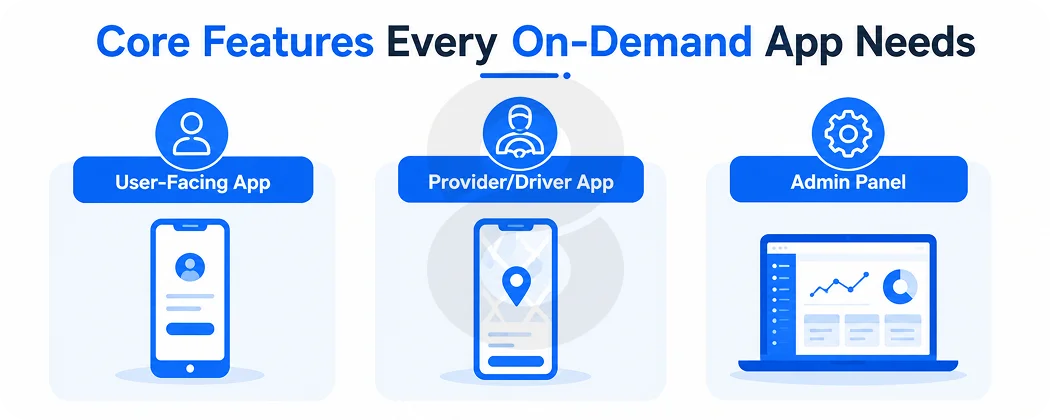
Across verticals, on-demand apps have similar feature sets. Your on-demand app developers will build around these pillars:
User-Facing App
- Easy user registration with social logins or OTPs
- Intelligent search and filter with availability indicator
- Real-time order/service tracking with maps
- Payments: credit cards, wallets, UPI, and BNPL
- In-app chat and push notifications
- Ratings, reviews and dispute resolution
Provider/Driver App
- Sign-up, document upload and approval
- Turn-on button and order acceptance
- Turn-by-turn navigation integration
- Payments dashboard and payout withdrawals
- In-app communication with customers
Admin Panel
- Real-time operations dashboard
- User and provider management
- Dynamic pricing and surge controls
- Analytics: retention, conversion, fulfillment rates
- Coupons, vouchers, and referral management
- Commission and payout configuration
These are not just conveniences; they are the baseline expectation of the marketplace as it stands now with companies like Uber Eats and Instacart. Start below this and you’ll have poor retention.
Read More: How Much Does It Cost to Build an On-Demand App in 2026?
Tech Stack for Developing Your On-Demand App
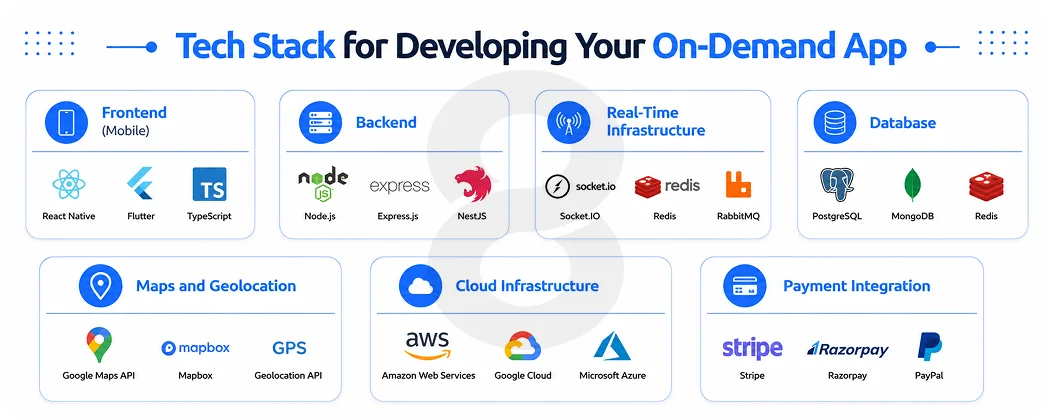
The tech stack is often a critical choice that impacts your time-to-market, scalability, and ongoing support. Here’s what experienced on-demand app developers recommend:
Frontend (Mobile)
Cross-platform development is dominated by React Native and Flutter, as they allow code sharing between iOS and Android, thus faster and cheaper development. For enterprise-level performance, Swift (iOS) and Kotlin (Android) are still the best.
Backend
Node.js is the go-to for on-demand backends due to its asynchronous, non-blocking nature, perfect for real-time connections to thousands of users. Python (Django/FastAPI) is suitable for data-intensive platforms with lots of ML. Go is also being used for microservices.
Real-Time Infrastructure
Firebase or Socket. IO or Firebase for real-time location data, order updates, and chat. This is the heart and soul of most on-demand apps. Delays in location data kill user confidence.
Database
PostgreSQL or MySQL for transactions. MongoDB for unstructured documents. Redis for caching common data, such as nearby providers or surge prices.
Maps and Geolocation
The Google Maps Platform is the best for geocoding, route planning, and distance matrix calculations. HERE Maps and Mapbox are affordable alternatives at scale.
Cloud Infrastructure
On-demand platforms can be easily supported by AWS, Google Cloud Platform, and Azure. Container-based orchestration via Kubernetes allows backends to automatically scale for demand spikes, essential for food delivery apps at lunchtime or during festivals.
Payment Integration
Stripe, Braintree, and Razorpay (South Asia) have excellent SDKs for payment cards, wallets, and service provider splits.
Read More: Mobile App Development Process – From Idea to Launch
How On-Demand App Development Works
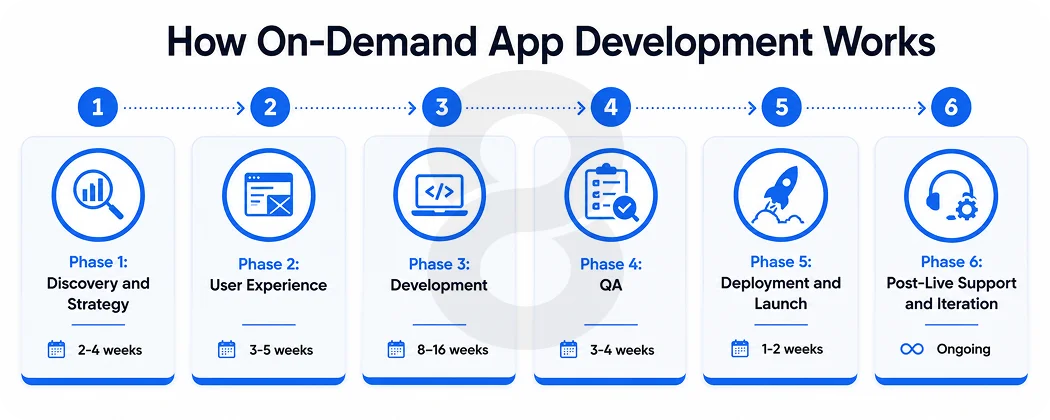
The development process is difficult to help you understand what to expect and how to manage your development partner.
Phase 1: Discovery and Strategy (2-4 weeks)
This phase clarifies the problem, assesses the competitive environment, pinpoints your competitive advantage, and details the functional requirements. An on-demand app development company will spend a lot of time here; rushing discovery will only lead to costly fixes.
Phase 2: User Experience (3-5 weeks)
Wireframes, user flows, and prototypes are created. The objective: to test the experience before committing a line of production code. Testing with users at this stage is cheap; testing with users after the product is launched is supremely expensive.
Phase 3: Development (8–16 weeks)
Software is typically developed in two-week agile sprints with a review of the software at the end of each sprint. The three apps (consumer, provider, admin) are developed in parallel if the development team is large enough. Maps, payments, and notifications are connected via API during development.
Phase 4: QA (3-4 weeks)
Functional, stress, security, device, and operating system compatibility. This is a phase that’s often cut short by budget-conscious clients and regretted later.
Phase 5: Deployment and Launch (1-2 weeks)
App submission to Apple’s App Store and Google Play, deployment of the back-end software, monitoring and analytics, and incremental rollout to a limited audience.
Phase 6: Post-Live Support and Iteration
The leading on-demand app development service companies also provide an after-launch support phase (30-90 days) for bug fixing, performance optimization, and feature enhancements to the first version based on user feedback.
Read More: 9 Steps for Startups to Hire the Right App Development Agency
On-Demand App Development Cost: What to Expect
On-demand app development costs are driven by feature count, number of user roles, third-party integrations, and your choice of platform. The ranges below reflect real project scopes, not estimates pulled from thin air, across three complexity tiers.
Basic On-Demand App
A basic on-demand app covers a single service category, two user roles (customer and provider), in-app payments, push notifications, and a simple admin panel. It is built for speed to market, not feature depth. MVP launches in this range are common for home services and freelance platforms where the core flow is straightforward.
Medium Complexity App
Mid-tier builds add real-time GPS tracking, multi-tier service categories, review and rating systems, dynamic pricing logic, and a richer admin dashboard with analytics. This is the range where most funded startups operate at launch. Food delivery and ride-hailing MVPs almost always fall here due to routing and matching requirements.
Enterprise-Level On-Demand Platform
Enterprise builds involve multiple geographies, multi-language support, white-label provider apps, advanced dispatch systems, AI-driven recommendations, and full compliance architecture for regulated industries like healthcare or financial services. These projects are multi-phase engagements, not single-sprint deliverables.
Cost Comparison Table
| Tier | Estimated Cost | Timeline | User Roles | Key Features |
|---|---|---|---|---|
| Basic MVP | $15,000 – $40,000 | 10–16 weeks | 2 (Customer + Provider) | Booking, payment, push notifications, basic admin |
| Medium Complexity | $40,000 – $100,000 | 16–28 weeks | 3 (Customer, Provider, Admin) | Real-time tracking, dynamic pricing, ratings, analytics |
| Enterprise Platform | $100,000 – $300,000+ | 6–12 months | 4+ (multi-role, multi-market) | AI features, compliance architecture, white-label apps |
| Annual Maintenance | 15–25% of build cost | Ongoing | — | Bug fixes, OS updates, security patches, feature additions |
How to Choose an On-Demand App Development Company
The right development team is more critical than a feature backlog. You will spend more money on rewriting and lost productivity with a poor codebase than you saved in the first place. How to choose:
- Breadth over depth: Ask for work in on-demand or marketplace. A shop that has developed five on-demand products knows the ins and outs of real-time synchronization, provider payouts, and surge pricing that the generalist will be learning on the job (on your money).
- Ask about post-launch behavior: Post-go-live behavior is indicative of a team. Ask for references and specifically about the experience of support, not just the development.
- Evaluate communication infrastructure: Overlapping time zones, project management software (Jira, Linear, and Notion), and the pace of demos and meetings are signals of success. No news is bad news.
- Evaluate ownership and IP rights: Your agreement should transfer all IP, code, design assets, and database schemas to you when you pay for them. Don’t go with a vendor that retains any ownership.
- Look for full-stack capability: Top on-demand app development services firms handle everything: product strategy, UX, mobile and server-side engineering, QA, DevOps, and post-launch support. Silos lead to siloed apps.
Industry reports predict the mobile app development market will reach $38.55 billion by 2032, with increasing demand for scalable on-demand applications across healthcare, delivery, logistics, and fintech sectors.
Red Flags To Watch Before On-Demad App Development
Even experienced buyers get burned. Here are warning signs that should give you pause before signing any contract:
Unusually Low Quotes
If an agency quotes you $10,000 for a full on-demand platform, they are either planning to cut corners on architecture, outsourcing without transparency, or will come back with change orders that exceed a realistic budget anyway.
No Discovery Phase
Any company that jumps straight to development without spending time understanding your business model, competitive landscape, and user needs is optimizing for billing hours, not your success.
Vague Tech Recommendations
If a team can’t clearly explain why they’re recommending React Native over Flutter or Node.js over Python for your specific use case, that’s a sign they’re working from habit rather than expertise.
No QA Team
Some shops rely on developers to test their own code. This is a false economy. Independent QA catches issues that familiarity blinds developers to, and in on-demand apps, a broken checkout or a missed push notification can cost you real revenue.
Cookie-Cutter Contracts
Every on-demand app is different. If the contract doesn’t reflect your specific deliverables, milestone structure, and IP transfer terms, walk away.
Read More: The Real Cost of App Maintenance – What Budget Percentage Should You Allocate?
Scaling Your On-Demand App After Launch
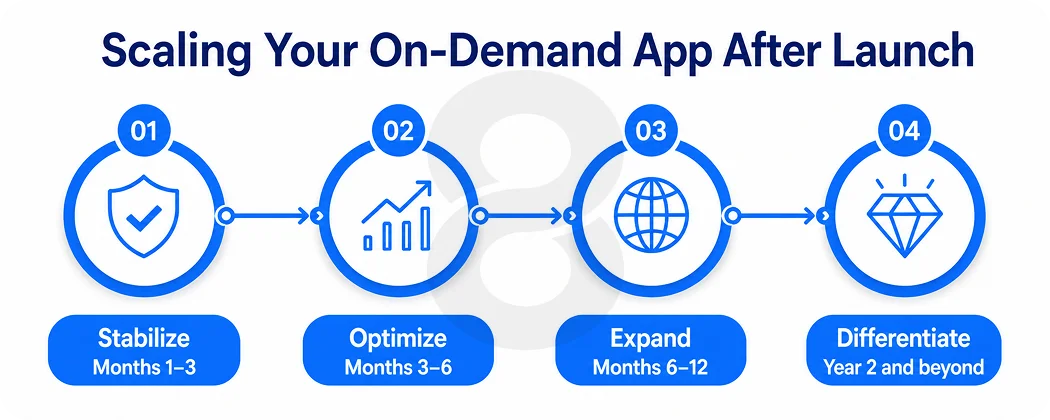
Getting to launch is only half the battle. The companies that win in the on-demand economy are the ones that iterate faster than their competitors. Here’s what the post-launch roadmap typically looks like:
- Stabilize Months 1–3: Focus on performance monitoring, crash rates, and user drop-off points. Use tools like Mixpanel, Amplitude, or Firebase Analytics to understand where users are leaving the funnel.
- Optimize Months 3–6: Improve onboarding flows, reduce friction in checkout, and fine-tune your matching or dispatch algorithm based on real-world data. This is where small UX changes drive outsized improvements in retention.
- Expand Months 6–12: Introduce new service categories, launch in additional cities, or add a subscription or loyalty tier. Expansion is much cheaper on a solid technical foundation than on a hastily built MVP that wasn’t designed to scale.
- Differentiate Year 2 and beyond: This is when AI and machine learning start paying dividends in demand forecasting, personalized recommendations, dynamic pricing, and predictive ETAs. These capabilities separate category leaders from also-rans.
The platforms that make this journey successful share one thing in common: they treated development as an ongoing investment, not a one-time project.
Read More: Mobile App Development Timeline: 2026 Guide
Ready to Build Your On-Demand App?
Whether you’re validating an early-stage idea or modernizing an enterprise operation, choosing the right on-demand app development company is the most consequential decision you’ll make. The right team brings not just engineering skills, but hard-won knowledge of what separates on-demand apps that scale from those that stall.
Start with a clear brief, ask the right questions during vendor selection, protect your IP from day one, and treat your launch as the beginning of the product journey, not the end.
The on-demand economy isn’t slowing down. The only question is whether your app will be part of it.