


Three browser tabs deep into vendor research, here’s the question that actually matters by hour two. Which of these healthcare software development companies is going to ship something patients actually use, and which one disappears after the discovery call.
The healthcare IT market was valued at $354.04 billion in 2025, and Fortune Business Insights projects it will climb past $1.38 trillion by 2034 at a yearly growth rate north of 16%. That kind of money pulls in a lot of vendors claiming healthcare expertise they don’t actually have.
Some of them have. Most of them haven’t. The list below leans on Clutch’s verified reviews, because a testimonial pulled from a vendor’s own homepage proves nothing, while a review tied to a real client and a real project at least gives a starting point.
How These Healthcare Software Development Companies Got Picked
Ranking healthcare software development companies is messier than it looks from the outside, and any article pretending otherwise is lying to you. Nobody called all fifteen companies on this page and ran a structured interview. That is not how lists like this get made, full stop.
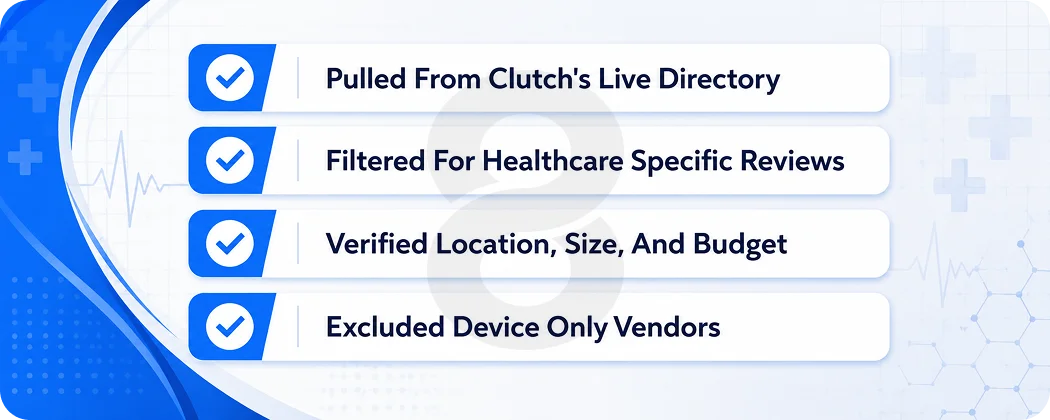
What actually happened is a pull from Clutch’s live healthcare industry directory, cross checked against the reviews each company has earned specifically on healthcare software projects rather than its overall average.
A 4.9 rating built on retail apps and restaurant booking tools tells you very little about whether a vendor can handle a medical device integration or a HIPAA audit. So the filter here favored companies with documented healthcare client work.
That filtering step matters more than it sounds. Plenty of generalist software agencies list healthcare as one of a dozen industries on their homepage, then their actual review history shows zero healthcare software projects… just a stock photo of a stethoscope.
Clutch makes that easy to check, because each profile breaks down review counts by service and lets you read the project highlights tied to specific industries. Anyone shortlisting vendors for a medical build should be doing that same check before a single discovery call gets booked, not after a contract is already signed.
Location, team size, and starting budget got pulled directly from each company’s Clutch profile, current as of this writing. None of it is guesswork, and none of it is paid placement.
A few names that show up constantly on other versions of this list, mostly large medtech vendors like Philips Healthcare or GE Healthcare, got left out on purpose. They sell devices with software attached, not custom development services, which is a different conversation entirely.
Top Healthcare Software Development Companies on Clutch Right Now
Ten companies made the cut here. The bar was rating, review depth, and actual healthcare software project work on file instead of just a services page with the word healthcare slapped on it somewhere.
A few more names that keep showing up on similar rankings get a quick mention near the end, without the full writeup, because no single list, this one included, covers the whole field.
 8ration
The team runs healthcare software development work out of its New York office alongside a wider practice spanning eCommerce, fintech, and AI development. In healthcare specifically, 8ration focuses on wellness apps, cardiovascular tracking, and pharma-sponsored patient support platforms rather than just EHR plumbing. Offices across North America and Middle East give the team coverage that most agencies cannot match.
8ration’s strengths include:
- Telemedicine apps, mobile EHR access, and healthcare CRM systems built with HIPAA and HL7 compliance from the architecture stage
- An engineering model that works as an extension of in house product teams rather than a black box vendor
- Compliance treated as a design constraint from week one rather than a fix bolted on before an audit
- A support model that stays involved after launch instead of handing off and disappearing
- Integration work built to hold up over time rather than break with the next system update
Notable Work: Matrix Health and Wellness, a goal tracking app built around motivational design. Cardiac Fitness, a heart health tracker built on five clinical protocols. Cinnamon, a pharma backed patient navigation platform.
Ideal For: Organizations that need a real engineering partner without an enterprise vendor’s six month procurement cycle.
Founded: Operating since 2014, officially incorporated in 2024
Location: New York, NY
Employees: 50 to 249
Pricing: $25,000+ minimum project, $100 to $149 per hour
Rating: ⭐⭐⭐⭐⭐ 4.9/5 (14 reviews)
 Goji Labs
The agency backs up its 5.0 rating with full stack work across 17 industries, healthcare being one of them. The Los Angeles team builds custom software, mobile apps, and UX design under one roof and reviewers consistently describe the relationship as a product partnership rather than a vendor arrangement. Clients also note a 4.8 out of 5.0 rating for cost, with several saying the quality justified paying more than the cheapest quote on the table.
Goji Labs stands out for:
- A services mix weighted toward custom software development, roughly 40% of total work, with mobile, UX, and AI filling the rest
- Documented client work in education, automotive, and financial services, beyond the healthcare experience named in its industry list
- A project highlight on Clutch involving custom software built for a tree removal company, an example of the range of industries served outside healthcare
Notable Work: Per the company’s own case studies. HealthPod, a care coordination platform built for Federally Qualified Health Centers. CompleteOR, an indoor location tracking system for surgical equipment in hospitals. MedsPal, a global medicine data platform supporting public health decisions in low and middle income countries.
Ideal For: Brands that want a close, hands on partner instead of a large offshore team
Founded: 2014
Location: Los Angeles, CA
Employees: 50 to 249
Pricing: $25,000+ minimum project, $100 to $149 per hour
Rating: ⭐⭐⭐⭐⭐ 5/5 (84 reviews)
 Saitasa
The company built its reputation on catching risk early, something that matters more in healthcare than almost anywhere else. The Newport Beach, California team pairs custom software development with a notably strong AR and VR practice, useful for patient education or surgical training builds.
What makes Saritasa worth a look:
- A services mix split roughly 40% custom software and 30% AR and VR work, with AI, mobile, and web development filling the rest
- A documented integration project for a shopping cart manufacturer, connecting work order, fleet tracking, and payroll systems into one platform
- Average custom software project costs in the $200,000 to $999,000 range, among the higher end of this list
Notable Work: A documented mobile app build for a healthcare medical device company, where the client specifically praised Saritasa for flagging and mitigating risk before it became a problem.
Ideal For: Medical device or hardware adjacent teams that need software paired with hands on risk management
Founded: 2005
Location: Newport Beach, CA
Employees: 50 to 249
Pricing: $50,000+ minimum project, $100 to $149 per hour
Rating: ⭐⭐⭐⭐⭐ 4.8/5 (103 reviews)
 Simform
Simform has built and supported a mobile app for a medical device company’s research and development department, the kind of multi year engagement that says more than a single review score. The company sits toward the affordable end of this list without giving up the cloud and AI capacity that healthcare systems increasingly need.
Simform’s strengths include:
- A broad services mix spanning cloud consulting, AI, CRM, ecommerce, and ERP work, not just custom software
- Healthcare and fitness named specifically among 15 industries served
- Strong reviews on enterprise app modernization and ERP consulting work
- Average custom software project costs in the $50,000 to $199,000 range
Notable Work: A mobile app built for a medical device company’s iOS and Android platforms, plus ongoing software development support for that client’s R&D team.
Ideal For: Teams that want enterprise scale capacity without enterprise pricing
Founded: 2010
Location: Orlando, FL
Employees: 1,000 to 9,999
Pricing: $25,000+ minimum project, $25 to $49 per hour
Rating: ⭐⭐⭐⭐⭐ 4.8/5 (84 reviews)
 Vention
It spent most of its history as iTechArt Group before rebranding and covers five time zones with engineers fluent in English and German, solving a real scheduling problem for healthcare clients running operations across the US and Europe. The team has completed projects in 15 countries, with most of its work concentrated in the US and UK.
Vention brings:
- A highly diversified services mix, with ten different service lines each making up roughly 10% of total work
- Average custom software project costs in the $50,000 to $199,000 range
- Healthcare named among 14 industries with a proven track record
Notable Work: Per the company’s own portfolio, not Clutch. Dialogue, a Canadian telemedicine startup Vention helped grow into the country’s largest virtual healthcare provider, including engineering work that supported its SOC 2 certification. Thirty Madison, a chronic care company, got a web app connecting patients with physicians for FDA approved treatment plans. Healthera, a UK startup, got a prescription management app.
Ideal For: Distributed healthcare organizations that need round the clock engineering coverage
Founded: 2002 as iTechArt Group, later rebranded to Vention
Location: New York, NY
Employees: 1,000 to 9,999
Pricing: $50,000+ minimum project, $50 to $99 per hour
Rating: ⭐⭐⭐⭐⭐ 4.9/5 (99 reviews)
 Apriorit
This agency built its name on the unglamorous, technical side of software, cybersecurity, IoT, and AI work that touches some of the trickiest parts of healthcare infrastructure. The Poznań, Poland team is fluent in English and Ukrainian and works across 10 time zones, which shows up in reviews praising their responsiveness despite an 8 to 9 hour gap with US clients. Healthcare sits among 12 industries served, alongside IT services and financial services.
Apriorit is built around:
- A habit of questioning requirements instead of building exactly what was asked for, even when the spec doesn’t make sense
- Deep cybersecurity and IoT expertise that pairs naturally with connected medical devices
- A services mix split across custom software, cybersecurity, IoT, and a growing generative AI practice
- Project costs that cluster at both ends, smaller engagements between $10,000 and $49,000 and larger builds between $200,000 and $999,000
Notable Work: Reviewers highlight Apriorit’s proactive engagement on a legacy app modernization project for a tech company, alongside AI solutions specifically praised by healthcare clients.
Ideal For: Healthcare teams with complex, security sensitive technical requirements
Founded: 2002
Location: Poznań, Poland
Employees: 250 to 999
Pricing: $25,000+ minimum project, $100 to $149 per hour
Rating: ⭐⭐⭐⭐⭐ 4.9/5 (43 reviews)
 Sidebench
Sidebench runs an entire healthcare focused side of its business, with a dedicated site of its own for that work. The Los Angeles team has built a teledermatology platform, designed UX research for a behavioral health company, and handled compliance heavy Salesforce work for a cannabis distributor.
Sidebench brings:
- A services mix evenly split across custom software, AI, CRM, and mobile work, each about 20% of total projects
- A dedicated wearable app development practice, a smaller but specific slice of total work
- Compliance heavy Salesforce implementation work for a cannabis distributor, showing range beyond pure healthcare
Notable Work: BrilliSkin, a teledermatology platform Sidebench helped design and develop. nOCD, a personalized treatment app for obsessive compulsive disorder, per the company’s own site. Plus UX research for a behavioral health company and frontend platform work for a family services provider.
Ideal For: Health and wellness startups that need product strategy alongside development
Founded: 2012
Location: Los Angeles, CA
Employees: 50 to 249
Pricing: $50,000+ minimum project, $50 to $99 per hour
Rating: ⭐⭐⭐⭐⭐ 4.9/5 (48 reviews)
 Jelvix
Jelvix built a unified orchestration layer for a healthcare client that pulled fragmented data streams into one system, built around FHIR standards from day one rather than retrofitted later. The Tallinn, Estonia team puts roughly 70% of its work under custom software development, and the 19 reviews tied to that service line carry a perfect 5 star average.
Jelvix’s edge comes from:
- A services mix that also includes AI, cloud consulting, and mobile development alongside its core custom software work
- An Estonian base that puts the team within a few working hours of both European and US business days
Notable Work: A unified orchestration layer built for a healthcare company, integrating fragmented data streams into one FHIR compliant system.
Ideal For: Healthcare organizations untangling fragmented data across multiple systems
Founded: 2011
Location: Tallinn, Estonia
Employees: 250 to 999
Pricing: $50,000+ minimum project, $50 to $99 per hour
Rating: ⭐⭐⭐⭐⭐ 4.9/5 (41 reviews)
 BGO Software — The Digital Health Lab
BGO Software rebranded part of its practice as The Digital Health Lab, which tells you exactly where its attention sits. The Sofia, Bulgaria team holds ISO 13485 certification, a standard specifically tied to medical device quality management, and lists NHS UK, Roche, and LabCorp among its past healthcare and pharma clients on its own site.
BGO Software’s strengths include:
- ISO 13485 certification, a quality management standard specifically tied to medical device manufacturing
- Deep experience across clinical trials, research platforms, and pharmaceutical manufacturing software
- Past work with NHS UK, Roche, LabCorp, and IQVIA, per the company’s own client list
- A second office in London alongside its Sofia, Bulgaria headquarters
Notable Work: A software platform built for a medical device company, handling sensor data capture and real time processing.
Ideal For: Healthcare and medical device companies that need GxP compliant, regulation heavy software
Founded: 2008
Location: Sofia, Bulgaria
Employees: 50 to 249
Pricing: $10,000+ minimum project, $50 to $99 per hour
Rating: ⭐⭐⭐⭐⭐ 4.8/5 (18 reviews)
 Sigma Software Group
Sigma Software Group runs a dedicated healthcare software practice inside a much larger operation, with healthcare named among a dozen industries served. The Lviv, Ukraine team ranges between 1,000 and 9,999 employees, giving it the bandwidth for complex, multi year builds that smaller names on this list would have to staff up for.
Sigma Software Group offers:
- A services mix split fairly evenly across custom software, mobile, and web development, each representing a fifth or more of total work
- An AI consulting and BI and big data practice layered on top of core development work
- An enterprise app modernization practice for organizations migrating legacy systems
Notable Work: Per the company’s own client stories, not Clutch. A patient recruitment and data management system built for AstraZeneca’s COPD clinical trials. A migration of a medical device monitoring platform’s data pipeline to Azure Cloud, complete with a BI dashboard for device status tracking. A multi vendor project supporting Siemens Healthineers in moving its CT monitoring platform to Azure.
Ideal For: Enterprise healthcare organizations that need a large bench for multi year builds
Founded: 2002
Location: Lviv, Ukraine
Employees: 1,000 to 9,999
Pricing: $50,000+ minimum project, $50 to $99 per hour
Rating: ⭐⭐⭐⭐⭐ 4.8/5 (37 reviews)
Here’s how all ten compare at a glance.
| Company | Clutch Rating | Headquarters | Typical Starting Budget |
| 8ration | 4.9 (14 reviews) | New York, NY | $25,000+ |
| Goji Labs | 5.0 (84 reviews) | Los Angeles, CA | $25,000+ |
| Saritasa | 4.8 (103 reviews) | Newport Beach, CA | $50,000+ |
| Simform | 4.8 (84 reviews) | Orlando, FL | $25,000+ |
| Vention | 4.9 (99 reviews) | New York, NY | $50,000+ |
| Apriorit | 4.9 (43 reviews) | Poznań, Poland | $25,000+ |
| Sidebench | 4.9 (48 reviews) | Los Angeles, CA | $50,000+ |
| Jelvix | 4.9 (41 reviews) | Tallinn, Estonia | $50,000+ |
| BGO Software, The Digital Health Lab | 4.8 (18 reviews) | Sofia, Bulgaria | $10,000+ |
| Sigma Software Group | 4.8 (37 reviews) | Lviv, Ukraine | $50,000+ |
What Separates a Solid Healthcare Vendor from a Risky One
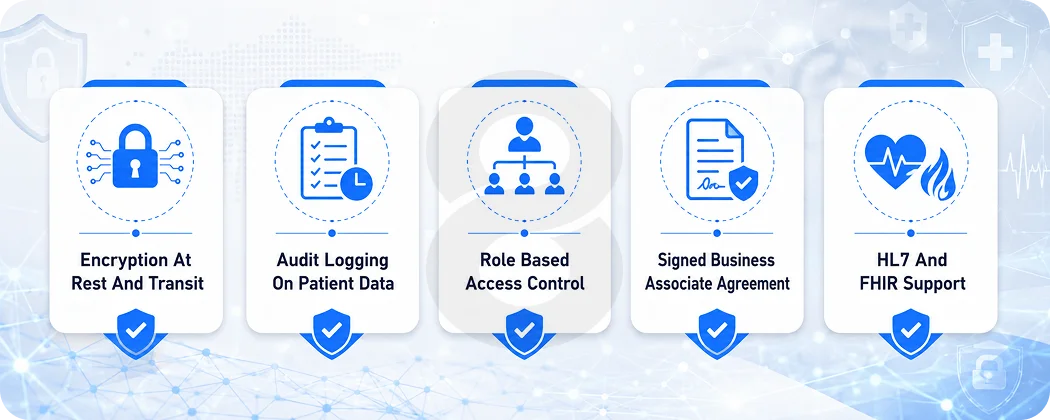
Every company on the list above will say it takes compliance seriously. That sentence alone means almost nothing, because typing it costs nothing while proving it costs months of engineering time.
What actually separates a serious healthcare software development company from one learning on a client’s dime comes down to a handful of unglamorous specifics, encryption at rest and in transit, audit logging on every touch of patient data, role based access control that holds up under a real audit, and a signed business associate agreement before a single line of code gets written.
Interoperability is the other half of the test. HL7 and FHIR stopped being optional vocabulary to drop in a sales call years ago.
The Centers for Medicare and Medicaid Services now requires FHIR based APIs for a growing list of payer and provider data exchanges, so a vendor who needs the standard explained during discovery is not ready for a production healthcare software build.
None of this shows up cleanly on a portfolio page, and that is exactly the problem. So ask a vendor to walk through a real scenario instead. A patient requesting their full record under the HIPAA right of access rule.
A lab result that has to flow into three different systems at once. Questions like that tend to separate teams who have actually lived through a compliance audit from the ones reciting a checklist they read online last week.
None of this is theoretical. The Department of Health and Human Services gets notified of more than 700 large healthcare data breaches a year, each one affecting at least 500 patients, and HIPAA Journal’s own tracking shows that number has barely budged even as the size of individual breaches keeps shifting.
“Most healthcare software does not fail because of a missing feature. It fails because nobody mapped who can see which field of patient data, and that gap gets found in a security review six months after launch, not during the demo.”
What Healthcare Software Actually Costs and How Long It Takes
Pricing among healthcare software development companies swings harder than almost any other category of software work, because the compliance layer adds cost before a single patient facing feature gets built. A basic appointment app and a hospital wide EHR rollout are not the same conversation, even though both technically count as healthcare software.
The gap usually comes down to three things, how many existing systems the new build has to talk to, how much of the data needs to be migrated rather than created fresh, and whether the project needs to pass a third party security audit before it can go live with real patients on it.
| Project Type | Typical Cost Range | Typical Timeline |
| Patient portal or appointment app | $20,000 to $60,000 | 2 to 4 months |
| Telemedicine platform | $40,000 to $150,000 | 4 to 7 months |
| EHR or EMR integration | $50,000 to $200,000 | 5 to 9 months |
| AI powered diagnostic or triage tool | $60,000 to $250,000 | 6 to 10 months |
| Enterprise hospital management system | $150,000 to $500,000 or more | 9 to 18 months |
Ranges like these only go so far. Anyone who wants an actual number instead of a guess can run the specifics through a software cost calculator before booking a single call with a vendor.
Hourly rates follow a similarly wide spread, from under $25 an hour at offshore shops to north of $150 an hour at US firms like Goji Labs or Sidebench. Neither end of that range is automatically the smarter buy.
A $25 hourly rate on a project that needs six months of rework after launch costs more in the end than a $150 rate on a team that gets the compliance layer right the first time. The cheapest quote and the cheapest project are rarely the same thing once a build runs past its first audit.
Mistakes That Sink Healthcare Software Projects Before Launch
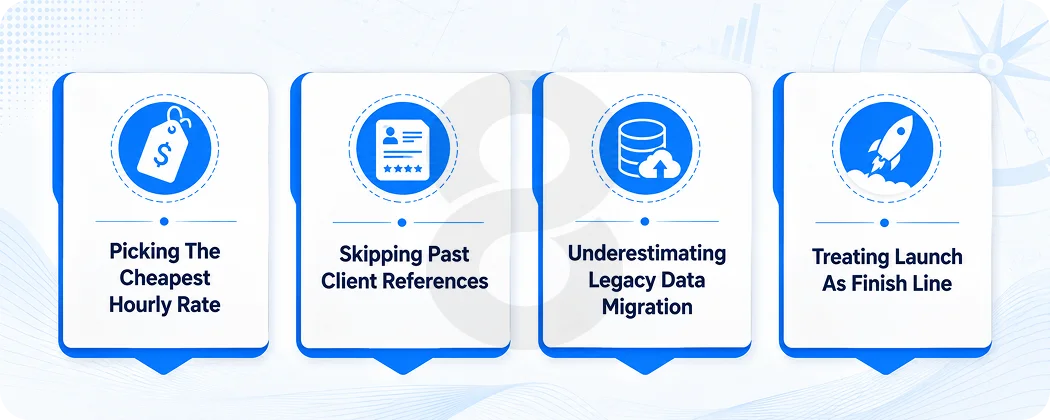
The project that actually sinks is rarely the one with the flashiest pitch deck. It is usually the one where the buyer picked the cheapest hourly rate on a list like the one above without checking whether that vendor had ever touched a HIPAA covered system before. Healthcare software is not the place to fund a vendor’s first compliance lesson.
Reference checks get skipped more often than they should, mostly because everyone is busy and the case studies on the website already look fine. That is a mistake. Call a past client who built something structurally similar.
Maybe it was an EHR integration, telemedicine app, or patient portal. Fifteen minutes on the phone with that person will surface problems no portfolio page will ever admit to.
Data migration is the other quiet killer. Moving patient records out of a legacy system sounds like a footnote in a proposal until the actual data turns out messier, more duplicated, and less standardized than anyone assumed, and that discovery tends to land three months into a project scoped around clean data from day one.
And then there’s the assumption that launch day is the finish line. It is not. Regulations shift, FHIR implementation guides get updated, and a system that passed its audit at launch can drift out of compliance within a year if nobody owns ongoing maintenance.
Whichever vendor makes the final shortlist, the support model after go live deserves just as much scrutiny as the build itself.
Where 8ration Fits Into This Decision
8ration already showed up in the list above but one paragraph squeezed between Sigma Software Group and a comparison table cannot cover what the team actually does in healthcare software development.
Behind that 4.9 Clutch rating sits more than ten years of building healthcare software, plus a client roster of more than 2,500 organizations across other industries too.
The team’s healthcare software work tends to land in a specific gap, organizations that need a real engineering partner but don’t have the budget or patience for an enterprise vendor’s six month procurement cycle.
In practice that means mobile apps patients actually open more than once, not just a feature checklist, and infrastructure built on cloud systems designed to hold up under a HIPAA audit rather than patched together after a near miss.
Increasingly, it also means AI models trained to support clinical decisions rather than replace the judgment of the people actually using them.