



Right now, the share of organizations using AI in at least one business function jumped by ten percentage points in a single year, according to McKinsey’s 2025 State of AI report.
The businesses moving fastest have found that the artificial intelligence advantages hold up under real scrutiny. Costs come down. Decisions sharpen. Customer-facing functions handle more volume without adding proportional headcount.
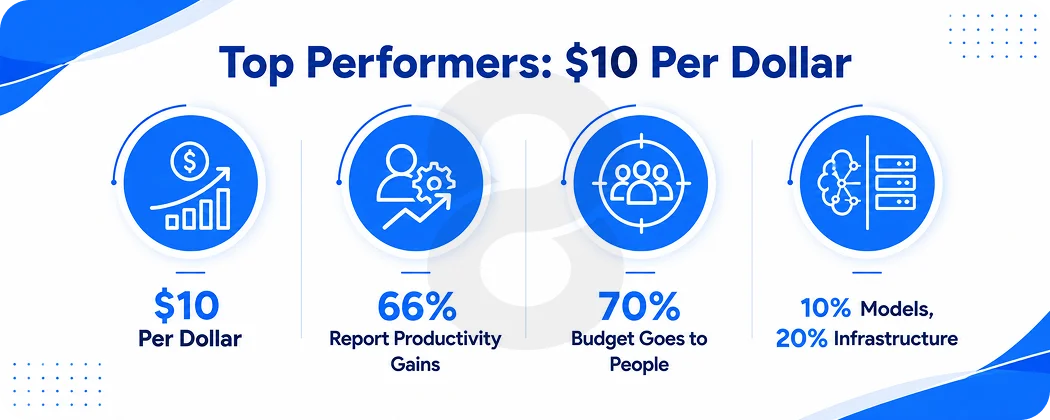
The gap between high performers and everyone else is already getting harder to close. McKinsey identifies a group of AI leaders who attribute more than 10% of their EBIT to AI deployment and earn over $10 for every dollar invested, nearly 3x the average. Those returns don’t flatten out. They build.
Gartner puts global AI spending at $2.5 trillion this year, nearly doubling the $1.5 trillion spent last year. This guide covers what the artificial intelligence advantages look like in actual production, with company examples, and ROI numbers. What businesses are getting out of AI today, at a scale that has been documented and measured.
What Are the Advantages of Artificial Intelligence for Business?
The advantages break into three tiers… operational, strategic, and competitive. They build on each other, and most businesses work through them in roughly that order.
Operational advantages show up first. AI handles high-volume work faster and more accurately than any team can at scale. Processing invoices, routing support queries, catching transaction anomalies. The error rates drop to levels no manual process could consistently hit, and the cost savings follow.
Strategic advantages live in decision-making. AI works through datasets too large for any analyst and finds patterns that would otherwise stay buried. That matters whether you’re forecasting demand, catching churn before it shows up in the numbers, or working out which marketing channels are actually earning their budget.
Competitive advantages are what accumulates when you sustain both. Businesses that embed AI across their operations build data assets and operational depth that take years to replicate. Competitors still running manual processes don’t just fall behind. The gap widens with every cycle.
| Category | What AI Does | Business Outcome |
|---|---|---|
| Operational | Automates repetitive, rules-based tasks | Lower costs, fewer errors, faster throughput |
| Analytical | Processes data at machine scale | Better decisions surfaced in real time |
| Customer-facing | Personalizes interactions at scale | Higher satisfaction and stronger retention |
| Competitive | Compresses R&D and innovation cycles | Faster time-to-market, durable differentiation |
Understanding which tier you’re targeting matters. Most businesses start with operational advantages because the ROI shows up fastest. Strategic and competitive advantages take longer to build, but they’re also harder for anyone to quickly replicate.
The 9 Core Artificial Intelligence Advantages
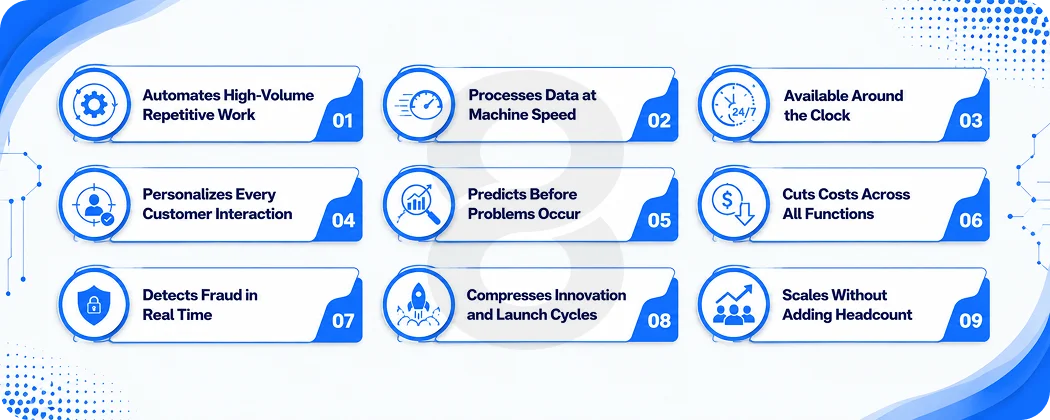
These aren’t abstract capabilities. Each one maps directly to something businesses are running in production today.
1. Automation of repetitive tasks
The most immediate return most businesses see from AI is straightforward: it takes repetitive, high-volume work off people’s plates. In accounting specifically, AI-equipped teams have reported a 72% drop in time spent on routine tasks, a 20% reduction in costs, and a 65% improvement in reporting accuracy. These aren’t projections from a vendor deck. Businesses have already documented them.
Invoices get processed without anyone touching them. Customer emails get routed automatically. Data reconciles across systems without a team doing it manually. When a team isn’t spending the day on routine tasks, it’s doing work that actually requires judgment. That shift accumulates in output quality over time.
2. Data-driven decision making at scale
At the scale AI operates, “faster decisions” is underselling it. The real advantage is that AI processes volumes of data that would take any analyst team weeks, and does it continuously, in real time.
JPMorgan Chase uses AI to scan every transaction for fraud signals the moment it clears. Doing that manually would require hundreds of analysts working around the clock, and they’d still miss things. BMW’s production lines run something similar: AI vision systems inspect each component at a throughput no quality control team could match at volume.
At Siemens, AI coordinates both predictive maintenance and production scheduling across multiple facilities simultaneously. McKinsey’s analysis of where AI creates measurable productivity gains draws the same line across all these cases: AI absorbs the data load; humans handle the judgment.
Marketing, supply chain management, and financial modeling follow the same pattern. The core problem is identical and that is too much data, moving too fast, for any team to process and act on before the window closes.
3. 24/7 availability and operational continuity
AI doesn’t clock out. For any business with customers expecting fast responses, that’s worth more than it sounds. Chatbots field queries at two in the morning, process returns, and hand off anything genuinely complicated to a human.
Gartner estimates 60 to 70% of routine inquiries now get resolved without a human ever getting involved, which puts support costs down by roughly 30%. Solutions built specifically for your operation train on your actual product knowledge and customer workflows. The difference between that and an off-the-shelf bot shows up fast in the quality of the answers.
4. Hyper-personalization at scale
Before AI, real personalization at scale didn’t exist. You could personalize for your top 100 customers. Doing it for 10 million wasn’t realistic.
AI changes math entirely. It works through purchase history and real time signals to give every user something that actually feels relevant to them. Amazon’s recommendation engine accounts for 35 percent of total sales.
Average order values go up when the suggestion actually fits. And the churn difference between a personalized experience and a generic one doesn’t just show up in satisfaction surveys. It shows up in the revenue numbers.
5. Predictive analytics and demand forecasting
One of the more powerful artificial intelligence advantages is the shift from reactive to predictive operations. Rather than analyzing what happened, AI models what will happen and gives businesses time to act before it does.
Walmart’s demand forecasting is one of the most documented cases in retail. The system pulls together historical sales, weather patterns, local events, and dozens of other variables at once to predict what customers will want before they show up. Overstock dropped 15%. Stockouts fell by 30%. Both hit margins directly. Manufacturing applies the same thinking to equipment, catching failure signatures before anything breaks. Healthcare uses it to identify high-risk patients before their condition changes. Across sectors, the move from reactive to predictive tends to show up among the strongest returning AI deployments.
6. Cost reduction across business functions
Most CFOs evaluating AI are really asking one question: what does this cost versus what does it save? The savings are documented across multiple functions. McKinsey’s State of AI research estimates that AI reduces HR costs by 15 to 20 percent by identifying patterns in employee attraction, performance, and turnover before they become problems.
IBM research found that AI-assisted call and ticket analysis reduces customer service costs by 23.5%. In manufacturing, predictive maintenance delivers cost reductions of 10 to 40% compared to scheduled maintenance programs. These are cross-deployment averages, not outlier numbers from a single implementation.
7. Enhanced cybersecurity and fraud detection
This one doesn’t get enough attention and it’s becoming urgent. 60% of companies experienced at least one AI-based cyberattack in 2025, according to BCG research. The attack surface keeps expanding, and the only viable way to defend at the speed and scale of AI-powered attacks is to use AI-powered defense.
AI fraud detection systems analyze transaction patterns and flag anomalies in real time, with accuracy exceeding 95% in mature deployments. Traditional rule-based systems generate more false positives and miss more real threats. In financial services, AI fraud detection has cut both losses and response times.
8. Faster innovation and reduced time-to-market
AI compresses the cycle from idea to market. That’s not just about speed; it changes how competitive advantage gets built. AI compresses the cycle from idea to market. That’s not just about speed. It changes how competitive advantage gets built. In software development, AI coding assistants reduce debugging time and catch edge cases earlier.
McKinsey puts the R&D acceleration from AI at 20 to 80 percent, depending on the domain. For most businesses, this shows up in iteration speed… how quickly they can test an idea and decide what to scale or cut. Competitors without AI in that loop are working at a structurally slower pace.
9. Scalability without proportional cost increase
Traditional business scaling has a stubborn problem: to serve twice as many customers, you generally need roughly twice the headcount. AI breaks that relationship.
A company using agentic AI for customer service workflows can triple its inquiry-handling capacity without adding a single agent. An e-commerce platform using AI recommendations can onboard a million new users without building a new recommendations team. The infrastructure scales; the marginal cost per customer falls. This is what makes AI so attractive to growing businesses and why investors read AI capability as a signal of long term margin expansion potential.
Real-World AI Examples and How Companies Use Them
Reading about AI benefits is one thing. Seeing where the results actually came from is another. Below are six documented, named-company examples of artificial intelligence advantages running in production:
| Company | Industry | AI Use Case | Documented Result |
|---|---|---|---|
| Amazon | E-commerce | AI-powered recommendation engine | 35% of total sales attributed to AI recommendations |
| JPMorgan Chase | Financial services | Real-time transaction fraud scanning | Continuous fraud detection at machine speed, impossible manually at this volume |
| BMW | Automotive | Computer vision quality inspection on production lines | 30% reduction in quality-related production costs |
| Siemens | Manufacturing | AI-coordinated predictive maintenance and production planning | Reduced operational variance and downtime across facilities |
| Healthcare AI | Breast cancer detection model | 94.5% accuracy, outperforming human radiologists | |
| Walmart | Retail | AI demand forecasting and inventory optimization | 15% reduction in overstock; 30% fewer stockouts |
What these cases share is specificity. None of them deployed “AI in general.” Each identified a high-volume, measurable problem and built a system to address that specific problem. The results are clear because the success metric existed before the build started.
That’s the pattern behind nearly every successful AI deployment: a specific, measurable problem, data that’s actually clean, and a target set before development begins.
Read More: 10 AI Hallucination Examples and Their Root Causes
Artificial Intelligence Advantages by Industry
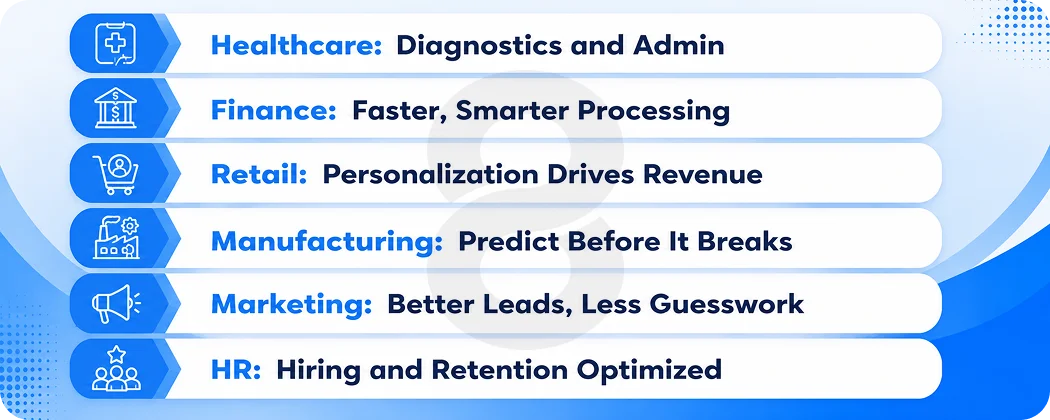
AI doesn’t deliver the same advantage across every sector. The industries that benefit most share a few characteristics such as large datasets and high volume repetitive processes.
Healthcare
AI in healthcare is applied primarily to diagnostics and operations. On the diagnostic side, it analyzes X-rays, MRIs, and CT scans at a speed and consistency no radiologist can maintain across a full shift.
Google’s breast cancer detection model hit 94.5 percent accuracy and outperformed human radiologists by more than 11 percentage points. On the operations side, AI takes on scheduling, billing, and clinical documentation.
Administrative work is one of the heaviest cost drivers in healthcare, and reducing it without touching clinical staff is where AI tends to deliver some of its most consistent returns.
Finance and banking
Financial services was one of the earliest industries to go deep on AI, and the results reflect how long that commitment has been running. Loan processing accuracy has improved by 90 percent while processing times have dropped by 70 percent.
Approvals that used to take days now clear in under a minute in some deployments. Beyond processing, AI covers risk modeling and fraud detection. McKinsey projects a net cost reduction of 15 to 20 percent across banking from AI alone.
Retail and e-commerce
Retail’s AI advantages concentrate in personalization, inventory management, and customer service automation. Amazon is the most cited case study for personalization ROI; Walmart for inventory optimization. The AI powered retail market is projected to reach $24 billion by the end of this year. B2B companies using AI for personalization report 15 to 20 percent revenue increases per customer on average.
Manufacturing
Manufacturing’s strongest AI returns come from predictive maintenance, quality control, and production optimization. BMW’s AI vision systems catch production defects in real time, at a speed and consistency that manual inspection can’t match at volume.
Siemens uses AI to coordinate predictive maintenance and production planning across multiple facilities, cutting variance and downtime in the process. Across the sector, predictive maintenance deployments return positive ROI in 95 percent of cases, with more than a quarter hitting payback within a year.
Marketing and sales
AI in marketing covers content generation, campaign optimization, and customer segmentation. Teams using AI test and iterate significantly faster than those working without it. 97% of senior sales leaders say AI has changed their team’s approach, and 81% say it gives them more time for actual selling. The value isn’t in replacing salespeople; it’s in giving them better data faster so they spend their time on leads that are actually worth pursuing.
HR and talent management
AI in HR covers resume screening, attrition prediction, and benefits optimization. McKinsey estimates it reduces HR costs by 15 to 20 percent by identifying what actually drives attraction and turnover before those patterns turn into problems. The recruitment time savings tend to be the first thing HR teams notice after adoption.
Screening that used to take hours gets done in minutes, and that alone tends to justify the investment before anything else kicks in.
What Do the Numbers Actually Say About AI ROI?
This is the question that matters most when you’re building a business case. The honest answer is that returns vary enormously depending on where you deploy and whether you defined what success looks like before you started.
| Deployment Type | Typical ROI Range | Payback Period | Source |
|---|---|---|---|
| Predictive maintenance (manufacturing) | 1.5x to 5x return | 6 to 18 months | Deloitte |
| Financial services back-office automation | 3x to 7x return | Fastest-ROI sector | Deloitte |
| Customer service AI (chatbots) | 30% cost reduction | 12 to 24 months | Gartner |
| HR cost optimization | 15 to 20% cost reduction | Ongoing | McKinsey |
| AI personalization (B2B) | 15 to 20% revenue increase per customer | 6 to 12 months | McKinsey |
The number most commonly cited comes from McKinsey: top AI performers see returns exceeding $10.30 per dollar invested. That’s the ceiling, not the average. Deloitte’s research found that 66 percent of organizations report productivity and efficiency gains from AI, while only 20 percent report revenue growth they can directly attribute to it.
Most businesses have figured out how to use AI to do existing work faster. Fewer have figured out how to use it to generate fundamentally new revenue.
What separates the high performers, according to McKinsey, is something they call the 10-20-70 principle. Ten percent of the AI investment goes to algorithms and models. Twenty percent goes to data and technology infrastructure. Seventy percent goes to people, processes, and change management. The technology turns out to be the smallest part of the problem.
Artificial Intelligence Advantages vs. Real Limitations
Most articles on AI advantages stop at the list of benefits. The businesses that implement AI most successfully are the ones that went in knowing what could go wrong.
| Artificial Intelligence Advantage | Real Limitation to Manage |
|---|---|
| Automates repetitive tasks | Requires high-quality, structured data to work reliably |
| Makes faster decisions at scale | Can produce confident wrong answers (hallucinations) |
| Available 24/7 without fatigue | Needs ongoing monitoring, updates, and maintenance costs |
| Scales without proportional cost increase | High upfront implementation costs for custom deployments |
| Personalizes at scale | Raises data privacy and regulatory compliance requirements |
| Accelerates fraud detection | AI-powered attacks are also getting faster and more sophisticated |
| Reduces HR costs | Workforce transition and retraining require active management |
The reason eight out of ten AI projects fail isn’t that the technology doesn’t work. It is mostly due to most organizations deploy without clean data or a real plan for the people whose jobs are changing. Usually some combination of all three.
The businesses getting the best returns run governance alongside their deployments. They audit outputs, keep humans in the loop on high-stakes decisions, and set improvement benchmarks before they scale rather than after. The advantages are real. So are the risks. Treating them as separate conversations is usually what kills the ROI.
Read More: How AI-Powered Mobile Apps Are Transforming Businesses in 2026
How Small and Mid-Size Businesses Can Access AI Advantages
A common misconception is that AI advantages are only accessible to enterprises with dedicated data science teams and eight-figure technology budgets. In 2026, that’s just not accurate.
According to a Microsoft survey, 67% of small business owners say they know little to nothing about AI in general. That’s a knowledge gap, not an access gap. The tools exist. They’re affordable. Many are already embedded in software businesses are paying for today.
Here’s where SMBs are accessing AI advantages without building anything from scratch:
Microsoft Copilot is embedded in Microsoft 365 and assists with drafting, summarizing, spreadsheet analysis, and routine communication. No separate AI budget required.
HubSpot AI includes AI-powered lead scoring, email optimization, and content suggestions built into a platform most SMBs already use for marketing and sales.
Salesforce Einstein delivers customer analytics, opportunity scoring, and predictive insights without requiring a dedicated data team.
ChatGPT for Business enables custom workflow automation, document analysis, customer communication drafts, and competitive research at low cost.
The better starting point for most SMBs isn’t ‘how do we build AI?’ It’s ‘which tools we’re already paying for have AI features we haven’t turned on?’ Most businesses are paying for AI capabilities they’re not using.
For SMBs with specific workflows that off-the-shelf tools can’t address, a custom-built solution through generative AI delivers faster ROI than trying to adapt a generic tool to a specific problem.
Read More: Custom Character AI Chatbots for Business: Cost, Timeline & What to Expect
How to Start Capturing AI Advantages in Your Business
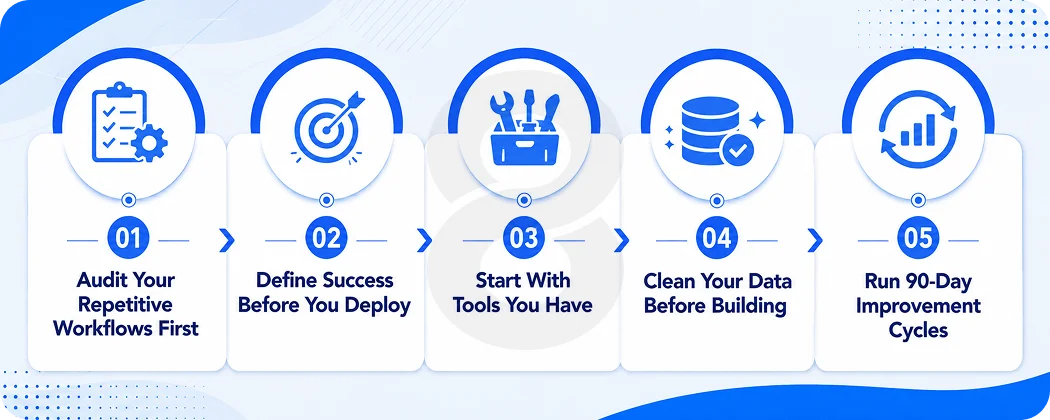
Starting doesn’t require a company-wide transformation program. It requires a disciplined first move. Here’s a five-step approach that applies to businesses at any stage of AI adoption:
- Audit your highest-volume, most repetitive workflows first: These are your lowest-risk, fastest-ROI automation targets. Document what they cost in time and labor today so you have a baseline to measure against.
- Define your success metric before you deploy anything: Pick a specific number: cost reduction, hours saved on a workflow, error rate improvement, or revenue growth. Without it, you can’t tell whether the implementation worked.
- Start with AI embedded in tools you already use: Activating the AI features in your existing CRM, marketing platform, or productivity suite is faster, cheaper, and lower-risk than a custom build. Prove the value of AI with tools you’re already paying for.
- Establish data quality as a prerequisite: The most common reason AI projects underperform is dirty, incomplete, or inconsistently structured data. Clean your inputs before you build your system.
- Iterate in 90-day cycles: Set a 90-day goal, measure the result, adjust the approach, and scale what’s working. AI implementations that drag on for 18 months without a clear milestone tend to lose organizational momentum before they deliver results.
How 8ration Can Help You Capture AI Advantages
8ration builds production AI systems across healthcare, fintech, retail, agriculture, and logistics. AI development is a core practice area, covering agentic AI, custom AI chatbot, generative AI apps, AI-powered voice assistants, and AI-powered speech recognition tools.
On the agriculture side, 8ration built Chem Savy, an AI-powered mobile app that lets farmers photograph crop symptoms and receive instant disease identification and treatment guidance. What once required an agronomist visit or days of research now completes in under a minute. You can see how 8ration built it in the Chem Savy AI agriculture app case study.
8ration’s AI work typically starts with a systems audit: figuring out where deployment would produce the clearest, fastest ROI based on actual workflows and existing data infrastructure. Whether that means a well-integrated tool connected to the right data source or a custom agentic system handling multi-step workflows autonomously, the right answer depends on the problem. 8ration works that out before a single dollar goes into the build.
Read More: AI System Integration: What to Look for in a Development Partner