


The cost of game development depends on project complexity, team size, and tech stack. Indie games may cost $10,000–$100,000, whereas AAA games often exceed $20 million, with additional costs from marketing, tools, and ongoing post-release support.
For indie developers, C++ game development has become a powerhouse option. While it demands a deeper technical investment, modern frameworks and engines have made it more accessible than ever. For small teams, this means the ability to build high-performance, console-ready titles with total control over system resources and gameplay architecture. This shift bridges the gap between indie creativity and AAA-level optimization.
In the article, we’ll walk you through:
- Why game budgets vary so much
- Key components that define the cost of a game
- Typical budgets for different types of games
- Sample budget scenarios for 2026
- Game engine comparison
- Real-world case studies from indie hits to AAA blockbusters
- Common mistakes when estimating game budgets
- Trends for 2026 that affect game development cost
- Step-by-step method to estimate your own game budget
By the conclusion, you will have a better answer to how much does it cost to make a video game in 2026, the cost, and the information you will be required to have to plan reasonably.
Read More: What Are the Main Stages of Video Game Development
Why Cost Estimates of Game Development Vary So Much

Games are unique. There is no “Standard Game”
Each game has its own artistic vision, technical difficulties, visual style, and purpose for viewers. The developers are interested in originality, polished graphics, clean gameplay, and a captivating user experience. Owing to this, there is not a single game that can be compared with the other, and it will demand distinct treatment, be it concept art, coding, animation, sound, or UI, testing, etc. That is why there is no standard budget that suits everyone.
Limited Public Disclosure
Very few studios release their complete development budgets. The majority of the cost information that comes across your sight (blogs, articles, or market reports) is an estimation based on how many people are on the project, how long the project is, and the average wage rate, instead of the actual account of their company. As a result, the cost of developing a game is usually a mere estimation and not a well-defined figure that all people can agree on.
Huge Range of Possible Outcomes
Prices may vary by factors of magnitude depending on scope, a basic 2D mobile game versus a blockbuster AAA open-world title. That is why the answer to the question of how much does it cost to make a video game is a tough question to answer without numerous qualifiers.
Added Costs: Other than Development
Budget does not finish when coding and design are completed. Marketing, promotion, licensing, after-sales, and updates are all cumulative. Most studios invest every bit as much (or more) in marketing as in development.
Due to these aspects, you need to consider the cost of games as a range of costs instead of a distinct and definite cost.
Components That Decide the “Cost to Develop a Game”
In order to realistically estimate the budget of game development, you are supposed to divide the major elements. All of these will mean more expense, and some will take over depending on your intentions. The major cost drivers are as follows:
Team and Personnel
- Game designers: Game designers establish the concept: rules, mechanics, story, level building, character development, and user interface/user experience.
- Artists & Animators: When there is a 2D or 3D game, it involves artwork by the artists to make the background, characters etc. Animators animate them, and 3D is far more costly and time consuming than 2D.
- Developers/Programmers: They are the ones who work on the interactive (gameplay, engine integration (e.g. Unity, Unreal), performance, and platform-specific (iOS, Android, PC, consoles).
- Sound designers / Composers: to be immersed, music, sounds effects and ambience should be present.
- Quality Assurance (Testers): Testers locate bugs, test gameplay, assure performance and cross-platform test. Here, setting fire to things is likely to ruin even good games.
- Other experts (not all required, game-scale dependent): UI/UX specialists, copywriters, level designers, artificial intelligence programmers, network engineers (when playing multiplayer or in a multiplayer/massive-online game), live-ops/support/community managers.
The larger the project, the larger the team, and the higher the costs.
Duration of Development (Time)
Complexity is proportional to development time. More complicated games, e.g., 3D, multiplayer, and open-world, require months or more. Salaries accumulate over time, and hence long projects increase the budget. Basically, there is a strong correlation between complexity and development time, and cost is driven by development time.
Tools, Engine Costs, and Technologies
Not only in salaries, but also tools: game engines (license), 3D modeling software, animation software, audio software, servers (online/multiplayer games), testing hardware (games, platforms), license fees (e.g. Nintendo, PlayStation, Xbox dev kits), and potentially proprietary/custom engines.
Art, Animation, Audio Assets
Good images (3D modeling, landscape design, cinematics) and audio (music, voice acting, sound effects) take a significant part of the budget. The more meticulous, realistic or stylistic the art, and the more intensive the audio, the greater the expense.
Marketing & Promotion
This is one of the things that are underestimated by many developers. A technically flawless game will not succeed when no one is aware of its existence. Marketing consists of trailers, ads, launch campaigns, reaching out to influencers, PR, potentially localization, community building, and so on. Other studios reallocate the development funds (20 percent-100 percent) towards marketing.
After-sales support, Live Ops, and Updates
Current games require ongoing support because they have multiplayer and live-service and expansion-based game modes. The required support includes bug fixes and balance patches and server maintenance and the introduction of new content which includes levels and characters and DLCs and seasonal events and community management. The total expenses for operation will increase because all these factors create permanent costs.
Licensing and Intellectual Property (if applicable)
In the event your game exploits licensed IP (brands, celebrities, real-world likenesses, sports leagues, etc.), there is a high risk of budgets being inflated by licensing charges.
Cost Distribution by Game Components
S.no |
Component |
Indie Game ($) |
Mid-Tier Game ($) |
AAA Game ($) |
| 1 | Art & Animation | $5,000 – $20,000 | $100,000 – $500,000,000 | $5,000,000 – $50,000,000 |
| 2 | Sound & Music | $3,000 – $20,000 | $50,000 – $200,000 | $2,000,000 – $10,000,000 |
| 3 | Programming / Development | $10,000 – $50,000 | $200,000 – $700,000 | $10,000,000 – $100,000,000 |
| 4 | QA & Testing | $1,000 – $5,000 | $50,000 – $150,000 | $1,000,000 – $5,000,000 |
| 5 | Marketing & Promotion | $500 – $10,000 | $50,000 – $200,000 | $10,000,000 – $50,000,000 |
| 6 | Post-Release Support | $500 – $5,000 | $50,000 – $100,000 | $5,000,000 – $20,000,000 |
Typical Cost Ranges for Different Types of Games
Given all those variables, team size, technology, scope, marketing, and support, here’s a breakdown of what how much does it cost to make a video game for different tiers of games typically looks like (as of 2025–2026).
# |
Type / Tier |
Typical Cost Range |
Key Characteristics |
| 1 | Simple Casual / Indie Mobile Game | $10,000 – $100,000 | Minimum art (2D), small team (1-2 people), low development time (weeks to few months), simple mechanics, may be launched on just a single platform. |
| 2 | Standard Indie / Small PC or Mobile Game | $50,000 – $500,000 | Better polish, higher quality art and sound, moderate difficulty, small dedicated team, several months of development. |
| 3 | Mid-Tier / “AA” Game | $500,000 – $5,000,000 | 3D elements, more mechanics, more gameplay, may have limited multiplayer, small-medium sized team. |
| 4 | Large 3D / Advanced Mobile or PC Title (Mid to High Scope) | $300,000+ (for simpler advanced projects) | More high-quality assets, increased number of team members, increased length, cross-platform support, added systems and features |
| 5 | Full PC / Console Game (Basic) | $200,000 – $500,000+ | 3D production, easy mechanics, 5-10 people team, 12 months development, small scope and ambition. |
| 6 | Large Mid-Tier / High-Quality Indie or AA | $500,000 – Several million | Multiple million High polish with limited scope, powerful art direction, niche or targeted audience focus. |
| 7 | AAA Titles | $20M – $300M+ | Blockbuster production, cinematic storytelling, huge teams, open or semi-open worlds, multi-year development. |
| 8 | MMO / Open-World / Massive Multiplayer Titles | $50M – $500M+ | Massive scale, server-based, live-ops, constant updates, extremely large develop and operations teams.
Real-World Cases: Indie Hits to the Blockbusters. |
Real-World Cases: Indie Hits to the Blockbusters
The real (or estimated) budgets can be used to base these figures on facts. The following are some examples of what you get out of the cash in games that you and I are familiar with, showing the diversification of the cost and what you can get.
Indie Success Stories: Minimal Budgets
- A simple 2-D low-cost mobile game of less than 10,000 can be completed even by casual means, as long as it is designed and polished. Small teams or individual developers can work on such a budget, with basic art, code and simple mechanics, depending on the team size.
- Indie games are considered games that cost between 50,000 and 500,000, are better in art, music, polish and gameplay. This is the honey zone within which many indie studios can roll dice, but quality may manifest.
- All these achievements demonstrate that the amount of money required to produce a video game does not necessarily require enormous amounts of creativity, clever design, and effective implementation.
AAA & High-Budget Titles
At the other end of the scale:
- Particularly, the AAA titles had been said to cost anywhere between 20 million and 300 million dollars to make. The latter figure is the cost of development only; it is usually accompanied by marketing, distribution, live ops, and post-release support, which usually makes the budget even larger.
- In the case of massively open-world or even MMO games, they can have a minimum budget of 50 million dollars and usually go far beyond 200-500 million dollars, particularly when the game includes a large number of developers, a rich 3D world, theatrical scenes, and web support.
These numbers represent the sheer size, ambition, and resource needs of the high-end games and represent the reasons why few studios ever take such ventures.
The Bigger Picture: Game Industry in 2026
What makes 2026 an important year to consider how much does it cost to make a video game? The reason is that the video game industry is still growing at a fast rate, which impacts both the opportunity and competition.
- The market researchers expect the video game industry to expand to approximately of US236.9 billion in 2026.
- Other predictions based on methodology reach even further and point to hundreds of billions in the global market size in a few years.
The trends in growth are an increase in the adoption of mobile gaming, the integration of cloud and VR/AR gaming, and a growing tendency among consumers towards immersive/social experiences.
A Simple Formula for Budget Estimation
If you prefer a quick, rough estimate before diving into detailed planning, you can use a simple formula:
(Rate per hour) × (8 hours/day) × (Number of team members) × (20 working days/month) × (Months of development)
For example, assume:
- Hourly rate: US$40
- Team size: 10 people
- Development time: 6 months
Calculation:
(40 × 8) × (10 × 20) × 6 = $384,000
This is to reflect the amount that you are likely to spend on labor alone – i.e. net wages on the team. Actually, the total budget would probably be over this, not to mention software licenses, hardware, creating assets, QA, sound, marketing, and other overheads.
That is why most studios, such as indies or small-scale ones, apply this type of formula to obtain a base, then multiply by a safety margin (usually 1.5x to 2x) to cover all additional expenses, more scope, changes, and contingency.
This formula provides a base point when you are asking how much does it cost to make a video game, not a last answer.
What Influences the Cost: The Variables to Take Notice of
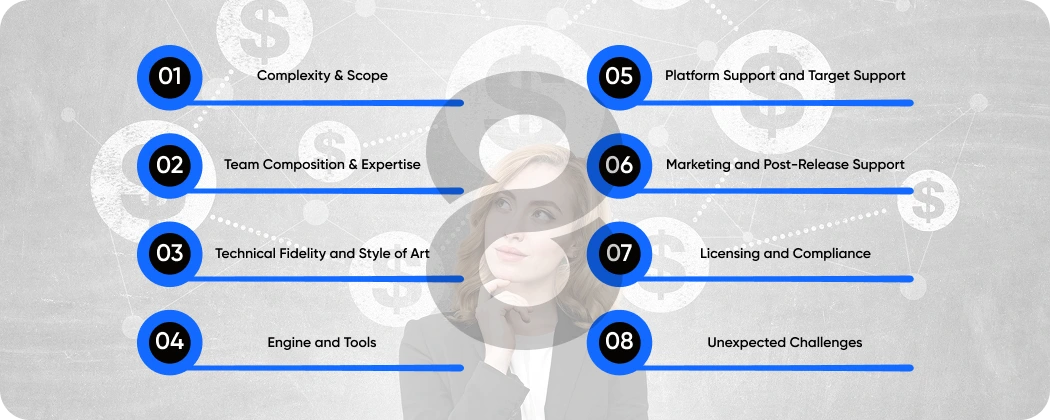
You need to understand the variables that are likely to ensure the difference between a $50,000 indie game and a $200 million AAA blockbuster when designing a game.
1. Complexity & Scope
The greater the complexity of the game (3D, physics, multiplayer, open world, AI), the longer it takes to develop it, and the larger the number of specialists. Complexity is an expeditious cost.
2. Team Composition & Expertise
A studio with veteran, older designers, artists, and designers will be more expensive per head, but may be quicker, higher quality, and fewer reworks. As well, cheaper cost teams (e.g., offshoring to less expensive locations) can be cheaper, but they can also have more protracted schedules or lower quality.
3. Technical Fidelity and Style of Art
The cost of producing animations through cartoons and 2D art and basic 3D graphics methods will remain lower than the expenses needed to create high-fidelity 3D animations. The same applies to audio, VFX, and cinematics.
4. Engine and Tools
In the case of a premium engine, which is required to be licensed, or in purchasing/maintaining expensive tools in the creation of the asset, this increases expenses. Custom engines add even more.
5. Platform Support and Target Support
It is less expensive to create a game on a single platform (e.g. Android) than to make it available across multiple platforms (iOS, Android, PC, and consoles). It frequently needs additional testing, optimization, and porting to support several devices.
6. Marketing, Launch Strategy, and Post-Release Support
As soon as the game is created, marketing starts. Launching campaigns, advertising, community building, perhaps localization, PR, and updates are expensive. You need to budget that in case you intend to invest in the game in the long term (DLCs, live service, patches, etc.).
7. Licensing, IP, Legal, and Compliance
Licensing fees can be a huge budget item if your game has licensed IP (brands, logos, trademarked content, famous characters). Always factor this in early.
8. Contingency and Unexpected Challenges
Delays, rework, bugs, change of scope, etc, they are. Budgeting never fails to make a contingency buffer (e.g. 10-20% of the starting budget) to cover any unexpected costs.
Sample Budget Scenarios for 2026
These are some of the hypothetical budget scenarios in 2026; of course, this depends on the kind of game that you want to build.
Scenario A: Solo/Micro-Indie Mobile Game
- 1 programmer/designer, works full or part-time
- Basic graphics, simple art, basic mechanics, no gameplay
- No advertising (perhaps use social media / free exposure)
Estimated cost: $5,000 – $20,000
What you receive: A playable and very basic game; it can be sufficient to test an idea, teach development, or can be a little indie hit.
Scenario B: Small Indie/Small-Team Game (Mobile or PC)
- Team: 1 developer, 1 artist, 1 animator, 1 sound designer/composer, 1 tester, total 5 people
- 2D or simple 3D, modest polish, short/medium gameplay length, single platform (e.g., PC or mobile)
- Limited marketing (word-of-mouth, small ad budget)
Estimated cost: $50,000–$200,000
What you get: A modest game with some polish, potentially viable for niche audiences or indie-focused platforms.
Scenario C: Mid‑Tier / AA Game
- Team: 8-10 individuals (programmers, artists, animators, designers, QA, perhaps UI/UX, sound)
- 3D graphics, average art quality, middle complexity, possibly cross-platform (PC and mobile or PC and console), and simple or more complex multiplayer interaction or gameplay.
- A small marketing budget and limited after-sales support.
Estimated cost: $500,000 – $2,000,000
What you receive: A good indie/mid-level title. This would have a high potential of returning and reaching large masses of people with proper planning and implementation.
Scenario D: High-Quality PC/Console Game (Lower-Scale AAA/High-end Indie)
- Team: 10 or more people (including outsourced experts: art, animation, and sound) or a small studio.
- Good polish, 3D graphics, decent mechanics, and more than an indie – perhaps a few hours of gameplay, a storyline, or more.
- Cross-platform, a bit of marketing, potential launch window on platforms, cross-device QA.
Estimated cost: $1,000,000 – $5,000,000+
What you receive: A refined PC/console game, not a blockbuster, but with the ability to compete in the middle to high-end market segments.
Scenario E: AAA-Level / MMO / Open-World / Big 3D Title
- Large team: dozens to hundreds of individuals during several years (designers, developers, artists, animators, sound engineers, QA, marketing, live-ops, servers, support)
- Real-world fidelity 3D, movie cutscenes, open world or huge map, cooperative or online, complicated mechanics, vast assets, and extensive marketing and licensing.
- Live after-release support, updates, DLCs, server support (perhaps voice acting), a substantial extent of QA, and intensive marketing.
Estimated cost: $20 million–$300 million+ (development only). With marketing, live ops, licensing, and long-term support, the total cost may double.
What you get: A blockbuster game with potential for massive reach and revenue, but also high risk and high upfront investment.
Game Engine Comparison: Unity vs Unreal and More

The ability to make the right choice when it comes to the game engine is one of the most important decisions when estimating the amount of money it takes to make a video game. The engine not only determines things like the visual quality, physics, and mechanics of your game, but also affects the development timeline, the know-how of the team, and the general cost of developing a game.
1. Unity
Unity game development is a very popular indie developer, mobile games engine, and mid-tier project engine. Its cross-platform, wide asset store and flexibility make it the perfect choice for 2D games and simple 3D games (and even multiplayer games). The price is between $40,000 and $900,000 in accordance with the scope and specifications. Unity is particularly appealing to startups and smaller studios that want to maintain a development budget.
2. Unreal Engine 5
Unreal Engine 5 is characterized by AAA graphics, cinematic effects, and multiplayer possibilities of high scale. One usually needs a team that is proficient in C++ and sophisticated rendering to use Unreal. The costs are more expensive, between $80,000 and more than 2 million in large projects, but the engine offers the latest images and a solid framework of the complicated gameplay. For studios aiming for high-quality AAA experiences, Unreal Engine development ensures both performance and cinematic quality.
3. Godot
Godot is a lightweight, open-source engine suited to the indie project and stylized 2D/3D games. It is cheaper to develop, between $25000 and $250000, which makes it suitable to smaller groups or experimental games. Godot enables developers to be creative and reduce the cost of licensing.
4. CryEngine
CryEngine is a high-fidelity graphics and realistic 3D environment engine that is typically applied in mid to high-end titles. The development cost per game based on the CryEngine can be seen as between $100,000 and 1.2 million+ based on the complexity and asset needs of the game. It suits well to projects that are open-world or graphics-rich.
5. Custom Engines
Other studios use in-house engines and build their structures themselves. Although it is the most flexible and performance-optimized, this is the most expensive, between $200,000 and $3 million+, depending on the features. Individual engines are primarily applied in AAA studios having specialized requirements, mature networking, or unusual gameplay.
Why Engine Choice Matters
The right engine not only impacts the cost incurred in developing a game but also the size of the team to develop it, the skill, and the development schedule. Unity or Godot can be used to create prototypes quickly by indie developers, whereas AAA studios use Unreal or in-house engines to create high-quality graphics and intricate gameplay. In 8ration, we help our clients make the wisest choice in choosing the most desirable engine according to the budget, type of game, and scalability on the long run, not only to be efficient but also to ensure quality in production.
Quick Comparison Among Game Engines
# |
Engine |
Ideal For |
Key Features |
Typical Cost Range |
| 1 | Unity | Indie, Mobile, Mid-tier | Flexible, cross-platform support, 2D/3D development, multiplayer-ready, extensive asset store | $40,000 – $900,000 |
| 2 | Unreal Engine 5 | AAA, High-end 3D, Multiplayer | AAA-grade graphics, cinematic visuals, large-scale environments, advanced multiplayer, C++ support | $80,000 – $2M+ |
| 3 | Godot | Indie, Experimental, Stylized 2D/3D | Lightweight engine, open-source, high creative freedom, low licensing costs | $25,000 – $250,000 |
| 4 | CryEngine | Mid to AAA, Open-world | High-fidelity realistic graphics, large open environments, advanced rendering | $100,000 – $1.2M+ |
Common Mistakes When Estimating Game Budgets
In calculating how much does it costs to make a video game, some of the common mistakes made by beginners and by some studios include:
- Non-development costs, including marketing, licensing, QA, and post-release support, are ignored
- Underestimating scope creep. When the project gets larger, additional features, polish or fixes are accumulated
- Making the wrong assumptions about the team productivity on the assumption that the developers, artists, etc are working perfectly, on time, without rework or bugs
- Failure to plan for contingency bugs, rework, delays, engine problems, and so on can introduce unwelcome costs
- Failure to provide support in the long run often necessitates continuous server patches and content updates
Due to these traps, most projects are more costly than the original proposal.
What 2026 Means for Game Developers: Trends That Affect Cost
When you consider how much does it cost to make a video game in 2026, you have to take into account the changing market and the technology world. Some trends to keep in mind:
- International market expansion: According to recent research on the industry, it is expected that the global games industry will grow to approximately US$236.9 billion in the year 2026.
- Rising competition: As additional studios and additional developers start entering the market, higher levels of polish, marketing, and cross-platform support are required.
- Expectations of quality: Games are expected to be more beautiful, in a smoother state of performance, and to have features, even in indie games. That raises minimum quality standards up, potentially raising budgets.
- Mobile, PC, console, cloud gaming, and even VR/AR, the diversity of platforms opens up more potential but also increases the expense if you want to cover many.
- Post-launch content and live services: Live-ops, events, expansions, updates, together with numerous successful games, simply go on generating revenue. That translates to continued budgeting after the initial issue.
- Tools, engines & licensing models vary: With the evolving engines (as well as potentially shifting license terms), or new technology (such as cloud-native multiplayer, real-time ray tracing, AI-assisted tools) becoming available, the cost of developing a tool can change, impacting development cost.
You can ask yourself in 2026 how much does it cost to make a video game, and you have to consider not only your initial development but also these market realities.
How to Estimate Your Own Game Budget: Step by Step

Assuming you have some theory and you have decided to go to the next stage of planning, a step-by-step estimate of the cost of making your game is provided here.
1. Establish the basic idea and extent
- Game category (2D, 3D, mobile, PC, console, multiplayer, single-player)
- What are its characteristics? (playable with multiple players, open world, levels, cutscenes, interface, sound)
- In what platforms will it be supported? (mobile, PC, console, multiple)
- This is the approximate length/content volume (short indie game vs. full campaign / open world)?
2. List required team roles
- Programmers / Engineers
- Artists (2D or 3D)
- Animators
- Level designers / Designers / Game designers
- Sound designers / Audio engineers, Composers
- QA/Testing
- (Optional) UI/UX designers, writers, network engineers, live-ops support, marketing, and community management.
3. Estimate development time
- Depending on scope and roles, simple games can require weeks or a few months; larger ones, months and years.
- Develop a project roadmap / plan (prototype – alpha – beta – release)
4. Calculate labor cost at a baseline
- Use such a formula as hourly rate x hours/day x days/month x months x number of team members.
- Select rate depending on region, level of skills, outsourced or in-house, etc.
Read More: How to Make a Video Game – Launch Your First Game
Final Thoughts: “How Much Does Making a Video Game Cost?”
Do you mean business in making a game, be it a small indie, a mid-tier PC/console game, or even a multiplayer game? The most crucial thing to start with is a realistic plan. Know what your vision needs: art, code, audio, testing, marketing, and support. Estimate costs, time, and risks. Then determine what you can afford, and mold accordingly.
By the year 2026, the gaming industry is going to be more robust than ever. It is a good time to build because it is experiencing rapid market growth, rising numbers of gamers, new platforms and technologies (cloud, VR, AR), and changing models of monetization. Opportunity, however, comes with competition and an increase in the standards of quality.
Then, can I again ask you: How much does it cost to develop a game?, I would reply: It depends on what game you make. Think ahead, calculate, and strategize. Then, no matter how big or small your budget is, say $20,000 or $200 million, you will know what you are trying to achieve and how to achieve it. At 8ration, we help developers, indie studios, and entrepreneurs plan their game development journey efficiently, aligning cost, team, and technology to turn ideas into reality.