


When developing HIPAA-compliant apps, end-to-end encryption and robust access controls are essential to securing client data. These apps are built on a ‘Privacy by Design’ philosophy, integrating rigorous technical safeguards with informed user consent and data sovereignty.
There exists an essential requirement for healthcare applications that need to provide complete security while meeting compliance standards and offering user-friendly interfaces. The development of HIPAA compliant applications represents a fundamental aspect that healthcare organizations must address because both patients, healthcare workers, and regulatory agencies consider data protection to be their highest priority. Developing solutions in telemedicine, patient management, or wearable health tracking apps, there is no compromise on building an application that can comply with regulatory requirements.
The guide will provide fundamental information about building HIPAA compliant applications while explaining the steps needed to create HIPAA compliant mobile applications and offering businesses practical strategies to build HIPAA compliant applications that provide both security and user friendliness. The article will explore GDPR compliance, which plays an essential role when handling European patient data.
Understanding HIPAA Compliance
The Health Insurance Portability and Accountability Act (HIPAA) introduced in 1996 explains the way sensitive patient data must be protected by healthcare organizations, technology providers, and the developers of apps. HIPAA compliance is aimed at protecting electronic protected health information (ePHI) as well as ensuring its confidentiality, integrity, and availability throughout its lifecycle. Adhering to these standards, business organizations minimize the risk of data breach, ensure patient trust, and comply with legal demands of safely storing healthcare information.
To businesses that are looking to develop HIPAA compliant apps, the HIPAA rules and requirements are understood:
- Privacy Rule: Secures the health information of patients and provides patients with control over their data.
- Security Rule: Protection of ePHI must be done administratively, physically, and technically.
- Breach Notification Rule: Requires the notification of affected parties in case of data breaches.
- Omnibus Rule: Modifies compliance rules and imposes them on business partners.
These are the regulations that should be followed in an attempt to develop mobile apps that are compliant with HIPAA, since even the slightest violations will lead to huge financial penalties and chargebacks.
The HIPAA compliance software market in the world is projected to increase significantly to approximately 2.1 billion dollars by 2032 (compared to approximately 950 million dollars in 2025) and the HIPAA compliance software market is projected to grow by a CAGR of approximately 10.2. This development is indicative of the increasing demand of automated tools to assist organizations in addressing the HIPAA requirements and protect electronic protected health information.
Read More: How the Best Pregnancy Tracker Apps Handle HIPAA and GDPR in 2026
The Importance of Developing a HIPAA Compliant App
Healthcare applications deal with sensitive information on a daily basis, containing personal identifiers, medical records, and billing information. There are serious consequences of the failure to protect this data. This is the reason why developing an app that is HIPAA compliant is not a mere regulatory necessity but a competitive edge as well.
The system will ensure that there is no unauthorized access to the system which causes security breach hence building trust between the patients. By observing the legal requirements the company does not incur expensive legal penalties that accrue due to failure to adhere to legal requirements. The company proves its interest in patient privacy, which leads to the growth of brand credibility. The program allows the organization to collaborate with hospitals, clinics, and insurance companies and both parties should comply with all the required compliance requirements.
Firms intending to create HIPAA compliant applications need to put in place security throughout the software development life cycle. Whether in the design and architecture or deployment and maintenance, all the decisions that are made will affect the compliance status of the app.
Essentials of the HIPAA Compliant Mobile App Development
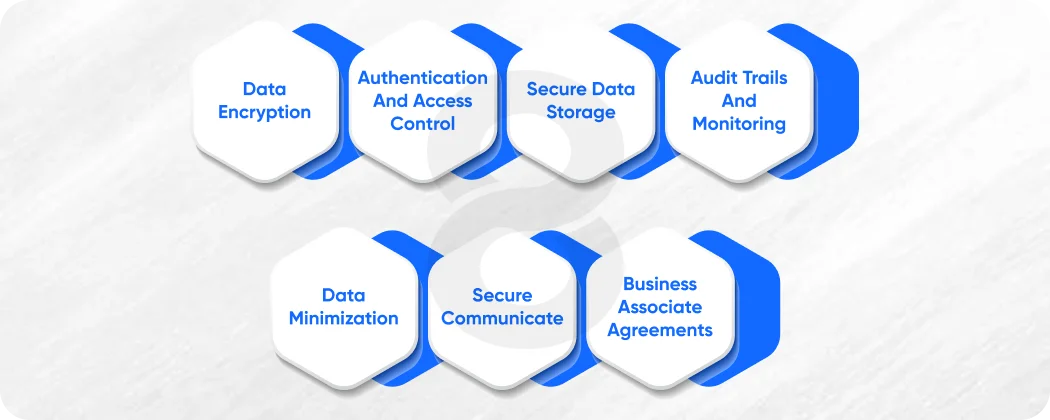
Developing an application that meets HIPAA will not be as easy as encrypting the data. It involves a holistic approach, which involves technology, process, and people. The following are the key principles that can be broken down:
1. Data Encryption
The foundation of the HIPAA compliant development of mobile apps is encryption. Any sensitive information in transit and at rest should be encrypted according to industry standards. This will make sure that data intercepted is not read without the necessary authorization.
- In-transit encryption: Secures the data between servers and computers (e.g., HTTPS, TLS)
- At-rest encryption: Protects data that is stored, such as database entries and backup files
2. Authentication and Access Control
HIPAA compliance application development is in need of tight user authentication and access controls. ePHI should only be accessed by authorized personnel, and a record of access should be kept to track usage.
- Introduction of role-based access controls (RBAC)
- Multi-factor Authentication (MFA) should be used on sensitive operations
- Periodically check and verify the privileges of access
3. Secure Data Storage
Storage is a very important factor when you develop HIPAA compliant apps. No matter the location of data storage, be it on cloud servers or on the local machines, all storage solutions should be compliant with HIPAA standards:
- HIPAA-compliant cloud providers should be utilized
- Backup encryption and develop disaster recovery guidelines
- Provide physical security of off-campus storage facilities
4. Audit Trails and Monitoring
HIPAA requires the keeping of detailed records of the ePHI activities. This involves the individuals who accessed the data, when they accessed it, and what they did. Constant surveillance is used to identify abnormalities and thwart possible violations.
5. Data Minimization
Only the required data needed to make the app work needs to be collected. This minimizes the exposure risk and makes compliance audits easier.
6. Secure Communication
In the case of apps that manage the communication between providers and patients, end-to-end encryption is necessary. Video consultations, file transfers, and messaging should have a high level of security and meet the standards of HIPAA.
7. Business Associate Agreements (BAAs)
Any third-party service that has access to ePHI, like a cloud provider or analytics systems, must enter into a BAA. This official contract will hold them legally responsible for protecting guarded data.
Read More: How to Promote Your App in 2026
Integrating GDPR Compliance with HIPAA
Although the U.S. regulates healthcare data through HIPAA, the European Union uses GDPR (General Data Protection Regulation) to govern personal data. Companies developing HIPAA-compliant apps should also address GDPR requirements if they target international markets.
The major GDPR implications are:
- Consent Management: The users are required to give their consent to the process and data collection.
- Right to Access and Erasure: The user has the right to access his/her data or request it to be deleted.
- Data Protection by Design and Determinism: The app is required to be designed in a manner that is security-aware.
- Cross-Border Data Transfers: Legal Mechanisms Make sure legal mechanisms exist to transfer data out of the EU.
HIPAA compliance application development in combination with GDPR would make your app prepared for both the domestic and international markets.
A broader analysis of HIPAA compliance tools shows the market could more than double, from about $2.7 billion in 2025 to $5.5 billion by 2035, at an estimated 7.2% CAGR over that decade, driven by increased demand for secure digital health operations.
How to Build a HIPAA Compliant App: Physical and Technical Protection
One of the main aspects of HIPAA compliant development of apps is the introduction of physical and technical protection. These security measures secure ePHI throughout the app lifecycle.
1. Physical Safeguards
Physical barriers help secure the infrastructure on which ePHI is kept and processed:
- Secure Server Locations: HIPAA-compliant cloud providers or limited data centers are already in use.
- Device Security: Secure laptops, mobile devices, and storage devices by use of encryption and remote wiping.
- Restricted Access: The access should be restricted to authorized personnel by use of biometric scanners, keycards or even security codes.
- Disaster Recovery: Have a backup and recovery strategy in place to avoid the loss of data to a natural disaster, failure of hardware theft.
2. Technical Safeguards
When constructing HIPAA compliant apps, technical protective measures are essential:
- Encryption: The ePHI sent and stored should be encrypted with industry standards.
- Access Controls and Authentication: Implement role-based access, multi-factor authentication (MFA), and strong passwords.
- Audit Trails: Keep track of all access to ePHI, including changes and deletions.
- Integrity controls: The controls should ensure that data will not be altered in an improper manner using a checksum or digital signature.
- Safe Communication: Scramble user-server communication, file communications, and API.
- Automatic Session Timeouts: Secure idle sessions to prevent unauthorized access.
- Periodic Security Testing: Perpetually test vulnerabilities, carry out penetration testing, and conduct code inspection in order to maintain compliance.
Combining both physical and technical protection, the companies will be able to construct HIPAA compliant applications that are safe, reliable, and in accordance with laws.
Read More: How Long Does It Take to Create an App
Steps to Develop a HIPAA Compliant App
The development of a healthcare application that will maintain complete compliance with HIPAA regulations requires detailed planning, together with strict execution and ongoing assessment. The procedure requires all of its steps because they protect the application from security threats while maintaining compliance with legal requirements. The following section contains an extensive explanation of the process:
1. Risk Assessment
The development of apps that meet HIPAA requirements is based on risk assessment. It entails the detection, assessment, and reduction of the possible vulnerabilities that may jeopardize electronic protected health information (ePHI).
Key Actions:
- Inventory ePHI: Add all the categories of patient data your application will process, such as medical records, personal information, payment data, and messages.
- Detect Threats: assess the possible threat to security, including unauthorized access, malware, phishing, or insider threats.
- Test Vulnerabilities: Check the architecture, API, servers, and third-party integration of your app.
- Estimate Impact: Calculate the possible outcomes of breaches of data, such as fines, loss of money, and reputation.
- Formulate a Risk Mitigation Plan: Identify the priority of actions regarding the severity and probability of occurrence, and take steps to mitigate, identify, and react to a security incident.
Conducting a thorough risk evaluation ensures that your development team understands potential threats and can implement effective mitigation measures, which is essential when building HIPAA-compliant applications.
2. Secure Architecture
HIPAA compliant app development includes designing a secure architecture. Security should not be an addition made to the app after it is developed, but must be part of the app.
Key Elements:
- Role-Based Access Control (RBAC): Access to sensitive data is allowed only to the authorized staff, but only by assigning permissions to users based on their role.
- Protected API: All API links must be secured, verified, and guarded against unauthorized intrusion.
- Session Management: Establish timeouts on sessions that are automatic and a secure system to prevent unauthorized access to idle devices.
- Cloud Security: When it comes to cloud infrastructure, select the providers who are HIPAA compliant and install firewalls, intrusion detection systems, and backup mechanisms of the servers.
The strong architecture will make the app secure by design to minimize the chances of a breach without having to overcome the HIPAA standards.
3. Data Minimization
Gathering the minimal yet crucial information about the patient is a concept referred to as data minimization. The minimization of data collection also minimizes the attack surface, which allows for keeping security and following HIPAA more easily.
Key Actions:
- Review Data Necessity: Only gather patient information that is purely essential in the functionality of the app. Do not store any extraneous information.
- Limit Access: Access sensitive data by roles and responsibilities. An example is that the administrative personnel might not require access to the in-depth medical history.
- Anonymize Where You Can: Anonymize or pseudonymize patient identities where possible and allow analytics.
Developers should adopt the principle of data minimization when building HIPAA-compliant apps, as it reduces exposure in the event of a security breach.
4. Business Associate Agreements (BAAs)
HIPAA also requires a third-party vendor that works with ePHI to sign a Business Associate Agreement (BAA) with them. This places the vendor in the position of being liable to the law to comply with HIPAA security and privacy laws.
Key Considerations:
- Name Third-Party Services: Name all third-party vendors, including cloud providers, analytics, payment processors, and messaging services.
- Negotiate BAAs: It is important to ensure that all vendors sign a BAA, which outlines the responsibilities, security controls, and breach reporting.
- Monitor Compliance: Significantly review the vendor activity to ensure additional compliance with HIPAA.
HIPAA compliant app development requires BAA since it will take responsibility away from your team, and it will guarantee your patient data a safe ecosystem.
5. Compliance Testing
You should conduct thorough testing to ensure your app complies with HIPAA before launch. This measure maintains all security operations and closes any potential gaps.
Key Testing Activities:
- Penetration Testing: Replicate attacks to recognize vulnerabilities of the infrastructure of the app, APIs, and authentication systems.
- Vulnerability Scans: Consistently scan code and servers from known vulnerabilities and misconfigurations.
- Code Reviews: Conduct comprehensive reviews to ascertain that secure coding is applied.
- Audit Preparedness: Make documentation and records that indicate adherence to HIPAA privacy and security regulations.
Through comprehensive compliance testing, you can be sure to develop HIPAA compliant applications that are both technical and regulatory compliant.
6. Continuous Monitoring and Maintenance
You cannot achieve HIPAA compliance with a single operation; you must monitor it continuously. Security threats evolve, and regulations can change, so maintaining constant vigilance is essential.
Key Practices:
- Real-Time Monitoring: Install measures that will be able to identify illegal access, abnormal activity, or possible breach promptly.
- Periodic Security Patches: Fix the vulnerabilities, update libraries, and keep the security configurations.
- Ongoing Risk Assessment: Perform periodic app architecture, workflow, and vendor practice reviews to identify new risks.
- Incident Response Plan: Have a written guideline to be employed to promptly respond to any security incidents, such as notifying the parties that their data has been affected.
Companies can also provide long-term security of their applications by investing in continuous monitoring and maintenance of their applications, and make sure that they are secure, reliable, and fully compliant with the HIPAA standards.
Tech Stacks for HIPAA Compliant App Development
To develop a HIPAA-compliant healthcare application, one will need to choose a technology stack that can provide security, privacy, encryption, and compliance at all levels. The following are the specifics of the recommended technologies:
Frontend Technologies
The frontend deals with the interactions with the user, which may be patients, physicians, and the administrative personnel. HIPAA-compliant mobile app development must have secure, responsive, and user-friendly interfaces.
Mobile App Frameworks:
- React Native: iOS and Android cross-platform application development. Supports encrypted communication and APIs.
- Flutter: The high-performance, cross-platform application with vigorous security guarantees from Google.
- Swift (cross): Native iOS development and high-quality security libraries and encryption.
- Okio (Android): HTTP-based frameworks and secure storage integration.
Frontend Security Practices:
- All communications use HTTPS using TLS 1.2 or more
- Data encryption on local storage with secure storage libraries (Keychain on iOS, and EncryptedSharedPreferences on Android)
- The integration of multi-factor authentication (MFA) to enable user log-in
2. Backend Technologies
The central part of the HIPAA compliant app development is its backend, which is in charge of storing, processing, and transmitting ePHI safely.
Programming Languages and Frameworks:
- Node.js: Small, scalable, and secure encryption and authentication libraries.
- Python (Django/Flask): Older frameworks are very secure and HIPAA-integrated.
- Java (Spring Boot): Security is enterprise-level, role-based access control, and encryption libraries.
- NET Core / C#: Supremely safe for enterprise healthcare applications, and HIPAA-compliant hosting is available.
Backend Security Features:
- Secure token storage and JWT-based authentication
- ePHI access has role-based access control (RBAC)
- OAuth 2.0 or OpenID Connect API security
- Brute-force attacks can be prevented by rate limiting and logging
3. Databases
The ePHI is stored in databases and needs to be encrypted, access-controlled, and audited.
Recommended Databases:
- PostgreSQL: Advanced encryption, row-level security, and audit logging.
- MySQL / MariaDB: It supports encryption in place, secure authentication, and control of access.
- MongoDB (Enterprise): HIPAA-compliant, encrypted storage, audit logging, cloud computing.
- Firebase (including HIPAA-compliant plan): In case of real-time apps, it is necessary to make sure that the Business Associate Agreement (BAA) is signed appropriately.
Database Security Measures:
- Crypting data in all data stored (Transparent Data Encryption)
- Encrypted off-site storage and backup
- User access policies based on granular access to ePHI to limit exposure
4. Cloud Infrastructure
Cloud infrastructure is vital in terms of scalability and security. Use HIPAA compliant cloud providers.
Recommended Providers:
- Amazon Web Services (AWS): EC2, RDS, S3, and encrypted and BAAs are all HIPAA-eligible services.
- Microsoft Azure: It provides HIPAA-compliant hosting, identity management, and encrypted storage.
- Google Cloud Platform (GCP): Audit log-compliant and security tools for cloud services.
Cloud Security Practices:
- Isolate sensitive data with Enable VPC (Virtual Private Cloud) and firewalls
- Store buckets and databases using server-side encryption
- Make CloudWatch, or Azure Monitor, audit logging and monitoring
- Install disaster recovery and backup in different locations
5. Security Tools & Libraries
HIPAA compliance is an area that needs a high level of security at all levels.
- Libraries: Encryption and Authentication:
- OpenSSL: Open source encryption of data in transit and at rest.
- bcrypt / Argon2: Secure password hashing authentication.
- JWT / OAuth2: Authentication API using tokens.
- Keychain (iOS) / EncryptedSharedPreferences (Android): Local data secure storage.
Example Full Tech Stack for a HIPAA-Compliant Mobile App
|
Layer |
Recommended Technology |
HIPAA Benefit |
| Mobile Frontend | React Native / Flutter |
Cross-platform security and encryption support |
| Native Mobile | Swift (iOS), Kotlin (Android) |
Secure local storage and biometrics integration |
| Backend | Node.js, Python (Django), Java (Spring Boot) |
Secure API development, RBAC, encryption libraries |
| Database | PostgreSQL, MongoDB Enterprise |
Encryption at rest, audit logging, fine-grained access control |
| Cloud Hosting | AWS, Azure, GCP |
HIPAA-compliant infrastructure with BAA support |
| Authentication | OAuth 2.0, JWT, MFA |
Secure login, role-based access |
| Encryption | AES-256, TLS 1.2+ |
Data protection in transit and at rest |
| Monitoring & Security | ELK, Splunk, Snyk |
Continuous auditing, threat detection, vulnerability scanning |
| DevOps | Jenkins, GitHub Actions, Terraform |
Automated builds, security testing, compliance enforcement |
By choosing the appropriate tech stack, enterprises can ensure they create HIPAA-compliant applications that secure data, scale effectively, and deploy seamlessly in healthcare settings. This is due to the layer of protective frontend framework coupled with powerful backend technologies and HIPAA-compliant databases and cloud infrastructure, which ensures full security of confidential patient data.
Read More: What Is QA Testing in Software – Our Experts Insights
Reasons to Select 8ration to Develop HIPAA Compliant App

In case of HIPAA compliant app development, 8ration is not another development firm; we are your reliable friend to develop a secure, scalable, and hundred percent compliant healthcare app. This is the reason why companies prefer us to develop HIPAA compliant applications:
- Skills That Count: Our team is highly skilled in the domain of healthcare technology, mobile application development, and secure architecture. We are perfectly aware of how to introduce HIPAA regulations and GDPR concerns to a seamless process.
- Security First Approach: Starting with encryption, multi-factor authentication, audit trail, and secure cloud infrastructure, we incorporate HIPAA compliant app development principles in each layer of your application.
- Templates Do Not Exist: Each healthcare application is different. We develop and create HIPAA compliant applications that meet your business objectives, patients, and workflow.
- End-to-End Compliance Support: Since Business Associate Agreements (BAAs) require continued monitoring and updates, 8ration keeps your app compliant today and tomorrow.
- Quick Growth, Consistent Supply: Light-Speed does not mean Less Compliance. Our agile approach and heavy security check-ups are the key elements that allow us to present strong, HIPAA-compliant mobile applications development solutions within their timelines.
- Scalable & Future-Proof: Our solutions are made to take advantage of your growth. You will never need to worry about a HIPAA-compliant app again because we can scale your application to a hundred or a million users.
Collaborating with 8ration will involve not only rolling out an app but a secure, trusted, and regulatory-compliant healthcare solution.
Final Thoughts
Privacy is no longer a choice in the modern healthcare environment; it is a necessity. By developing an app that is HIPAA compliant, you can guarantee the safety of the data of your patients, keep your business on course, and remain a reliable choice compared to the rest of the competitors.
Through proper planning, physical and technical security, use of an appropriate technology stack, and collaboration with a well-tested team such as 8ration, it is possible to develop HIPAA compliant applications that are safe, user-friendly, and scalable.
HIPAA compliance is not a one-box solution, be it telemedicine, patient portals, or wearable health solutions, but a commitment to excellence, trust, and patient safety. And 8ration, you are in masterful hands to bring forward apps that do not disappoint the promise.
Build an app that complies with HIPAA today. Secure patient data, remain compliant, and be a leader in healthcare innovation with 8ration.