


You have a game idea and a budget spreadsheet that keeps you up at night. Anyone who has shipped a game knows the gap between the number in the pitch deck and the money that actually leaves the bank account. That gap is the real story behind mobile game development cost and most guides skip straight past it.
Here is the honest range before the breakdown begins. A simple game can cost around $15K to $30K. A polished midcore or multiplayer game can run past $300K before a single marketing dollar gets spent. What you actually pay comes down to two things, which are what you decide to build and how long you keep it alive once it ships.
Mobile games pulled in roughly $103 billion last year, about half of everything gaming earned worldwide. That figure is what gets founders to the table. It also buries the harder truth waiting a few sections from here, the spending that starts the day the build is finished.
What You’re Really Paying For
People hear game development and picture a programmer and an artist in a room. The actual bill spreads across seven or eight workstreams that each eat into the budget. A game design document defines the loop and the economy before anyone codes.
UI and UX work turns that plan into screens players can read in one tap. Core development builds the gameplay logic and state handling that make the thing feel like a game instead of a slideshow.
Then come the parts founders forget to price in. Backend work handles multiplayer sync, cloud saves, and matchmaking, plus the leaderboards and player profiles nobody thinks about until they break. One real multiplayer feature can quietly cost more than your entire front end.
Quality assurance is its own grind, because you are testing across dozens of phones, and a crash on a $200 Android loses you a player just as fast as a crash on the latest flagship. Then there is monetization, where the job is wiring in ads, purchases, and paywalls without making players feel like they walked into a toll booth.
The table below shows where a typical mobile game development cost lands across these layers. Treat the ranges as a starting frame, since a heavy genre can push any line item higher.
| Workstream | Typical Cost Range | What It Covers |
|---|---|---|
| Game design document | $1,500 to $5K | Core loop, reward logic, economy, monetization plan |
| UI and UX design | $2K to $8K | Screens, flows, icons, animations, responsive assets |
| Core development | $15K to $100K and up | Gameplay logic, physics, client side code |
| Backend and APIs | $5K to $30K | Multiplayer sync, cloud saves, profiles, leaderboards |
| QA and testing | $3K to $10K | Device coverage, performance, bug fixing |
| Monetization setup | $1,500 to $5K | Ad SDKs, purchase flows, paywall handling |
| Project management | 10 to 20 percent of total | Sprint planning, version control, stakeholder updates |
Mobile Game Development Cost by Type and Genre
The fastest way to estimate a budget is to be honest about what kind of game you are making. A two touch arcade game and a real time strategy title share almost nothing on the balance sheet.
Game type sets the floor, and genre adjusts it from there. The cost to make a game app also shifts with platform, since an iOS build, an Android build, and a cross platform release each carry a different price tag.
Hypercasual games sit at the bottom. They use minimal art, one core mechanic, and ad based money, and small teams ship them in weeks. Casual and puzzle games add cleaner UI, light progression, and a mix of ads and purchases.
Midcore games introduce social features, multiplayer, and custom systems, which is where budgets cross into six figures. AAA style mobile games compete with console ports through heavy 3D, real time sync, and large content pipelines.
| Game Type | Typical Cost Range | Build Time | What You Get |
|---|---|---|---|
| Hypercasual | $15,000 to $30,000 | 1 to 2 months | One mechanic, simple 2D art, ad money |
| Casual and Puzzle | $30,000 to $60,000 | 2 to 4 months | Clean UI, levels, ads plus purchases |
| Midcore and Strategy | $60,000 to $150,000 | 4 to 6 months | Social features, multiplayer, custom logic |
| AAA Mobile | $150,000 to $500,000 and up | 6 to 12 months and longer | Heavy 3D, real time servers, large content load |
Genre layers on top of type. A puzzle game stays cheap because the logic is contained. An RPG climbs fast once you add dialogue and 3D world. A real time multiplayer game carries server costs that never go away.
Picking a genre your team has shipped before saves more money than any tooling trick, because unfamiliar systems double the time spent guessing. Pinning down the cost by genre and the cost by platform early keeps the wider game app development cost predictable once production begins.
The Costs That Never Make It Into the First Budget
This is the section that should have a warning label. Most game budgets do not fail on the build. They fail on everything that lands after the build, when the founder assumed the hard part was over.
Marketing leads the list. A good game with no user acquisition sinks without a ripple and the spend is brutal. For most launches, the marketing budget in the first six months ends up about equal to what you spent building the thing, and plenty of times it runs double.
Cost per install for casual games sits around $2.50 to $4 in 2026, and midcore titles pay a good bit more for every player who actually spends money. That spend buys attention you can no longer get for free.
And it only gets harder from here. Mobile game in app revenue barely moved last year, up 1.3 percent to $82 billion, while downloads actually slipped and studios quietly gave up chasing new installs to wring more out of the players they already had.
The money is there. It just pools around a tiny club of publishers while everyone else fights over the scraps. A great build does not fix a market where getting noticed costs more every quarter.
Then there is the part nobody warns you about until it bills you. Server and cloud costs climb right alongside your player count, so a multiplayer game paying $500 a month at launch can blow past $20K a month if the thing actually takes off. Live operations and content updates run 15 to 25 percent of your initial budget every year.
App store compliance and OS updates demand ongoing engineering time. These are not edge cases but the standard cost of keeping a mobile game alive.
What Pushes the Number Up or Down
Two games in the same genre can land a hundred thousand dollars apart. The difference comes from a short list of decisions, and most of them get made in the first two weeks.
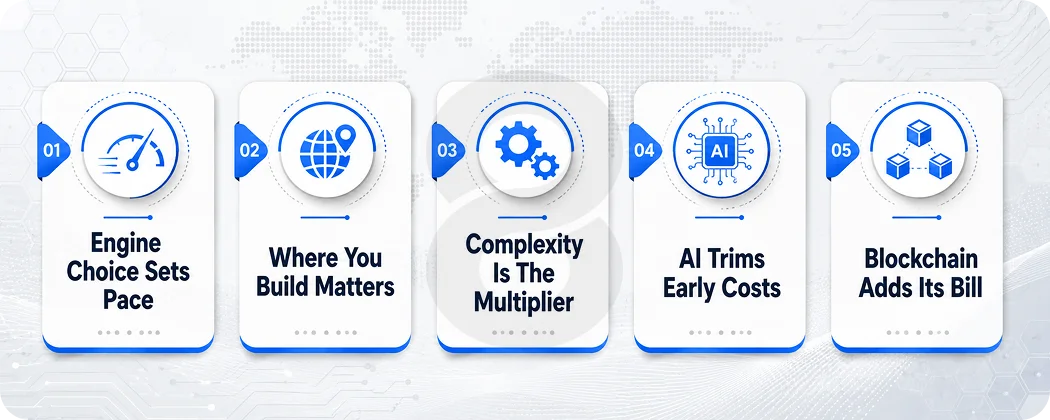
Engine choice matters, though less than people think. Unity stays the default for mobile because the talent pool is wide and builds iterate fast, which usually makes it the cheaper path.
Unreal Engine produces sharper 3D and suits high fidelity work, but it asks for pricier developers and higher end devices. Switching engines mid project is the expensive mistake, since it can double a timeline overnight.
Team location moves the number more than any feature. The first call is who builds it, whether that means a freelancer, an in house game development team, or a mobile game development company that has shipped the genre before.
Senior developers in the United States bill $100 to $280 an hour, while skilled teams in Eastern Europe and South Asia deliver comparable work at a fraction of that. Many studios run a hybrid model that keeps core vision in house while sending art, animation, and QA to offshore partners. That approach trims overall cost by 30 to 50 percent without gutting quality.
Region shapes the entry point as much as the hourly rate. A North American studio rarely starts a serious build under $80K, while a vetted team in Eastern Europe or South Asia can deliver the same MVP closer to $20K to $35K.
The trade is rarely about skill anymore, since the quality gap has narrowed sharply. It comes down more to time zones, communication, and how much hand holding a founder wants early on. Choosing where to build is one lever that quietly decides the whole mobile game development cost.
Complexity is the quiet multiplier. Real time combat, procedural levels, and smart difficulty all demand advanced architecture and heavier testing. Adding AI driven systems like dynamic difficulty or adaptive NPC behavior raises both build cost and the skill level you need on the team.
Some studios also add blockchain based ownership for in game assets, which opens new revenue paths but carries its own integration bill.
How Long It Takes to Build a Mobile Game
Time is cost, so a schedule is really the budget viewed from another angle. A hypercasual game can go from idea to store in six to eight weeks, because the scope stays small and the team stays lean.
A casual or puzzle game usually wants two to four months, once you factor in levels, progression, and figuring out how it makes money. Midcore and multiplayer games stretch closer to six to nine months. A heavy 3D title can eat a year or more before it stops feeling half done.
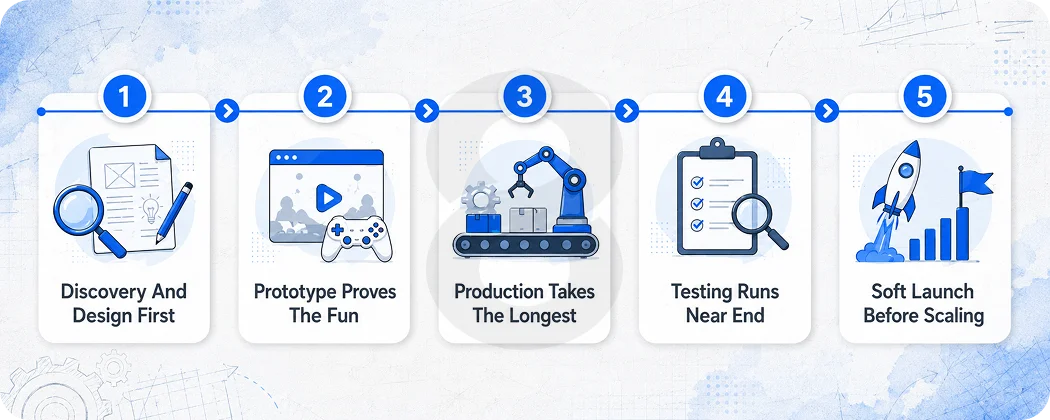
The work moves through a handful of clear stages and trying to skip one almost always comes back to bite you later. A discovery and design phase locks the concept and the economy first. A prototype or vertical slice then proves the core loop is fun before real money goes into production.
Production builds the systems and the content, which is the longest stretch by far. Testing runs near the end, and a soft launch in a smaller market catches the problems that only surface with real players.
One habit saves more time than any other. Founders who freeze their feature list before production starts ship faster and cheaper, because every mid build change ripples through art, code, and testing at once.
Scope creep is the quiet reason games miss their dates, and a missed date is just a bigger invoice wearing a calendar. The teams that protect the schedule end up protecting the budget too.
Read More: How Long Does it Take to Make a Video Game
Why Your Money Model Shapes the Build Cost
How a game makes money is a design decision and a budget decision at the same time. A simple ad integration costs almost nothing to wire in.
A full purchase economy with consumables, bundles, and dynamic offers takes real engineering, and a battle pass or gacha system can add tens of thousands on its own. The more your revenue leans on how players actually behave, the more you end up paying for analytics and testing to make any of it work.
Most of the games doing well in 2026 run a hybrid setup that mixes in app advertising with purchases. A casual player watches a rewarded video to keep going. A committed one buys a bundle to kill the ads and unlock the extras.
That blend pulls in more per user but it also means you are building two money paths instead of one. Each path is another set of screens, another integration, and another thing QA has to break before launch.
A growing number of studios now run direct to consumer web stores to dodge the cut app stores take on every purchase. The savings are real, and a web store can lift net margins. It also adds a payment system, a login flow, and compliance work that a pure in app model avoids.
None of this argues for skipping monetization planning. It argues for deciding the model early, because bolting a complex economy onto a finished game costs far more than designing the build around it from the start.
Read More: Ideas for Game Development: How Businesses Can Enter the Gaming Market
How to Spend Less Without Shipping a Worse Game
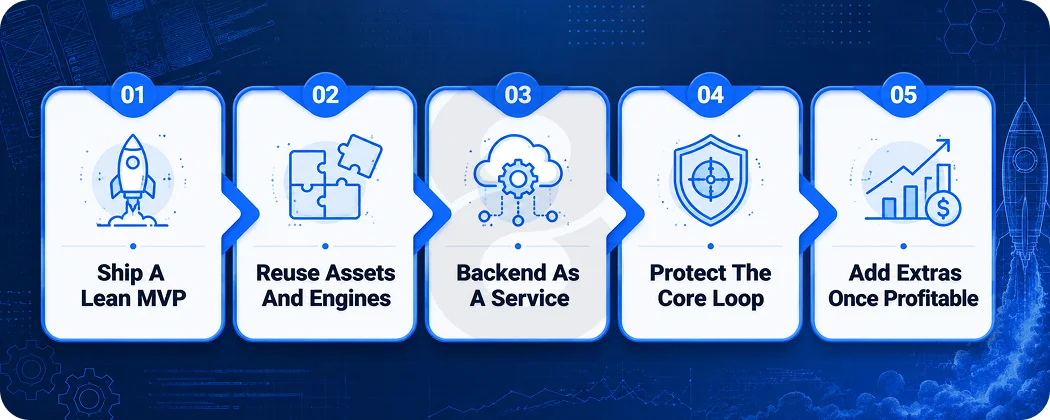
You do not need a AAA budget to put out a game that earns. Reducing game development cost comes down to scope discipline far more than cheap labor. You also need the nerve to cut anything that does not serve the core loop. The studios that bleed money are the ones building features nobody asked for.
Start with a lean version that proves the idea actually works. Ship the core gameplay and the main way it makes money. Add the one hook that makes the game what it is. Then bolt on cosmetics and social features after real players tell you the thing has legs.
That MVP first habit keeps a mobile game development cost from ballooning on guesses. Plenty of profitable casual games got out the door for under $50K doing exactly that.
Lean on what already exists. Asset libraries and prebuilt engines cut design time way down. Backend as a service tools like Firebase or PlayFab handle your authentication and analytics so you skip building all of it from scratch.
Put the hours you save into the parts players actually feel. That means the core loop, the pacing, and those first few minutes that decide whether anyone comes back the next day.
Some things earn their cost. Multiplayer and in app purchases drive revenue over the long haul, so they stay. Community boards and elaborate avatar systems can sit on the shelf until the numbers say otherwise.
A phased rollout and a tight list of features you genuinely cannot launch without will pull a serious chunk out of your starting budget. And you still ship something people want to play.
Read More: What Are AAA Games? Breaking Down the Biggest Titles in Gaming
How 8ration Keeps a Game Budget Honest
Plenty of agencies hand over a vague estimate and hope the scope holds. 8ration runs mobile game projects the other way, starting with a discovery phase that maps the business goal to the gameplay before anyone writes code. That front loaded planning kills the expensive mid project pivots that wreck most budgets.
The build runs in short sprints with something playable early, so a founder gets hands on the core gameplay loop in a few weeks instead of waiting half a year to find out whether the game is any fun.
A dedicated game studio running the whole pipeline usually beats stitching a bunch of freelancers together. The art, code, backend software that powers multiplayer, and testing all stay in step with each other. When the time comes to ship, the same team handles getting the app onto both stores and through their review rules.
Cost transparency is the part founders remember. Every proposal includes best case, expected, and worst case numbers with the assumptions spelled out, so there are no surprises buried in a change request.
For anyone who just wants a fast ballpark, you can estimate a build budget in a couple of minutes and bring real numbers into the first conversation.