


The selection of a correct backend can or cannot make your app successful. Speed, scalability, and future-proofing your product are not the only battles. Node.js vs. Python is a language battle.
Node.js is better for high-concurrency, real-time applications with a lightweight, event-driven architecture. In contrast, Python is better for AI, data-intensive applications, and rapid prototyping, with clean syntax and reusable libraries.
To the founders, CTOs, and product owners, the backend is not merely a part of the infrastructure but the driver of the user experience, APIs, security, and database communication.
This article compares Node.js and Python based on their performance, ecosystem, productivity, and real-world applications to assist you in deciding the most appropriate one.
Understanding the Foundations
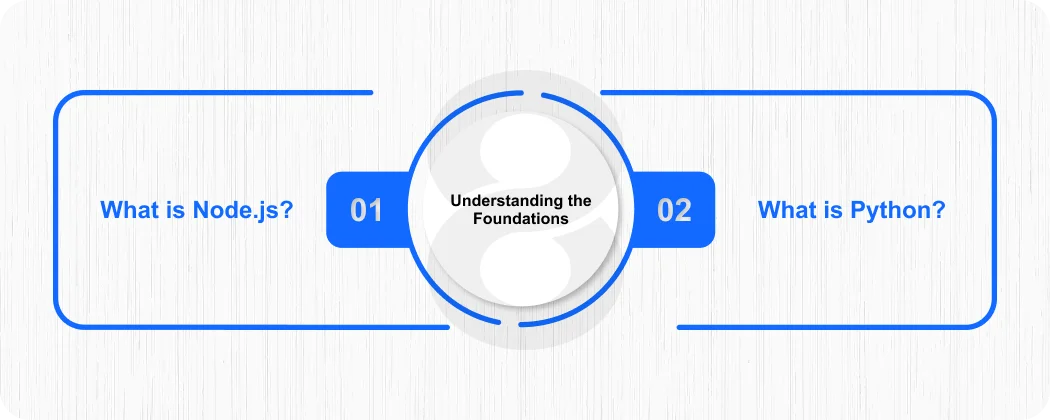
It is important to gain an insight into what each technology is all about before we proceed any further to the comparison of Node.js and Python.
What is Node.js?
Node.js is a JavaScript server-side environment that has been written in the V8 engine of Chrome. It enables programmers to execute JavaScript out of the browser. Node.js is a non-blocking, event-driven platform, therefore well-suited to the management of concurrent requests.
As the need for real-time and microservices increases, Node.js development is chosen by both startups and businesses that create scalable web and mobile back-end services.
Statista indicates that JavaScript is currently the most adopted programming language across the world, with more than 63 percent of developers utilizing it as of 2023.
Naturally, that hegemony also affects the adoption of the backends.
What is Python?
Python is an interpreted, high-level language with a reputation for being readable and fast to write. It is a language that promotes various paradigms such as object oriented, procedural, and functional programming.
Python is popular in web applications, data science, AI, automation, and enterprise systems. Python is also very productive in the backend systems through frameworks such as Django and Flask.
Statista documents that Python has always been among the three most frequently used programming languages in the world.
When comparing Python to Node.js, businesses are likely to be comparing performance-based architecture and versatility-based development.
Node.js vs Python: Core Technical Differences
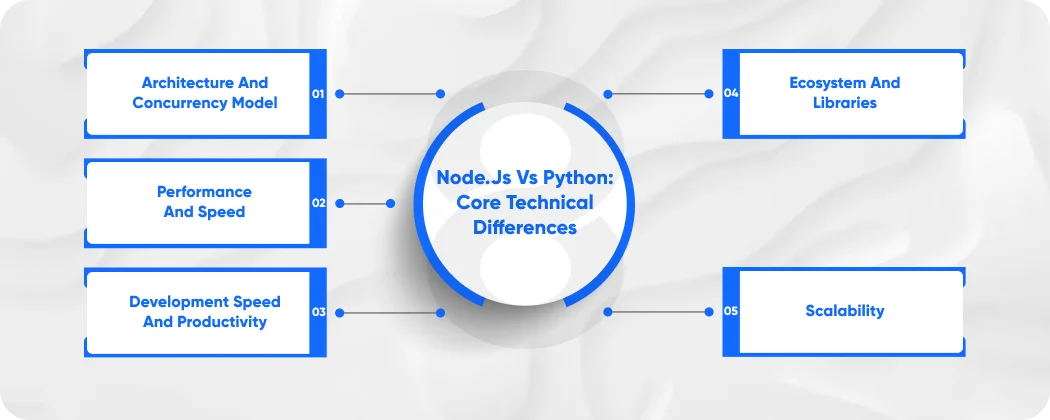
At this point, we will dissect the actual differences between Node.js and Python in backend app development.
1. Architecture and Concurrency Model
The Node.js platform is a non-blocking, single-thread, event-driven I/O platform. It has an event loop with the capacity to support thousands of connections simultaneously.
Historically, Python is a multi-threaded system. In CPython, though, the execution of pure, CPU-bound, multi-threaded code is not permitted by the Global Interpreter Lock, abbreviated as GIL.
What does this mean for you?
When you have an app requiring a very high level of concurrency with real-time updates, e.g., chat systems or live dashboards, the performance of Node.js vs. Python might lean towards Node.js.
Python might have superior ecosystem support in case your application is heavy or highly depends on scientific computing and AI libraries.
2. Performance and Speed
Comparing Node.js to Python speed, most businesses compare the speed of request handling and response time in heavy traffic.
The advantages of Node.js performance include:
- V8 engine compilation
- Non-blocking architecture
- Effective management of I/O-bound processes
The interpreted Python can be slow in pure execution benchmarks. But performance can be very optimized with CPU-intensive workloads that are combined with C-based libraries such as NumPy.
Most real-time web applications have Node.js vs. Python performance testing, whereby Node.js can serve concurrent users more effectively at a lower latency.
Nonetheless, the following factors also influence backend performance:
- Server architecture
- Database design
- Caching strategy
- Load balancing
So, speed does not depend only on the language.
3. Development Speed and Productivity
In the case of Node.js vs Python, the speed at which it can be developed is a crucial consideration.
The syntax of Python is readable. This simplifies the process of onboarding and lowers the code complexity. Such frameworks as Django have built-in authentication, ORM, and administration panels.
Full-stack JavaScript development, in turn, is supported by the development of Node.js. That is, your frontend and backend teams will be able to share logic, reuse validation layers, and be consistent.
Python can provide a small bit of faster prototyping in the case of startups developing MVPs. Nonetheless, when the teams are already well versed in JavaScript development, Node.js would help them to switch contexts less and enhance their productivity.
4. Ecosystem and Libraries
Python boasts a strong ecosystem in
- Artificial Intelligence
- Machine Learning
- Data analytics
- Automation
- Scientific computing
Node.js dominates in:
- Real-time applications
- Streaming platforms
- Microservices architecture
- RESTful APIs
- Serverless applications
In the event of developing a backend based on AI, Python is likely the default. Many businesses would want to know why to use Node.js in case they want to build scalable APIs or real-time systems. The solution is usually found in its concurrent nature and lightweight design.
5. Scalability
The Node vs Python debate has one of the largest decision drivers with scalability.
Horizontal scaling is built into Node.js. It is very good in microservice-based systems.
Python is also capable of scalability, although there is frequently additional architectural work needed, like
- Asynchronous systems such as FastAPI
- Task queues like Celery
- External load balancers
When rapid scaling and high concurrency are on your product roadmap, Node.js can often fit better.
Read More: 10 Web Application Frameworks – Selecting the Best Tech for Your ROI
Node.js vs Python: Real-World Use Cases

Knowledge of the application will aid in the decision-making of Node.js vs Python, allowing businesses to know how to match technology selection to app type, performance requirements, scalability requirements, and expertise of the staff.
When to Choose Node.js
Select Node.js when you are developing:
- Real-time chat applications
- Streaming services
- Collaborative tools
- APIs serving mobile apps
- IoT backends
Companies such as Netflix and PayPal have been able to use Node.js to handle high traffic simultaneously, create real-time services, and provide highly responsive, scalable, and efficient user experiences.
When to Choose Python
Python is mostly used to build:
- AI-driven applications
- Data-heavy platforms
- Analytics dashboards
- Automation systems
- FinTech risk engines
Python is found to be excellent in machine learning pipelines and computational backends; its libraries are robust and efficient in data processing and able to integrate with AI-based frameworks in analytics, automation, and complex algorithm solutions.
Node.js vs Python in Modern App Ecosystems
Backend decisions also have a great impact on the smoothness of your frontend and mobile frameworks at scale. In a comparison between Node.js and Python, one should take into account the extent to which each of the backends is integrated with cross-platform ecosystems and API-driven architectures.
To illustrate, when developing cross-platform applications and comparing Flutter and React Native applications, the compatibility of the backend is a strategic choice. React Native is compatible with Node.js because both platforms share similarities in the JavaScript low-level features, making it easy to deal with data and development processes.
Nevertheless, Python and Node.js can effectively drive RESTful or GraphQL APIs that are used by Flutter and React Native. Eventually, a considered system architecture is more important than language.
Node.js vs Python: Cost Factors That Matter Most
The decision between Python and Node.js must not be restricted to the hourly rates of the developers. Rather, consider the financial impact of the long term using 5 factors:
- Availability of developers and costs of hiring locally
- Speed of time-to-market and MVP development
- Scalability of infrastructure, hosting efficiency
- The maturity of the ecosystem and integration with third parties
- Complexity of long-term maintenance and upgrade
The full-stack JavaScript environment can be cost-reduced with Node.js, and AI development costs can be reduced with Python due to strongly developed libraries. Finally, emphasize reducing the overall cost of ownership within five years.
Read More: 40 Best Technology Stacks for Mobile App Development
Python vs Node.js: Security Considerations
Comparing Python and Node.js concerning the security of the back-end, one must realize that both of the frameworks offer powerful tools and libraries to secure the applications against the current threats.
Node.js:
- Protecting the middleware ecosystem
- Secure API authentication packages
Python:
- Django has built-in security measures
- Effective ORM defense against injection attacks
Security in the end relies on the right architectural design, code standards, and implementation practice. Selecting either Node.js or Python will not be safe until best practices are the order of the day during the development lifecycle.
So, Which One Should You Choose?
The Node.js vs Python argument is a complicated issue with no universal answer. The choice of backend will be determined by the performance requirements of your app, scalability requirements, expertise of your team, and the long term vision of the product.
Choose Node.js if:
- You need high concurrency
- You are developing real-time platforms
- Your company deals with JavaScript development
- You need a common frontend and backend language
Choose Python if:
- You are creating AI-based platforms
- Data science is critical to your product
- One of the priorities is rapid prototyping
- You need solid infrastructures that are built-in
Finally, the correct decision involves weighing the technical architecture, business purpose, and developer capacity so that your app backend is capable of accommodating growth, dependability, and creativity, and at the same time reduces risks and maximizes efficiency for both current and future needs.
Why Businesses Trust Us for Backend Architecture Decisions
We do not simply paper compare the technologies at 8ration. The goals that your product will achieve, the traffic that you will handle, security needs, and the scales that you will achieve in the long term are all analyzed before we can suggest a stack to you.
Be it an architecture of high-performance, high-concurrency systems in Node.js or a data architecture built in Python, our architects create the performance-optimized, secure, and future-ready backend infrastructures.
We are not much concerned with the details: we are just building systems that are easily scalable, minimize risks in operations, and help you get to market faster.
Final Thoughts!
In a comparison between Node.js and Python, do not make decisions based on trends. Select depending on performance requirements, ecosystem compatibility, and scalability.
The two technologies are potent. Both drives are business-grade systems. The variation is in their suitability to your technical requirements for a product.
When you have a high-performance, scalable, secure backend on your next app development project, our team will assist you in architecture evaluation, performance benchmarking, and systems design on a future-ready system that fits your growth plan.
Since eventually, the backend technology is not merely code. It is the basis of the scale, reliability, and innovation of your product.