



The idea to create a healthcare app in 2026 is one of the best business choices you can make, but one of the most complicated ones. The technical depth is almost unparalleled by any other digital product with HIPAA-compliant architecture and EHR integrations, real-time telemedicine dashboards, and AI-based diagnostics.
However, the biggest question that founders, product managers, and healthcare executives ask before they take the plunge is: How much does it cost to develop a healthcare app?
We disaggregated all the information on types of apps and compliance costs to team structure and secret costs in this comprehensive guide, so you can proceed with real numbers and true certainty.
Why the Healthcare App Market Demands Serious Investment in 2026
Before diving into numbers, it is important to understand why healthcare app development is not a place to cut corners.
According to Grand View Research, the global mHealth apps market was valued at $37.5 billion in 2024 and is projected to reach $86.37 billion by 2030, growing at a CAGR of 14.8%. Meanwhile, Fortune Business Insights reports that the mHealth apps market is expected to grow from $45.14 billion in 2026 to $113.2 billion by 2034. And Statista confirms that health and fitness apps surpassed 3.6 billion downloads in 2024 alone.
Moreover, these numbers are not just impressive. They signal that user demand is real, sustainable, and accelerating. Clinics, hospitals, insurers, and independent developers are all racing to build digital health products. That means the bar for quality is rising too. A poorly designed, insecure, or non-compliant app will not survive in this market. Consequently, a thoughtful investment in healthcare app development is not optional; it is the price of entry.
Read More: Healthcare Web App Development in 2026
What Does Healthcare App Development Cost in 2026?
Here is the broad-strokes answer: healthcare app development costs range from $40,000 to $400,000+ depending on complexity, platform choice, feature depth, and the location of your development team.
Complexity Level |
Example Apps |
Estimated Cost |
Timeline |
| Simple | Medication reminders, appointment booking | $40,000 – $100,000 | 3 – 6 months |
| Medium | Telemedicine, remote patient monitoring | $100,000 – $200,000 | 6 – 9 months |
| Advanced | AI diagnostics, mental health platforms | $200,000 – $300,000 | 9 – 12 months |
| Enterprise-Grade | EHR-integrated systems, hospital management | $300,000 – $500,000+ | 12 – 18 months |
These are starting points, not ceilings. The actual cost of developing a health app shifts based on a layered set of variables that we will now explore in detail.
Key Factors That Drive the Cost of Developing a Healthcare Mobile App
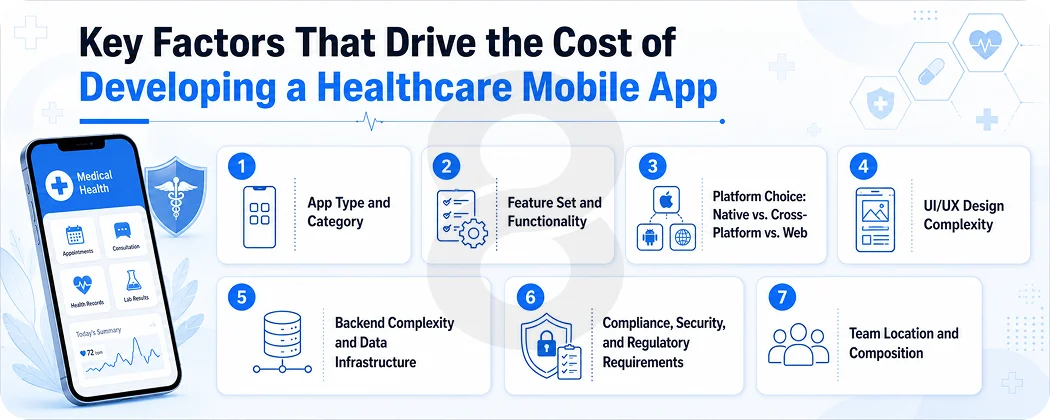
1. App Type and Category
Not all healthcare apps are built the same. A fitness tracker and an AI-powered diagnostic tool are worlds apart in terms of engineering complexity, regulatory exposure, and integration requirements. Below are the most common categories and their typical cost ranges.
Telemedicine Apps
Telemedicine app development cost typically falls between $50,000 and $200,000. These apps require secure video streaming, end-to-end encrypted messaging, appointment scheduling logic, and payment processing.
The technical infrastructure for real-time audio and video alone adds meaningful complexity and cost. Additionally, these apps must comply with regulations like HIPAA in the US and GDPR in Europe.
EHR/EMR Integration Apps
These are among the most expensive categories, often ranging from $100,000 to $300,000 or more. Integrating with electronic health record systems demands specialized API work, strict security protocols, and extensive compatibility testing with existing hospital infrastructure. As a result, the timeline is also longer, typically 12 to 18 months.
Mental Health and Chronic Disease Management Apps
Both categories sit in the $50,000 to $150,000 range for mid-complexity builds. They share a common challenge: extremely sensitive data that requires robust security, careful UX design for vulnerable users, and ongoing regulatory compliance.
Fitness and Wellness Apps
These are generally the most accessible entry point, starting at around $40,000 for basic builds. However, once you introduce wearable integrations, AI-driven coaching, or social features, the cost of developing a health app in this category can scale quickly.
2. Feature Set and Functionality
Features are the biggest individual cost driver in healthcare app development. Basic features like user profiles, appointment booking, and health dashboards cost far less than advanced features like real-time vitals monitoring, AI symptom checkers, or blockchain-based patient data management.
Here is a practical breakdown:
Feature Tier |
Examples |
Cost Estimate |
| Basic | User profiles, scheduling, notifications | $10,000 – $20,000 |
| Moderate | In-app messaging, payments, analytics | $20,000 – $30,000 |
| Advanced | IoT integration, AI recommendations, video consults | $30,000 – $50,000 |
Furthermore, you need to factor in the cost of compliance-specific features: audit trails, multi-factor authentication, data encryption layers, and role-based access control. These are non-negotiable in any clinical-grade app and add both cost and time.
3. Platform Choice: Native vs. Cross-Platform vs. Web
The platform decision significantly affects your medical app development cost.
Native iOS and Android apps deliver the best performance and deepest hardware access, but they require separate codebases. This nearly doubles the development effort and cost for a two-platform launch.
Cross-platform apps built with frameworks like Flutter or React Native share a single codebase across iOS and Android. This approach can reduce development costs by 30 to 40% and shorten the healthcare app development timeline significantly. For most early-stage healthcare products, cross-platform is the smarter starting point.
Web apps and Progressive Web Apps (PWAs) are the most budget-friendly option and suit administrative tools or provider-facing dashboards well, though they may lack the offline capabilities and native device integrations that patient-facing apps often require.
4. UI/UX Design Complexity
Healthcare UI/UX is not a place to go generic. Your users include elderly patients, people managing chronic conditions, and overworked clinicians. Accessibility, clarity, and trust-building design patterns are mandatory.
Design Type |
Description |
Cost |
| Standard | Template-based, minimal customization | $5,000 – $10,000 |
| Custom | Tailored flows, original branding | $10,000 – $30,000 |
| Advanced | Animations, 3D elements, accessible design systems | $30,000 – $50,000 |
Investing in strong UX upfront also reduces support costs and user churn down the road.
5. Backend Complexity and Data Infrastructure
The backend is where healthcare apps live or die. A simple backend with basic authentication and a relational database starts at around $5,000 to $15,000.
However, a complex backend with real-time data pipelines, multi-tenant architecture, HL7/FHIR API support, and scalable cloud infrastructure can run $20,000 to $40,000 just for the core engineering, before cloud hosting costs.
Speaking of which, hosting a healthcare app on HIPAA-compliant cloud infrastructure (AWS, Google Cloud, or Azure with Business Associate Agreements in place) costs roughly $500 to $2,000 per month for mid-scale apps, rising to $5,000+ per month for enterprise deployments.
6. Compliance, Security, and Regulatory Requirements
This is where many healthcare app budgets get blindsided. HIPAA, GDPR, HITECH, and FDA regulations for certain digital health tools are not optional checkboxes. They are foundational requirements that must be engineered into the product from day one.
Initial compliance setup typically costs $15,000 to $40,000. Ongoing annual security audits add another $5,000 to $20,000 per year. Data encryption and multi-factor authentication add $10,000 to $50,000 depending on implementation depth.
Skipping compliance is never worth the risk. Regulatory fines for HIPAA violations alone can reach $1.9 million per violation category per year.
7. Team Location and Composition
Developer hourly rates vary dramatically by geography:
Region |
Hourly Rate |
| USA / Canada | $100 – $200 |
| Western Europe | $80 – $150 |
| Eastern Europe | $40 – $80 |
| South Asia (Pakistan, India) | $25 – $60 |
| Southeast Asia | $30 – $70 |
A full healthcare development team typically includes a project manager, frontend and backend developers, UI/UX designers, QA engineers, and a security or compliance specialist. Choosing the right partner, not just the cheapest, is critical in a regulated domain like healthcare.
Read More: 10 Telehealth Mobile App Success Stories: What Worked and What Didn’t
The Cost to Build a Healthcare App: Stage-by-Stage Breakdown
Understanding where your money goes at each stage helps you plan more accurately and avoid surprises.
Development Stage |
Cost Range |
Timeline |
| Discovery and Market Research | $2,000 – $10,000 | 1 – 2 weeks |
| Feature Definition and Scoping | $4,000 – $20,000 | 2 – 4 weeks |
| UI/UX Design | $5,000 – $50,000 | 4 – 6 weeks |
| Compliance and Security Architecture | $5,000 – $25,000 | 2 – 3 weeks |
| Frontend + Backend Development | $20,000 – $200,000 | 8 – 16 weeks |
| QA Testing and Security Audits | $5,000 – $25,000 | 3 – 5 weeks |
| Deployment and Launch | $3,000 – $10,000 | 1 – 2 weeks |
| Annual Maintenance | $5,000 – $30,000/year | Ongoing |
A common approach among successful healthcare startups is to begin with a Minimum Viable Product (MVP). An MVP focuses only on the core features that deliver immediate clinical or patient value.
This strategy can reduce initial costs by 40 to 60% and gets you to market in 3 to 6 months instead of 12 to 18. Real user feedback then guides the next phase of development, which is a much smarter way to allocate capital.
Hidden Costs You Must Budget For
Beyond the core build, several often-overlooked expenses add up quickly.
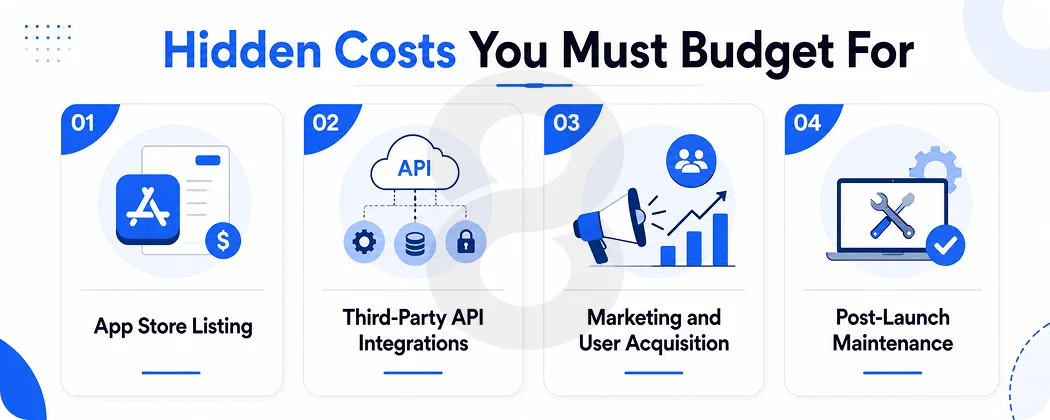
- App Store Listing: Google Play charges a one-time $25 fee; Apple App Store charges $99 per year. However, app store review and approval for medical apps can take weeks and may require documentation.
- Third-Party API Integrations: Payment gateways (Stripe, PayPal), communication tools (Twilio for HIPAA-compliant messaging), and EHR integrations (Epic, Cerner) all carry licensing or per-use fees. Budget $5,000 to $30,000 for integrations depending on complexity.
- Marketing and User Acquisition: Even the best app fails without distribution. Pre-launch campaigns, App Store Optimization (ASO), and paid acquisition can cost $10,000 to $50,000 per month in a competitive market.
- Post-Launch Maintenance: Plan to spend 15 to 20% of your original development budget annually on maintenance, security patches, OS compatibility updates, and feature improvements.
Read More: 13 Must-Have EHR Features in 2026 for Efficient Healthcare Management
AI, IoT, and Emerging Technologies: What They Add to the Cost
How AI Is Reshaping Healthcare App Development
AI-powered healthcare apps are transforming diagnostics, patient engagement, and clinical workflow automation. From NLP-driven symptom checkers to predictive readmission models and computer vision-based imaging analysis, AI integration adds $100,000 to $250,000 to your budget.
According to Grand View Research, 80% of pharmaceutical professionals now use AI in drug discovery, reducing timelines from 5 years to just 1.
IoT and Remote Patient Monitoring
IoT integrations that connect wearables, glucometers, blood pressure cuffs, and ECG monitors significantly raise your healthcare app development cost, adding $80,000 to $200,000 depending on device complexity.
Real-time data pipelines, alert systems, and edge computing logic all contribute additional engineering depth and infrastructure overhead that must be budgeted carefully from the start.
Blockchain for Secure Health Data Management
Blockchain for immutable health record management and secure consent tracking adds $120,000 to $250,000 to your overall healthcare app development cost.
This technology is most relevant for enterprise or multi-provider platforms where data integrity, audit transparency, and cross-institutional trust are critical non-negotiable requirements that standard database architectures simply cannot fulfill reliably.
Read More: Modern Healthcare App Features: Top 10 Essential Additions for 2026
How to Reduce Your Healthcare App Development Cost Without Sacrificing Quality
Cost efficiency in healthcare app development is about prioritization, not compromise on the things that matter.
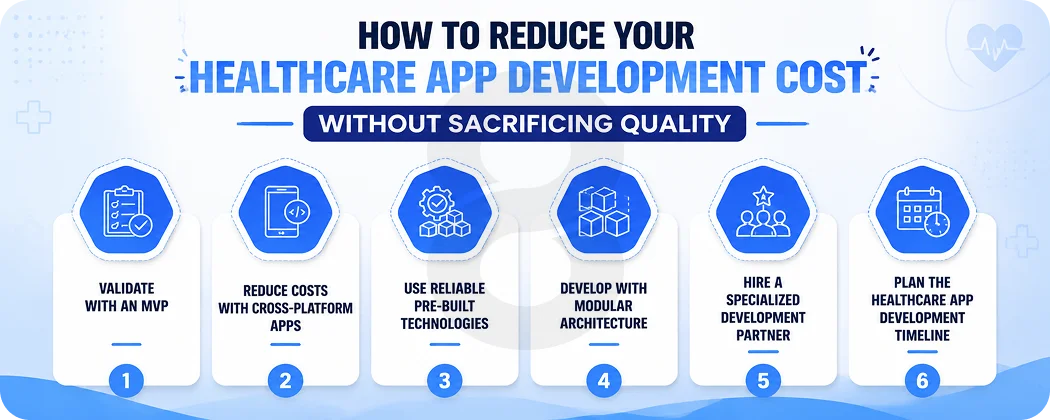
Validate with an MVP
Starting with an MVP reduces unnecessary development costs while helping healthcare businesses test real patient needs quickly. Core features launch first, while future updates are guided through practical user feedback and performance insights.
Reduce Costs with Cross-Platform Apps
Cross-platform apps lower development expenses by using one shared codebase for iOS and Android. This approach speeds up delivery, simplifies maintenance, and supports scalability without sacrificing performance, usability, or long-term flexibility.
Use Reliable Pre-Built Technologies
Using trusted tools like Firebase, Stripe, and Twilio reduces custom development work significantly. Pre-built technologies improve reliability, shorten engineering time, and help healthcare apps launch faster with fewer infrastructure-related challenges overall.
Develop with Modular Architecture
Modular architecture helps healthcare development teams reuse common components across different workflows. Features like dashboards, login systems, and notifications reduce repetitive coding efforts while improving scalability, efficiency, and long-term maintenance management.
Hire a Specialized Development Partner
Working with an experienced digital transformation company helps businesses avoid costly technical mistakes early. Healthcare-focused development teams understand compliance requirements, scalable infrastructure, and patient-centered experiences that reduce rework and improve project outcomes.
Plan the Healthcare App Development Timeline
A realistic healthcare app development timeline prevents rushed development decisions and unnecessary technical debt. Therefore, proper planning improves resource allocation, strengthens testing processes, and reduces expensive fixes or redevelopment requirements after the application launches successfully.
Read More: Architecture of Trust: How the Best Pregnancy Tracker Apps Handle HIPAA and GDPR in 2026
HIPAA, GDPR, and Compliance: What It Really Costs to Build a Compliant Healthcare App
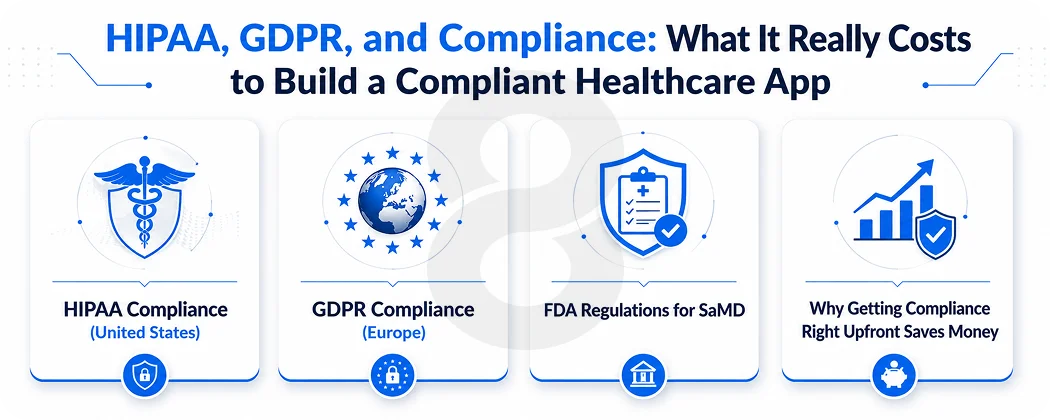
Compliance is not a final checklist before launch. It is an architectural commitment that shapes every technical decision from day one, and understanding what is involved makes the costs make complete sense.
HIPAA Compliance (United States)
Any app handling Protected Health Information (PHI) must comply with HIPAA. This requires end-to-end data encryption, audit logging, role-based access controls, and Business Associate Agreements (BAAs). Moreover, HIPAA compliance typically costs $15,000 to $40,000 upfront, plus $5,000 to $20,000 annually for audits.
GDPR Compliance (Europe)
If your app serves EU users, GDPR applies regardless of where your company is based. It requires explicit consent, data portability, and the right to erasure. Implementing HIPAA and GDPR together adds roughly $10,000 to $25,000 to the project.
FDA Regulations for Software as a Medical Device (SaMD)
Apps that make clinical decisions or monitor chronic conditions may qualify as a Software as a Medical Device under FDA guidelines. This regulatory pathway adds $50,000 to $200,000 to your budget and 6 to 12 months to your timeline.
Why Getting Compliance Right Upfront Saves Money
Retrofitting compliance after launch can cost 50 to 80% of your original budget. A single HIPAA violation carries fines from $100 to $50,000 per incident. Furthermore, the cost to build a mobile app that is compliant from day one is always lower overall.
Choosing the Right Healthcare App Development Partner
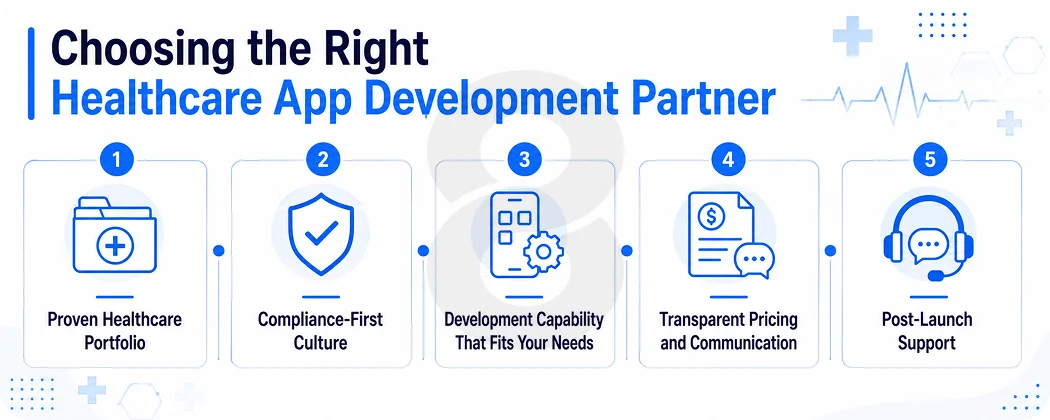
The partner you choose shapes everything: cost, timeline, quality, and compliance. Here is what to look for:
Proven Healthcare Portfolio
Ask for case studies in EHR integration, telemedicine, or chronic disease management before signing any contract. Healthcare is a specialized domain, and generic software development experience alone is simply not sufficient.
Compliance-First Culture
Your partner should bring HIPAA and GDPR expertise proactively, not reactively. Moreover, security architecture decisions made early consistently save enormous amounts of money and reduce serious regulatory risk considerably down the road.
Development Capability That Fits Your Needs
Off-the-shelf platforms rarely fit your exact clinical workflow or specific patient population needs. A partner offering true custom software development will build something purpose-built that genuinely solves your exact problem effectively.
Transparent Pricing and Communication
Detailed statements of work, milestone-based billing, and consistent weekly progress updates are all clear signs of a truly professional development team that genuinely respects both your investment and your project timeline.
Post-Launch Support
Healthcare apps require ongoing maintenance, regular security audits, and continuous feature evolution over time. Always choose a development partner who commits to long-term support rather than simply disappearing right after launch.
Read More: Artificial Intelligence in Medicine: Transforming Healthcare with Smart Technology
Monetization: How to Recover Your Healthcare App Investment
Understanding your revenue model before you build shapes architecture decisions and helps justify the investment. Common monetization strategies for healthcare apps include:
- Subscription models work well for telemedicine platforms, chronic disease management tools, and mental health apps. Monthly or annual recurring revenue creates a predictable cash flow.
- Freemium models lower the barrier to adoption and convert engaged free users to paying customers over time. They are especially effective for wellness and fitness apps.
- B2B licensing to hospitals, clinics, or insurers offers high-value contracts and steady recurring revenue without the complexity of consumer user acquisition.
- Per-consultation or transactional fees suit telemedicine platforms where users pay per virtual visit.
A simple ROI formula: if your app costs $150,000 to build and generates $250,000 in revenue or operational savings in year one, your return on investment is approximately 67%. Moreover, healthcare apps with strong clinical value and sticky usage patterns typically achieve positive ROI within 12 to 24 months.
Read More: 10 Benefits of Artificial Intelligence in Healthcare: Key Insights
Final Thoughts!
Healthcare app development cost is best treated as an investment to optimize, not an expense to minimize. Start with a clear clinical problem, scope an MVP that proves value fast, build compliance in from day one, and choose a partner who understands the technology and regulatory landscape.
At 8ration, we deliver end-to-end healthcare software solutions, from discovery and design through development and post-launch support. Get in touch today and let’s build something that genuinely changes how people experience care.