



Three quotes for the same project are probably sitting in your inbox right now and none of them agree with each other. One agency wants $8K. Another wants $60K. Some guy on Upwork swears he can have it done by Friday for $1K. Nobody explains the gap. They just send the number and wait for you to flinch.
That gap is not random. It comes down to what each provider actually includes, where they’re located, and how much of the work is real design versus dragging templates around in Figma.
This article breaks down web app design pricing 2026 numbers the way someone who has burned a budget or two would explain them. No inflated ranges to scare you into a sales call. Just what things cost, why they cost that, and where the money quietly leaks out.
What Web App Design Includes… And What It Doesn’t
Here’s the thing that took an embarrassingly long time to learn. The word “design” means almost nothing on a proposal. Some teams use it to cover research, architecture, testing, the works. Others use it to mean Figma screens and a handshake. Until you know which one you’re paying for, every number is noise.
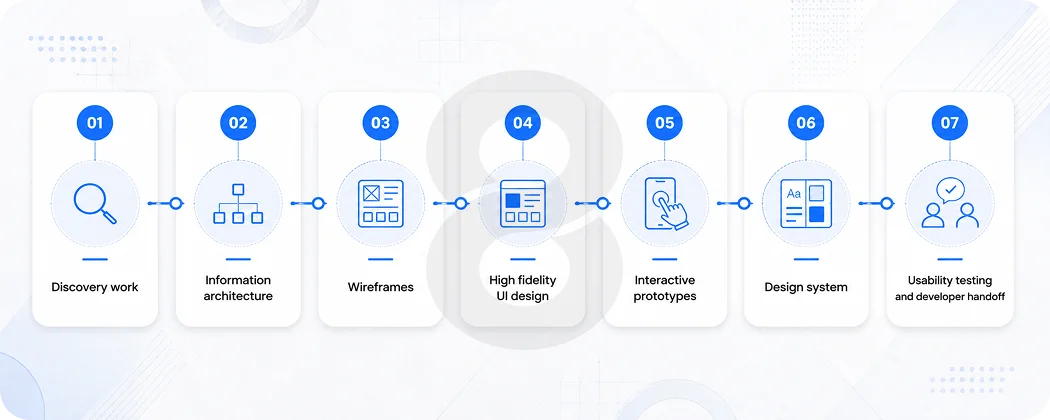
- Proper web app design covers the discovery work (understanding your users and the problem).
- information architecture (how screens connect and where things live), wireframes (the gray box skeletons).
- high fidelity UI design (the polished screens).
- interactive prototypes (clickable mockups you can test).
- design system (the reusable components developers build from).
Usability testing and developer handoff documentation sit at the premium end, and they’re the pieces most often cut when budgets shrink.
What design does not include is the build itself. A designer hands over files. Turning those files into a working product is a separate line item. And if you want a partner who handles both, look at firms offering end to end custom software development so the design and engineering teams aren’t pointing fingers at each other six weeks in.
Here’s the part that stings. Skipping good design feels like saving money right up until the numbers come in. McKinsey followed 300 companies for five years and the design led ones grew revenue at almost double the pace of their peers. Whatever you think you’re saving on the design line item, you’re probably giving back somewhere less visible.
So when a cheap quote skips research and testing, you’re not saving money. You’re deferring the cost to your churn rate.
Read More: What to Ask Before You Sign a Web App Design Contract (Most Clients Skip These)
Web App Design Pricing in 2026 at a Glance
So how much does web app design cost right now? Industry data puts the design phase of a typical web application between $3K and $15K for straightforward products, with complex platforms climbing well past that.
Cleveroad’s 2026 estimates place full app design between $5K and $30K or more, with complexity as the single biggest driver. Agency projects in Europe covering research, UI, and prototyping commonly land between €15K and €60K.
Here’s the honest version of that range, broken down by what you’re actually building.
Project type |
Screens |
Typical design cost |
Timeline |
| Simple web app (MVP, single core flow) | 10 to 15 | $3,000 to $10,000 | 2 to 4 weeks |
| Standard SaaS product (dashboard, auth, settings, billing) | 20 to 40 | $10,000 to $30,000 | 4 to 8 weeks |
| Complex platform (multi role, data heavy, integrations) | 40 to 80+ | $30,000 to $80,000+ | 8 to 16 weeks |
| Enterprise redesign (legacy product, design system, audits) | 80+ | $60,000 to $150,000+ | 3 to 6 months |
The web app design cost for your project lands somewhere in that table based on three things. Screen count. Interaction complexity. And how much thinking has to happen before anyone opens Figma. A founder who shows up with mapped user flows pays less than one who shows up with a vague pitch deck, every single time.
One more market reality worth knowing. The global SaaS market is projected to pass $465 billion in 2026, and Statista’s software development data shows enterprise application spending climbing year over year.
More products fighting for attention means design standards keep rising, and the bar for “acceptable” in 2026 is what “impressive” was in 2021.
Hourly Rates in 2026: From Freelancers to Full Agencies
Hourly rates are where geography and experience do the heavy lifting. The same screen designed in San Francisco and Lahore can differ in price by 5x, and honestly, the output gap is often much smaller than the price gap suggests.
Current market data shows freelance UI/UX designers in the US charging a median of around $72 per hour for remote work, with the typical range running $56 to $92. Junior designers start near $30. Senior specialists with strong portfolios command $100 to $175, and top tier experts touch $230 or more.
On the agency side, Clutch’s UX pricing data puts the average agency engagement at $25 to $49 per hour, which mostly reflects offshore teams. US based boutique agencies run $100 to $200 per hour, and big name studios in New York charge $120 to $300.
Provider type |
Hourly rate (2026) |
Best for |
| Junior freelancer | $30 to $50 | Small fixes, single screens |
| Mid level freelancer | $50 to $100 | MVPs, defined scopes |
| Senior freelancer or specialist | $100 to $175+ | Complex flows, design strategy |
| Offshore agency | $25 to $50 | Budget builds with management overhead |
| US or Western Europe agency | $100 to $200 | Full product design, accountability |
| Premium studio | $200 to $300+ | Brand critical, enterprise work |
Why the hourly rate is the wrong thing to optimize
Hourly rates lie. A $40 designer who burns 200 hours costs more than a $100 designer who needs 70, and that’s before counting your own hours spent explaining the brief for the fourth time.
The rework arrives later, usually right after a developer says the design can’t be built. By then the cheap option has stopped being cheap. Rate matters less than rate multiplied by hours multiplied by how many times you redo things.
Regional reality check
Eastern Europe and South Asia deliver genuinely strong design work at $25 to $60 per hour in 2026. The catch isn’t talent. It’s a process. If the team doesn’t run structured discovery and just designs whatever you describe on a call, you become the product manager, the researcher, and the QA department. Factor your own hours into the math.
Rate matters less than rate multiplied by hours multiplied by how many times you redo things.
Regional reality check
Eastern Europe and South Asia deliver genuinely strong design work at $25 to $60 per hour in 2026. The catch isn’t talent. It’s a process. If the team doesn’t run structured discovery and just designs whatever you describe on a call, you become the product manager, the researcher, and the QA department. Factor your own hours into the math.
Read More: Web App Redesign Checklist: 10 Things to Demand from Your Design Agency
Web App Design Packages and What’s Inside Each Tier
Most studios have stopped quoting raw hours and moved to web app design packages because clients hated the uncertainty. Fair enough. But packages hide things too, so here’s what each tier usually contains and what quietly gets left out.
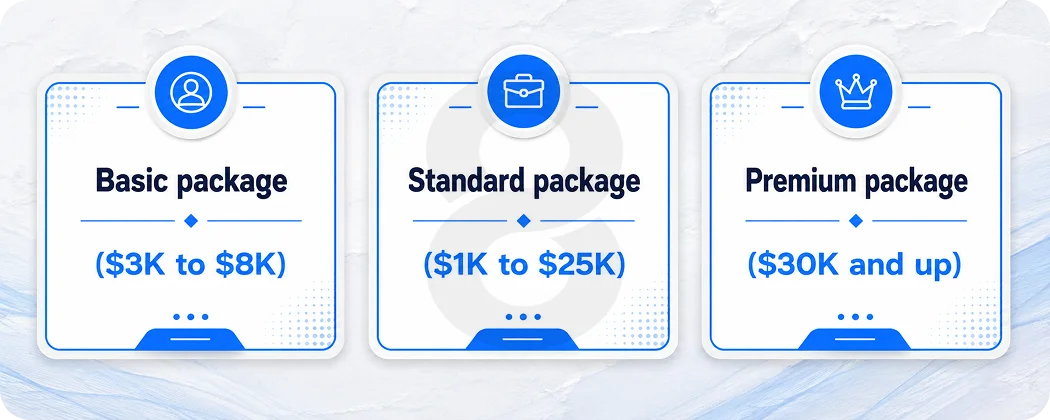
Basic package ($3K to $8K)
You get wireframes for core flows, 10 to 15 high fidelity screens, basic responsive layouts, and source files. You don’t get user research, usability testing, or a real design system.
This tier works when you’re validating an idea and expect to redesign within a year anyway. Plenty of founders pair this with lean startup focused development to get a testable product out fast without pretending it’s the final version.
Standard package ($1K to $25K)
This adds an interactive prototype, a component library, dark mode or theming if needed, and two to three structured revision rounds. Most funded startups and small businesses belong here. It’s the tier where design stops being decoration and starts being a system developers can actually build from.
Premium package ($30K and up)
At this tier you stop buying screens and start buying certainty. User interviews before anyone designs a thing. Competitor teardowns. Usability testing on real users, not the founder’s friends nodding politely.
A design system documented down to the tokens, accessibility handled properly, and a designer who doesn’t vanish at handoff but sticks around for the hundred small questions development always raises.
If you’re enterprise or juggling complex user roles, this is the tier. If you’re not, skip it without guilt. Paying for certainty you don’t need yet is its own kind of waste.
One pricing model that grew fast in 2026 is the design subscription. Flat monthly fee, usually $3K to $6K, unlimited requests handled one at a time. It works well for ongoing product work after launch. It works badly for a full product design that needs deep, connected thinking rather than a ticket queue.
What Actually Drives Web App Design Cost Up or Down
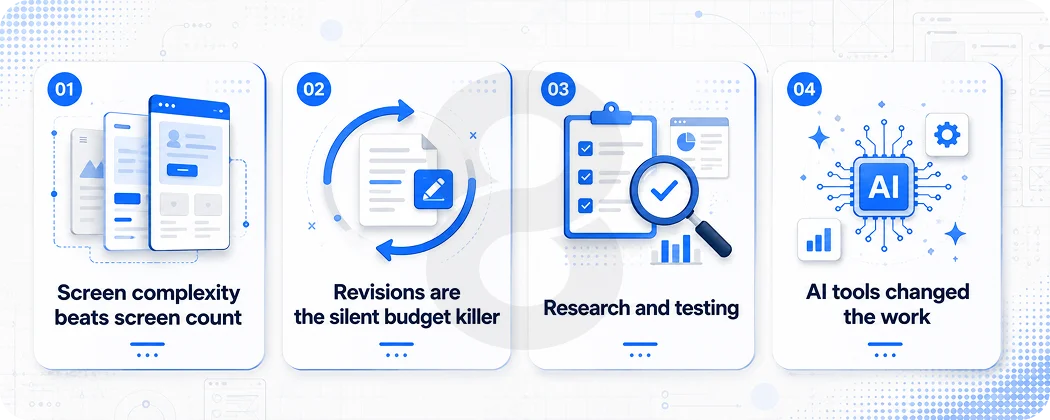
Quotes feel arbitrary until you see the levers behind them. These are the ones that move the number most.
Screen complexity beats screen count
A login screen takes hours. A data dashboard with filters, live charts, empty states, error states, and loading states takes days. That’s why per screen pricing runs $150 to $300 for simple screens but $500 to $1,500 for dashboard style screens. When a quote seems high, count the dashboards before you negotiate.
Revisions are the silent budget killer
“Unlimited revisions” sounds generous and almost always signals a junior team padding the contract. Professional teams cap revision rounds because each round costs real hours.
Two structured rounds with consolidated feedback beat eight rounds of “can we try the blue from the other version” every time. If your internal stakeholders can’t agree on feedback, fix that before hiring anyone, because you’ll pay for your own indecision at full hourly rate.
Research and testing
User research adds $3,000 to $10,000 to a project and most clients cut it first. Sometimes that’s fine. But when the product handles money, health data, or complex workflows, skipping research means you’re testing on paying customers.
Products with heavy logic, especially ones leaning on AI driven features, need extra design attention because users distrust automation they can’t understand, and earning that trust is a design problem, not an engineering one.
AI tools changed the work
Yes, designers now use AI to generate first draft layouts and components faster. That compressed timelines on simple projects. It did not make senior judgment cheaper, because the expensive part of design was never drawing rectangles.
It was knowing which rectangles matter. The savings show up as faster delivery at the basic tier, not as lower rates at the senior tier.
Hidden Costs Nobody Puts in the Proposal
This is the section most pricing articles skip because it makes the industry look bad. Here it is anyway.
Developer handoff gaps cost real money. A beautiful Figma file with no documented spacing rules, no component states, and no responsive behavior notes means your developers guess, and their guesses become your bug list.
Ask every provider how they handle handoff before you sign. If the answer is “we send the Figma link,” budget another 15 to 20 percent for the cleanup.
Design without development context creates expensive surprises. A designer who has never shipped a product will happily design interactions that triple your build time.
This is why design work tied to an actual product development process tends to come in cheaper overall, even when the design line item looks higher. The feasibility check happens during design instead of after it.
Then there’s the responsive tax. Many quotes cover desktop only, with mobile layouts billed separately at 30 to 50 percent extra. Given how much traffic arrives on phones, treating mobile as an add on in 2026 is honestly absurd, but plenty of contracts still do it.
The same applies if you later want native apps. Designing your web product with mobile app development in mind from day one saves you a second full design cycle later.
And maintenance. Design systems rot. New features get bolted on, components drift, and within 18 months your product has four button styles. Budget a small ongoing design retainer or accept the slow visual decay everyone pretends not to notice.
How to Choose the Right Pricing Model for Your Stage
Forget what providers prefer. Here’s what fits where you actually are.
Pre launch with under $10,000? Hire a strong mid level freelancer with a fixed scope, skip research, design only your core flow, and accept that you’ll redesign after you learn what users do. That’s not failure. That’s the plan working.
Funded and building your real product? Take a standard agency package with capped revisions and a proper design system. Pay for the prototype. Test it on ten users before development starts, because finding a broken flow in Figma costs hundreds and finding it in production costs thousands.
Established product with ongoing needs? A design subscription or part time senior designer beats project quotes. You need continuity more than capacity.
Enterprise or regulated? Premium tier, full research, accessibility compliance, documented everything. The expensive option is the cheap option here, because compliance failures and enterprise churn cost more than any design budget.
Whatever stage you’re in, get the scope in writing with screen counts, revision limits, and handoff deliverables named explicitly. Vague proposals produce expensive arguments. Specific ones produce products.
Read More: How to Build a Web App From Scratch: A Step-by-Step Guide for 2026
A Quick Word on How 8ration Does This
Full transparency, since this article lives on the 8ration blog. The team behind it designs and builds web apps for a living, so take this section for what it is.
Here’s the part that affects your money. Design and development happen under one roof, which sounds like brochure language until you’ve lived the alternative. The alternative is a finished design landing on a developer’s desk, a long silence, and then a list of everything that can’t be built. That conversation happens early here, while it’s still cheap to have.
Scoping happens before quoting. Screen counts, revision rounds, prototype deliverables, and handoff documentation get written into the proposal, so the number you see is built from the actual work rather than a guess padded for safety.
If the project doesn’t need research or testing yet, nobody pushes it. Plenty of early stage products genuinely don’t, and selling a premium tier to a pre launch founder helps no one.
The team has shipped products across SaaS, eCommerce, healthcare, and fintech, which mostly matters because complex dashboards and regulated flows stop being scary once you’ve designed enough of them.
If you want a second opinion on a quote you’ve already received, that conversation is free and there’s no obligation attached to it. Worst case, you walk away knowing exactly what’s inside the numbers you’re comparing.