



You’ve shortlisted a couple of agencies. The proposals look good. One of them even sent over a contract already. And there’s that familiar pull to just sign, get started, and build the thing. Don’t. Not yet. The web app design industry is growing fast.
The global web development market reached a total value of $82.4 billion in 2026 and is expected to grow to $165.13 billion with a CAGR of 8.03% till 2026, as per the Business Research Insights. Many agencies compete for your budget, and some explain their costs more honestly than others. It’s normally not because a bad designer is your client, it’s because the client didn’t ask the questions first. By the time problems appear, the agency may have already fixed the number of revisions, missed deadlines, and stored the IP you thought you owned in another repository.
This guide walks you through the five most important web app design contract questions you need answered before you write a single check. It’s not a series of questions for the sake of moral check-marking. It’s these guys that will decide if your project is delivered on time and on budget, and if it works the way you thought.
Why the Contract Stage Is Where Most Projects Go Wrong
The contract is viewed as a business formality by most business owners. They review portfolios, find weeks of demos to attend, and shop for prices. Then when they get the contract, they skim and sign it. That’s backwards. The most critical contract in your project exists! The most important contract in your entire project exists! It outlines what you’ll be given, when you’ll receive it, when things go wrong and who gets what when it does. And web app design contracts are particularly tricky because the work is iterative, technical, and often invisible until it’s built.
A vague scope clause that sounds fine in week one becomes a source of serious conflict by week eight. According to Gitnux, approximately 35% of outsourcing projects face scope creep, leading to 20–30% budget overruns, while hidden fees can lift totals by a further 15–25%. Most of those overruns start with unclear contracts, not bad developers.
Not Executing this Step Can Cost You a Lot
To give a sense of scale, here’s an idea of the costs of the ambiguous contract terms, depending on project size:
Project Scale |
Common Contract Gap |
Estimated Cost of the Dispute |
| Small app ($15K–$30K) | Undefined revision rounds | $3,000–$8,000 in extra billing |
| Mid-range app ($30K–$80K) | Unclear IP ownership | Full rebuild cost if vendor changes |
| Enterprise app ($80K+) | No timeline accountability clause | 2–4 month delays, $20,000+ in losses |
| Any scale | Missing post-launch support terms | Emergency fix rates of $150–$250/hr |
None of these are edge cases. They’re what happens on a daily basis when customers neglect to ask their contract questions. Therefore, to make sure you’re making the right move, there are five questions that every client should have answered prior to making the commitment. See this as your contract hiring web application designer checklist.
1. Who Owns the Intellectual Property When the Project Is Done?
This is the most common problem area that gets clients in trouble. You may think you have the design and that is correct, you do, as you are paying for the design.
IP ownership in web app design agreements can be structured in several ways. Some agencies retain full ownership of the code and design assets and license them to you, meaning if you ever want to change vendors, you could find yourself locked out of your own product.
Others transfer full ownership to you upon final payment. Many contracts have a hybrid structure where the agency retains ownership of certain proprietary frameworks, design systems, or UI components they built previously, while custom work becomes yours.
None of these structures is inherently wrong. But you need to know exactly which one you’re agreeing to. Ask specifically:
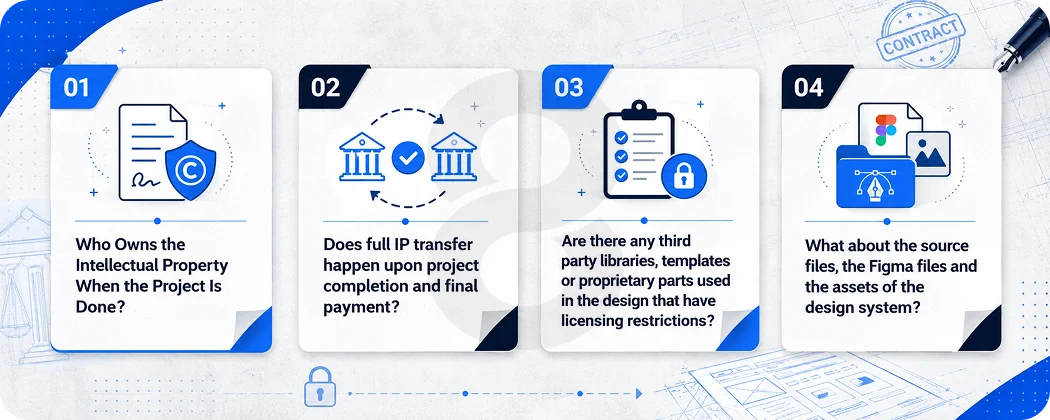
- Does full IP transfer happen upon project completion and final payment?
- Are there any third-party libraries, templates or proprietary parts used in the design that have licensing restrictions?
- What about the source files, the Figma files and the assets of the design system?
This is one question you’ll wish you had if you need to move to another team later and can’t go back to scratch. Our web app development team always provides full source code and design file ownership upon project completion. Make sure whichever agency you’re talking to does the same.
Read More: Intellectual Property in Software: How to Protect Your App Idea Before You Build
2. What Does the Scope Actually Include (And What Triggers Extra Charges)?
Web app projects have a secret cost killer scope creep. You request a small change. The agency charges for a full sprint. You argue about whether it was in scope. Everyone’s frustrated and the project stalls. The best way to avoid this is to pressure-test the scope definition before you sign.
A solid web app design agreement should define not just what will be built, but what level of design iteration is included. How many rounds of revisions are covered? What counts as a revision vs. a change request? Do you have a list of deliverables that have acceptance criteria?
When choosing a web app design company, ask them to explain a situation to you: “If I view the first mockup and decide that I want to change the color scheme and restructure the navigation, does that count as part of the agreed scope or would it be considered a change order?” The answer tells you a lot.
What Should Be Defined in the Scope Section
Scope Element |
What to Look For in the Contract |
Red Flag |
| Revision rounds | A specific number (e.g., 2 rounds per deliverable) | “Revisions as needed” with no limit |
| Responsive design | Explicitly states mobile, tablet, and desktop | Desktop-only with mobile as an add-on |
| UX research & user flows | Listed as included deliverables | Not mentioned at all |
| Wireframes and prototypes | Defined as part of the design phase | Billed separately without disclosure |
| Change order pricing | Hourly rate specified in writing | Rate TBD or “industry standard” |
| Acceptance criteria | Each deliverable has a clear pass/fail definition | No criteria, just “client approval” |
How Scope Gaps Turn Into Budget Surprises
Here’s how it typically plays out. An agency offers you a contract to create a web application for $45,000. Sounds clear. But the contract says “design of core screens” without listing which screens. You assume the contract includes the onboarding flow. They assume it’s phase two. By week six, you’re in a change order discussion for $12,000.
Ask for a deliverables list attached to the contract as an exhibit. If the agency won’t provide one, that’s your answer.
Our software design services break down what a structured design engagement actually looks like from kickoff through handoff. If you’re comparing proposals, use it as a baseline for what comprehensive scope documentation should cover.
3. What Is the Payment Structure and What Are the Conditions for Each Milestone?
A bad payment structure can hurt you from both directions. If it’s not up to scratch, you lose out if you have paid a lot too much for the work. If you tie payments too closely to vague milestones, you will likely face disagreements.
A typical payment model for a fair web app design contract will be milestone fees with clearly defined and reviewed deliverables. The agency may require 25% to 30% of the total budget upfront, then charge a set percentage at each project stage, including wireframes, design mockups, prototype development, and final handoff.
You don’t want to have a contract that requires big payments over time instead of quality work produced. “Payment 2 is due 30 days after project kickoff” means you could end up paying for a month of work that hasn’t actually produced anything tangible.
Ask specifically:
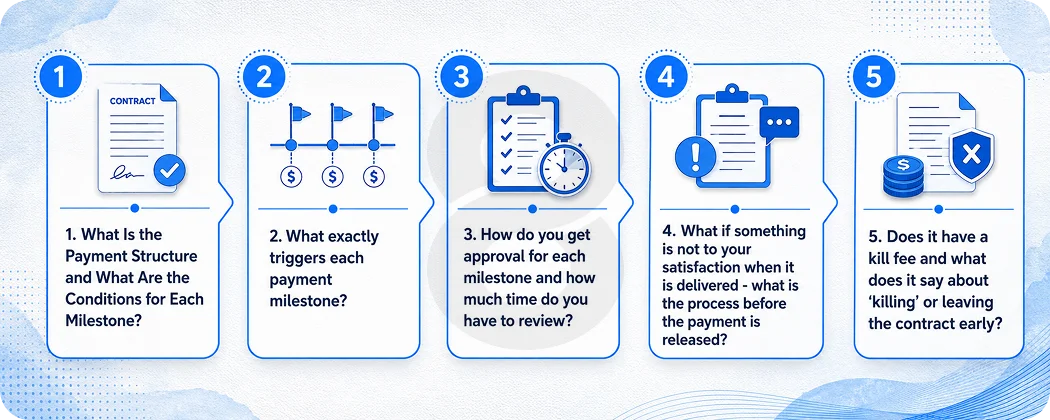
- What exactly triggers each payment milestone?
- How do you get approval for each milestone and how much time do you have to review?
- Ask what process the agency follows if the delivered work does not meet your expectations before you release payment.
- Does it have a kill fee and what does it say about “killing” or leaving the contract early?
Also look carefully at change order pricing. The best agencies will specify their hourly rate for out-of-scope work in the contract so there are no surprises later. If a company refuses to put this in writing, that’s a signal worth paying attention to.
This is part of what should appear in your hiring web app designer checklist, well before you get to the signature line.
Read More: Web App Redesign Checklist: 10 Things to Demand from Your Design Agency
4. What Are the Timeline Commitments and What Happens If They’re Missed?
Timelines are where things get fuzzy fast. Most agencies will quote you a project timeline during the pitch. The question that you need to ask is whether that timeline has a bite to it in the contract.
Ask whether the contract defines milestones at different stages, with specific tasks the team must complete. Just a project end date doesn’t cut it.
You need to know when the agency will share wireframes, design mockups (included revisions), and final files.
Typical Web App Design Timeline Phases
Phase |
What Gets Delivered |
Realistic Duration |
| Discovery & Research | User flows, sitemap, project brief | 1–2 weeks |
| Wireframing | Low-fidelity wireframes for all core screens | 1–3 weeks |
| UI Design | High-fidelity mockups with full visual design | 2–5 weeks |
| Prototype & Review | Clickable prototype for stakeholder feedback | 1–2 weeks |
| Revision Rounds | Incorporated feedback, finalized designs | 1–2 weeks |
| Design Handoff | Developer-ready files, style guide, assets | 1 week |
Each of these phases should have a date in the contract. Not approximate. Actual dates with accountability attached.
Senior Web Developer at 8ration says:
“Timeline clauses without accountability are just optimistic estimates. The contracts that actually protect clients are the ones that define delay remedies as clearly as they define the work itself. Both parties need skin in the game.”
Some things to push for:
- The team attaches a project schedule to the contract as an exhibit, with milestone dates included.
- A clause defining what constitutes a client-caused delay vs. an agency delay
- A remedy process if the agency misses key dates (credit, priority resourcing, etc.)
Timeline accountability is especially critical for web app projects because delays compound. A two-week slip in wireframes pushes the entire development schedule back, which then affects your launch date and your marketing plans. Nail this down upfront.
5. What Post-Launch Support is Included and What Comes at Extra Cost?
The day most people don’t consider until it’s too late: launch day! You’ve given the designs the approval, the developers have implemented it and you have a live product. Then three days later, something breaks. Or the app behaves unexpectedly on a certain browser. Or you realize that the team needs to adjust a critical user flow.
Who fixes it? At what cost?
This is where the web app design agreement either saves you or stings you.
Most agencies provide a short warranty, typically 30 to 90 days, to fix bugs related to the delivered scope. Anything beyond that usually falls into paid maintenance or support retainer territory. That’s reasonable. But the contract needs to define this clearly.
The question(s) here are:
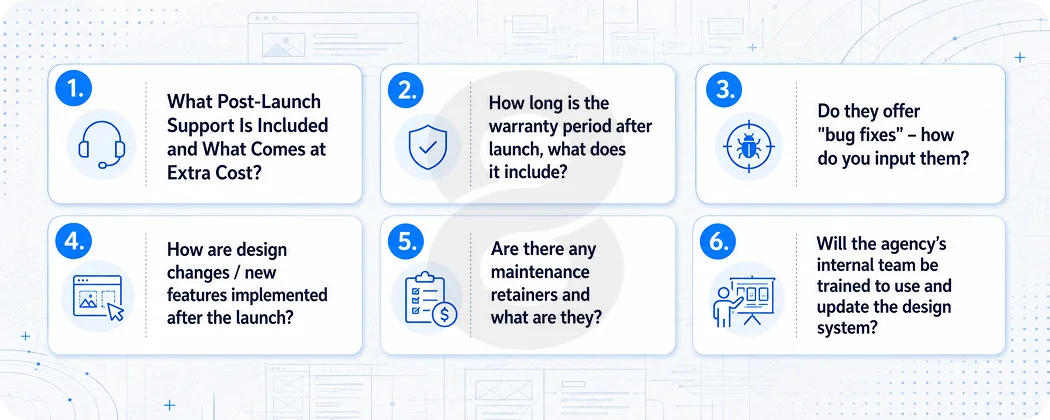
- How long is the warranty period after launch? What does it include?
- Do they offer “bug fixes” – how do you input them?
- How will the team implement design changes or new features after launch?
- Are there any maintenance retainers and what are they?
- Will the agency train its internal team to use and update the design system?
This is part of any complete web app design agreement: what to know guide, and it often gets skipped because clients are so focused on getting to launch that they don’t plan for what comes after. Our software maintenance and support services are structured specifically to avoid this gap. Post launch is not a post-thought. It is a part of the project that has a definite set of deliverables and a timeline. If the agency you are considering doesn’t cover this aspect in their contract, you should ask it directly. The answer they give will help you establish a lot about how they function once the project has closed.
Read More: How to Build a Web App From Scratch: A Step-by-Step Guide for 2026
6. How Will Confidential Business Data Be Protected?
During development, you’ll share sensitive business information, customer data, and proprietary ideas. Before signing, ensure the contract includes confidentiality clauses, explains how your data is stored and accessed, and outlines security responsibilities. Clear data protection terms reduce legal risks and help safeguard your business throughout the project.
- Includes an NDA or confidentiality clause.
- Defines who can access your data.
- Explains secure data storage practices.
- Covers data deletion after project completion.
- Addresses compliance with privacy regulations.
- Specifies liability in case of a data breach.
Putting It All Together: A Quick Pre-Signing Checklist
Before you sign anything, run through these five checks:
Contract Area |
What to Confirm |
Status |
| IP Ownership | Full transfer upon final payment, including source and design files | Check before signing |
| Scope Definition | Specific deliverables listed, revision rounds capped, change order rate in writing | Check before signing |
| Payment Structure | Milestone-based tied to reviewable work, kill fee terms defined | Check before signing |
| Timeline Commitments | Specific dates with accountability for both parties | Check before signing |
| Post-Launch Support | Warranty period, bug fix process, and maintenance path documented | Check before signing |
None of these requires you to be a lawyer. They require you to ask direct questions and read the answers in the contract, not just in the sales conversation.
Read More: 15 Top Web App Examples for Startups in 2026 (With Business Models Explained)
What Makes a Web App Design Company Worth Trusting
Choosing a web app design company is ultimately about more than portfolio and price. It’s about whether this team has the professional maturity to put their commitments in writing, define them clearly, and stand behind them.
A company that hedges on IP ownership, gives vague scope language, or can’t answer a direct question about post-launch support is showing you something important before the project even starts.
The good news is that asking these questions upfront actually tends to improve the working relationship. It sets clear expectations on both sides, reduces the chance of mid-project friction, and lets everyone focus on what matters: building something that actually works.
The web app development market is growing fast because businesses genuinely need capable digital products. The web app design contract questions in this guide exist not to create adversarial relationships with your design partner, but to make sure the relationship starts on solid ground.
Take the time to get the contract right. You’ll thank yourself six months from now.