


Consider the following: your product launch takes place tomorrow. You’ve spotted a critical bug at 11 PM your time. You send a message to your development team and wait. And wait. And wait. Twelve hours later, your team in a different time zone finally clocks in, reads your note, and gets busy working on the fix. At this point, your launch window has ended, your early adopters already left negative reviews, and you are left wondering why no one had warned you about this.
This situation takes place more frequently than most companies anticipate. Time zone compatible app developers are now not only a preference but also a mission-critical requirement of the company that needs responsive, agile, and seamless collaboration.
This is a complete guide that will take you through all you need to know about finding, evaluating, and working with time zone compatible app developers, whether you are looking to hire app developers, or just receive full mobile app development services. At the end you will have a clear outline of how to make the correct decision.
Why Time Zone Compatibility is More Than You Think
It will help to know why time zone alignment is so commonly underestimated and so often expensive before delving into the question of how to choose developers.
The Actual Price of Friction in Time Zones
The development teams and clients working on different sides of the clock bring the consequences on the other end of the entire project lifecycle.
- Delayed decision-making: A programmer in a 10-hour time zone requires a solution to release his work. They make a message. You’re asleep. They pause, switch to a different task, lose track, and get back to your feature the following day, a day late.
- Communication compression: Small overlap teams are compelled to fit everything they have to say into a one-hour time slot. The time that it would have taken five minutes to answer in real time instead takes the entire 48-hour asynchronous thread to resolve.
- Quality degradation: Devoid of timely feedback loops, developers make assumptions. Assumptions cause rework. Rework is an expense in terms of money and time.
- Reduced agility: The current mode of mobile application development is iterative. Fast feedback is needed in sprints, standups, reviews, and pivots. A team 12 time zones away is structurally incapable of actual agile delivery.
When Time Zone Compatibility Becomes Non-Negotiable
Not all projects require real-time cooperation, but the following almost always do. Daily visibility and rapid iteration are necessary to develop MVPs with active stakeholder participation, which entails that you need overlap. Enterprise app integrations are complex backend dependencies, where blockers are generated continuously, and immediate resolution needs synchronous communication. Another evident situation is ongoing maintenance and support contracts; bugs do not wait till working hours, and neither should your developers.
Lastly, regulated industries such as fintech and healthcare have compliance needs that require quick communication and team synchronization. All of these scenarios demand time zone compatible app developers who can align their schedules with your team and ensure seamless, uninterrupted collaboration.
Read More: How to Hire AI Developers in USA: A Strategic Approach in 2026
Understanding the Time Zone Compatibility Spectrum
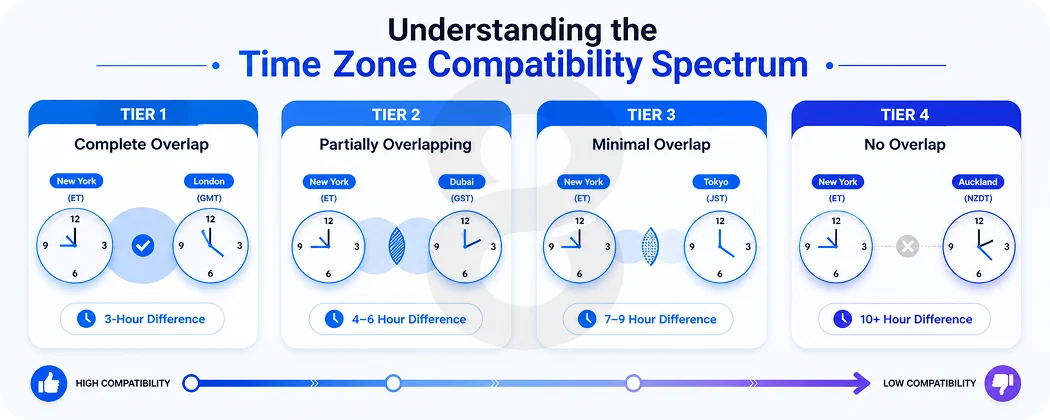
“Time zone compatible” doesn’t necessarily mean “same time zone.” It implies that there is enough overlap to work effectively. This is how to reason about the spectrum.
Tier 1: Complete Overlap (3-Hour Difference)
Developers within 3 hours of your time zone give you an approximation of a full working day of shared availability. This is the gold standard. It facilitates real-time stand-ups, ad hoc Slack chat, and same-day problem solutions.
Tier 2: Partially Overlapping (4-6 Hour Difference)
Even a difference in time of 46 hours can still provide a meaningful work-collaboration window, usually 3-4 hours of time in shared work collaboration, depending on team schedules. This is the confection zone of most US-Latin American or US-Western European alliances.
Level 3: Minimal Overlap (79 Hour Difference)
In this distance, teamwork demands a lot of discipline. The teams have to embrace stringent asynchronous-first, extensive documentation, and active communication practices. It is practical to implement phases with heavy execution and well-defined specifications but not practical when it comes to exploratory or iterative work.
Tier 4: No Overlap (10+ Hours Difference)
The full handoff models technically have the potential to be useful with long-term, well-scoped projects but do not structurally fit with any development methodology that requires fast feedback or iteration.
Read More: How to Choose a Mobile App Development Company? A Comprehensive Guide
How to Hire App Developers With Time Zone Compatibility in Mind
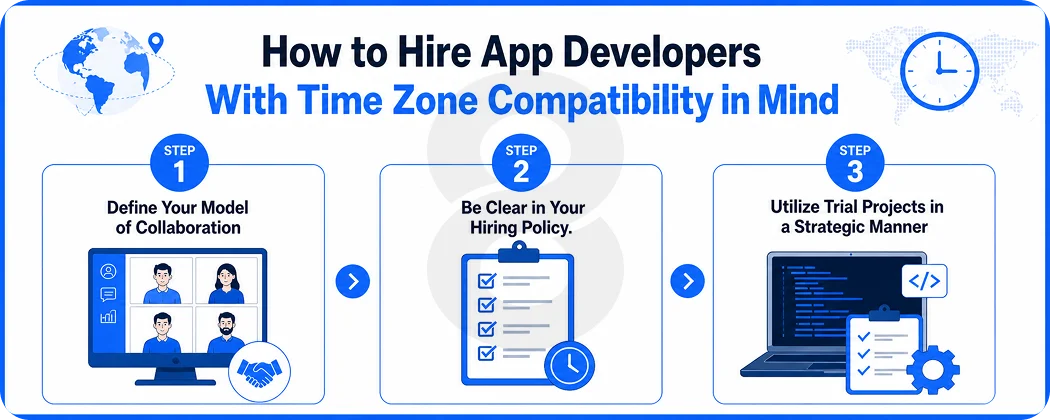
When you go to the job market to hire app developers, most job advertisements and requests for proposals dwell on technical capabilities and portfolio, pricing, and the ability to communicate. The compatibility of time zones usually receives a single sentence, or none at all. Here is the way of raising it to a first-class requirement.
Step 1: Define Your Model of Collaboration
The following are some of the basic questions you must answer before posting a job or starting to vet agencies: How many hours of daily overlap do you require? A single founder, with specifications, might require only one daily sync, whereas an enterprise team with continuous points of decision-making may need four or more. What is your style of communication: heavy real-time collaboration or async-first? And where is the project at? Discovery and design phases need a higher level of sync than heads-down coding sprints.
When you have defined your collaboration model you have a tangible time zone requirement to communicate to candidates.
Step 2: Be Clear in Your Hiring Policy
In writing job descriptions or RFPs, use language such as: We need at least 4 hours of daily overlap with your time zone, or Candidates must be available to stand up with each other at least 4 hours a day at specific time. Such ambiguous requirements as must have good communication do not bring this important dimension to the surface. Specificity will help to attract the right candidates and to eliminate the misaligned candidates at an early stage.
Step 3: Utilize Trial Projects in a Strategic Manner
Get a paid trial project underway before making any commitment to a full engagement; better still one that involves back-and-forth communication. A trial that merely analyzes the code quality is half the battle. Assess their responsiveness to messages, whether they engage and take initiative to communicate blockers or you have to chase updates.
A slightly lower-technical developer who can be reached in real time during your working hours will perform better than a technically brilliant developer who is only accessible 12 hours later. Ultimately, the goal is to find time zone compatible app developers who not only meet your technical requirements but also integrate seamlessly into your workflow through timely, proactive communication.
Read More: Local vs. Remote: Does it Matter Where Your App Development Firm is Based?
How to Recruit Android Developers in Different Time Zones
There are collaboration nuances peculiar to Android development that predispose time zone compatibility in particular.
Android Development Lifecycle and Sync Points
When you hire Android developers, the development life cycle includes several decision-intensive stages that can benefit immensely when provided with real-time access:
- Debates on design and architecture: Android has a fragmented ecosystem of devices, so early decisions about what sizes to use for screens, the level of API, and whether to support hardware require a series of back-and-forths.
- Google Play Store submission compliance: When a submission is rejected or flagged, the quickest resolution would be through live communication with your team.
- Testing and QA of the devices: Android is fragmented, and bugs tend to manifest themselves on particular hardware configurations, which means that a developer who can respond instantly will radically shorten the debugging process.
- Kotlin and Jetpack Compose architecture options: These can best be solved using synchronous technical discussions, rather than days-long asynchronous email chains.
Red Flags When Staffing Android Developers: Look out for Applicants Who
- Can’t specify their working hours or daily availability
- List time zones sporadically (a typical symptom of distortion)
- Use completely long asynchronous emails in the course of the trial project.
- Is unable to give a steady window of overlap.
- Top Places to Find Time Zone Android-Compatible Time Zone Developers.
- To US based companies, strong Android development talent is becoming more and more available in Latin America, especially in Argentina, Brazil, Colombia, and Mexico (UTC-3 to UTC-6).
- To UK and European firms, Eastern Europe (UTC+1 to UTC+3) has great overlap and a well-established Android development ecosystem.
How to Hire iOS Developers Across Time Zones
iOS development has its own peculiar time zone implications, frequently related to the Apple development environment and the Apple product development cycle.
Why iOS Requires Close Cooperation
When you contract iOS developers, the platform presents external time constraints, making asynchronous workflows especially painful:
- App Store review windows: When your application is under review, and Apple wants to ask a question, you usually have 24 hours to respond before the review period restarts. A developer who is unable to reply within your working hours may cost you days of loss.
- Xcode and SDK updates: Apple releases new versions with varying degrees of frequency that sometimes cause existing functionality to break.
- TestFlight Feedback Loops: Real-time beta feedback must be effectively responded to immediately when the momentum is high.
- Swift and SwiftUI Architecture Choices: Made in real time, these save much rework in the future.
Read More: 5 Red Flags to Watch for When Hiring an App Development Agency
Evaluating Time Zone Fit for iOS Developers
- How many hours do you spend free and what time overlap is there with our time zone?
- How to deal with urgent matters, such as App Store rejection notices, during times outside of your regular hours?
Evaluating Mobile App Development Services for Time Zone Fit
Good applicants will possess tangible responses and actual practices, not empty promises. When considering the mobile app development services offered by an agency or vendor instead of hiring individual developers, things change a bit in the conversation about time zone but it is no less important.
Agency vs. Freelancer: Dynamics of different time zones
- Freelancers have fixed schedules: Their time zone fit is binary. They’re either available during your hours or they’re not.
- Agencies bring in the elements of a team: one project manager in one time zone, another group of developers in another time zone and another group of QA in a third time zone. They can provide a point of contact, who crosses with you even without the broader team but this has to be accompanied with clear setting of expectations of who is available when and what purpose.
Read More: The 2026 Founder’s Guide: Finding the Best Mobile App Developers for Hire
Key Questions to Ask Mobile App Development Services Vendors
Beyond the portfolio review and inquire:
- Where do your developers work, at what time zones do they work?–Do not accept vague answers such as globally distributed. Get specifics.
- Whom will be our main point of contact and what are their working hours in their time zone?
- How do you deal with urgent matters that come in outside of our overlap window? Look to structured on-call processes, and not promises of us being available at all times.
- Can we talk to the developers assigned to our project? Agencies that do not allow their clients to directly interact with the developers working on their project put an additional layer of communication that exacerbates time zone delays.
- What collaboration tools do you use, and how do you document decisions to support asynchronous communication?
Final Thoughts!
Technical skill is table stakes in global mobile app development. The teams that can deliver consistently on time, on budget, and to spec are the teams that have addressed the collaboration problem. And time is at the core of collaboration.
When you go out to hire app developers, hire Android developers, hire iOS developers, or even hire mobile app development services, you must make time zone compatible app developers a first-order rule, not a secondary consideration. Determine your overlap needs, filter candidates through the prism of communication and responsiveness, formalize expectations in your contracts, and invest in the tools and practices that close the geographic distance.
The collaborators who will assist you in creating great products, not merely providing lines of code, are the partners who can come to you where you are, not just across the screen.
Choose wisely. Build smart.