


Most people ask the wrong question at the start. They ask whether they should go local or remote, as if it were a simple preference decision. Like choosing between two equally good options where location is the only variable.
That is not how this actually works. Because local vs remote app development is not really about distance. It is about how the team operates when things stop being simple, when requirements change, when users behave differently than expected, and when decisions need to be made quickly without perfect information. That is where the difference shows up.
Key Take Aways
- Location matters less than how the team thinks and communicates
- Local vs remote app development is really about alignment, not geography
- Poor communication kills more projects than distance ever will
- Remote teams can scale faster, but require a stronger structure
- Local teams offer proximity, but not always better execution
- The best choice depends on product complexity, not preference
Why This Question Exists in the First Place
The concern usually comes from control. When a team is local, it feels easier to manage. You assume communication will be smoother. You assume accountability will be stronger. You assume things will move faster because everyone is closer.
Sometimes that is true. But not always. Because proximity does not automatically create clarity, especially in projects involving software development, where most problems are not physical, they are logical, structural, and decision-based. At the same time, remote teams introduce uncertainty.
Different time zones, different working styles, and less face-to-face interaction. It feels like there is more room for things to go wrong. But that only becomes a problem if the system is weak. So instead of asking whether local vs remote app development is better, the real question should be:
Which setup gives you better execution for your specific product?
Where Local Teams Actually Make Sense
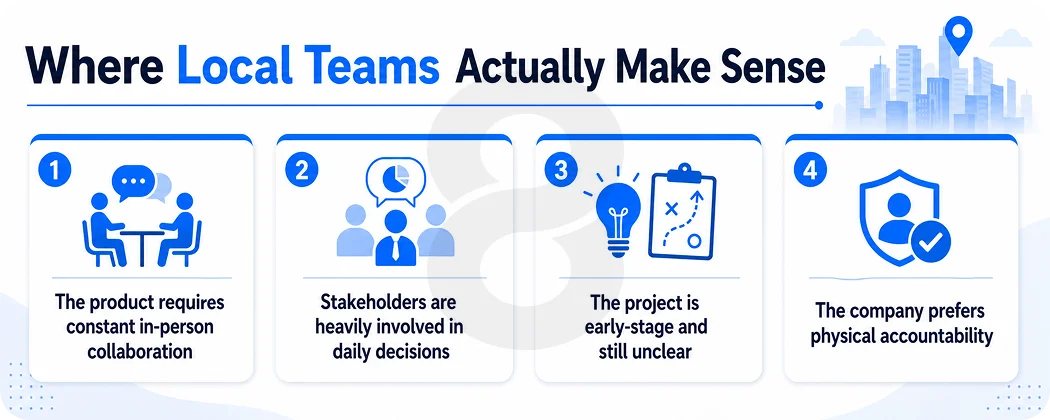
There are situations where local teams genuinely add value. This is not about saying remote is always better. It depends on what you are building. Local teams tend to work better when:
- The product requires constant in-person collaboration
- Stakeholders are heavily involved in daily decisions
- The project is early-stage and still unclear
- The company prefers physical accountability
The reduction of friction in these situations results from being closer together. The ability to work in the same space enables you to complete problem-solving tasks more efficiently while eliminating the need for extended back-and-forth communication. The framework supports mobile app development projects that require frequent user experience design changes.
But here is the part people overlook. Just because a team is local does not mean they are better. It just means they are closer.
Read More: How to Choose the Right Mobile App Development Company
Where Remote Teams Quietly Outperform
Remote teams have improved a lot over the last few years. Not just technically, but operationally.
The best remote teams are structured. They document properly. They communicate clearly. They do not rely on casual conversations to move things forward. That makes them surprisingly effective. Local vs remote app development becomes less about distance and more about discipline at that point.
Remote teams usually perform better when:
- The product scope is clearly defined
- The business values flexibility and scalability
- You need access to specialized talent
- The project connects with AI development or complex systems
Because here is the reality. The best people are not always local. And limiting yourself to one location often limits the quality of the outcome.
Read More: Mobile App Development Process – From Idea to Launch
The Real Problem: Communication, Not Location
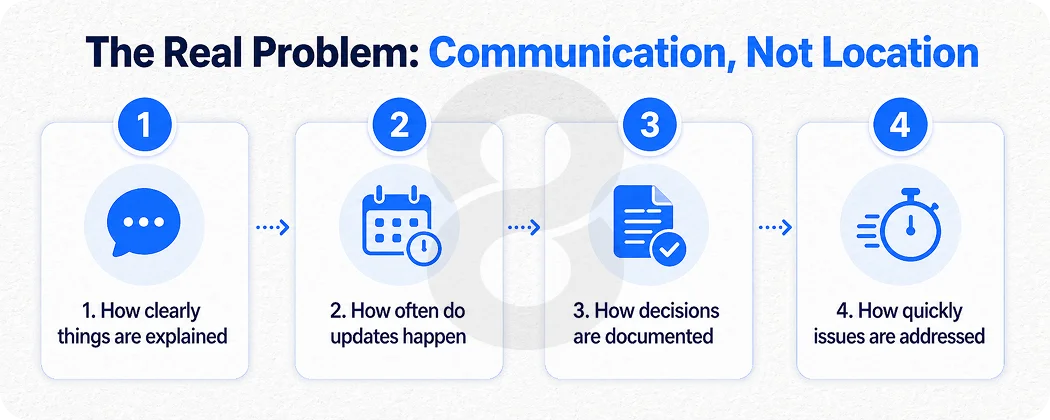
Most project failures are not caused by distance. They are caused by poor communication. This applies equally to local and remote teams. You can sit in the same office and still misunderstand everything. You can work across continents and still stay perfectly aligned. That is why local vs remote app development should always be evaluated through the lens of communication quality.
What actually matters:
- How clearly things are explained
- How often do updates happen
- How decisions are documented
- How quickly issues are addressed
Good communication removes distance. Bad communication creates it.
Cost vs Value: What People Get Wrong
A lot of businesses assume remote automatically means cheaper. That is not always true. Yes, some regions offer lower hourly rates. But cost is not just about pricing. It is about how efficiently the team works.
A cheaper team that takes longer or makes more mistakes ends up costing more. A slightly more expensive team that works cleanly often delivers better value. This becomes even more important in projects involving AI integration, where mistakes can become harder to fix later.
So when comparing local vs remote app development, cost should never be the only factor. It should be one part of a bigger evaluation.
Local vs Remote App Development
Factor |
Local Teams |
Remote Teams |
| Communication | Easier in-person, but not always structured | Requires structure, often more documented |
| Talent Access | Limited to the location | Global talent pool |
| Cost | Usually higher | More flexible pricing |
| Scalability | Slower to scale | Easier to scale teams |
| Flexibility | Lower | Higher |
| Speed | Faster in the early stages | Faster in structured environments |
How This Impacts Real Product Development
This decision affects more than just development. It affects how your product evolves. Because modern products rarely stay static. They grow, change, and adapt based on usage. If your setup cannot support that, things start breaking.
For example:
- If your product connects with broader software development systems, you need consistency.
- If your product relies on cross-platform access, then mobile app development alignment becomes important.
- If your product includes automation or intelligence, then AI development and AI integration need to be handled properly.
And if the product supports internal operations, then enterprise app development considerations become critical. None of these depend on location alone. They depend on how the team works.
A More Practical Way to Decide
Instead of asking whether local vs remote app development is better, ask:
- Does the team understand your product clearly?
- Can they explain decisions in a way that makes sense?
- Do they communicate consistently without being chased?
- Do they think about what happens after launch?
If the answer is yes, location becomes less important. If the answer is no, the location will not save the project.
Read More: How to Hire a Full Stack Developer in 2026: The Complete Guide for Tech Founders
Small but Important Differences That Add Up
There are a few subtle differences that become noticeable over time. Local teams often rely more on informal communication. That can be helpful early, but risky later if things are not documented properly. Remote teams rely more on structured communication. That can feel slower at first, but it creates clarity as the project grows. Neither is perfect. But one scales better. And that matters when your product becomes more complex.
Read More: 5 Red Flags to Watch for When Hiring an App Development Agency
If You Are Still Deciding, Focus on This
If you are trying to choose between local vs remote app development, the decision should not be based on comfort alone. It should be based on what your product actually needs.
The system must function correctly while users need to continue using it, and the team must develop new skills to handle future changes. The execution process determines everything. The outcome requires execution to take place.
What Actually Impacts Success More Than Location
Factor |
Impact Level |
Why It Matters |
| Communication Quality | High | Prevents misunderstandings |
| Product Understanding | High | Aligns development with goals |
| Technical Capability | High | Ensures system stability |
| Scalability Planning | Medium | Supports future growth |
| Location | Low | Secondary compared to execution |
Final Thoughts
Local vs remote app development sounds like a big decision. But it is often misunderstood. The real decision is about choosing a team that can build something that works beyond launch. Because once the product is live, location stops mattering.
The system’s performance depends on its ability to maintain operations through ongoing user engagement and dynamic team response. The success of the project depends on its implementation. The project requires execution without existing location constraints.