




An AI model can score well in testing and still give a wrong answer inside your business. The model did what it was trained to do. Nobody told it that your refund policy changed in March, that one customer segment falls under stricter rules, or that its answer feeds a decision a regulator will review.
AI governance contextual accuracy closes that gap. It asks whether each AI decision is correct for the situation in which it is made, and it builds the controls that prove the answer. This guide defines the concept, lays out a working framework, and shows how validation, evidence and continuous improvement fit together.
What AI governance contextual accuracy means
Standard accuracy compares a model’s output with a labeled answer. Contextual accuracy compares the output with what is right for a specific business situation. A loan-approval model may classify applicants correctly on average and still break a rule that applies to one region. A support chatbot may write fluent replies that quote a discontinued plan. Both pass a generic test and fail the real one.
Three ideas sit inside the term. AI governance contextual intelligence is the model’s access to the right facts about a case: current policies, customer history, jurisdiction and authority level. AI governance contextual truth is the habit of grounding answers in verified company sources instead of plausible text. Contextual accuracy is the measured result, the share of decisions that were correct once both were applied.
Governance makes this repeatable. Without it, accuracy depends on whoever wrote the prompt or tuned the model last quarter. With it, owners are named, sources are approved and decisions can be traced. NIST builds the same logic into its AI Risk Management Framework, where the Map function establishes the context that frames risks for an AI system.
Why inaccurate AI decisions hurt businesses
Inaccurate AI output costs money, trust and time. This section shows how often companies report problems and where contextual gaps usually start, so you can judge where your own systems are exposed.
What the survey data shows
McKinsey’s 2025 global survey on AI found that 51 percent of respondents from organizations using AI had seen at least one negative consequence, and nearly one-third reported consequences from AI inaccuracy. The same survey says inaccuracy is one of two risks that most respondents are actively working to mitigate. Companies know the problem exists. Fewer have a method for measuring it against their own rules.
Where context goes missing
Most contextual failures trace back to a small set of gaps. The model is not broken. It lacks something the business assumes every employee knows.
| Context Gap | What Goes Wrong | Example |
|---|---|---|
| Stale policy | The model applies a rule that no longer exists | A chatbot quotes a discontinued return window |
| Missing jurisdiction | The answer is right for the wrong region | A pricing tool ignores local tax rules |
| Wrong authority level | The AI acts beyond its remit | An assistant approves a refund above its limit |
| Unverified source | Fluent text with no factual basis | A summary cites a document that does not exist |
Each row is fixable, but only if someone owns the fix. That is the job of governance.
Building an AI contextual governance framework
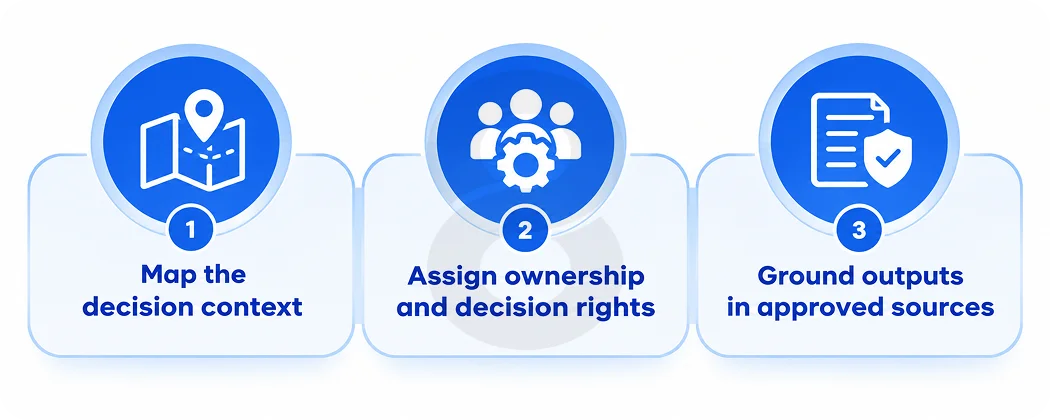
A working framework turns context into rules your AI systems follow. Use these layers to decide who owns each decision, which sources count as true, and where a human must step in.
Map the decision context
Start with an inventory. List every AI system, the decisions it makes or influences, the data it reads and the people affected by its output. Teams are often surprised by how many systems make decisions nobody documented.
NIST organizes AI risk work into four functions: Govern, Map, Measure and Manage. Govern is the cross-cutting foundation of policies and accountability, while the other three run in a loop for each system. A context map is the output of the Map step, and every later control depends on it.
Assign ownership and decision rights
For every mapped decision, name one accountable owner and set the AI’s authority. Can it act alone, recommend only, or draft for human approval? Set limits in numbers where possible: a refund ceiling, a credit threshold, a data category it may never touch.
Decision rights also define escalation. When confidence is low, when a case falls outside the tested scenarios, or when the stakes pass a set line, the system hands off to a person and logs the handoff.
Ground outputs in approved sources
An AI contextual governance solution should let the model answer only from sources your organization has approved, each with an owner and a review date. Retrieval from a governed knowledge base is the usual pattern. Teams building on generative AI development can wire that retrieval layer into the model itself, and teams building agentic AI can add tool permissions so an agent cannot take an action outside its assigned scope. For customer-facing use, an AI chatbot can be limited to verified policy content and set to escalate when no approved source applies.
The layers fit together like this:
| Layer | Question It Answers | Typical Control |
|---|---|---|
| Context map | Which decisions does this system touch? | AI inventory with data sources and affected users |
| Decision rights | How far may the AI act? | Authority thresholds and human approval steps |
| Source grounding | Which facts count as true? | Approved sources with owners and review dates |
| Validation | Is this decision correct here? | Scenario test suites with pass thresholds |
| Monitoring | Is accuracy holding over time? | Drift alerts and sampled human review |
Scoping these layers for a real product is a design problem as much as a policy one. A software consulting engagement is a common way to settle scope before any build starts.
Contextual validation and evidence
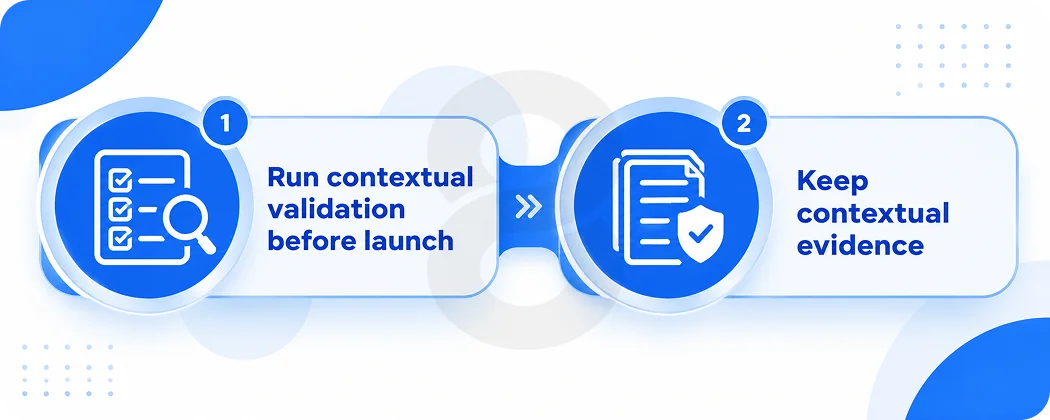
Trust in an AI decision comes from proof. Here you will see how to test decisions against real business scenarios and keep the records that show your results to auditors and leaders.
Run contextual validation before launch
AI governance contextual validation tests the system against cases that look like your actual work, not against a generic dataset. Build the test set from real historical decisions. Include the awkward ones: the customer in a special jurisdiction, the policy exception, the request that sits right on a threshold.
Set pass marks by risk. A tool that drafts internal summaries can tolerate more error than one that recommends a payment. Rerun the whole suite whenever a prompt, source or model changes. Dedicated software testing practice helps here, because scenario suites are regression suites with a business-specific twist.
Keep contextual evidence
AI governance contextual evidence is the record that a decision was checked. Passing a test today means little if you cannot show it next year. Store the material in a form an outsider could read without asking the engineer who built the system.
| Evidence Type | What It Shows | When to Collect |
|---|---|---|
| Scenario test results | Decisions match expected outcomes on real cases | Before launch and after each change |
| Input and source logs | Which data and documents shaped an answer | At every decision |
| Reviewer records | A person checked a flagged or high-risk decision | Whenever escalation rules trigger |
| Change history | What changed in prompts, sources or models, and why | At every release |
NIST’s Measure function covers this territory: methods and metrics for analyzing and monitoring AI risk. Good evidence also protects the team. When a decision is questioned, the log answers in minutes what memory would answer badly in weeks.
Contextual refinement and continuous improvement
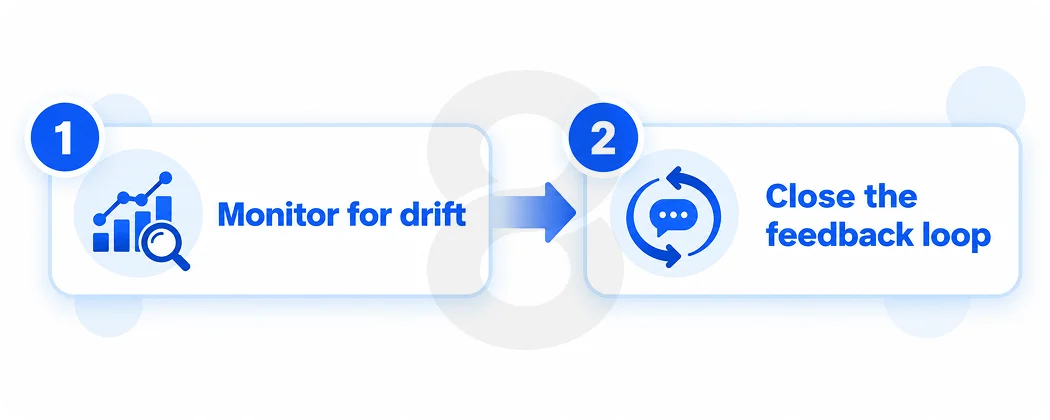
Accuracy fades when policies, data and users change. This section shows how to catch that drift early on and feed what you learn back into your rules, prompts and model choices.
Monitor for drift
A system that was accurate at launch will not stay that way by default. Prices change, regulations move, customers ask new questions. NIST says users must keep applying the Manage function to deployed systems as methods, contexts, risks and expectations evolve.
Track a small set of signals: the rate of escalations, the share of sampled decisions a reviewer overturns, the age of each approved source, and the number of queries that match no approved content. A rising override rate is often the first visible sign that context has moved.
Close the feedback loop
AI governance contextual refinement means every correction becomes an improvement. When a reviewer overturns a decision, add that case to the scenario suite. When a source is out of date, fix it at the source and log the change. When a gap keeps recurring, change the rule, the prompt or the model.
This loop is what AI contextual governance continuous improvement looks like in practice. AI governance contextual improvement is not a quarterly project. It is a small, steady routine with named owners, and it compounds: each cycle makes the test suite harder to fool and the sources harder to neglect.
Strategic visibility across your AI systems
Leaders cannot govern what they cannot see. AI contextual governance strategic visibility means a single view of which AI systems exist, what decisions they touch, how risky each one is and whether accuracy is holding.
In practice that is a dashboard fed by the artifacts described above: the inventory, risk tier, latest validation result, override rate and source freshness. A chief risk officer should be able to open it and see which three systems need attention this month. A product owner should see the same numbers for their own system.
The hard part is data, not design. Test results sit in one tool, logs in another, and approval records in a third. System integration work connects those sources so the dashboard reflects reality instead of a spreadsheet someone updates by hand. Visibility also changes budget conversations. When the numbers show that one system drives most escalations, funding follows the evidence and not the loudest request.
What an AI contextual governance solution costs
Cost varies too much for a single number to be honest. What you pay follows a short list of drivers, and each is something you can estimate before you commit.
- Number of AI systems in scope. Governing one chatbot is a different project from governing a portfolio.
- Integration effort. Connecting logs, knowledge sources and identity systems takes more engineering than most teams expect.
- Risk level of the decisions. Payments, health and legal content demand deeper validation and more human review.
- Human review capacity. Someone has to examine escalations and sampled decisions, whether staff or a managed team.
- Ongoing maintenance. Sources, tests and monitors need upkeep after launch.
Start by scoping one high-value system, prove the loop works, then extend it. That usually costs less than a company-wide rollout and gives you real numbers for the next estimate.
How 8ration works in AI development
8ration is a software development company with offices in the United States, Canada, the United Arab Emirates, and Kuwait. Its AI development work covers agentic AI, chatbots, generative AI, voice assistants and speech recognition. Alongside those, it offers software consulting, integration, design and testing, and its site lists ISO 9001 and ISO 27001 among its certifications.
That mix matters for governance because contextual controls are implemented in software. Approved-source retrieval, authority limits, escalation paths, audit logs and monitoring dashboards all have to be built into the product and connected to existing systems. 8ration’s role is on that build side: developing the AI systems, integrating the data they need and testing them against the scenarios a business defines. The policies and risk thresholds stay with the client’s own leadership, and the engineering makes them enforceable.