


So, if you’re thinking about hiring a CRM developer or buying pre-made CRM software, the answer is straightforward: businesses with more intricate sales processes and workflows or businesses with a more long-term outlook tend to gain more from hiring custom CRM software developers, while those businesses that have more regular workflows and a more modest budget are better off with pre-made CRM software. It all depends on your budget, timeline, team size, and how different your processes are from the norm.
Introduction: The CRM Dilemma Every Growing Business Faces
Customer relationship management is now a must. From a small startup team of 10 to a large enterprise of 500, your leads, customer data, pipelines, and communication management are the direct drivers of your revenue. The actual issue that companies are encountering today is not whether to use a CRM, it’s whether to acquire a web-based CRM developer and develop a CRM system from scratch or simply subscribe to a ready-made platform such as Salesforce, HubSpot, or Zoho.
This is no simple choice to make. Do it wrong, and you’ll be paying for features you don’t need for years or end up spending hundreds of thousands on a custom build that doesn’t live up to your standards. If done properly, your CRM is a serious competitive asset, eliminating mundane tasks, bringing to light the right information at the right time, and growing with your business, without breaking.
In this blog, we’ll explore both sides of the hire CRM developer vs CRM software argument objectively, with insight, and provide some tips for making the right decision for your situation.
What Does Hiring a CRM Developer Mean?
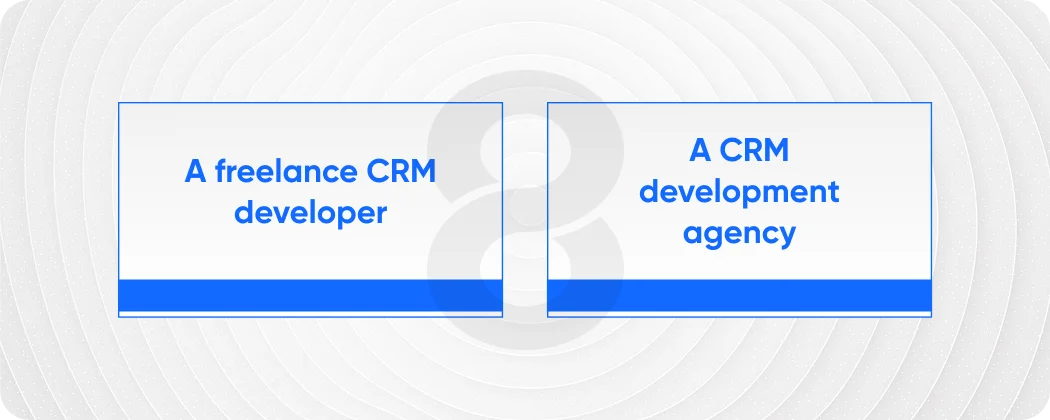
There are three common times when people state they want to hire a CRM developer:
An in-house developer, or developer team, means you hire developers to work full-time with you and develop your CRM, build it and maintaining it on your own. This provides the maximum control and maximum overhead.
- A freelance CRM developer: You hire a person to do a specific job that has a specific timeline. Cheap for small projects but hazardous if features change after the project.
- A CRM development agency: You work with an agency that specializes in CRM software development services, which include discovery, architecture, development, testing, and support. For businesses of intermediate or larger size, this is typically the best choice if they are looking for a solution without having to create a dedicated team from scratch.
The cost structure, risk profile, and timeline of each path are unique. What they have in common is a guarantee to offer a CRM tailored to your business, not a one-size-fits-all solution designed to fit any business.
What is a Ready Made CRM Software?
The CRM systems listed above that are ready-made or off-the-shelf are software packages that a business subscribes to and then customizes. The most popular ones are Salesforce, HubSpot CRM, Zoho CRM, Pipedrive, and Microsoft Dynamics 365.
The platforms are designed to meet the needs of a wide variety of industries and applications. They are also equipped with various features right from the start, such as contact management, deal pipelines, email integration, reporting dashboards, and even more, AI-driven forecasting tools. You register, set up your options, load your information, and you’re up and running in days or weeks instead of months.
The draw of it is clear: low friction, fixed price, hundreds of engineers maintaining the product. The restriction is just as apparent: you’re not in your own mind but in the mind of another.
The Reasons for Hiring a CRM Developer
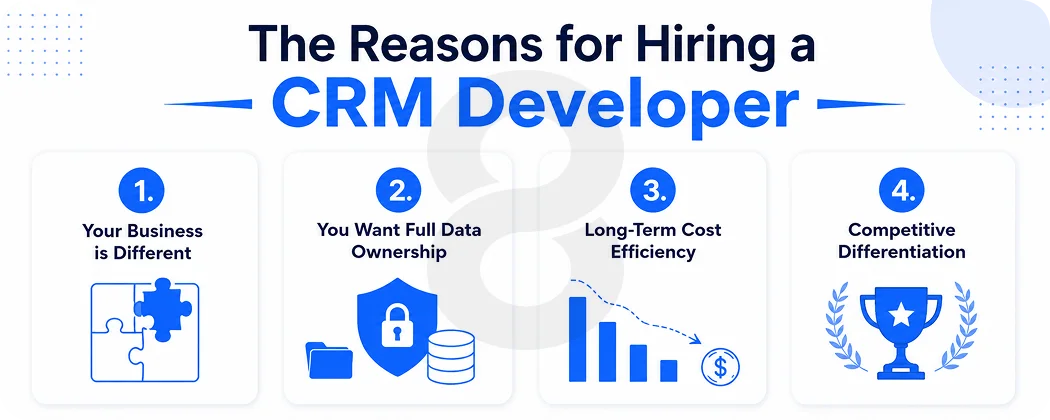
1. Your Business is Different
Most businesses believe their processes are one-of-a-kind. However, the truth is that many aren’t, and a typical B2B sales funnel will translate into HubSpot or Salesforce, and with some setup. There are other businesses though, that really aren’t like that: multi-sided marketplaces, complicated approval processes, industry-specific compliance standards, or workflows that are so closely interconnected with the business that no off-the-shelf solution fits.
Your team is already using a CRM, but not in a way that’s working, creating workarounds, copying data to spreadsheets, and maintaining parallel systems: that’s a telltale sign that you’re on to a good idea hiring custom CRM developers.
2. You Want Full Data Ownership
If you use ready-made CRM software, your data is stored on another server. You accept their privacy policies, their security, and most importantly, they continue to exist as a company. If they get acquired or they are phased out or if they just increase the price a lot, then you’re in their hands.
If you use a CRM developer, and create your very own system, it is yours and yours alone. It is hosted at a location of your choosing, backed up according to your specifications, and accessible to whomever you design. This is often a must for companies in regulated industries, such as healthcare, finance, or legal.
3. Long-Term Cost Efficiency
The cost of a custom CRM development is not so daunting once you do the math over the long run. The middle-tier Salesforce subscription is $75 to $300 per user, per month. For a team of 50 users, that’s $45,000 to $180,000 per year, every year, indefinitely. Implementation fees, consultation fees, third party add-ons, and the list goes on and on.
The initial investment for a customized CRM system designed by a CRM development company could be anywhere between $100,000 and $350,000. Once installed, costs for you are maintenance and hosting, which is usually a small fraction of the cost of licensing for perpetuity. If you’re looking at a cost-benefit analysis over the next five to seven years, custom development can typically beat out a pre-packaged solution in a landslide.
4. Competitive Differentiation
You cannot win the technological advantage if your CRM is set up exactly like your competitor’s CRM, and you’re on the same platform. You can create custom CRM features that SaaS providers can’t replicate such as AI-powered lead scoring based on your own data, custom forecasting models, and custom workflow automation.
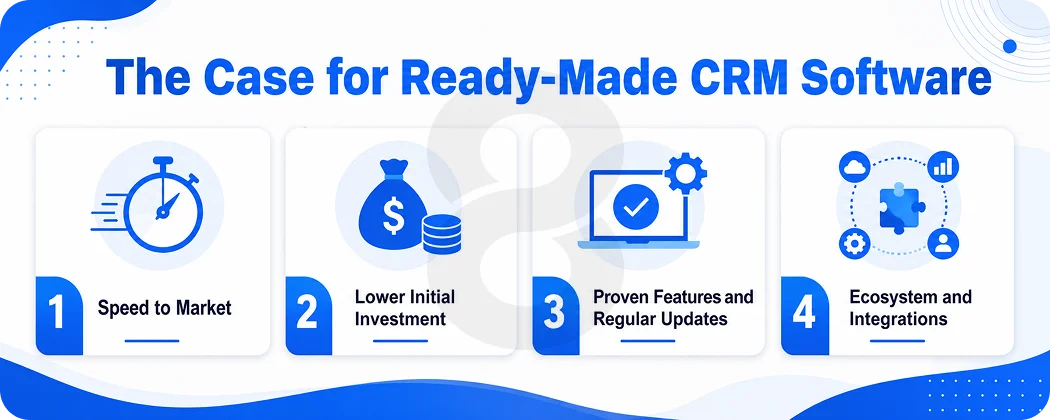
The Case for Ready-Made CRM Software
1. Speed to Market
If you need a CRM system up and running in four to eight weeks, then you’re in luck, because you only have one option: off-the-shelf software. Proper and custom development is anywhere from 3 to 12 months based on complexity. When your organization is expanding and requires its sales team to be ready today that is just not an option.
2. Lower Initial Investment
No, you are not required to spend $600,000 in the beginning to implement HubSpot or Zoho. The price of entry-level plans begins in the hundreds of dollars per month. This is the beginning to build your sales process for startups, testing the market, and small businesses with simple needs.
3. Proven Features and Regular Updates
There are CRM platforms already available to use, which have been improved over many years and millions of users. The email tracking functions. The pipeline visualization is user-friendly. The mobile application works well. You’re not developing and iterating this yourself; you’re taking advantage of years of development.
Moreover, these platforms are continually updated. New AI features, enhanced integrations, enhanced reporting tools, you get them all as part of your subscription. A bespoke CRM will need conscious investment to keep it up-to-date.
4. Ecosystem and Integrations
There are more than 3000 third-party integrations in Salesforce’s AppExchange. HubSpot integrates with hundreds of marketing, sales and service tools natively. Ready-made CRM software comes with a wealth of integrations, and custom integrations have to be developed one at a time.
CRM Developers Salary: Understanding the Real Cost of In-House Development
When it comes to CRM developers’ salaries, it’s crucial to consider this range if you are thinking of getting an in-house developer for your needs instead of using an agency. In the United States, the salaries of CRM developers also depend on their expertise and geographic location:
- The salary of a CRM junior developer having one to three years of experience usually ranges from $65,000 to $90,000 per year.
- Mid-level developers (3-6 years experience) earns between $90,000 and $120,000. In strong markets such as San Francisco, New York or Seattle, senior CRM developers or architects with 6+ years of specialty experience can command more than $130,000.
- This includes no benefits, any payroll taxes, equity, onboarding costs, or management overhead for maintaining an engineering team. Taking all-in costs into account, a single senior developer in the USA is $180,000 to $220,000 a year.
- This is why many businesses choose to hire CRM software development services from a reputable agency instead of hiring an in-house staff. An agency has a whole team of developers, QA engineers, project managers, UX designers, and more, and they’ll charge you, often less than two full-time devs, and you don’t have to sign a long-term contract.
What CRM Software Development Services Actually Include
With a professional agency providing you with CRM software development services, you aren’t just coding. The good competency of a CRM development agency provides you with:
- Discovery and requirements gathering: Here, you will learn about your sales process, data model, user roles, and integration requirements before you write a line of code.
- UX and interface design: Creating a CRM that your team will love to use. Whatever they choose to use, whether it’s custom or off-the-shelf CRM, the top reason for failure is poor UX.
- Backend coding: Creating the foundation of your CRM, such as the data structures, APIs, business logic, and automation engines.
- Frontend development: Building user-friendly dashboards, pipeline views, reporting tools and mobile interfaces.
- Integration development: When you need to integrate your CRM with your ERP system, marketing system, helpdesk, billing program, and other systems you’re using.
- Testing and QA: Data integrity, security, and performance up to going live.
- Deployment and training: Transferring data, setting up production environments, and training your staff.
- Continuous Support and Maintenance: Fixing bugs, handling feature requests, and maintaining the infrastructure after the release.
Conclusion
No one size fits all when it comes to the choice between a CRM developer and CRM software. It has the right solution for your business at your stage.
When you’re in the early stages, moving quickly, and using a traditional sales approach, off-the-shelf CRM software will get you up and running quickly and cost-effectively. For those who are scaling, running complex workflows, working with larger teams, or operating in an industry where proprietary technology is crucial, it’s a smart move to invest in custom CRM developers, whether in-house or through a CRM development agency, that will reap compounding returns over time.
The point is that the cost of choosing the wrong CRM, whether it’s an inflexible off-the-shelf solution your team is forced to adapt to or a poorly defined custom-built platform that never delivers real value, is far greater than investing the proper time and consideration into digital product development from the start.
Take the time. Run the numbers. Discuss with CRM software development services provider and some SaaS vendors. Then, take the step that’s appropriate on your road to the future and not your present.