



A surgical tray can be delayed because an instrument is missing, its location is unclear or an assembly issue requires another check. By the time the operating room asks for an update, the sterile processing team may already be searching several systems for answers.
AI in sterile processing is gaining attention because it could help teams recognize these problems earlier. Some tools analyze instrument records. Others use cameras to support assembly checks or help managers turn operational data into readable reports.
The value depends on the task. Finding a pattern in missing-instrument records is very different from deciding whether a device has been adequately reprocessed. A useful system needs a defined purpose, reliable data and clear limits on what it can decide.
For healthcare leaders considering an investment, the priority is choosing a problem worth solving and establishing how the technology will prove it helps.
What Is AI in Sterile Processing?
Artificial intelligence in sterile processing refers to software that analyzes information or recognizes patterns to support work in a sterile processing department, often called an SPD.
The inputs might include instrument images, equipment records or timestamps from an existing tracking system. Depending on its design, the software could flag an assembly omission, identify a recurring delay or draft an operational summary for review.
Sterile processing automation is broader than AI. A barcode scan that records a tray’s location is automation. A model that analyzes its movement history to estimate a delay introduces prediction. Hospitals should understand that distinction before paying for an “AI-powered” feature.
The underlying clinical process remains essential. The FDA describes reusable medical device reprocessing as a multistep process involving cleaning followed by disinfection or sterilization, as appropriate. Software does not remove the need to follow device-specific reprocessing instructions.
Where AI Can Support Sterile Processing Workflows
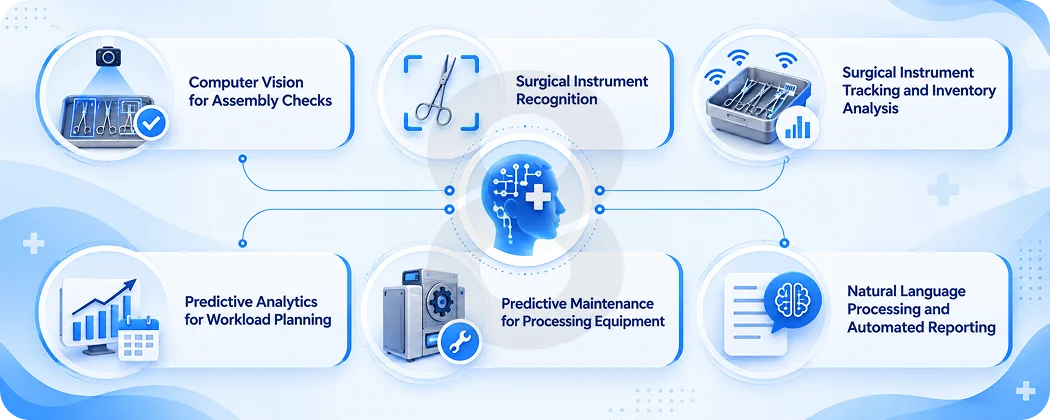
Not every application is equally mature. Some capabilities are commercially described today, while others require substantial local development and evaluation.
| Application | What it could help staff do | Evidence or implementation status | Essential boundary |
|---|---|---|---|
| Assembly checks | Detect a defined omission before packaging | Commercial examples exist | A camera check does not establish sterility |
| Instrument recognition | Suggest the identity or category of an instrument | Research and product development are ongoing | Similar instruments still require verification |
| Tracking analytics | Investigate missing items and repeated delays | Available in vendor offerings | Results depend on complete tracking records |
| Workload prediction | Anticipate demand and capacity pressure | Requires evaluation against local operations | Forecasts should support supervisor decisions |
| Maintenance prediction | Flag equipment behavior for investigation | Depends on equipment data and model validation | It does not replace required maintenance |
| Reporting assistance | Draft summaries from approved data | Feasible with existing language-model technology | Staff must verify the output |
Computer Vision for Assembly Checks
Computer vision analyzes images to detect specified objects or visual features. In an SPD, a narrowly defined task might be checking whether a required indicator is present at the end of assembly.
Censis describes this application in its Assembly Copilot: Final Check offering. That is a useful example of a bounded check: the system looks for something specific at a particular point in the workflow. It should not be interpreted as comprehensive verification of every instrument or the sterilization process.
During evaluation, ask what the camera cannot see. An item may be obscured by another object or positioned outside the expected view. The software should distinguish an uncertain image from a confirmed satisfactory check and give the technician a clear next step.
Surgical Instrument Recognition
Surgical instrument recognition could help technicians identify unfamiliar items or compare an instrument with an approved reference.
A 2025 study evaluated multimodal AI models for instrument recognition. Its reported results varied across models, with the strongest result for instrument categorization still falling short of perfect accuracy. The study demonstrates potential, not universal readiness for unsupervised identification.
Hospitals should test recognition against their actual inventory. Instruments that share a general shape may differ in length, curvature or function. Identifying an item as a forceps category does not necessarily establish its exact catalog identity.
A practical interface should show the suggested match alongside reference information and allow the technician to reject it.
Surgical Instrument Tracking and Inventory Analysis
Surgical instrument tracking provides information about where an item was recorded. AI can potentially help explain patterns across those records.
For example, an analysis might identify sets that repeatedly reach assembly with missing items. Another could highlight instruments that appear unused in the available records and deserve an inventory review. Censis markets AI-supported analytics for tracking, inventory and operational performance. These are vendor-described capabilities rather than guaranteed outcomes for every facility.
Automated inventory management should still preserve a difference between observation and inference. “Last scanned in decontamination” is an observed record. “Probably available in storage” is an inference and should never appear as a verified location.
Predictive Analytics for Workload Planning
Predictive analytics could combine historical processing times with upcoming surgical demand to estimate where capacity may become tight.
Consider a proposed system that flags a busy afternoon because several cases depend on the same limited tray inventory. The supervisor could review staffing and priorities before the backlog grows.
That is a planning opportunity, not evidence that a model can produce a reliable staffing schedule from case counts alone. A useful forecast must account for local conditions, including differences in tray complexity and late changes.
Compare its recommendations with a simple baseline. If an experienced supervisor or a basic scheduling rule performs just as well, a more complicated model may not justify its cost.
Predictive Maintenance for Processing Equipment
Predictive maintenance aims to identify patterns that may precede equipment problems. A potential implementation could analyze service history alongside permitted operational data from washers or sterilizers.
The design challenge is obtaining enough relevant information. A hospital may have detailed cycle records but few labeled equipment failures. That can make a failure-prediction model difficult to evaluate.
Start with a precise objective, such as prioritizing unusual operating patterns for a qualified maintenance team. Keep the approved maintenance program in place. An absence of AI alerts should never be treated as evidence that equipment no longer needs scheduled attention.
NLP and Automated Reporting
Natural language processing allows software to work with written or spoken language. Within an SPD, it can support report drafting, document search and educational material development.
Getinge discusses potential uses such as generating narratives from structured data and helping educators prepare learning resources. These are useful starting points because the output can be reviewed before anyone relies on it.
For automated reporting, calculate the numbers through a dependable data pipeline and let the language model explain the results. The reviewer should be able to trace each statement back to its source. A polished paragraph is not evidence that the underlying calculation is correct.
Benefits of AI in Sterile Processing
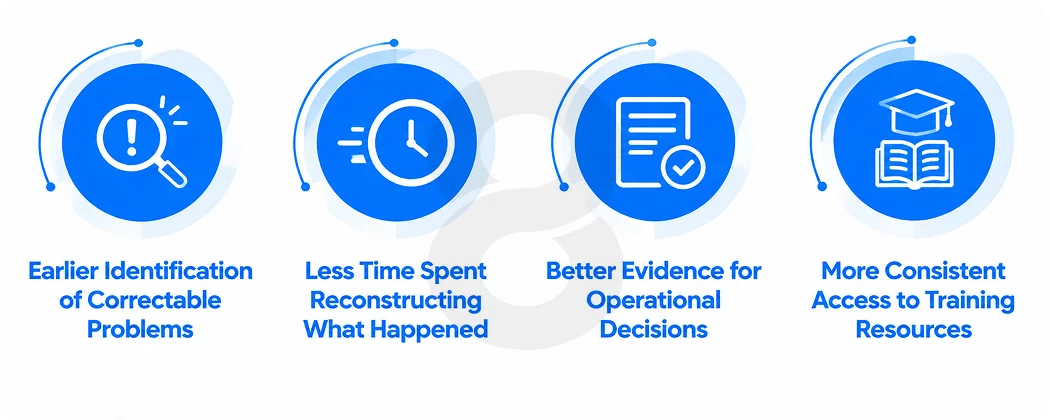
The benefits are best treated as outcomes to test. A convincing demonstration is useful, but it does not show what happens across ordinary shifts.
Earlier Identification of Correctable Problems
A well-designed alert may help staff catch an omission while the tray is still at the relevant workstation.
The benefit is not the number of warnings generated. It is the number of meaningful issues resolved without introducing excessive interruptions. Teams should examine both missed problems and unnecessary alerts.
Patient safety remains the reason quality matters, but a reduction in one type of assembly error does not by itself prove a reduction in infections.
Less Time Spent Reconstructing What Happened
Investigating a delayed tray can involve checking multiple records and asking several people for context. A system that brings reliable information together could shorten that search.
To test the benefit, choose a recurring investigation and measure the time required before and after implementation. Include time spent correcting the AI’s output. Otherwise, apparent savings may simply move work to someone else.
Better Evidence for Operational Decisions
Managers often need to distinguish between a staffing problem and an inventory or equipment constraint. An analytical tool can be designed to help explore those possibilities.
For example, a recurring delay may coincide with a particular tray arriving late rather than slow work at assembly. The system should present supporting records so leaders can investigate instead of treating a prediction as the explanation.
More Consistent Access to Training Resources
An assistant connected to approved materials could help employees locate the right reference during sterile processing training.
The strongest design retrieves the relevant document and shows its version. It also makes clear when no reliable answer is available. Training staff can review common questions to identify topics that need better teaching materials.
A chatbot should not become an unofficial source of new reprocessing instructions.
How to Measure Whether the Investment Is Working
Agree on the measurement plan before the pilot. Otherwise, a project can produce attractive dashboards without answering whether it improved work.
| Objective | Practical measure | What to examine alongside it |
|---|---|---|
| Improve assembly checks | Defined defects per comparable number of trays | Missed defects and false alerts |
| Reduce investigative work | Time to resolve a specified tracking question | Data completeness and correction time |
| Improve reporting | Staff time to prepare and verify a report | Numerical and factual accuracy |
| Support forecasting | Prediction error against actual workload | Performance during schedule changes |
| Improve inventory decisions | Verified recoveries or justified purchasing changes | Costs of investigation and integration |
| Support adoption | Appropriate use and documented overrides | Staff feedback and workflow burden |
Keep the comparison fair. A less complex case mix or a staffing change can affect results independently of AI.
For financial evaluation, include the full operating cost. Software fees may be only one part. Integration, equipment, training and ongoing monitoring all need budget ownership. Count time savings as financial savings only when the organization can explain how that time will be used or expenditure will change.
Challenges of Implementing AI in the SPD
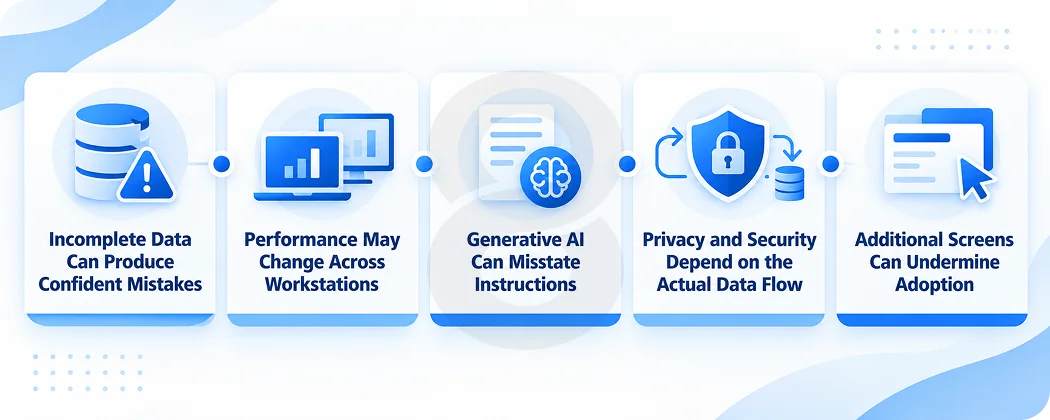
An AI tool may work well in a demonstration but struggle with incomplete records or unfamiliar instruments on a busy shift. Before staff rely on it, the department needs to understand where it can fail and how those failures will be handled.
Incomplete Data Can Produce Confident Mistakes
A missing scan creates an information gap. It does not establish that an instrument is lost.
Before model development, examine identifier consistency and timestamp quality. Check whether the data represents overnight shifts and unusual events, rather than only the cleanest records.
The system should expose missing information. It should not silently fill gaps with plausible descriptions that users mistake for facts.
Performance May Change Across Workstations
A vision tool tested under one camera setup may struggle elsewhere. Reflections, positioning and different tray contents can affect the images it receives.
Test representative working conditions and record where performance deteriorates. An overall accuracy number can hide poor results for a small but important instrument category.
Local acceptance criteria should reflect the consequence of the error. Confusing two similar instruments deserves different treatment from failing to read a nonessential label.
Generative AI Can Misstate Instructions
A language model may omit a condition or combine information from different documents. An answer can sound clear while being unsuitable for the device in question.
Use controlled source documents and require visible references. A retrieval-based assistant should open the current instructions for use, or IFU, rather than replace them with an unsupported summary.
The FDA’s reprocessing guidance addresses scientific validation and labeling instructions for reusable devices. That reinforces why a generated answer cannot be treated as a newly validated procedure.
Privacy and Security Depend on the Actual Data Flow
Some SPD information is operational. Other records may connect instruments or procedures with identifiable patients. Map that distinction before sending data to an external service.
HHS explains that a cloud provider handling electronic protected health information on behalf of a covered entity generally acts as a business associate, requiring an appropriate agreement and applicable safeguards. A signed agreement alone does not resolve every security obligation.
Review access permissions, retention and whether uploaded data can be used for model training. Avoid including patient information when the use case does not need it.
Additional Screens Can Undermine Adoption
A tool that requires repeated typing may save management time while increasing technicians’ workload.
Include frontline staff in interface testing. Observe how the proposed system fits into assembly and handoffs. Make overrides straightforward and record why staff reject a recommendation.
A high override rate is a reason to investigate the product, not automatically a sign that employees resist change.
Best Practices for Introducing AI in Sterile Processing
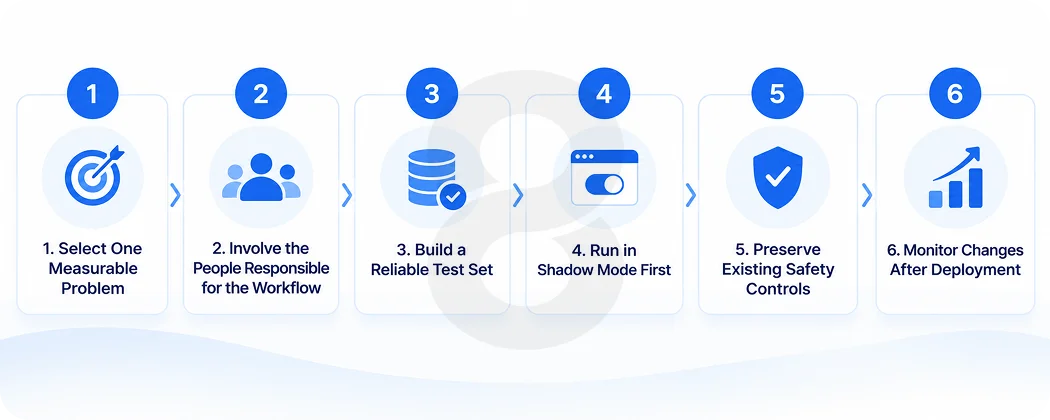
Start with one task your team can evaluate without disrupting established procedures. Involve the people who do the work and agree on what the tool must demonstrate before it becomes part of the daily routine.
1. Select One Measurable Problem
Begin with a problem that has a clear definition and a manageable consequence if the software is wrong.
A report-drafting assistant or read-only tracking analysis can be easier to evaluate than a system proposing broad operational changes. Write down what the application is allowed to do and what remains outside its scope.
2. Involve the People Responsible for the Workflow
Bring SPD staff together with relevant IT, infection prevention and quality stakeholders. Include equipment specialists where the application touches machinery.
Assign ownership for approving outputs and reviewing incidents. A project needs someone responsible for daily operation after the development team leaves.
3. Build a Reliable Test Set
Use examples from real operating conditions, with appropriate privacy controls. Separate development data from evaluation data so the test measures performance on information the model has not already learned from.
Include difficult cases deliberately. Missing records and unfamiliar instruments should trigger appropriate uncertainty rather than disappear from the evaluation.
4. Run in Shadow Mode First
In shadow mode, the system produces suggestions without changing the live workflow. Compare those suggestions with verified outcomes.
This can expose weaknesses before staff depend on the tool. It also provides an opportunity to check whether alerts arrive early enough to matter.
Move to assisted use only after the responsible stakeholders review the evidence.
5. Preserve Existing Safety Controls
An AI result should not be used to bypass established reprocessing checks. CDC recommendations call for mechanical, chemical and biological monitoring of sterilization processes. An image classification or anomaly score does not substitute for that monitoring.
Document what happens when the application is unavailable. Staff should have a workable fallback, not an improvised process during an outage.
6. Monitor Changes After Deployment
A successful pilot is the start of operational oversight. New instruments, revised documents and software updates can change performance.
Keep records of model versions and approved configurations. Review errors regularly and establish conditions that require pausing the system. Expansion should follow evidence that the application works across the intended environment.
Future Trends in AI and Sterile Processing
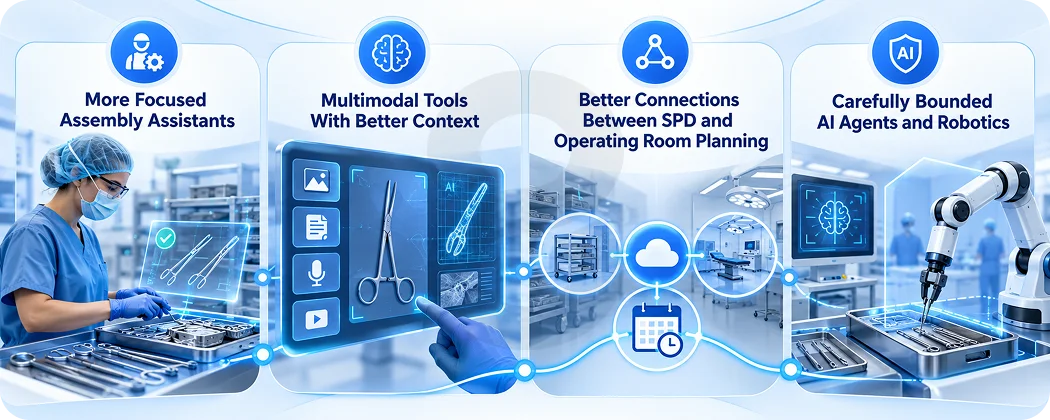
The following are plausible development directions, rather than predictions that every hospital will adopt them.
More Focused Assembly Assistants
Narrow checks may expand into tools that help staff investigate specific assembly concerns. The useful progression is toward clearer evidence and better handling of uncertainty.
Broad autonomous tray approval would require a much stronger demonstration of reliability. Hospitals should evaluate the exact supported function rather than assume that one successful check validates the whole assembly process.
Multimodal Tools With Better Context
Future systems may combine images with instrument records and approved reference documents. This could help distinguish visually similar items or explain why a proposed match is uncertain.
The integration itself will need evaluation. More inputs can provide context, but conflicting or outdated information can also create new errors.
Better Connections Between SPD and Operating Room Planning
Closer coordination could make forecasts more useful. A system might help teams explore how a schedule change affects expected tray demand and processing capacity.
Such tools should preserve human control over priorities. The aim is to make trade-offs visible before pressure builds, with evidence that both departments can inspect.
Carefully Bounded AI Agents and Robotics
AI agents could eventually coordinate administrative steps, such as preparing an exception report and routing it for approval. Physical automation may also expand for narrowly defined handling tasks.
Both directions need explicit limits. An agent should not change a release status merely because it completed a checklist. Physical systems must be evaluated for the specific instruments and environment in which they operate.
Plan a Practical AI Project With 8ration
A worthwhile project starts with a clear account of the work: what slows the team down, what information is available and how a wrong output could affect the process.
8ration offers custom AI development, computer vision and predictive analytics, along with AI integration services. Those capabilities can support the software side of a carefully scoped initiative. Healthcare workflow approval and clinical validation should remain with qualified stakeholders.
Before development, define the intended users and success criteria. Decide which data the application can access and which actions require approval. That gives the team a concrete basis for evaluating a prototype.