


Some app projects do not fail because the idea was bad. They fail because the team was built the wrong way from day one.
It usually starts with one developer because the budget is tight. Then the backend needs more work than expected. QA slips behind. The designer waits for product decisions that never come on time. Someone finally asks about the admin panel, and the room goes quiet because nobody really planned it.
By testing, the app is held together with guesses, tired people, and decisions everyone postponed. The founder is angry. The roadmap has turned into a shared Google Doc full of optimism, missing details, and small compromises that are now very expensive to fix.
That is usually when companies start comparing staff augmentation vs outsourcing. The question sounds simple. Should you add people to your current team, or hand the project to an outside app development team?
The real answer depends on how much control you want, how much management work you can handle, and whether your internal team actually has the time to carry another build. I know that sounds boring. It is also the part people ignore before they burn six months and then blame the developers.
What Staff Augmentation Means in App Development
Staff augmentation means you bring external people into your existing team. These people can be mobile developers, backend engineers, UI designers, QA testers, DevOps specialists, AI engineers, or full stack developers.
They work with your existing team instead of replacing it. That matters because your company still owns the direction. Your product owner sets priorities, your technical lead reviews the code, and your team controls sprint planning, feature decisions, release timing, and the product backlog.
The model works well when the internal team is already functional. Maybe the backend team is still stuck on payment logic while the mobile team keeps asking when the API will finally be ready. The app may already be live, but every release still feels risky.
That is where flexible IT staff augmentation can help. You bring in capable people for the parts that are slowing the team down, instead of pretending your current team can keep absorbing every delay, every bug, and every last minute fix without burning out.
But staff augmentation is not magic. If nobody inside your company knows what needs to be built, the extra developer will not fix that. They will wait for tickets, ask for context, sit in meetings, and eventually start making assumptions. That is how bad features are born.
As the talent market is going to stay competitive in coming years, good app developers are not sitting around waiting for unclear briefs and messy repositories.
Read More: The 2026 Founder’s Guide: Finding the Best Mobile App Developers for Hire
What Outsourcing Means in App Development
Outsourcing means you give a project, or a large part of it, to an external team. That team handles delivery. In a real app project, that usually includes discovery, wireframes, UI design, backend development, mobile development, QA, DevOps, deployment, and post launch support.
This model fits companies that do not have a full product team inside the business. A founder with an app idea does not always need to hire six people. A retail company building a loyalty app may not need a full internal mobile department.
Similarly, a healthcare business may need a patient app, admin dashboard, secure backend, and testing support, but it may not have the people to manage all of that.
That is where app development outsourcing can make sense. A serious outsourcing team does more than write code. It asks annoying questions early.
What happens if payment fails? What happens if the user enters the wrong address? Who can delete an account? What data does the admin see? What happens when push notifications do not deliver? These questions are not glamorous, but they stop the app from collapsing after launch.
Many companies choose mobile app development support because they need the whole build managed in one place. That does not mean outsourcing is always better. It means some teams need delivery, not another person added to a broken process.
The Real Difference: Control vs. Convenience
This is the honest core of the staff augmentation vs outsourcing debate.
With staff augmentation, you own the process. You manage the developers, product manager, or tech lead who has the bandwidth to actually direct external contributors and review their PRs. If you don’t have that person, augmented talent becomes expensive confusion.
With outsourcing, you hand off that management burden. The vendor owns process, timelines, and architecture decisions. For non-technical founders or teams without dedicated project management, this sounds like a relief. And honestly, for the right type of project, it is.
But here’s what the convenient pitch doesn’t mention. When scope changes in an outsourced engagement (and it will), every change is a new negotiation. Change requests in outsourcing agreements can inflate costs by 20 to 40 percent.
If you started with a $120,000 fixed-price app contract and your requirements evolve twice over the course of a build, you could easily land at $160,000 or more before you’ve shipped anything.
Factor |
Staff Augmentation |
Outsourcing |
|---|---|---|
| Best Fit | Existing app teams that need more skills or speed | Businesses that need a full app built by an outside team |
| Control | High control over daily work | Lower daily control, higher delivery delegation |
| Management Load | Your team manages people, sprints, reviews, and priorities | Vendor manages team structure, delivery, QA, and milestones |
| Cost Model | Hourly, monthly, or role based | Fixed scope, milestone based, or dedicated team pricing |
| Flexibility | Easier to add or remove specialists | Scope changes need review and budget updates |
| Speed | Fast when your internal process is strong | Fast when scope is clear and vendor process is mature |
| Risk | Poor internal management can waste talent | Poor vendor selection can damage timeline and quality |
| Knowledge Ownership | Stays closer to your internal team | Needs planned documentation and handover |
| App Examples | Add a Kotlin developer, fix backend APIs, scale QA | Build an MVP, redesign an app, create a full platform |
A company can outsource the MVP, then use staff augmentation later when the app has users and an internal product team. Another company can keep the mobile app in house, then outsource the admin dashboard or AI feature.
Read More: How to Hire a Software Engineer: The 2026 Checklist
When Staff Augmentation is Better Choice
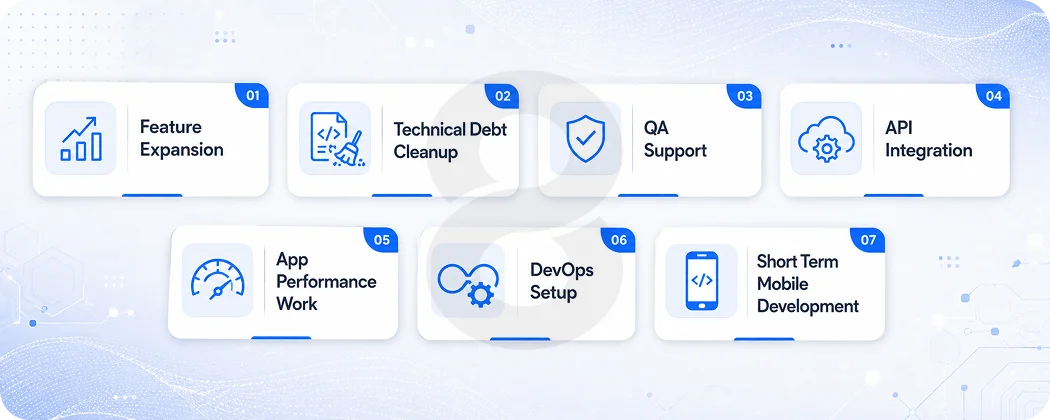
Staff augmentation is the better choice when your team is already moving, but it needs help.
That means product decisions already have an owner, code reviews are happening, and the backlog is clear enough for new developers to understand the work without chasing five people for answers. The app has direction. The problem is capacity, because the team needs more hands to finish the work without turning every release into late nights, weekend fixes, and another round of tired people pretending they are fine.
Say your app is already live and users keep asking for a loyalty feature. Your internal team knows the codebase, but they are buried under bug fixes and release work. Hiring an augmented developer for the feature can help. You keep control, but you do not force your core team to absorb every task.
It also works when you need niche skills for a limited time. AI recommendations, blockchain wallets, streaming features, complex dashboards, or health data workflows may need specialists. Hiring full time for one feature can be wasteful. Bringing in the right person for three or six months can be more practical.
The danger is pretending outside people manage themselves. They do not. Someone still writes tickets, explains context, reviews pull requests, handles access, answers questions, and decides what matters. If your internal team is already drowning, staff augmentation can become another thing to manage.
When Outsourcing is Better Choice
Outsourcing is the better choice when you need delivery more than headcount.
That is the part many founders learn too late. They think they need a developer. What they actually need is product planning, UI/UX, backend logic, mobile development, QA, deployment, and someone who can say no when the feature list starts getting ridiculous.
A real MVP still needs structure. It needs login, onboarding, user roles, data storage, payments, analytics, notifications, admin controls, error handling, security basics, and a release plan. A smaller product still has to work. Otherwise, you are not building an MVP. You are building a demo that will embarrass you in front of users.
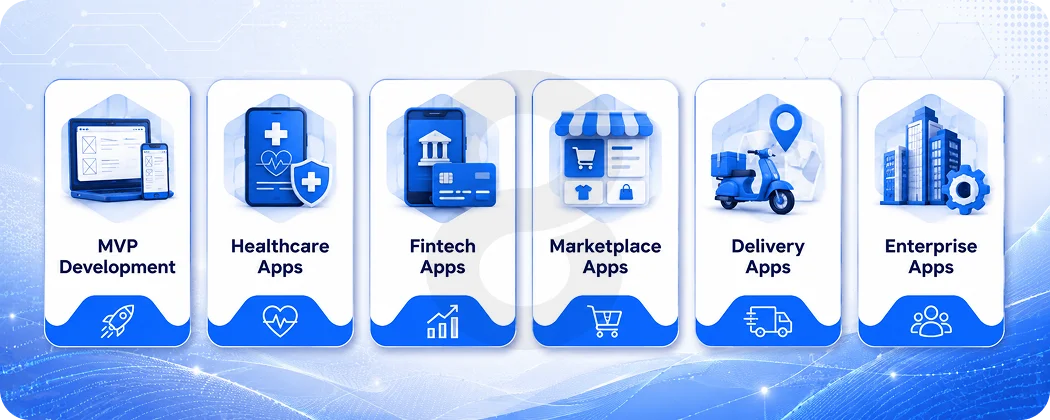
Outsourcing fits startups without technical leadership, businesses building their first app, enterprises that need a separate product team, and companies that want a defined launch plan instead of a hiring experiment.
It also fits app types where several roles need to move together. Marketplaces, booking apps, delivery apps, fintech platforms, healthcare apps, and enterprise workflow tools usually need more than mobile screens. They need backend systems, dashboards, integrations, permissions, QA plans, and long term maintenance.
That is why many companies pair mobile work with custom backend development instead of treating the app as a pretty front end. Users may tap on the app, but the business logic usually lives behind it.
The downside is control. You will not manage every developer every day. If that bothers you, outsourcing will feel uncomfortable. You need clear scope, weekly reviews, milestone demos, source code access, documentation, and honest reporting. Without those things, outsourcing becomes expensive guesswork.
Cost Differences That Actually Matter
Cost Area |
Staff Augmentation Impact |
Outsourcing Impact |
|---|---|---|
| Recruitment | Vendor sources talent, your team interviews | Vendor assembles the delivery team |
| Management | Your team manages daily work | Vendor manages daily delivery |
| Project Planning | Your product team owns backlog and sprint priorities | Vendor helps plan scope, milestones, and execution |
| QA | You provide QA or add QA roles separately | QA is usually part of the delivery team |
| Tools and Access | Your team often provides tools and environments | Vendor may use its own tools or shared setup |
| Change Requests | Easier to shift developer priorities | Changes may affect timeline and budget |
| Total Cost Risk | Poor internal management increases waste | Weak scope and poor vendor control increase waste |
| Best Cost Outcome | Strong internal team plus temporary skill gaps | Clear product scope plus accountable delivery team |
Everyone asks which model is cheaper. The better question is which model wastes less money.
Staff augmentation can look cheaper because you pay for specific people. One iOS developer. One QA tester. One backend engineer. You can see the monthly cost and compare it with hiring.
But the visible cost is not the whole cost. Someone still has to manage the work, review the code, explain priorities, test releases, and answer all the small questions that never show up in the invoice. If your product owner, technical lead, and QA team are already stretched thin, the real cost shows up later in delays, messy handoffs, missed bugs, and the kind of frustration that makes every sprint feel heavier than it should.
Outsourcing usually looks more expensive upfront because you pay for a team and delivery process. That may include discovery, design, development, QA, DevOps, project management, release support, and documentation. On paper, it feels heavier. In practice, it can be cheaper than hiring people one by one and then realizing nobody owns the full product.
Statista projects worldwide IT outsourcing revenue to reach $634.18 billion in 2026. Companies are not spending that kind of money because outsourcing sounds fashionable. They are doing it because hiring every skill internally is slow and often unrealistic.
If you are still early in planning, a web app cost estimate can help you check whether your scope and budget live in the same universe. It will not replace a proper discovery call, but it can stop the first pricing conversation from turning into pure fantasy.
The cheap option is not the lowest quote. The cheap option is the one that gets you working software without forcing a rebuild three months after launch.
Read More: Choosing Time Zone Compatible App Developers
Security, Ownership, And Handoff
Security is where tired teams get careless. They are trying to ship, the deadline is ugly, and someone says they will fix permissions later. Later usually means after something breaks.
App security needs attention before launch, not after users start sending support emails. IBM’s 2025 Cost of a Data Breach Report puts the global average breach cost at $4.4 million. OWASP lists risks such as improper credential use, weak authentication, insecure communication, weak privacy controls, and insecure data storage.
With staff augmentation, your company controls access. That means role based permissions, code review rules, test environments, secret management, and clear approval paths. Do not give every external developer full access because everyone is in a hurry. That is how small shortcuts become expensive stories.
With outsourcing, you need security expectations in writing. Ask how the team handles API protection, mobile security testing, dependency checks, data privacy, release approvals, and source code access.
Ownership also needs clarity. Who owns the code? Where is the repository hosted? Who has admin access? What happens if the contract ends? Who documents the architecture? Who maintains the app after launch?
A vendor can build a decent app and still leave you helpless if the handoff is weak. Ask for API documentation, architecture notes, deployment steps, test cases, environment details, and a walkthrough of the parts that can break the business.
Which Model Fits Your App Type
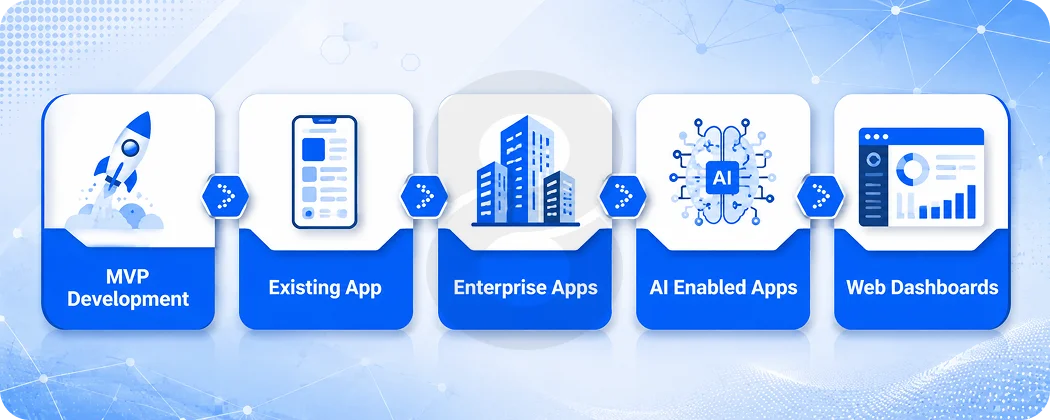
The app type should affect the team model. A simple booking app, a fintech product, and an enterprise workflow app do not need the same setup.
For MVP development, outsourcing often works better when the founder has no technical team. You get product discovery, design, development, QA, and launch support together. That structure matters because early products are full of blind spots.
For an existing app, staff augmentation often makes more sense. Your team already knows the codebase, user complaints, roadmap, bugs, and business logic. You may only need extra people to push a release, clear technical debt, or build a feature your team cannot handle alone.
For enterprise apps, the answer depends on internal ownership. If the company has a strong IT team, staff augmentation can support integrations, reports, admin tools, and workflow modules. If the company has no delivery team, outsourcing is safer.
For AI enabled apps, do not treat AI like a button you add near the end. You need data rules, backend logic, user experience safeguards, testing, monitoring, and fallback behavior. If your team already knows the product, you can add specialists. If the product is new, it is better to work with a team that understands AI feature development as part of the full app, not as a decoration.
For products that need dashboards, admin portals, reporting, or internal tools, mobile and web usually move together. The app may be what users see, but the business often runs through web dashboards and admin panels behind it.
Read More: Staff Augmentation vs Managed Services: Which Is Better?
A Practical Decision Framework
Use staff augmentation if your team can manage the work. Use outsourcing if you need another team to carry delivery.
That sounds simple because it is. The hard part is being honest about your internal capacity.
Ask these questions before you choose.
- Do we have a product owner who can make decisions quickly?
- Do we have a technical lead who can review the work properly?
- Do we already know the app scope?
- Can our team manage sprint planning, QA, deployment, and support?
- Do we need specific skills, or do we need a full product team?
- Will this talent be needed after launch?
- How much control do we really want every week?
If your answers show strong internal ownership, staff augmentation is likely the better fit. If your answers expose missing structure, outsourcing will probably save you more stress.
The worst choice is hiring augmented developers when nobody has time to manage them. The second worst choice is outsourcing a vague idea and expecting the vendor to guess the product in your head.
Final Verdict
The choice between staff augmentation vs outsourcing is really a choice between control and delivery responsibility.
Staff augmentation is best when you already have a capable internal app team and need extra people to move faster. It keeps product knowledge inside your company and gives you more control over daily work.
Outsourcing is best when you need a full team to plan, build, test, launch, and support the app. It reduces management pressure, but it only works when scope, ownership, milestones, and communication are clear.
For many companies, the answer changes over time. You might outsource the first version, then use staff augmentation when the app has traction and your internal team grows. Or you might use staff augmentation for the main app while outsourcing a dashboard, AI feature, or backend module.
Just do not choose based only on price. That is how teams end up with cheap code, angry users, and a second development bill nobody budgeted for.
Choose the model based on who will own the product, who will manage the work, and who will still understand the app six months after launch.