


The current fast-moving digital environment requires companies to select between two different approaches for their application development process. The decision will create substantial effects which will alter project timelines and project costs and project outcomes.
To achieve effective app strategy execution which aligns with your business goals, you must understand how staff augmentation and managed services function together with their main distinctions and their ideal usage conditions. This guide will present the differences, give real-life examples, and demonstrate how the different development services can be incorporated into your engagement model.
Understanding Staff Augmentation vs Managed Services
Staff augmentation enables companies to bring talented personnel to their workforce temporarily. These professionals become part of your workflows, report to your project managers, and give expertise where it is required the most. This model is the best to use in cases where you have an internal team but require special skills during a project stage, such as building an MVP or introducing new features.
On the other hand, managed services imply the complete accountability of an external provider in delivering a project. Managed services provide a turnkey solution, which covers planning all the way to deployment and the subsequent maintenance, saving internal overheads and creating accountability.
The distinction between managed services and staff augmentation is more about control, in that staff augmentation can provide direct control and flexibility, whereas managed services can be predictable, and close supervision is minimal.
Read More: The 2026 Founder’s Guide – Finding the Best Mobile App Developers for Hire
Key Differences: Staff Augmentation vs Managed Services
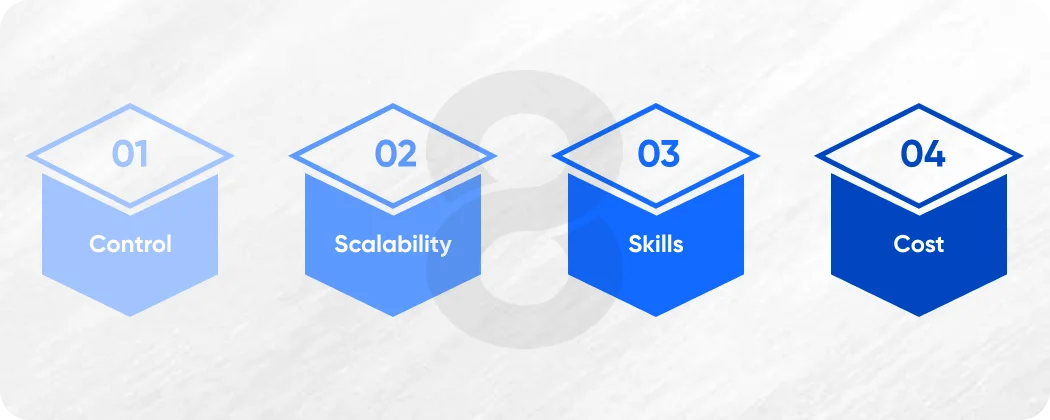
The decision of managed service vs staff augmentation is based on several factors:
- Control: Staff augmentation allows your in-house personnel to handle daily activities. This is outsourced by managed services.
- Scalability: Augmentation will enable you to scale resources in either direction very fast. Managed services are based on predetermined workflows and schedules of delivery.
- Skills: Augmentation can be used to address shortcomings in your team by the use of temporary specialists. The managed services offer end-to-end expertise in the form of a complete team.
- Cost: Augmentation can be economical in the short-term requirement, whereas managed services can minimize the operational cost of operations over the long term because of streamlined operations.
Knowing what the difference is between staff augmentation and managed services, businesses can then intelligently decide which model to use for their project needs.
When Staff Augmentation Makes Sense
The staff augmentation and managed services model is effective in the case when your team already has internal capacity but needs special expertise in the short term. For example:
- Contracting an experienced developer to head an MVP deployment
- Adding an intermediate-level engineer to add features
- Hiring AI or computer vision expert to Enterprise MLOps programs
Staff augmentation will ensure that your team has control of decision-making and access to the experience required to shorten project schedules.
In the case of organizations that seek the services of app development, staff augmentation could assist in a temporary increase in the number of staff to ensure that the organization delivers its services faster without the need to sign a long-term employment arrangement. Enterprises also have the advantage of augmentation, where complex deployments need the input of highly professional resources, which are also met with high levels of security and compliance.
When Managed Services Are the Better Choice
Managed services are a bright idea in case one is interested in a full-service and outcome-oriented solution. This model may be found to be perfect in case your organization wishes to reduce management overhead whilst achieving consistent results.
In managed services, the provider provides complete control over the architecture of software design, code, testing, deployment, and continued maintenance. It comes in handy particularly on projects that involve app development, which entail specialized expertise that might not be available within the company. Through the managed services, businesses are able to minimize the risks, meet tight deadlines, and deliver high quality.
Incorporation of App Development Services
Concerning companies that seek app development services, selecting between staff augmentation and managed services is related to the scope of a project.
In case you have the background and just require certain skill sets (e.g., React Native, Flutter, or back-end experience), staff augmentation is the best choice. Short-term projects allow developers to join your team and accelerate development without the need to commit to long-term development.
Managed services are a smooth method to take in case you require an end-to-end solution, including design, development, QA, and deployment, requiring no extra managerial effort internally.
Read More: How to Choose a Mobile App Development Company
What is the Difference Between Staff Augmentation and Managed Services? (Detailed Overview)
In making technology projects, a company may recruit the right talent or engage in the right engagement; this may greatly affect the timelines, costs, and outcome of a project. The two most common business models which organizations choose for their operations are staff augmentation and managed services. The two options which provide technical knowledge support for organizations show essential distinctions because of their different systems of control and their allocation of responsibilities and their capacity to adapt and their range of operations.
This is a comprehensive analysis of the major distinctions, benefits, limitations, and situations where each model should be selected, which will inform your project decisions.
1. Staff Augmentation Definition
Staff augmentation is a dynamic approach to staffing when companies take in a temporary workforce in the form of qualified professionals to become part of the current team. These professionals become part of your working process, report to your project managers, and deal with certain tasks or modules.
Major attributes of staff augmentation:
- Temporary Scaling: This is where developers, engineers, or designers are added when necessary without permanent employment.
- Control: Day-to-day activities, prioritization, and workflow are handled by your internal staff.
- Specialized Skills: Can be helpful to close knowledge gaps in such areas as AI, computer vision, or API development.
- Integration: Augmentation staff collaborate with your team and embrace your processes and tools.
- The example: When a company is creating a mobile application, staff augmentation might be engaged with a senior developer in React Native to deliver an MVP faster since the internal team is busy with the development of the backend context.
2. Managed Services Definition
Managed services are a model in which a third party accepts complete accountability to provide a particular result or do an entire job. The provider accommodates all the planning, development, testing, rolling out, and maintenance.
The major features of managed services:
- End-to-End Responsibility: The provider has ownership of project delivery and outcome.
- Limited Supervision Requirements: Your internal staff is informed that it is not included in day-to-day operations.
- Foreseeable Costs and Schedule: Providers adhere to formal workflows and SLA-driven contracts.
- Skills and Best Practice: Mature processes and teams are introduced with managed services.
Examples: A managed services provider outsources API development to a company that, as a result, delivers an API that is functional, tested, and documented and is ready to deploy to the production environment without the company allocating any resources towards the development process.
A forecast estimates that mobile app consumer spending will grow at a 12 % CAGR, reaching around $233 billion in spending by 2026 across app stores.
Prominent Dissimilarities between Staff Augmentation and Managed Services
# |
Feature |
Staff Augmentation |
Managed Services |
| 1 | Control | Your team manages tasks and priorities | The provider manages the project; you focus on outcomes |
| 2 | Scope | Specific roles or skills integrated into your team | Full project or function ownership |
| 3 | Flexibility | Scale resources up or down quickly | Fixed processes and team structure |
| 4 | Accountability | Responsibility for results remains with your internal team | Provider responsible for delivering outcomes |
| 5 | Expertise | Supplements your team with niche skills | Provides end-to-end expertise across the project lifecycle |
| 6 | Cost | Hourly or contract-based; flexible for short-term needs | Predictable cost structure, often better for long-term projects |
| 7 | Integration | Staff works within your tools and processes | The provider may use their own workflows and align deliverables with your goals |
| 8 | Ideal for | Temporary skill gaps, fast scaling, or short-term projects | Long-term projects, full-service solutions, or resource-constrained teams |
Advantages of Staff Augmentation
Control Over Project: Maintain complete control over tasks, priorities, and processes.
- Scalability: Scale with ease; rise or fall as requirements change.
- Niche Expertise: One can gain access to niche expertise without the need to hire a person permanently.
- More Rapid Onboarding: Experts become a part of the existing teams and tools.
- Cost-Effective in the Short-Term: Pay as long as you are engaged.
- Application Case: Hiring a senior computer vision developer to work on a 3-month MVP development project and maintaining your internal AI team to do model research.
Advantages of Managed Services
- End-to-End Delivery: The provider takes care of everything in the project.
- Foreseeable Results: SLAs guarantee schedules, expenses, and quality.
- Less Management Workload: Your staff is able to work on business priorities.
- Process Maturity: Providers introduce standardized work processes, which mitigate risk.
- Availability of Full Expertise: The members can consist of designers, developers, QA engineers, and DevOps specialists.
Use Case: To secure, scale, test, and maintain the API, you can outsource the API development to a managed services partner because overloading your internal staff is not a concern.
Cost Comparison: Staff Augmentation vs Managed Services
One of the biggest factors influencing the choice between staff augmentation and managed services is cost. While every project is unique, here’s a general comparison based on industry averages:
# |
Cost Factor |
Staff Augmentation |
Managed Services |
| 1 | Hourly Rates | $40–$150/hr depending on skill level and region | $75–$200/hr depending on provider and scope |
| 2 | Project-Based Cost | Flexible; pay only for hours worked or duration | Fixed; provider offers full project delivery cost |
| 3 | Hidden Costs | Onboarding, training, software tools, supervision | Usually included in service contract (project management, QA, monitoring) |
| 4 | Long-Term Engagements | Can become expensive if contracts are extended | More cost-effective for ongoing or large-scale projects due to efficiency |
| 5 | Resource Flexibility | High – add/remove staff as needed | Medium – fixed team assigned by provider |
| 6 | Risk Mitigation Costs | Managed internally, potentially higher risk | Managed by provider—lower risk, often covered under SLAs |
Selection of the Right Model: Managed Services vs. Staff Augmentation
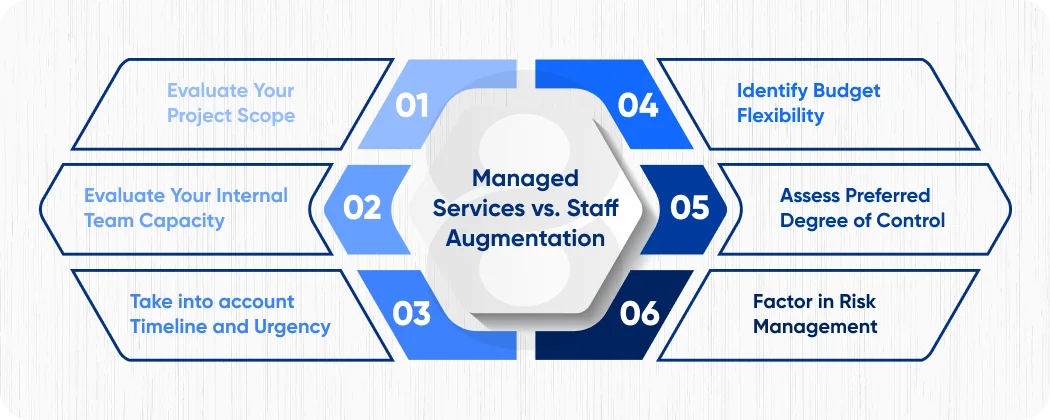
Selecting the appropriate engagement model is not a universal thing. The choice between staff augmentation and managed services will depend on the scope of your project, internalization, budget, and long-term strategic objectives. The following is the step-by-step method, which will assist you in making the decision:
Evaluate Your Project Scope
- Small or Niche Projects: Staff augmentation is the best solution when you have a well-identified short-term project or require specific technical skills (such as AI, computer vision, or Sencha app development services). It allows you to contract the services of specialized developers temporarily and get them on your existing project team.
- Big or Complex Projects: Managed services might be more suitable in full-scale projects, enterprise applications, or continuous support and maintenance (enterprise app development services). Providers are providing end-to-end solutions and have dedicated teams and process maturity, and hence they risk less in terms of being delayed and making errors.
Evaluate Your Internal Team Capacity
- Superior Internal Team: When you have existing developers, project managers, and designers, you can use staff augmentation to cover the gaps or expand to meet the short-term requirements.
- Limited Resources: Managed services are superior in the case of limited bandwidth of your team of specialists to administer the project or expertise. They own all the lives in the delivery lifecycle planning, execution, test-QA, and even after-delivery support.
Take into account Timeline and Urgency
- Tight Deadlines: With staff augmentation, you can fast-track the projection of an on-demand project and deliver on time for deadlines such as MVPs or feature releases.
- Foreseeable Delivery: Managed services are workflow-based, which is perfect when working with a project that has milestones or an enterprise-scale app (API development, backend integrations).
Identify Budget Flexibility
- Adaptable Short-Term Budget: Staff augmentation may take an hourly or contract-based charge. You spend on the knowledge that you require, as long as you require it.
- Fixed Budget Projects: Managed services are usually provided on a project or retainer basis. This will allow cost predictability and decrease the unpredictable costs of having extra employees in the company.
Assess Preferred Degree of Control
Complete Maturity Requirement: Staff augmentation provides you with control of the team, prioritization of tasks, and decision-making.
Ready to Outsource Control: Managed services assume the daily management of the project, and it is possible to concentrate your team on the main business areas.
Factor in Risk Management
- Risk Responsibility: Your team takes on the risk of delivery, quality, and deadlines in staff augmentation. There must be appropriate management and processes.
- Risk Mitigation: Managed services providers generally encompass risk mitigation practices, compliance tests, and quality assurance in their processes. In the case of sensitive projects or regulated industries, this lowers liability.
The global mobile app market is growing aggressively, with forecasts estimating over $540+ billion in revenue by 2026, which means demand for skilled developers and contractors will continue rising.
Final Thoughts on Staff Augmentation vs Managed Services
The decision between staff augmentation and managed services is a business move that may have a very great influence on the project results, schedules, and efficiency.
Staff augmentation is ideal in the case of short-term projects, skills gaps, or circumstances where the internal teams can manage the progress directly, as it offers flexibility, control, and access to specialized skills only temporarily. Managed services offer accountability, process maturity, and predictable results and are particularly useful when faced with complex, long-term projects or resource-intensive projects.
Finally, you should base your choice on your project scope, schedule, staff capacity, budget, and risk tolerance. It is not very uncommon in most instances that a composite system of the two models can be used to provide the best of both worlds: changeability, cost-efficiency, and quality outcomes.
Learning about the main distinctions, benefits, and drawbacks of each of the models, organizations should be able to make the right choice in line with their strategic objectives, resource efficiency, and ability to deliver projects successfully.