



Multi vendor marketplace development covers everything involved in building a platform where independent sellers trade through one storefront and the owner gets paid through commissions or subscriptions. Amazon runs on this model. So does Etsy, so does Fiverr, and so do a few thousand niche platforms you have never heard of because they only matter to the industry they serve.
The pull is easy to understand once you see the numbers. Statista puts online marketplaces at the largest share of online purchases worldwide as of 2025. This guide walks through how these platforms actually work, and spends real time on the problems that tend to surface around month three, after the contracts are signed.
What is a Multi Vendor Marketplace
A multi vendor marketplace is an ecommerce platform where many independent sellers offer products or services through a single website or app. The inventory never belongs to the platform. Sellers handle their own listings and ship their own orders. Meanwhile, the owner runs the venue and takes a cut.
Which is exactly the appeal. You are the mall rather than the shops inside it. Revenue grows with sellers and transactions instead of with stock you had to pay for and might never sell.
How it differs from a single vendor store
A single vendor store, the kind most ecommerce store development projects produce, has one seller, one catalog, and one checkout. A marketplace multiplies everything. Every seller needs their own dashboard, their own order queue, and their own payout schedule.
One customer order can contain items from four different sellers, and each of them has to be paid their share, minus your commission, without anyone doing math in a spreadsheet.
| Factor | Single Vendor Store | Multi Vendor Marketplace |
|---|---|---|
| Who Sells | One Business Selling Its Own Catalog | Many Independent Sellers |
| Inventory | Owned and Stocked by the Store | Owned by Sellers, Not the Platform |
| Revenue | Product Margins | Commissions, Subscriptions, Listing Fees & Advertising |
| Growth Driver | Marketing and Product Range | Number of Active Sellers and Buyers |
| Main Risk | Unsold Inventory | Failing to Attract Sellers and Buyers at the Same Time |
Real-world examples
Amazon is the one everyone names, though strictly speaking it is a hybrid, since it sells its own stock next to third-party listings. Etsy is the cleaner example. Nothing sold on it belongs to Etsy.
Fiverr applies the same structure to freelance work, Airbnb to spare rooms and holiday homes. Hand the model a niche, almost any niche, and it fits, which is why new regional and industry-specific marketplaces keep showing up every year.
Types of Multi Vendor Marketplaces
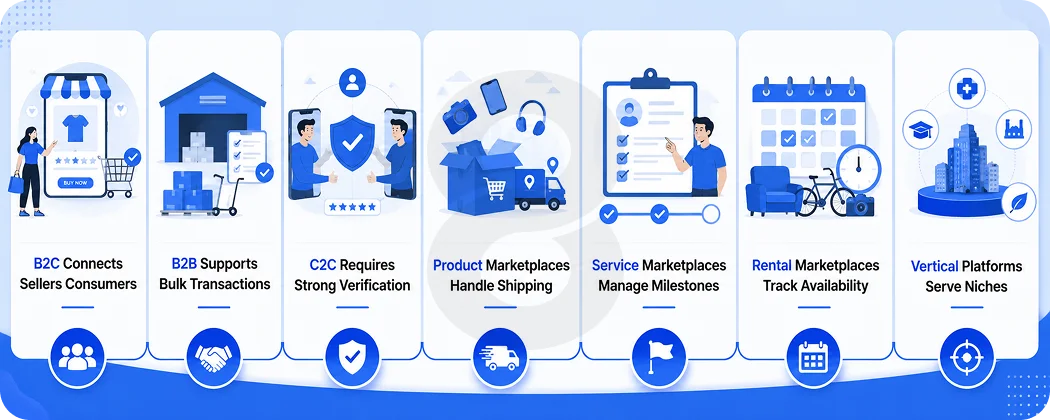
Three questions sort every marketplace. Who trades on it, what gets traded, and how wide the catalog runs. Answer them for your idea and you have quietly made half your build decisions already, whether you meant to or not.
B2C, B2B, and C2C marketplaces
B2C is the familiar setup, professional sellers on one side and consumers on the other, with Amazon and Etsy as the textbook cases. B2B is a different beast. Platforms like Alibaba or Faire deal in bulk orders, negotiated prices, and credit terms and all of that weight lands on your checkout and payment logic.
C2C sits at the messy end. When ordinary people sell to each other on eBay or Vinted, the platform has to work far harder at verifying identities and catching fraud. The reason is neither side is a registered business you can hold to account.
Product, service, and rental marketplaces
Product marketplaces need the classic machinery of inventory, shipping, and returns. Swap products for services and the machinery changes. Fiverr and Upwork have no parcels to track, so bookings, milestones, and delivery confirmation take their place. Rentals pile more on top.
Airbnb and Turo juggle availability calendars, security deposits, and occasional argument over a scratched bumper. Be clear which of these transaction shapes you are building before anyone writes code… because they do not mix cheaply.
Read More: How to Build an Ecommerce Inventory Management System
Vertical vs horizontal marketplaces
A horizontal marketplace sells everything to everyone. A vertical one picks a lane and stays in it, the way StockX did with sneakers or Reverb did with music gear. For a new platform this is barely a choice.
Going horizontal means fighting Amazon on Amazon’s terms. A tight niche costs less to market to, and it lets you build the oddly specific features, sneaker authentication, serial number lookups, that a general platform would never get around to.
Read More: Top 10 eCommerce Solution Providers for the B2B Industry
How Does a Multi Vendor Marketplace Work
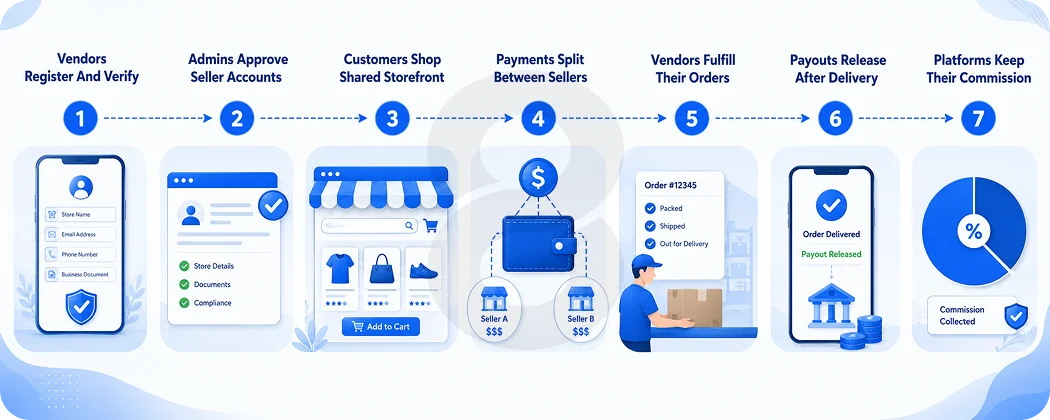
A multi vendor marketplace sits between sellers and buyers and handles the parts neither side could manage alone. It includes discovery, checkout, and payments. Sellers list, customers buy through a shared storefront, and the platform divides each payment among the sellers involved, keeps its commission, and pays the rest out. Order by order, it runs like this.
- A vendor registers and hands over whatever documents your verification process requires.
- The admin approves them, and the vendor starts building out listings.
- A customer shops the storefront and checks out… sometimes with items from three or four different sellers sitting in the same cart.
- The payment gateway takes the full amount once, then splits it, sending each seller their share and holding back your commission.
- Every seller fulfills their piece of the order and updates its status as they go.
- Once delivery is confirmed, payouts are released to sellers on the platform’s schedule.
Steps four and six look small on that list. In development terms they are among the biggest, and we will come back to them.
Commission and revenue models
Commission on each sale is the default model, usually somewhere between 5 and 30 percent depending on the category. Plenty of platforms mix in other streams. Subscription tiers charge sellers a monthly fee for better tools or lower commission. Listing fees charge per item posted, which Etsy still does. Featured placement and ads are the third lever, where sellers pay to be seen.
Most marketplaces that survive long enough end up running two or three of these side by side, so pick your mix early. It sounds like a business-plan detail, but it decides what your vendor panel and checkout have to support, and retrofitting a subscription tier into a commission-only build is nobody’s idea of fun.
Read More: How to Hire Magento Developers: 5 Red Flags to Avoid
Essential Features of a Multi Vendor Marketplace
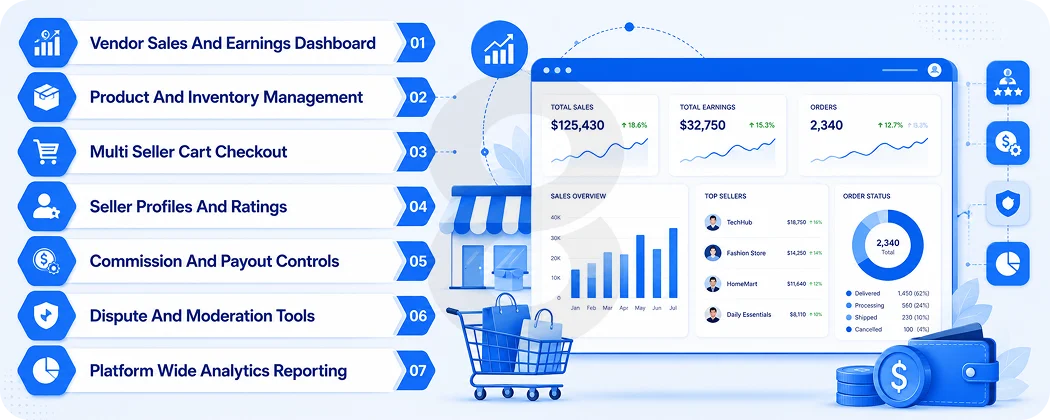
A marketplace is really three products wearing one interface. Sellers, customers, and administrators each get their own set of screens, and shorting any one of the three shows up fast in churn or chaos.
Vendor panel features
- A dashboard with sales, traffic, and earnings at a glance, because sellers who cannot see their numbers stop trusting the platform.
- Product and inventory management, including bulk upload for sellers with large catalogs.
- Order processing with status updates, shipping labels, and return handling.
- Payout tracking that shows exactly what is pending, what has been paid, and what commission was taken.
- Reviews and messaging so sellers can respond to customers without leaving the panel.
Customer-facing features
- Search and filtering that works across thousands of listings from different sellers with inconsistent data.
- A cart and checkout that handles items from multiple sellers in one payment.
- Seller profiles and ratings, since buyers are trusting a stranger, not your brand.
- Order tracking split by seller, so a three-seller order does not look like one late package.
- Support channels, increasingly backed by AI chatbot development to handle the routine questions that flood in once order volume grows.
Admin panel features
- Vendor onboarding and approval, with the ability to suspend sellers who break the rules.
- Commission configuration, ideally per category or per seller rather than one global rate.
- Dispute resolution tools for the inevitable arguments over refunds and non-delivery.
- Content moderation for listings, reviews, and seller messages.
- Platform-wide analytics and financial reporting, because at tax time you will need every transaction accounted for.
Multi Vendor Marketplace Development Process: Step by Step
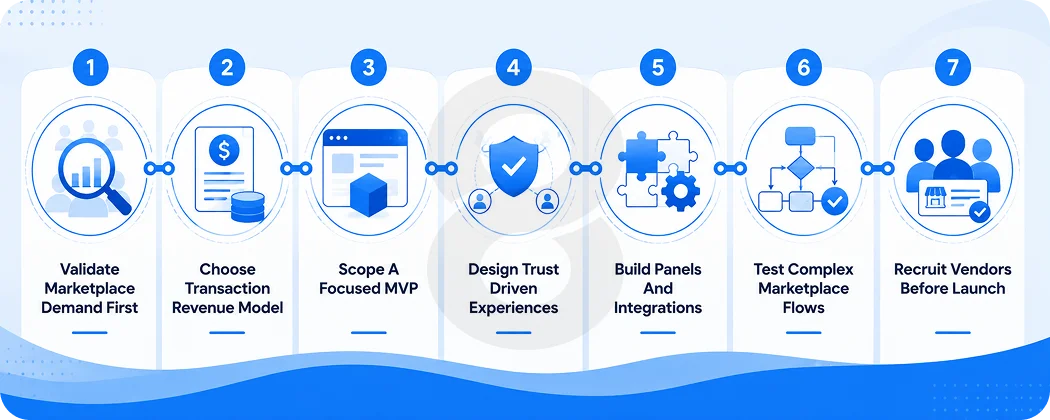
Every agency describes its process a little differently, but multi vendor marketplace development follows the same broad arc everywhere. What varies is how honestly each stage gets done.
1. Market research and niche validation
Before any design work, find out whether sellers in your niche are unhappy enough with existing channels to try a new one. Talk to twenty of them. If you cannot get twenty sellers on a call now, you will not get two hundred onto a platform later. Check what buyers currently pay in fees elsewhere, because your commission has to undercut or clearly outvalue it.
2. Choosing a business and revenue model
Decide who trades, what they trade, and how you get paid. These choices ripple through the entire build. A B2B rental marketplace with escrow needs a very different architecture than a C2C product marketplace with instant payouts, and switching models after launch is expensive.
3. Scoping the MVP
Everything listed above describes a platform at maturity, and treating it as a launch spec is how budgets die. Version one needs vendor onboarding, listings, a multi-seller checkout that works, split payments, and enough admin control to keep order. That is it. Ratings can wait. Subscriptions, ad slots, native apps, all of it can wait until actual sellers are asking, at which point you will also know you are building the right things in the right order.
4. UI and UX design
Marketplace design is mostly about trust. Buyers are handing money to sellers they have never met, so seller profiles, reviews, clear return policies, and secure-checkout signals need real design attention. The vendor panel deserves equal care. Sellers compare your tools against Amazon Seller Central and Etsy, whether that is fair or not.
5. Development and integrations
This is the longest stretch, covering the storefront, vendor panel, admin panel, and the integrations that hold them together. The payment layer usually runs through a provider like Stripe Connect, which is built specifically for routing funds between platforms and their sellers. Shipping APIs, tax calculation, email, and notifications round out the integration list.
6. Testing and QA
Marketplace QA is heavier than store QA because every flow exists three times. Test the multi-seller cart with partial refunds, cancelled sub-orders, and commission edge cases. A rounding error in payout logic is not a bug ticket, it is an angry seller with a screenshot.
7. Launch and vendor acquisition
Launch day mostly marks the start of the supply problem. Most successful platforms recruit their first 50 to 100 sellers manually, one call at a time, often with zero commission for the early months. Plan that campaign before launch day, not after.
Read More: How to Hire a Shopify Expert Developer for Headless Commerce
Choosing the Right Tech Stack for Your Marketplace
Tech stack conversations tend to start with framework names, which is the wrong end to start from. The real decision is how much of the platform you want to own versus rent, and everything from hosting bills to hiring plans flows out of that answer. Get that call right and the framework debate mostly settles itself.
Ready-made platforms vs custom development
The honest starting question is whether you should custom-build at all. Ready-made marketplace software gets you live fast and cheap, and for validating a niche that speed is worth a lot. The trade is control. You inherit the platform’s data model, its performance ceiling, its plugin quality, and its licensing costs forever.
Popular marketplace platforms compared
| Platform | Best For | Watch Out For |
|---|---|---|
| CS-Cart Multi-Vendor | Product Marketplaces That Need Most Features Out of the Box | Heavy Codebase and Complex Customization at Scale |
| Sharetribe | Fast Validation of Service and Rental Marketplace Concepts | Transaction Fees and Limited Deep Customization |
| Magento with a Marketplace Extension | Large Catalogs and Complex B2B Pricing Models | Requires Experienced Developers and Higher Hosting Costs |
| WooCommerce with a Vendor Plugin | Smaller Budgets and WordPress-Focused Teams | Plugin Conflicts Can Increase as the Marketplace Grows |
| Shopify with Marketplace Apps | Fast B2C Marketplace Launches on Managed Infrastructure | App Fees Add Up and Marketplace Features Are Added Through Apps |
If you go the platform route, implementation quality matters more than the platform choice itself. Experienced Magento or WooCommerce development partners know exactly where each system’s marketplace extensions strain.
And a good Shopify store development team will tell you upfront which marketplace apps hold up under volume and which ones fall over.
Read More: Magento Development: Custom Web & App Solutions Guide
When custom development makes sense
Go custom when your transaction model does not fit standard templates, when you expect volume that plugin stacks cannot carry, or when the marketplace is your core business rather than a side channel.
Custom software typically means a JavaScript or Python backend, a React or Vue storefront, and mobile app for native iOS and Android apps once the web platform proves demand. You pay more upfront and own everything after.
Read More: Magento vs Shopify: Which Platform is Best for Your Ecommerce Business
How Much Does Multi Vendor Marketplace Development Cost
On ready-made software, expect somewhere between 10K and 40K dollars once setup and customization are done. A custom-built MVP is a different bracket, usually 50K to 150K dollars. Once native apps, escrow, and multi-currency support enter the picture, budgets clear 200K dollars without much effort.
These are planning numbers. What you actually pay comes down to scope, who is building it and at what rates, and how much of the feature list above survives into version one.
Read More: Marketplace App Development Cost Guide (2026)
What drives the price up
The multi-seller checkout and split payment logic are the single biggest cost center, followed by the vendor panel, which is effectively a second product. Past those two, the price climbs with multi-currency and multi-language support, native apps, escrow with delayed payouts, custom search, and hookups to outside logistics providers. Each one is justifiable. Stacking all of them into an MVP is how 80,000 dollar projects become 250,000 dollar projects.
Common Challenges in Marketplace Development
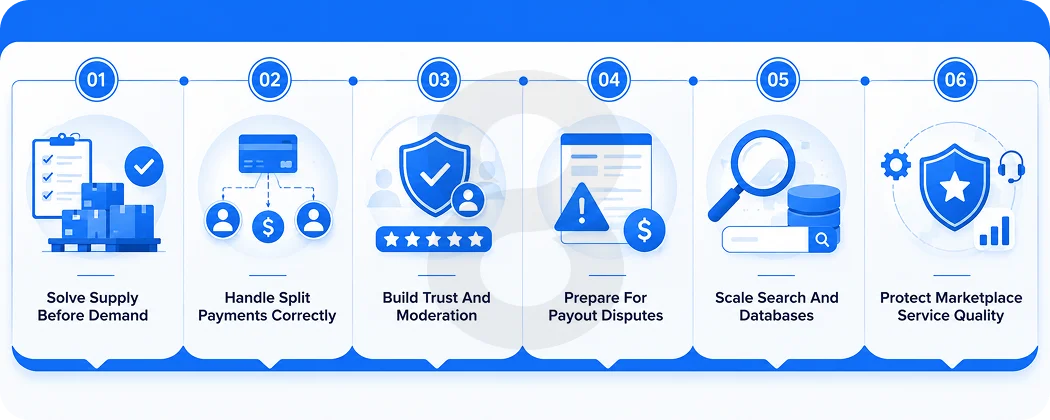
Every marketplace project runs into the same four walls sooner or later. None of them is a secret, yet teams keep budgeting as if their build will be the exception. It rarely is, and planning for these from day one costs a fraction of discovering them live.
The chicken and egg problem
Buyers will not come without sellers, and sellers will not come without buyers. Harvard Business School Online describes this as the defining dilemma of platform businesses, and it kills more marketplaces than anything technical. The practical fix is to pick one side and solve it first. Usually that means supply.
Get on the phone and recruit sellers one at a time, seed the first listings yourself if you have to, and waive commission until there is real liquidity to charge for. Staying narrow helps more than founders expect. Fifty sellers in one category looks like a busy platform. The same fifty spread across ten categories looks abandoned.
Payment splitting and vendor payouts
Picture an order with items from five sellers, where the buyer returns item three a week later and your commission rate on electronics differs from the one on clothing. Somebody has to reconcile that, correctly, every single time.
Stripe Connect and similar providers do the plumbing, moving funds, holding balances, paying out across borders, but the rules about who gets what and when are yours to write and yours to get wrong.
And the failures here are rarely loud. They show up as a seller emailing about a payout that is 40 cents short, which they will notice long before your dashboards do.
Trust, disputes, and quality control
Every bad seller damages your brand, not their own. That means verification at onboarding, review systems that resist manipulation, clear dispute processes with defined timelines, and moderation that scales past what one admin can read. Budget for this from the start. Bolting trust features onto a live platform after the first fraud wave is far more painful.
Scaling without breaking the experience
Search that felt instant with 500 listings crawls at 50,000. Databases that handled one seller’s traffic buckle under a flash sale across hundreds. Architecture choices made in month one decide whether scaling is a config change or a rewrite, which is a strong argument for involving senior engineers early even on a modest MVP.
Multi Vendor Marketplace Examples Worth Studying
Etsy won by staying narrow. Handmade and vintage only, with policies that protect that identity even when loosening them would have grown GMV faster. The lesson for new platforms is that a defended niche beats a broad catalog.
Fiverr turned services into products. By packaging freelance work as fixed-price gigs with clear deliverables, it removed the negotiation that makes service marketplaces slow, and its checkout could work like a product store’s.
Faire solved the B2B trust problem with money. Free returns on first orders and net-60 payment terms took the risk out of stocking unknown brands, which is what actually convinced independent retailers to try it.
None of these won on features. They won by removing one specific fear that kept their sellers or buyers away, which is a better product roadmap than any feature checklist.
Read More: eCommerce App Development Guide: Everything You Need to Know
Building Native Apps With 8ration
8ration builds marketplace platforms as a core part of its ecommerce software development, and the portfolio includes live examples of the models covered in this guide. Allie Marketplace is a C2C platform 8ration built with secure payments, real-time chat between buyers and sellers, and intelligent product discovery.
Trailer4Rent is a peer-to-peer rental marketplace connecting trailer owners and renters across Canada, with all the calendar, deposit, and trust mechanics rentals demand. ShortClip pairs a local services marketplace with short-video discovery, and Done Right Away connects homeowners with verified professionals for plumbing, repairs, and maintenance.
That spread is the point. A rental platform, a services platform, and a product marketplace look similar from the outside and share almost nothing under the hood, which this guide has hopefully made clear by now. 8ration’s engineers have been through the hard parts on live products, the split payments, the vendor onboarding, the disputes, the scaling pains that arrive right after things start working.
So if you are stuck between a ready-made platform and a custom build, or trying to scope an MVP before it balloons, talk to the team. The conversation is free, and it tends to catch expensive assumptions while they are still cheap to fix.