



You’re probably here because someone on the team quit. Or the hiring pipeline dried up. Or the CTO handed over a quote from a local development agency and the number was enough to kill the project before it started.
Maybe all three.
Nobody wakes up thinking “let me hand the product off to a team halfway around the world.” Most companies get here by exhausting every other option first. And then they’re staring at spreadsheets trying to figure out how Google, Microsoft, and IBM can have entire engineering centers overseas while the startup can barely get a developer to reply to a job posting.
Here’s what nobody tells you upfront: going offshore isn’t the backup plan anymore. For a lot of companies, it’s the only plan that actually works.
But doing it wrong? That’s where the horror stories come from. And there are plenty of horror stories.
This guide is about doing it right.
What Offshore Software Development Actually Means
Offshore software development means hiring a company or team in another country to handle some or all of your software engineering work. They write the code, test it, and ship it. Sometimes they manage the whole product. Sometimes they slot into an existing team.
What it doesn’t mean: handing over an idea and hoping for the best six months later.
The confusion around this term keeps getting worse because people lump three different models together.
Offshoring means working with teams in distant geographies, typically Asia, Eastern Europe, or parts of Africa, where the cost difference is significant and the time zone gap is real. Nearshoring means working with teams in countries closer to home. For US companies, that’s often Latin America. Similar time zones, lower cost than domestic, slightly higher than offshore. Onshoring keeps everything local. Great for compliance-heavy industries. Expensive everywhere else.
Most of the debate online is about offshoring vs. nearshoring, but honestly? The geography matters less than the process. A badly managed team in the same city will fail just as reliably as a badly managed team in Kyiv or Manila.
Engagement models compared
| Model | Best For | Control Level | Cost | Risk |
|---|---|---|---|---|
| Project-based | Defined, short-term scope | Low | Fixed | Medium |
| Staff Augmentation | Adding skills to your team | High | Variable | Lower |
| Dedicated Team | Long-term product development | High | Monthly retainer | Lowest |
Staff augmentation is where most smart companies start. You’re not outsourcing a project, you’re hiring people. They attend your standups, use your Jira, and also build product knowledge over time instead of handing off a deliverable and disappearing. For teams building a custom web application or scaling a SaaS product, this model tends to outperform fixed-scope contracts at nearly every stage.
The Market Size and Why It Keeps Growing
According to Statista, IT outsourcing makes up the largest share of the global outsourcing market at $66.5 billion, and that number keeps climbing. The broader offshore software development market was valued at around $160.9 billion in 2024 and is expected to hit $413 billion by 2033, growing at roughly 11% annually.
That’s not a trend. That’s a structural shift in how software gets built.
The reasons aren’t hard to find. There are around 1.8 million tech professionals in Eastern Europe alone. India’s GitHub developer population grew 28% in 2024 and is on pace to overtake the US by 2028. The Latin American market for enterprise software is growing at 12.7% a year.
Meanwhile, hiring a senior full-stack developer in San Francisco or London takes months and costs more than $150,000 a year before benefits. The same caliber of developer in Eastern Europe or South Asia costs 50–70% less, and they’re available now, not in four months after three rounds of interviews.
That math doesn’t get worse the longer you wait.
Developer Rates by Region (2026)
| Region | Average Hourly Rate (USD) |
|---|---|
| USA / Canada | $100–$200 |
| Western Europe | $75–$150 |
| Eastern Europe | $40–$80 |
| Latin America | $35–$75 |
| South / Southeast Asia | $20–$50 |
| Africa | $20–$45 |
The cost difference is real. But the point isn’t to find the cheapest developer on the planet. The point is to find the right one at a price that makes the product viable.
How to Evaluate an Offshore Software Development Company
This is where most guides go soft. They say things like “look for good communication” and “check their portfolio.” Not very useful.
Here’s what actually separates a partner worth working with from a vendor who’ll cost you a year of productivity.
What to ask before you commit
Do they push back on bad ideas?
The best offshore teams aren’t yes machines. If you describe a feature and a developer just says “sure, we can build that,” that’s a yellow flag. A team that pushes back, asks why, or suggests a simpler path is actually thinking about your product.
Can they explain their code clearly?
Run a technical interview. Ask them to walk through a recent problem they solved. The quality of that explanation tells you everything about documentation culture, communication habits, and how much sense the handoff will make down the line.
What does QA look like?
A lot of shops skip this question because they assume it’ll get handled. Ask directly: who does QA, when, and how do bugs get tracked? A vague answer is essentially an admission that there’s no real process. For anything beyond a basic prototype, solid software testing practices are non-negotiable.
What’s their team turnover?
High turnover is one of the most expensive things that can happen to a software project. Every developer who leaves takes product knowledge with them. Ask how long the team that would work on the project has been together. If they can’t answer that, that’s an answer in itself.
Can they give a difficult reference?
Anyone will hand over a glowing reference from a happy client. Ask for a reference from a project that ran into trouble and how the agency handled it. That single conversation will tell you more than any case study.
Red flags worth walking away from
- Proposals that match the budget perfectly without asking enough questions about scope
- Guaranteed delivery timelines before any discovery or technical assessment
- No defined process for handling change requests or scope creep
- Vague contract language around IP ownership
- Reluctance to run a paid trial before full engagement
Contract terms that can’t be skipped
| Clause | Why It Matters |
|---|---|
| IP ownership | You need to own everything built on your project from day one |
| NDA and data handling | Critical if you’re handling user data or operating in regulated industries |
| Termination terms | What happens if things go south? Can you take the codebase with you? |
| Change request process | How are out-of-scope additions handled and priced? |
| Milestone and payment schedule | Never pay everything upfront |
Risks That Actually Sink Offshore Projects
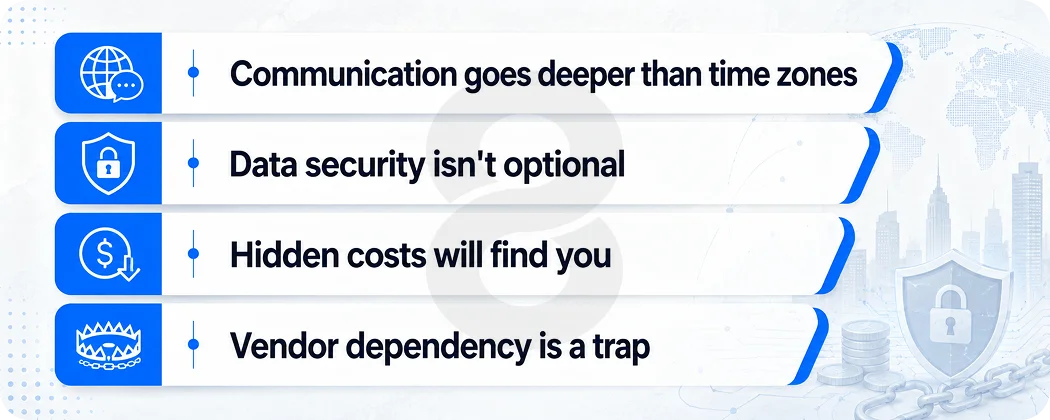
Most offshore projects don’t fail because of weak technical skills. They fail because of unclear ownership, poor governance, and gaps that are easy to ignore early and expensive to fix late.
Communication goes deeper than time zones
Yes, working with a team 8 hours ahead is harder than working with someone down the hall. But the real communication problem is usually documentation.
Teams that rely on verbal updates and Slack messages instead of written specs and clear tickets will struggle whether they’re across the office or across the world. Build the documentation habits, and the time zone problem shrinks considerably.
Data security isn’t optional
In 2024, the average cost of a data breach reached $4.88 million, the highest total on record. And roughly 60% of companies that suffer a data breach end up going out of business.
Handing sensitive user data or financial information to an offshore team without a proper data processing agreement, access controls, and encryption standards is a material risk. Ask about security protocols the same way you’d ask about code quality.
Hidden costs will find you
The hourly rate in the proposal is rarely the final number. Scope creep, extended timelines, change requests, and extra QA cycles all add up. Insist on a detailed contract with a scope definition, a change management process, and fixed pricing for defined deliverables where possible.
Vendor dependency is a trap
If the entire tech stack is managed by an offshore partner and they raise prices or shut down, the project is stranded. Keeping a product manager or tech lead in-house who understands the codebase protects against that scenario. Teams that follow a structured MVP development process tend to maintain better internal ownership because scope is defined tightly from the start.
Gartner’s 2024 IT Services forecast found that 55% of companies now use staff augmentation over traditional outsourcing, specifically because it preserves internal control while scaling external capacity.
Picking the Right Region for Your Project
Geography isn’t everything, but it’s not nothing either. Different regions have different strengths, cost profiles, and cultural norms around communication and work style.
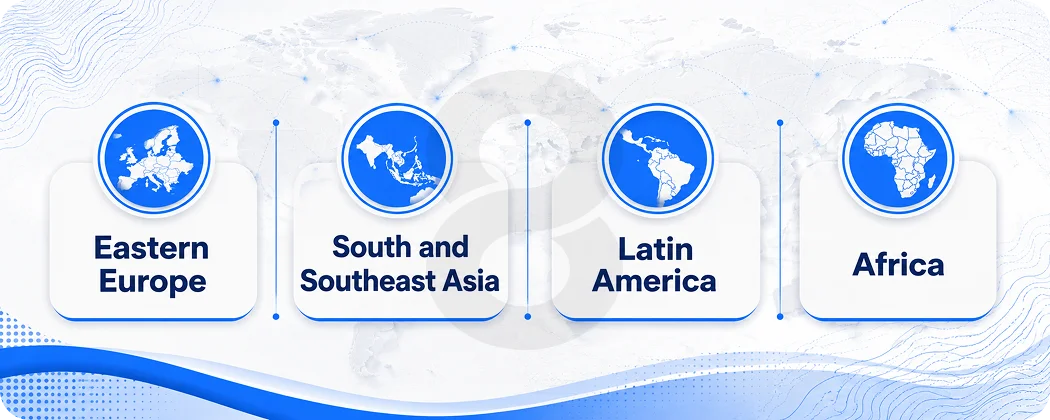
Eastern Europe
Strong engineering culture, excellent computer science education, and generally solid English proficiency. Countries like Poland, Ukraine, Romania, and the Czech Republic have produced seriously talented development teams. US companies on EST can usually find 3–4 hours of workable daily overlap.
South and Southeast Asia
India remains the dominant offshore destination. 54% of US companies that outsource development choose India, and for good reason. The talent pool is enormous, English is widely spoken, and the cost efficiency is hard to beat. The Philippines, Vietnam, and Pakistan are also producing quality engineers at competitive rates.
Latin America
For US companies where the time zone gap is the primary concern, Latin America largely solves that problem. Significant cost savings compared to domestic hires, near-total time zone alignment, and a deepening talent pool. Rates run slightly higher than Asia or Eastern Europe, but the collaboration friction is lower.
Africa
Countries like Nigeria, Kenya, Egypt, and South Africa have growing tech communities, strong English skills, and very competitive rates. The infrastructure has improved dramatically over the past five years. Worth serious consideration for companies building for emerging markets or wanting to diversify their talent geography.
Read More: How to Hire a Software Development Team: 12-Step Guide
What Good Offshore Partnerships Look Like in Practice
The successful ones share a few patterns.
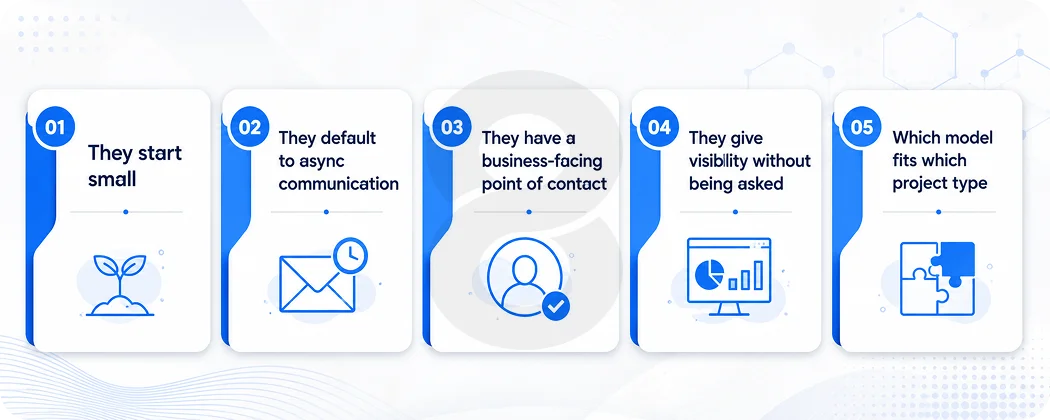
They start small
Don’t kick off with a 6-month engagement before knowing if the team can actually execute. Run a paid discovery project or a 4-week sprint first. A good partner welcomes that. A bad one pushes back.
They default to async communication
The best distributed teams write things down, document decisions, and treat async as the default. Meetings are for decisions, not status updates.
They have a business-facing point of contact
There needs to be someone on the offshore side who translates between business requirements and technical specs. A great engineering team with a weak product manager is still a struggling project.
They give visibility without being asked
Weekly written updates, accessible sprint boards, real-time dashboards. If chasing the team for status updates becomes routine, that warning sign only gets worse over time.
Teams building mobile applications need this structure even more than web projects, because design, backend, and platform-specific logic all need to stay tightly coordinated across time zones.
Which model fits which project type
| Project Type | Recommended Model | Avg. Team Size | Timeline |
|---|---|---|---|
| MVP or prototype | Project-based or staff augmentation | 2–4 | 6–16 weeks |
| SaaS product scaling | Dedicated team | 5–10 | Ongoing |
| AI or ML feature build | Staff augmentation | 2–3 specialists | 8–24 weeks |
| Mobile app (iOS/Android) | Dedicated team or project-based | 3–6 | 12–24 weeks |
| Enterprise integration | Project-based with defined scope | 4–8 | 16–32 weeks |
AI and Offshore Teams: What’s Actually Changing
The conversation around AI and offshore development has gotten dramatic in some corners, with people suggesting AI will make offshore teams unnecessary. That’s not what’s actually happening.
What AI is doing is raising the floor and the ceiling at the same time. Good offshore developers who use AI tools well are more productive than they were two years ago. AI-assisted code review, automated testing, and faster documentation are genuine efficiency gains.
But AI hasn’t solved the problem of figuring out what to build, who to build it for, and whether the architecture will hold up in 18 months. That still requires human judgment, domain knowledge, and real engineering experience.
Teams that have built AI-powered products know this firsthand: AI accelerates execution, but it doesn’t replace the thinking that has to happen before the first line of code gets written.
Ask any team you’re evaluating how they use AI in their process. Not whether they use it, but how. The answer reveals a lot about engineering culture.
Pre-Signing Checklist
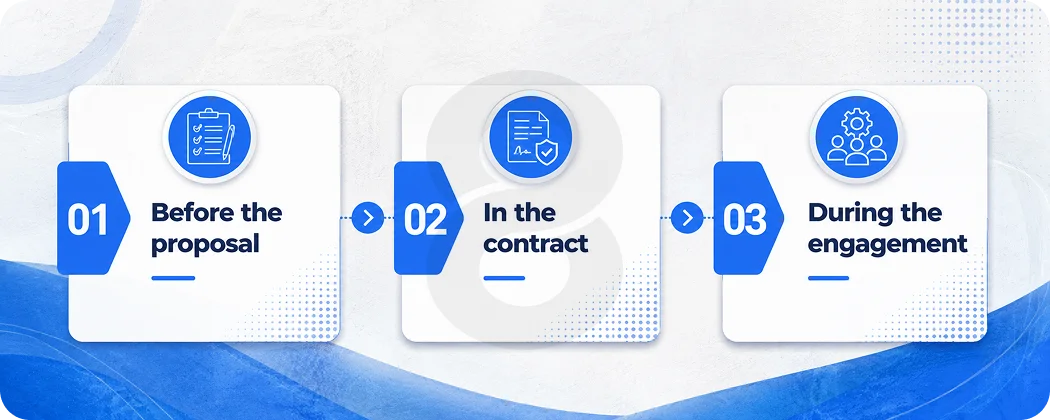
Here’s what separates companies that get this right from the ones rebuilding everything six months later.
Before the proposal
- Did the team run a technical discovery session before scoping?
- Did they ask more questions than they were asked?
- Have at least two past clients been contacted as references?
- Is there clarity on who specifically will be working on the project?
In the contract
- Does the IP ownership clause clearly state that everything built is owned by the client?
- Is there an NDA with specific data handling provisions?
- Are payment milestones tied to deliverables, not just time?
- Is there a clear process for scope changes?
- What are the termination rights and handoff obligations?
During the engagement
- Is there a defined communication rhythm, daily standups, weekly written updates?
- Is there access to the code repository at all times?
- Is there at least 2–4 hours of daily overlap time?
- Are bugs and blockers documented in a shared, accessible system?
Get those boxes checked and the risk drops significantly. Leave them unchecked and luck becomes the primary project management strategy.
For companies building eCommerce platforms, this checklist matters even more because revenue flows directly through the product. A delayed launch or security gap isn’t just a development problem, it’s a business problem.
Read More: How to Hire a Full Stack Developer in 2026: The Complete Guide for Tech Founders
Closing Thoughts
You’ll know the right offshore partner has been found when they stop feeling offshore at all. They’re just the team. They’re in the standups, they know the users, they push back when something doesn’t make sense, and they ship.
That’s not idealistic. That’s what good partnerships look like when the structure is right.
The offshore software development market keeps growing because companies keep finding that it works, when they approach it as a partnership instead of a transaction. The failures happen when corners get cut on vetting, contract details get skimmed, and developers get treated like interchangeable resources.
Do the work upfront. Pick the right model. Communicate like the product depends on it. Because it does.