


Somewhere in the last conversation with your developer, the phrase “Node.js backend” came up. You moved past it. Now you’re a few days out from a hiring decision and quietly unsure what you’re actually buying.
Node.js isn’t mysterious. Netflix and Uber run on it. Moreover, most JavaScript developers have worked with it at some point. Knowing the name doesn’t help you pick the right person to build with it. That part most founders figure out about three weeks after signing a contract, when the gap between “this developer explained everything so clearly on the call” and “this codebase is going to need to be rebuilt” gets hard to keep explaining away.
This is the part of the conversation that tends to happen after a bad hire. The goal here is to flip that.
What is Node JS App Development?
Node.js is a JavaScript runtime and runs on Google. For a hiring decision the definition matters less than one practical consequence. JavaScript runs on both sides of the build.
Frontend and backend speak the same language, which cuts the translation layer that causes most of the friction when two developers are building toward each other without quite understanding what the other one needs.
The event loop is what drives the performance. A regular server works like a cashier at a single register. It sits with one order until the kitchen is done. Only then does it call the next person. Node.js skips the standing around. It passes the request along and keeps moving.
Responses come back and it handles them as they arrive. One process ends up carrying a lot of open connections without the memory cost of spinning up a separate thread for each one.
The Stack Overflow Developer Survey puts it as the most widely used non browser JavaScript runtime among professional developers. That number has been consistent for several years running. At a certain point, durability like that stops being interesting data and just becomes the baseline assumption you are working from.
What Can You Build With Node JS App Development?
This question matters more than most people realize before they hire. The answer determines whether Node.js is the right call for your product at all.
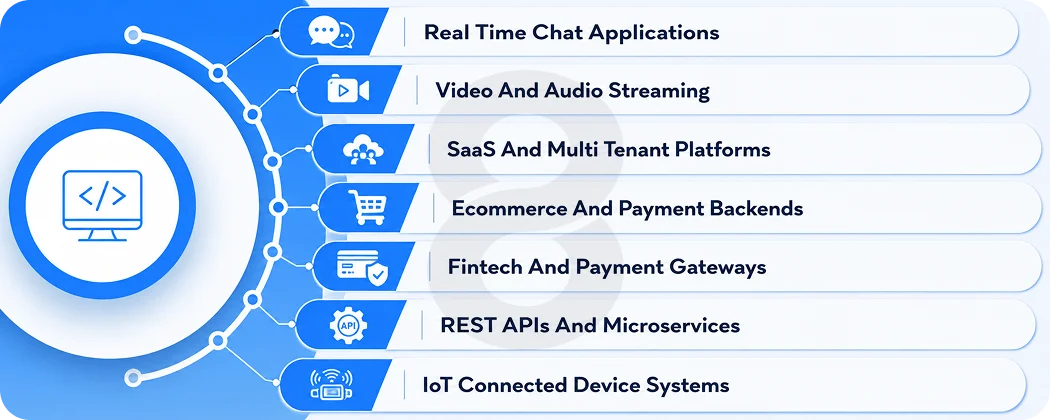
Real Time Chat and Messaging Applications
Node.js handles WebSocket connections natively. Data reaches users the moment something changes rather than waiting on a page refresh. Slack is built this way. So are most in-app chat tools and live notification systems.
If the words ‘real time’ appear anywhere in your product requirements, this section probably applies to you. If you’re planning custom software around a communication layer, Node.js should come up in your first technical conversation.
Streaming Platforms
Node.js processes data in chunks rather than loading a full payload before responding, which is why it handles video and audio streams without the server choking. Netflix migrated key infrastructure to Node.js and cut startup time by 70%.
SaaS Products and Multi-Tenant Platforms
Most SaaS products have hundreds of users on the same endpoints at once. They are all pulling separate data. Node.js handles those concurrent requests without much drama. Trello built on it for exactly this reason. If you’re building a platform where multiple companies share the same infrastructure on separate data sets, the concurrency model is a real advantage.
E-Commerce Backends
E-commerce backends run on API calls. Inventory and payment requests fire at the same time and Node.js handles that volume without the server slowing. PayPal moved over and saw a 35% drop in average response times. The developer headcount it took to run the platform dropped too.
Fintech Apps and Payment Gateways
Real time financial data has a short tolerance for lag. Transaction processing, fraud detection, live balance updates. A slow backend in this context is not just annoying, it erodes user trust fast. Our fintech software work has used Node.js in these exact scenarios across multiple client projects.
REST APIs and Microservices
Honestly, this is where most Node.js projects live. API first products, microservices that need to be lightweight and independently deployable, backend patterns that feed multiple frontends. If a development team is not using Node.js here, they are usually using something adjacent for the same reasons.
IoT and Connected Device Applications
Sensors, location pings, device status updates. These arrive as a continuous stream of small packets rather than big batch requests, and Node.js’s event driven model handles that kind of I/O cleanly. IoT app development on Node.js has grown as more hardware categories have become software connected, and the architecture fits better here than most alternatives.
Read More: Node.js vs Python: Which One is Best For App Development?
Is Node JS Right for Your App?
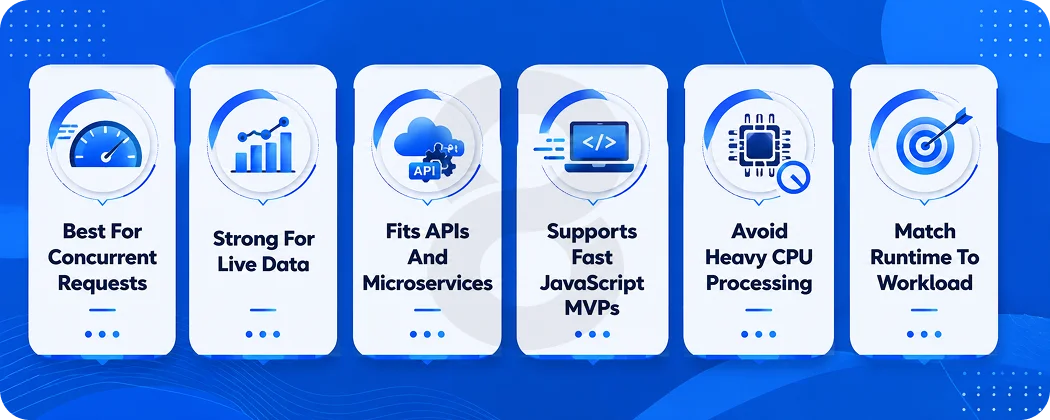
Node.js handles concurrent requests without blocking on any of them. A database call goes out and the server keeps moving. An external API takes a second to respond and nothing stops while it does. The event loop drives all of that. Node.js stays responsive under real traffic without a massive server behind it.
CPU-heavy work is a different story. Machine learning training and real-time video encoding push against a hard ceiling. JavaScript runs on a single thread and cannot spread heavy computation across multiple cores the way those tasks require. For products built around that kind of processing Python or Go is worth the conversation before Node.js development starts.
|
Node.js Works Well For |
Think Twice If You Need |
|
Real time data feeds and live updates |
Heavy CPU computation or number crunching |
|
High-concurrency REST APIs |
Machine learning model training in the backend |
|
SaaS and multi-tenant platforms |
Complex relational data modeled purely in SQL |
|
Microservices and serverless functions |
Apps with zero JavaScript in the current stack |
| Fast MVPs built with JavaScript teams |
Legacy systems requiring no runtime changes |
If you sit in the left column consistently, Node.js is a defensible choice. If you are consistently in the right column, sort out the runtime question before any architecture decisions get locked in.
The Three Hiring Models for Node JS App Development
How you hire shapes the project more than most founders expect. The budget is part of it but so is the risk profile and what happens when something breaks six weeks after launch. The right model depends almost entirely on where the product is right now.
Freelance Node.js Developers
Toptal and Upwork can put a developer in your inbox within a day. Rates run $35 to $150 per hour based on location and experience level. For a short project with a locked scope that speed is genuinely useful.
The catch is accountability. Freelancers often carry multiple clients at once. Nobody manages the project except you. Toptal’s developer engagement research notes that contract models require stronger documentation and handoff planning compared to in house setups. When a freelancer goes quiet for a week, you may not have a clean way to follow up. IP ownership can also get murky without a well-drafted contract.
A three-week prototype with a locked scope? A freelancer is a reasonable call. Three months of iterative development where requirements keep evolving? The risk compounds in ways that are hard to see until they are expensive.
Node.js Development Agencies
Agencies bring a team. Backend developer, frontend developer, QA engineer, project manager. The project management piece is often what makes the real difference. US-based agencies charge $100 to $150 per hour. Eastern European firms run $30 to $70. Latin American agencies land in a similar range. That price gap is labor cost, not necessarily quality of output.
The main reason to choose an agency is that you are buying ownership of the delivery process, not just labor. You set requirements and review milestones. They handle execution.
In House Node.js Teams
This makes sense after you have validated the product and need an engineering function that grows with the company. MoldStud’s 2025 salary research puts mid level Node.js developers in the US at $80,000 to $120,000 a year. Senior developers at major tech hubs cross $160,000. Benefits and recruiting costs add another 25 to 30% before anyone has written a line of code.
You own the engineering function outright, which has real value once you have a product worth protecting. If you need to scale without the overhead of full-time employment right now, staff augmentation sits in the middle.
| Model | Best Situation | Typical Budget | Timeline |
| Freelancer | Defined scope, short term | $5,000 to $20,000 | 1 to 3 months |
| Agency | Full product build | $25,000 to $150,000+ | 3 to 9 months |
| In House Team | Long term product engineering | $200,000+ per year | Ongoing |
Node JS Developer Skills Checklist
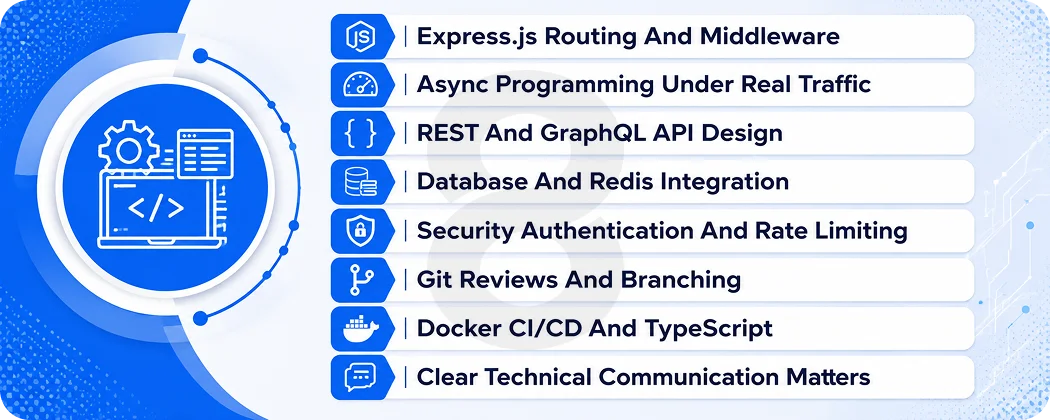
You do not need to know Node.js yourself to hire well. You need to know what to probe for and what answers should give you pause.
Core Technical Skills
Express.js
Most Node.js development runs through Express.js. It handles routing and middleware without a lot of overhead and most developers who have worked seriously in Node.js have built something with it. In an interview ask them to walk through how they structured middleware on a past project. Vague answers usually mean surface-level experience.
Async programming
A developer can read about promises and async/await and pass an interview question about them without having actually debugged a race condition at two in the morning. The code they write often looks clean. It holds up fine in testing. Then the app gets real traffic and something that was never quite right starts showing up in the logs.
REST API and GraphQL design
REST API and GraphQL design come up on almost every Node.js project. Can they design a clean endpoint structure? Can they document it well enough that another developer can use it without a 45-minute orientation call? That is the real bar.
Database integration
Database integration covers the data layer. MongoDB pairs naturally with Node.js. PostgreSQL shows up more when the data structure needs strict relational modeling. Ask about Redis specifically. It is not always part of a developer’s standard pitch, but caching is often what determines whether an app feels fast to actual users.
Security fundamentals
Security is where hiring conversations get optimistic. Ask directly how they handle authentication and rate limiting on a production build. If those topics haven’t come up in their process before you asked, they probably weren’t coming up at all. Ask what they do about npm dependency vulnerabilities. That question tells you whether they treat security as part of the build or as someone else’s problem.
Git usage
Git usage is table stakes, but how they use it is not always. Ask about their branching strategy. Ask what a typical pull request review looks like on a team they’ve worked on. A developer who commits directly to main without code review is telling you something about how they will work on your project.
Advanced Skills Worth Asking About
Docker and containerization signal that a developer thinks about the full environment, not just the code. CI/CD experience through GitHub Actions or CircleCI means deployment is not an afterthought. TypeScript has become standard practice in 2025 for anything beyond a small prototype.
WebSocket experience matters if real time is in your product requirements. Cloud deployment knowledge covering AWS Lambda, Google Cloud Functions, or Azure matters if you want the app to scale without adding dedicated DevOps staff.
The Soft Skills Part That Actually Matters
Technical interviews tend to go deep on code and skip past communication entirely. That gap shows up later. A developer who goes quiet when asked to explain a decision they made is going to create problems that have nothing to do with whether the code works.
Somewhere around month two, you will be in a meeting where something is broken and nobody in the room who matters can understand what the developer is actually saying. Ask them in the first conversation to walk through a technical problem they solved. You are not listening for the right answer. You are listening for whether you can follow them at all.
On the UX side, design and backend development running separately is how you end up with an interface the server cannot support. It happens more than it should and it is expensive to untangle.
Node JS App Development Cost Breakdown
Budget conversations in software development happen too late more often than not. Here is what the numbers actually look like for Node.js projects.
A basic MVP runs $8K to $20K. That gets you authentication, a working interface, and a couple of API endpoints with a freelancer or small agency. The number moves fast once the scope does. A feature added mid-build rarely costs what it would have cost upfront.
The $25K to $70K range is where most serious first products land. Third party integrations, a payment gateway, an admin panel. Each one adds time and the timeline is where the budget actually lives. Analytics and social logins sound straightforward until they are not.
Enterprise work starts at $80K and the ceiling is genuinely open. Multi-tenant architecture, serious security requirements, complex data models. Projects in this range regularly cross $200,000 before the edge cases get handled.
| Project Type | What’s Included | Estimated Cost |
| Simple MVP | Auth, basic UI, 1 to 2 APIs | $8,000 to $20,000 |
| Mid Level App | Integrations, admin panel, real time features | $25,000 to $70,000 |
| Enterprise Platform | Microservices, security, multi-tenant architecture | $80,000 to $200,000+ |
Developer hourly rates vary by region:
| Region | Hourly Rate |
| North America (US and Canada) | $75 to $150 per hour |
| Western Europe | $60 to $120 per hour |
| Eastern Europe | $30 to $70 per hour |
| Latin America | $30 to $65 per hour |
| South and Southeast Asia | $12 to $50 per hour |
The Hidden Costs Founders Miss
QA and testing add 10 to 15% on top of whatever the build costs. Agencies often quote this separately and a lot of founders find out three weeks in when a new line item appears on an invoice. Ask before signing whether testing is in the number.
DevOps work tends to disappear from early estimates because it does not feel like building the product. The cloud environment, deployment pipelines, and monitoring all need configuration. That work adds $2,000 to $8,000 and rarely shows up in the first budget conversation.
After-launch maintenance is where the real surprise usually lands. A $50K app needs $8K to $10K a year to stay patched and current. Security updates and dependency changes do not stop once the build is done. Getting software maintenance and support into the contract before work starts is easier than negotiating it after something breaks.
Project management is worth asking about directly. Some agencies include it in the hourly rate. Others invoice it separately and the final number ends up looking different from the estimate.
Read More: Offshore Software Development Guide: How to Find the Right Partner
How to Vet a Node JS Developer or Agency
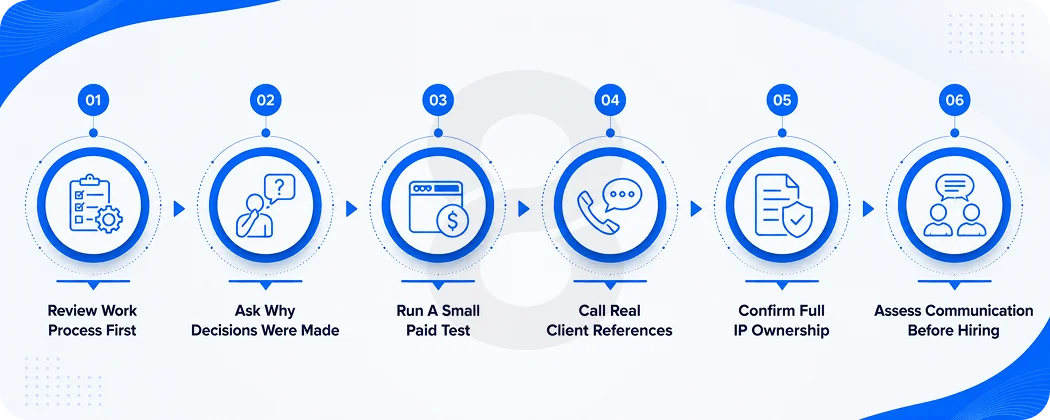
Hiring decisions go wrong earlier than most people realize. By the time something breaks during development the real mistake is usually a few months old.
Step 1: Look at How They Work, Not Just What They Built
Start with their GitHub profile. Look for commit history that tells a story, README files that suggest someone cared about the next person reading the code, and signs that pull requests went through review rather than merging straight to main.
A lot of developers claim experience they cannot show publicly. Client NDAs explain some of that. But if they cannot open a codebase and walk you through the decisions they made in it, ask yourself what that says about how well they actually understand their own work.
Step 2: Ask Them to Explain a Decision, Not Just Show a Demo
Demos show output. They do not show you how someone thinks. Ask about an architectural choice they made in a past project. Not what they chose but why and what they weighed before landing on it. That conversation tells you more about how they will handle the hard calls on your project than anything on their profile does.
Step 3: Run a Small Paid Test Before Any Long Commitment
Before any full commitment pay $200 to $500 for a small defined deliverable. With freelancers this is not negotiable. With agencies ask whether they offer a paid discovery sprint. The quality of that first piece of work tells you more than a reference call will.
Step 4: Call References, Do Not Read Testimonials
Website testimonials were written to be there. Ask for two past clients you can actually call and give them a question with some friction in it. “What broke on the project and how did they handle it?” produces a real answer. “Would you recommend them?” produces a testimonial delivered out loud.
Step 5: Sort Out IP Before You Sign
Your contract needs to explicitly state that all code written for your project belongs to you. This gets missed more than you would think, particularly with offshore teams and freelancers. Have a lawyer review it. The cost of that review is nothing compared to untangling IP ownership after a relationship goes wrong.
Step 6: Watch How They Communicate Before Money Moves
Response time on your initial message. Clarity in the scoping conversation. Whether their proposal actually reflects what you discussed. These are not just courtesy signals. They predict how the project will feel in month three when something is not working and you need clear, fast communication to fix it.
Read More: How to Hire a Full Stack Developer: The Complete Guide for Tech Founders
Red Flags to Watch Before You Hire
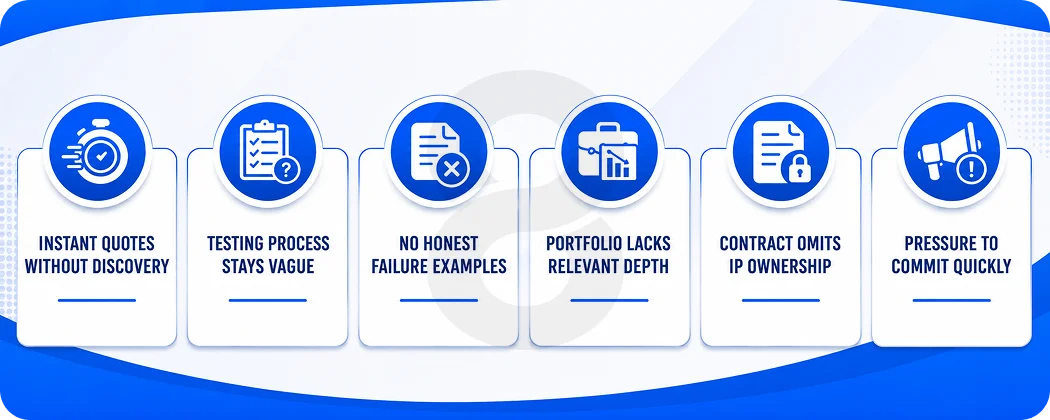
- A quote that arrives before anyone has asked about the project is a guess. The person who ends up paying for that guess is you.
- Ask what they actually test and how it fits into the build process. A vague answer means it was not part of the plan. Code with no test coverage is not a finished product regardless of whether it runs.
- Ask about a project that went wrong. Not what they learned from it. What broke and what they did about it. A developer who can answer that clearly is more reliable than one whose track record sounds like a highlight reel.
- A portfolio that spans fintech and healthcare and social networking and gaming and logistics is not a strength. Five industries at the surface level is not the same as going deep in one. The developer who has built three payment systems knows things that do not show up in a general portfolio.
- If the contract has no IP clause add one or walk away.
- Developers and agencies with real work do not need you to commit this week. The ones who do usually have a reason for the urgency.
Read More: Pricing Models for Software Services: Fixed vs. Hourly Rates Explained
How 8ration Approaches Node JS App Development
Node js app development is part of the team’s active project work, not a listed capability sitting on a services page without real experience behind it.
Before development starts the team runs a discovery phase. Data flows get mapped. Integration points get identified. The backend architecture gets designed around actual traffic and concurrency requirements rather than assumptions about them. Most of the expensive rebuilds happen because nobody asked those questions early enough.
Two recent examples. Allie Marketplace is a C2C platform with real time chat, secure payments, and intelligent product discovery. The Node.js backend manages concurrent buyer and seller sessions without the latency problems that come with a synchronous architecture.
TruckersKonnect processes live route planning and repair booking data for truckers across the US. The Node.js API layer handles incoming location data continuously, which is a different technical problem than handling a batch request at a scheduled time. Both projects went through 8ration’s software consulting process before the first sprint started.
The team includes MERN Stack engineers, full stack developers, and senior engineers working across Express.js, NestJS, MongoDB, Redis, and cloud deployment on AWS and Google Cloud. Software testing and QA is part of every engagement. It is not an add-on quoted after the build budget is agreed.
For specific industries, 8ration has active app development project work in fintech, marketplace platforms, and IoT-connected applications.
Final Thoughts
The technology decision is usually the easy part. Node.js is a strong choice for real time apps, APIs, and SaaS products, and the developer market for it is large enough that you have real options across every hiring model and budget range.
What is harder is the actual hiring decision. Not because the information is hard to find, but because the red flags are easy to rationalize when you are under timeline pressure and someone gives you a quote that fits the budget.
Most projects that go badly have a moment you can trace it back to. It is almost never the technology. The hiring decision is where things usually went wrong, and by the time anyone noticed, the project was already weeks in.
Get the hiring piece right. The Node.js part tends to take care of itself after that.