


Here’s a scenario that plays out constantly in healthcare tech. A founder at Googles telemedicine app development costs lands on a blog that says “$25,000 to $50,000”, and he is happy with that figure, but then he gets a real quote for $180,000.
The shock is real. And it’s not the developer’s fault.
Nobody accounts for the full stack. HIPAA compliant infrastructure, encrypted databases, and EHR integrations that are going to get in your way. The $25,000 figure is for a proof of concept. Not something that you can legally place in front of patients.
The telemedicine market is projected to reach $156.31 billion in 2026 and is expected to reach $317.26 billion by 2031. There’s money here. There’s also a lot of burnt runway. This is the breakdown that aims to rectify it.
What Drives Telemedicine App Development Cost in 2026
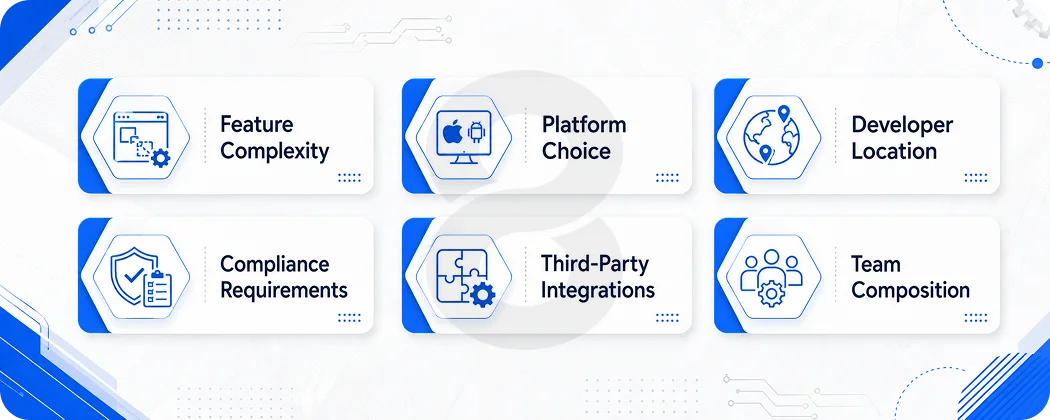
To begin with, it’s important to recognize why two apps with the same “face” price can cost as much as $200,000 different in terms of build. The number of levers that control the final number is approximately six and most founders underestimate at least three of them.
Feature Complexity
The cost of a basic video consultation application is $50,000, but requires additional security, regulatory compliance, and system integrations to add up to $85,000. Higher-end telehealth systems like EHR integration, remote patient monitoring, analytics, and multi-role access can cost over $300,000.
All of the features that you add like async messaging, prescription management, multi-specialty routing, and wearable device sync are development hours and those hours cost money. It’s more or less linear up until you get to complex integrations, where it can suddenly get steep.
Platform Choice
The typical time to develop an app with authentication, profiles, chat, video calls, and basic EHR integrations is 800–1200 hours, across either an iOS or Android platform. With an average hourly rate of $40–60, the cost ranges from $32,000 to $72,000. The time to develop two native apps is in the range of 1,600-2,400 hours, and the cost is at least $64,000 to $144,000+.
Tools such as cross-platform frameworks like React Native or Flutter bridge that gap considerably. One codebase for both iOS and Android, less duplication, faster testing cycles and lower bills! The tradeoff is that these are not as fast as native builds, but for most telemedicine use cases, the differences are only slightly apparent to end users.
Developer Location
1,000 hours of work: India? $25k. Eastern Europe? $60k. USA? $150k. That’s a very large spread, and it’s not just a quality indicator. The contributions of all these areas to great work are recognized. You’re not buying a passport, you’re buying on the topics of time zone overlap, communication style and process maturity.
Compliance Requirements
This one surprises people the most. Ongoing guidance is needed for HIPAA compliance. Recurring prices include BAA contracts with providers, annual security audits and legal advice. When building for the US market, this is not an option. This will cost you $10,000 to $30,000 at launch and yearly thereafter.
Third-Party Integrations
Integration is not easy with EHRs such as Epic or Cerner. These are all projects in and of themselves. Include video SDKs (Twilio, Agora), payment gateways, push notifications, and mapping, and you have continuous API licensing costs along with the build costs.
Most third-party push notification, payment gateway, mapping and video SDKs charge monthly usage or subscription fees. Cloud-based infrastructure expenses will rise with the number of users. As more users join, the cost of cloud-based infrastructure will follow AWS, Azure, or Google Cloud.
Team Composition
The individual freelancer can be inexpensive on an hourly basis, but costly on an overall basis. A full team (project manager, UI/UX designer, front-end dev, back-end dev, QA engineer, compliance consultant) builds faster, and finds bugs sooner, and creates something you can maintain. The hourly rate appears to be a higher price, but the cost per working feature may be less.
White-Label vs. Custom Telemedicine App: Which One Is Right for You?
Choosing between white-label and custom development is one of the earliest and most consequential decisions you will make. The right choice depends on your timeline, budget, and long-term goals. Here is a side-by-side breakdown to help you decide faster.
| Factor | White-Label | Custom Build |
| Time to Launch | 4 to 8 weeks | 4 to 18 months |
| Upfront Cost | $5,000 to $30,000 | $40,000 to $300,000+ |
| Ongoing Fees | $500 to $5,000/month | 15 to 20% of build cost/year |
| Customization | Limited | Full Control |
| Scalability | Platform-Dependent | Built to Your Needs |
| HIPAA Compliance | Vendor-Managed | Your Responsibility |
| Branding | Restricted | Fully Custom |
| EHR Integration | Basic or None | Deep and Custom |
| Best For | Early Validation | Long-Term Business |
The Real Cost Tiers: What You Actually Get at Each Level
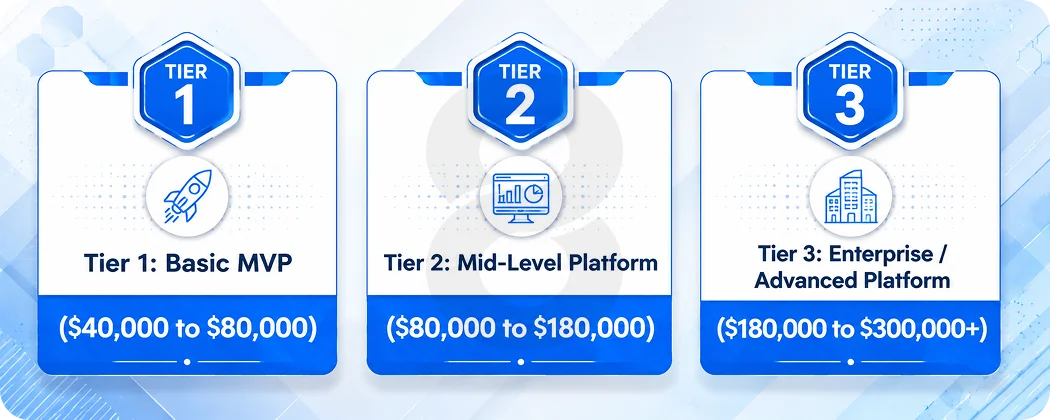
Here’s where most articles pull their punches. They will tell you a range, such as “$40,000 to $300,000” and leave it up to you to decide where to place yourself. Let’s take a look at it step by step.
Tier 1: Basic MVP ($40,000 to $80,000)
This is where the majority of the healthcare startups must start. The basic telemedicine app (MVP) includes essential features of a telemedicine app, such as user profiles, appointment scheduling, and simple video consultations.
This is the level of core functionality that you’re getting: patient registration and basic profile management, HIPAA compliant video consult, simple appointment scheduling, secure patient-to-provider communication, provider dashboard availability management, and basic payment gateway. You are not getting EHR integration, AI features, or remote monitoring. You have enough to test your product for legs.
An MVP will be completed within 3 – 5 months. That’s tight. Assume that things will change. With compliance reviews and iteration cycles, real MVPs are more likely to fall along the lines of 5 months.
Tier 2: Mid-Level Platform ($80,000 to $180,000)
You have tested your idea, had some early success and you want to go further. Complete EHR integration (Epic or Cerner), cross-functional workflows, in-app prescription management, analytics dashboards, access to patient history, and multiple provider roles.
The UI/UX is developed with real healthcare user research, not on assumptions. The development of a mobile app at this complexity level could take 5–9 months. Quality testing takes longer only due to the fact that there are more integration points that need to be tested.
Tier 3: Enterprise / Advanced Platform ($180,000 to $300,000+)
Looking to create the next platform of its kind, like Teladoc? This is your range. Enterprise telehealth platforms that allow access by multiple roles, analytics, RPM, and integrate EHRs can cost over $300,000 based on deployment size.
You’re adding AI-powered triage, IoT device integration, multi-language support, and an architecture designed for thousands of concurrent video sessions.
This process is 9–18 months or longer. Typically, teams here are related to healthcare organizations that have established patient populations, healthier startup ventures, or health system additions to larger enterprise app initiatives.
| App Tier | Estimated Cost | Timeline | Key Features |
|---|---|---|---|
| Basic MVP | $40,000 – $80,000 | 3–5 months | Video consult, scheduling, basic messaging, payments |
| Mid-Level | $80,000 – $180,000 | 5–9 months | EHR integration, prescriptions, analytics, multi-role |
| Enterprise | $180,000 – $300,000+ | 9–18 months | AI triage, RPM, IoT, multi-language, advanced billing |
Feature-by-Feature Cost Breakdown
Understanding the aggregate tiers is useful, but a modular view helps you prioritize when the budget gets tight. Here’s what individual features typically add to the total:
| Feature | Estimated Development Cost |
|---|---|
| User registration and profile management | $3,000 – $6,000 |
| HIPAA-compliant video consultation (WebRTC/Twilio) | $8,000 – $20,000 |
| Appointment scheduling and calendar management | $4,000 – $8,000 |
| Secure in-app messaging | $5,000 – $10,000 |
| EHR integration (Epic, Cerner, or similar) | $15,000 – $40,000 |
| E-prescription management | $7,000 – $15,000 |
| Payment gateway and billing | $5,000 – $12,000 |
| Doctor/patient dashboards | $8,000 – $15,000 |
| AI symptom checker or triage | $15,000 – $35,000 |
| Remote patient monitoring (RPM) | $20,000 – $50,000+ |
| Admin panel and user management | $5,000 – $10,000 |
| Push notifications | $2,000 – $5,000 |
| Multi-language support | $4,000 – $10,000 |
| Analytics and reporting dashboard | $8,000 – $18,000 |
The numbers above are additive but not perfectly so. A strong custom software development team will identify shared infrastructure across features, which reduces the cumulative total. Independent estimates for each feature tend to overstate the final number by 15–20%.
The Hidden Costs Nobody Quotes You
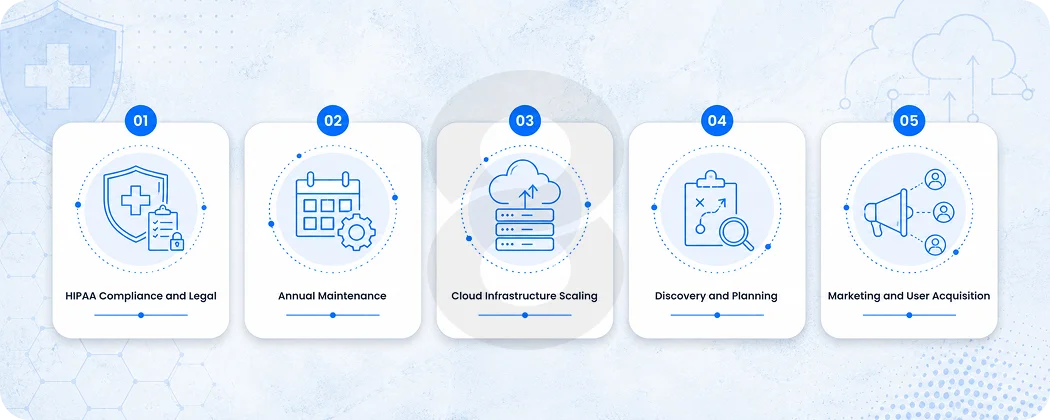
This is where budgets die quietly. The visible cost of building a telemedicine app is real, but there’s an entire second invoice that arrives after launch, or sometimes partway through development, that teams consistently underestimate.
HIPAA Compliance and Legal
Compliance isn’t a checkbox. It’s architecture decisions, legal agreements, audit logs, and ongoing monitoring. You need to finance an additional $10,000 to $30,000 for compliance-related obligations alone. And that’s just upfront. Annual security audits, BAA renewals, and legal reviews continue indefinitely.
Annual Maintenance
The rule of thumb is to allocate up to 15–20% of the initial development cost to app maintenance. On a $120,000 build, that’s $18,000 to $24,000 every year. That covers OS updates, security patches, bug fixes, server management, and minor feature iterations. Skip it and your app rots.
Cloud Infrastructure Scaling
Your server bill looks manageable on day one. It looks very different when you’ve got 5,000 active users running concurrent video sessions. AWS, Azure, and Google Cloud are all usage-based. Budget accordingly, or you’ll get a nasty surprise during your first viral growth period.
Discovery and Planning
Requirements gathering and workshops can cost $2,000 to $5,000. Regulatory compliance assessment adds $1,500 to $4,000. Technical architecture planning runs $2,000 to $6,000. These feel optional when you’re budget-squeezed. They’re not. Organizations often rush through discovery. Inadequate planning typically doubles development costs later through rework and scope changes.
Marketing and User Acquisition
A lot of healthcare founders build the product and then realize they have no idea how to get patients or providers to actually use it. App store optimization, paid campaigns, content marketing, and influencer outreach for healthcare audiences don’t come cheap and aren’t included in development estimates.
How Team Location and Structure Affect Your Final Number
The geography question is awkward but necessary. The location of your development team is often more important than any other decision to your overall budget. Here are the approximate hourly wages for each area in 2026:
| Region | Average Hourly Rate | Notes |
|---|---|---|
| United States / Canada | $100 – $250/hr | Highest cost, best timezone fit for US clients |
| Western Europe | $80 – $150/hr | Strong compliance expertise, good quality |
| Eastern Europe / Ukraine | $40 – $80/hr | High technical quality, popular for healthcare projects |
| India / South Asia | $20 – $50/hr | Largest talent pool, variable process maturity |
| Latin America | $35 – $70/hr | Growing quickly, strong timezone overlap with US |
The amount of savings can be considerable and, on a 1,200-hour project (a realistic mid-tier telemedicine app), it comes to $108,000, assuming an Eastern European team of $60/hour and a US-based of $150/hour. It’s not a rounding error; it’s a real business decision.
But there’s more to it than hourly rate. Healthcare app development requires people who understand HIPAA, who’ve integrated with EHR systems before, and who know what “HIPAA-compliant video stream” actually means technically. A $25/hr team that learns compliance on your dime will cost more in the long run. Experience in the specific domain matters here more than it does for, say, a social media app.
This is exactly where enterprise app development experience pays off. Teams that have built healthcare platforms before don’t repeat avoidable mistakes, and they don’t underestimate the compliance scoping work that junior teams consistently miss.
Read More: How to Build HIPAA & GDPR Compliant Apps
The Compliance Reality in 2026: What HIPAA Actually Costs You
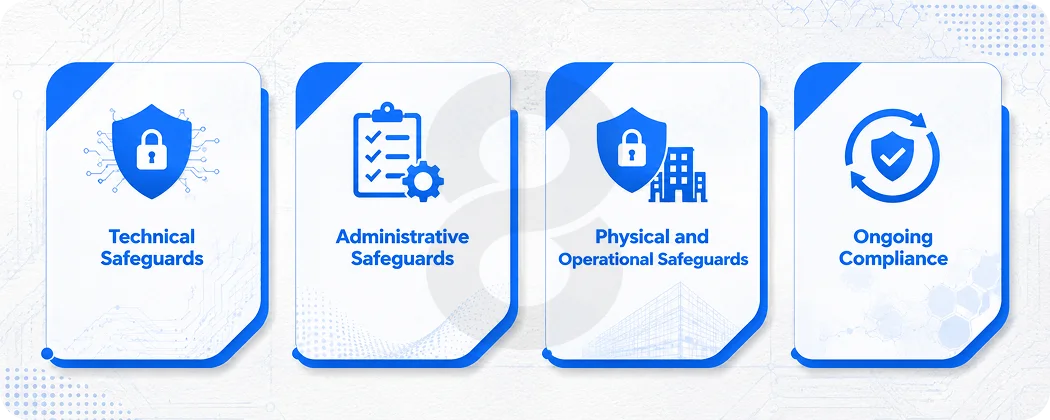
Let’s spend a moment here because this is where most guides get vague and hand-wavy. Compliance isn’t one line item. It’s a category with multiple components, and each one has a price.
Technical Safeguards
End-to-end encryption for all data in transit and at rest, unique user identification, automatic logoff features, encrypted audit logs, and multi-factor authentication are all required by HIPAA’s technical safeguard standards. Building these correctly from the ground up adds roughly $8,000 to $15,000 to your development budget.
Administrative Safeguards
Business Associate Agreements (BAAs) with every vendor who touches patient data, your cloud provider, your video SDK vendor, and your analytics platform. Each one needs legal review. Budget $2,000 to $5,000 for initial legal work.
Physical and Operational Safeguards
Your cloud architecture needs to be configured specifically for healthcare workloads. AWS has a HIPAA-eligible services list. Not all AWS services make that list. If your developer doesn’t know this going in, you’ll either rebuild or risk non-compliance.
Ongoing Compliance
Annual penetration testing, security audits, staff training documentation, incident response procedures. This isn’t a one-time cost. Healthcare regulators aren’t forgiving, and a data breach in telemedicine can cost millions in fines, not counting the reputational damage.
44% of US adults had a virtual visit in the prior 12 months in 2024, and 94% would repeat it. The patient appetite is there. The compliance burden is the price of admission, and it’s non-negotiable.
AI Features in Telemedicine Apps: What They Cost and Why They’re Worth It
In 2024, there were over 116 million users of online doctor consultations worldwide, up from around 57 million in 2019. The bar for what patients expect from a telemedicine app has risen significantly. AI features are moving from nice-to-have to expected.
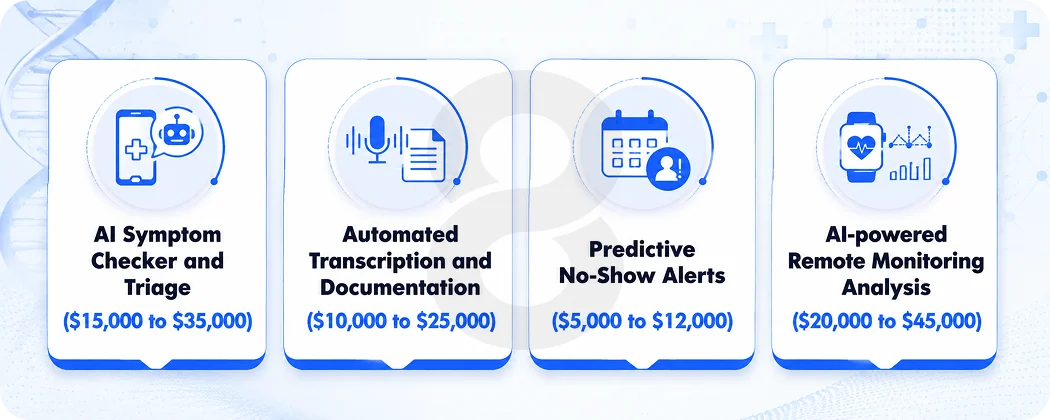
Here’s what AI adds to a telemedicine platform and what it costs in 2026:
AI Symptom Checker and Triage ($15,000 to $35,000):
Patients describe symptoms, the AI pre-categorizes urgency and routes them to the right specialist. Reduces provider time spent on basic intake and improves patient flow. The AI development work here involves training on medical datasets, NLP model integration, and a clinical review workflow.
Automated Transcription and Documentation ($10,000 to $25,000):
Converts the video consultation into structured clinical notes automatically. Providers spend significantly less time on documentation. This one has a measurable ROI almost immediately.
Predictive No-Show Alerts ($5,000 to $12,000):
Machine learning models that flag patients likely to miss appointments, enabling proactive rescheduling. Smart alerts can reduce no-show rates by as much as 67%, enhancing overall participation.
AI-powered Remote Monitoring Analysis ($20,000 to $45,000):
Paired with wearable devices, AI models analyze patient vitals in real time and flag anomalies for provider review. Especially valuable for chronic disease management platforms.
The ROI math on most of these features works in favor of adding them, even when they push the initial budget up. A telemedicine platform that reduces provider documentation time by 30 minutes per consultation retains providers. One that cuts no-shows by half earns back its development cost faster than you’d expect.
Read More: Healthcare App Development Cost in 2026: A Detailed Guide
Build vs. Buy: White-Label vs. Custom Development
Before committing to a full custom build, it’s worth evaluating white-label telehealth platforms. They exist. They’re faster to launch and significantly cheaper upfront.
White-label solutions typically cost $5,000 to $30,000 upfront plus monthly licensing fees ranging from $500 to $5,000 depending on user volume and features. You get a working product faster, with less technical risk and lower initial investment.
The tradeoffs are real though. You’re working within someone else’s feature set. Customization is limited. Your brand and UX are constrained by their platform decisions. You’re dependent on their compliance posture. And if they raise prices or shut down, you’re in trouble.
Custom development wins when you have specific clinical workflows that don’t fit generic platforms, when differentiation in UX is part of your go-to-market, or when you’re building for scale and need architecture you control entirely. The product development investment is higher upfront, but the long-term flexibility is worth it for teams building a real business rather than a quick-launch experiment.
| Factor | White-Label | Custom Build |
|---|---|---|
| Time to launch | 4–8 weeks | 4–18 months |
| Upfront cost | $5,000 – $30,000 | $40,000 – $300,000+ |
| Ongoing fees | $500 – $5,000/month | 15–20% of build cost/year |
| Customization | Limited | Full control |
| Scalability | Platform-dependent | Architect to your needs |
| Compliance control | Vendor-managed | Your responsibility |
Post-Launch Telemedicine App Costs: The Bill That Never Stops
Launch day is not the end of the spending. It’s the beginning of a different kind of spending. Here’s what to expect in year one after launch and every year after:
- Cloud hosting: $500 to $5,000/month depending on concurrent user volume and video session frequency. Video is bandwidth-heavy. Your hosting cost scales with usage in a way that simple content apps don’t.
- Third-party API fees: Video SDKs like Twilio charge per minute of video. Payment processors take a percentage of each transaction. Push notification services charge by volume. None of this is expensive in isolation, but together it adds up to $500 to $3,000/month for a mid-sized platform.
- Security monitoring and maintenance: Active threat monitoring, security patch deployment, and vulnerability scanning. This is not optional in healthcare. Budget $1,000 to $3,000/month.
- Feature updates and iterations: User feedback will surface things you didn’t anticipate. Plan for 2–4 development sprints per year to address them. Add this to the 15–20% annual maintenance budget.
- App store compliance updates: Apple and Google update their requirements regularly. Healthcare apps face additional scrutiny. Budget for at least two forced update cycles per year.
The maintenance and support side of telemedicine platforms is where teams most consistently underbudget. An app that goes unmaintained for six months in healthcare is an app that becomes a liability.