



A customer inquiry arrives while you’re preparing a proposal. An invoice needs checking, and someone on your team is waiting for an answer buried in last month’s meeting notes. These are useful starting points for AI because you can identify the work, inspect the result, and decide whether the help was worth paying for.
AI for entrepreneurs works best when it has a defined responsibility. Start with a task that consumes time every week, then judge the system by completed work and corrections required. Generating more drafts means little if every draft creates another editing job.
What Is AI for Entrepreneurs?
AI for entrepreneurs means applying artificial intelligence to the work of starting and operating a business. That might involve summarizing interviews, drafting a customer response, or extracting information from documents. The useful distinction is what the software is allowed to do with its output.
An assistant can prepare a recommendation for you. A connected workflow can move approved information between applications. An agent can select actions within limits you establish. Those arrangements require different levels of oversight.
AI entrepreneurs building products for customers face an additional question: will someone pay for the result? An impressive demonstration does not establish demand. The underlying business still needs customers, workable economics, and a reason to be chosen.
How Are Entrepreneurs Using AI in 2026?
The Census Bureau’s 2026 analysis of business AI use reported adoption between 17% and 20% from December 2025 through May 2026. That is a dated measure of surveyed businesses, not a statistic specifically about entrepreneurs or a current adoption rate.
For a founder, the practical question is where assistance belongs at the present stage of the business. A new venture needs evidence about demand. An established business may need help processing work it already understands.
Build: Test a Small Business Hypothesis
Use AI to organize customer interview notes into recurring problems and unresolved questions. Keep the original comments alongside the summary so you can challenge its interpretation. Then test an offer with prospective customers.
If the offer requires software, a narrowly scoped minimum viable product gives customers something concrete to try. Define the behavior you need to observe, such as completing a booking or returning to use the product again.
Run and Scale: Find the Repeated Handoff
Examine where people repeatedly copy information, chase missing details, or translate messages into records. A useful first project might turn incoming inquiries into structured drafts for a coordinator. Expand to another department only when the original workflow has a clear owner and a manageable exception queue.
Benefits of AI for Entrepreneurs Worth Measuring
The strongest benefit is specific enough to verify. For an inquiry workflow, measure time to a useful response. For document extraction, count records accepted without correction. For an internal assistant, track whether employees find the right information without escalating the question.
These measures capture different outcomes. Faster responses are not automatically more accurate. Time freed for customer conversations is valuable, but it is not the same as reducing payroll. Decide which result matters before estimating a return.
When several projects compete for attention, AI consulting for workflow selection can help frame the evaluation. Compare task volume, available data, integration requirements, and the consequences of a mistake.
Best AI Tools for Entrepreneurs: Choose by Task
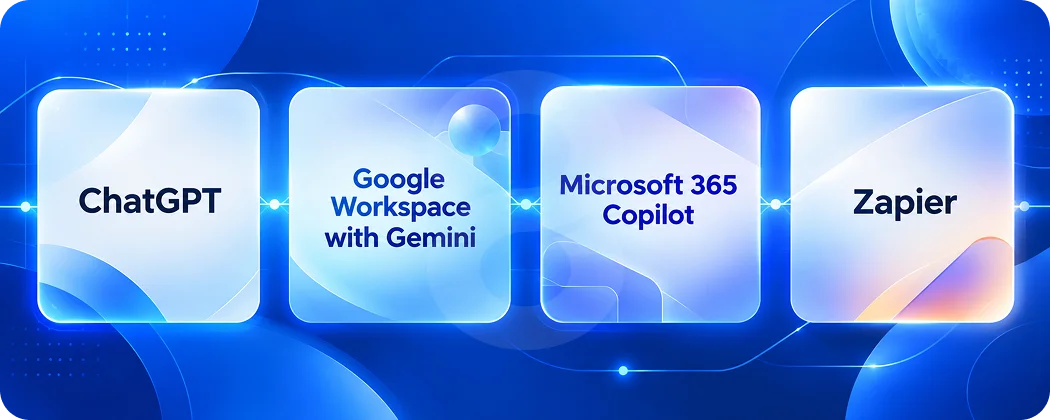
The best AI tools for entrepreneurs depend on the work and the applications already in use. The following shortlist maps documented capabilities to practical starting points. It is a selection aid, not a performance ranking or a claim that every feature is included in every plan.
| Tool | A useful starting task | Check before committing |
|---|---|---|
| ChatGPT | Draft documents and analyze uploaded files or data exports. | File limits, data settings, workspace controls, and output accuracy. |
| Google Workspace with Gemini | Assist with email and documents inside an existing Workspace environment. | Edition eligibility and the features available in each application. |
| Microsoft 365 Copilot | Support work in applications such as Word, Excel, Outlook, and Teams. | Licensing requirements and access to the underlying business files. |
| Zapier | Connect workflow steps and pause for a person to review an action. | Supported integrations, task usage, and approval configuration. |
Compare two candidates on the same sample of work. Include incomplete requests and ambiguous wording, not just the examples most likely to succeed. Record correction time as well as output quality.
For connected tasks, Zapier’s Human in the Loop feature provides a concrete example of an approval step that pauses a workflow pending review. Check how an equivalent safeguard works in any platform you shortlist.
Resist buying several overlapping subscriptions at once. A single tool used consistently is easier to evaluate than a collection of trials with no common success measure.
AI Assistants vs. AI Agents for Entrepreneurs
Product labels overlap, so judge the system by its permissions. An AI assistant for entrepreneurs might draft a follow-up email when asked. An agent might inspect an inquiry, retrieve account information, and decide which approved action to take next.
Use AI agents for entrepreneurs when a task genuinely requires flexible decisions. If every request follows the same path, ordinary automation may be sufficient. Adding autonomy creates another set of behaviors to test.Consider custom AI development for business workflows when standard tools cannot meet a defined requirement. Before commissioning a build, specify what the system may read, what it may change, and which actions always require approval.Agentic AI for entrepreneurs should begin with limited authority. A purchasing assistant, for example, could compare approved supplier information and prepare an order for review. Granting permission to spend money is a separate decision from granting access to a price list.
| Approach | Who determines the next step? | Example |
|---|---|---|
| Assistant | The user directs the task. | Summarize a meeting and propose follow-up actions. |
| Fixed automation | Rules define the sequence. | Create a task when an approved form is submitted. |
| Agent | The AI selects steps within configured boundaries. | Gather missing details through permitted tools before preparing a response. |
Business Tasks Entrepreneurs Can Automate With AI
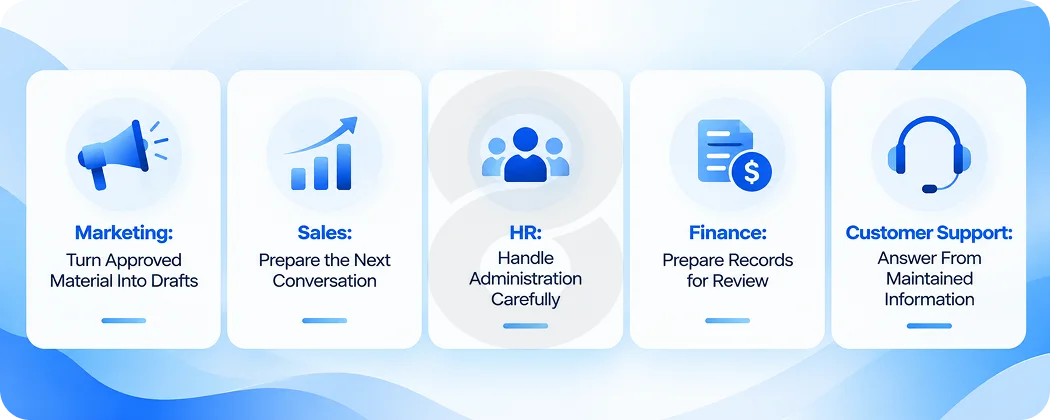
Choose a bounded task inside a department rather than trying to automate the department itself. The examples below are proposed uses, not reported customer outcomes.
Marketing: Turn Approved Material Into Drafts
Start with product specifications or approved messaging. Ask AI to prepare a campaign brief or several email variations from those materials. Keep an editor responsible for factual claims and tone. A plausible sentence is not evidence that a product has the feature being advertised.
Sales: Prepare the Next Conversation
Use AI to summarize inquiry details and identify missing information before a salesperson responds. Keep discounts and contractual commitments outside the first automation. A lead summary should help a person understand the opportunity without quietly changing the terms offered.
HR: Handle Administration Carefully
Can AI automate HR tasks for entrepreneurs? Yes, suitable starting points include drafting onboarding checklists and answering routine questions from approved employee policies. Keep sensitive personnel records outside a general company knowledge base.
The EEOC explains that AI in employment decisions can violate discrimination laws. Do not treat automated applicant scores as inherently objective. Employment decisions need accountable review and appropriate legal guidance.
Finance: Prepare Records for Review
A useful pilot could extract invoice fields into a review queue and flag missing purchase order references. Have accounting staff verify amounts and classifications. Keep calculations in reliable accounting software, and require explicit approval before payments or changes to bank details.
Customer Support: Answer From Maintained Information
A support assistant needs current policies and a route to a person when it cannot resolve a request. Give it a clear stopping point for exceptions, such as a disputed charge that requires account review.
When assessing AI chatbot development for customer support, include the handoff experience in the scope. The receiving employee should get the customer’s question and relevant context so the conversation does not restart from the beginning.
How to Build an AI-Powered Business Workflow
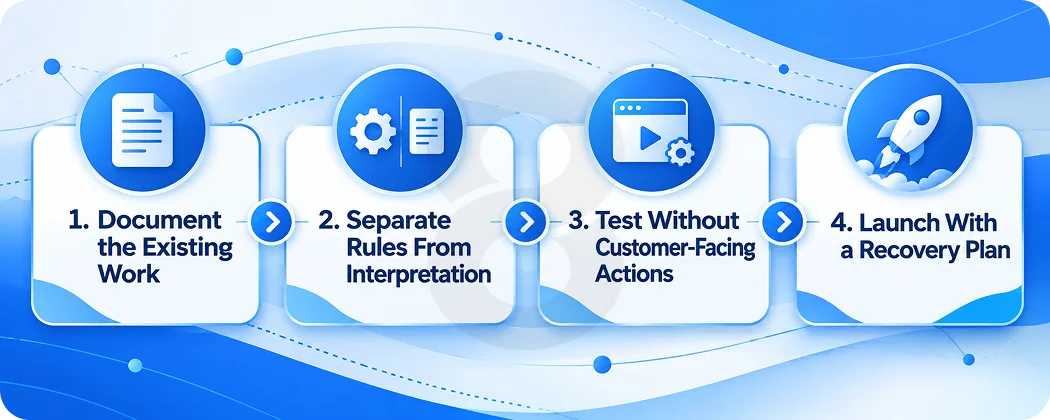
Consider a hypothetical service business handling requests through an online form. Its objective is to prepare accurate inquiry summaries for a coordinator. The first release will not send quotes or book appointments independently.
1. Document the Existing Work
Record what arrives, which fields the coordinator checks, and what a finished summary looks like. Collect examples of ordinary requests and exceptions. Define acceptance criteria before writing prompts, including what must happen when information is missing.
A practical instruction could be: “Extract the requested service, preferred date, and stated budget from this inquiry. Include the supporting text for each field. Mark anything absent as ‘not provided.’ Return a draft for the coordinator; do not contact the customer.” This gives the reviewer something they can check against the original message, with less room for an unsupported interpretation to pass unnoticed.
2. Separate Rules From Interpretation
Use conventional rules to check required fields and detect duplicate submissions. Use AI to interpret the customer’s free-text description. Route uncertain cases to the coordinator instead of filling gaps with guesses.
Plan AI integration with existing business systems around the records that actually need to move. The inquiry tool may need permission to create a draft CRM entry without gaining access to unrelated customer files.
3. Test Without Customer-Facing Actions
Run the workflow against previously handled examples, then compare its summaries with accepted results. Include contradictory dates and requests outside the business’s service scope. Log missing facts, invented details, and corrections separately.
4. Launch With a Recovery Plan
Begin with a limited stream of requests. Assign someone to monitor failures and provide a manual route if the integration stops. Ensure retries cannot create duplicate records. Keep a clear way to disable the workflow without losing incoming inquiries.
Review both speed and quality before expanding volume. If the coordinator spends longer correcting summaries than preparing them, revise the design or stop the pilot.
How Much Does AI Automation Cost?
A useful budget separates implementation from operation. AI automation tools for entrepreneurs may involve subscriptions, usage charges, and paid integrations. A custom project also needs time for requirements, testing, and deployment.
For an AI workflow automation project, request an estimate tied to named deliverables. It should identify the systems being connected, approval steps, and ongoing responsibilities rather than promise a general “AI transformation.”
Ask the provider to separate essential work from optional additions. Connecting one form to one customer database is a different scope from consolidating several inconsistent databases. Likewise, producing an internal draft and releasing a system that can update customer accounts require different checks. Review the assumptions behind the hours so you can reduce scope without removing work the system needs to function.
An Illustrative Budget, Not a Market Price
The following worksheet uses invented planning assumptions to demonstrate the calculation. It is not an 8ration quote, a vendor price, or a typical project benchmark. Replace every input with your own estimates.
| Budget item | Example assumption | Calculated cost |
|---|---|---|
| Initial implementation | 60 hours at $100 per hour | $6,000 once |
| Subscriptions and usage | Combined monthly allowance | $200 per month |
| Human review | 6 hours monthly at $40 per hour | $240 per month |
| Maintenance | 2 hours monthly at $100 per hour | $200 per month |
| First-year total | 6,000+(640 × 12) | $13,680 |
This example excludes taxes and any additional infrastructure or scope changes. It includes review labor because that work remains part of delivering an acceptable result.
Check Whether the Economics Work
Suppose the workflow replaces 30 hours of existing monthly work valued at $40 per hour. That represents $1,200 in gross capacity value. Against the example’s $640 monthly operating cost, $560 remains before recovering setup costs.
Under those assumptions, the $6,000 setup cost takes roughly 11 months to recover in modeled value. Actual cash savings require reduced expenditure or additional profitable work. Unused time alone does not pay the invoice.
Common AI Mistakes Entrepreneurs Should Avoid
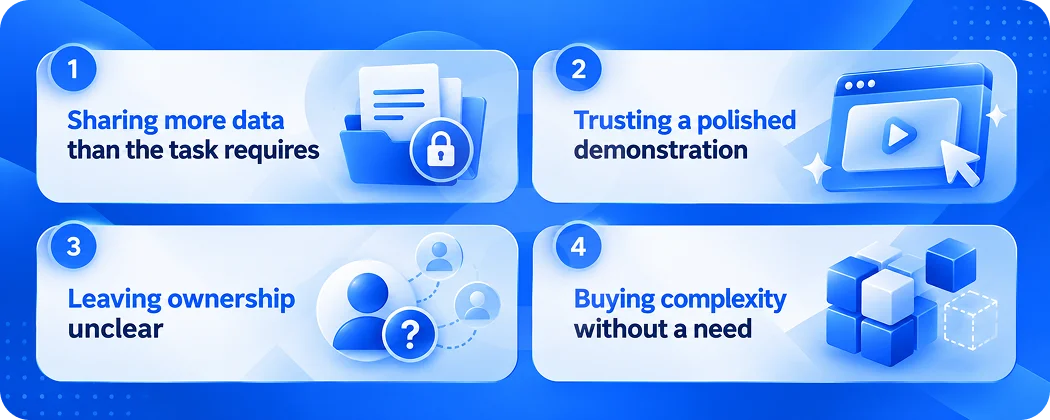
Sharing more data than the task requires
Review retention settings and access permissions before connecting business information. A tool that drafts product descriptions does not need the employee directory.
Trusting a polished demonstration
A formal software testing plan for AI workflows should cover realistic failures as well as successful requests. Retest when prompts, models, or connected applications change.
Leaving ownership unclear
Name the person who updates source material, approves changes, and investigates complaints. Without those responsibilities, a working pilot can become an unattended business process.
Buying complexity without a need
Before adding another agent, ask which decision it must make that a fixed rule cannot handle. Remove steps that add coordination work without improving the result.
The voluntary NIST AI Risk Management Framework Playbook organizes suggested actions around Govern, Map, Measure, and Manage. Use relevant parts to structure responsibilities and evaluation; adopting a framework is not a guarantee that a system is safe.
The Future of AI for Entrepreneurs
The next purchasing decision may concern how much authority to delegate rather than which chatbot to use. As products offer more connected actions, entrepreneurs should distinguish broader capability from permission to exercise it.
Preserve flexibility by documenting business rules outside individual prompts and keeping test cases that can be reused with another model. Make it possible to replace a component without rebuilding the entire process.
Include ongoing software maintenance and support in ownership planning. Model or integration changes should trigger checks against the same business requirements that justified the original investment.
The practical goal remains straightforward: make a valuable task easier to complete, then keep proving that the system helps.