


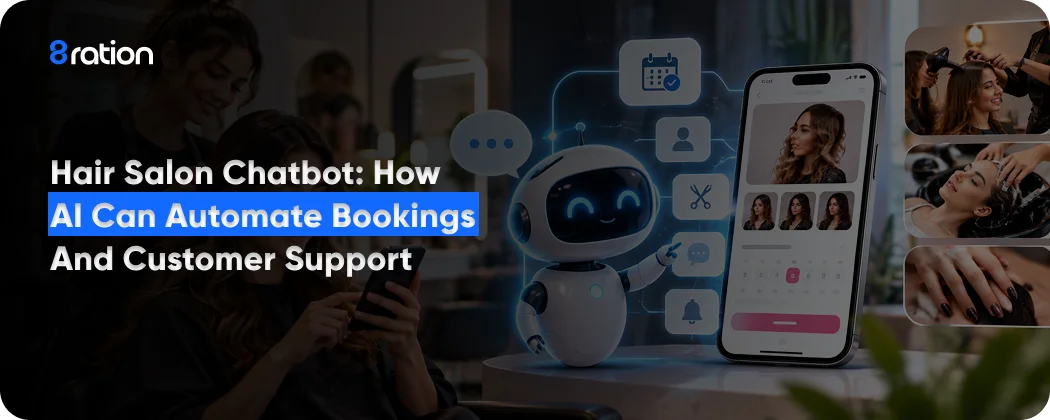
A hair salon chatbot books appointments, answers the questions your front desk fields all day and reminds clients before they forget. It does this on your website, Instagram inbox or WhatsApp at any hour. For salons the hours matter.
The U.S. Bureau of Labor Statistics notes that stylists often work evenings and weekends because those are the times salons may be busiest. Those are also the hours when a stylist has both hands in a client’s hair and the phone will not stop ringing.
The pressure on staff is growing. BLS counted 670,800 barbers, hairstylists and cosmetologists in 2025 and projects 7% employment growth from 2025 to 2035. More chairs bring more calls, more messages and more calendars to keep straight. A salon chatbot takes the repetitive share of that work so stylists can stay with the client in the chair.
What a Hair Salon Chatbot Handles for Your Front Desk
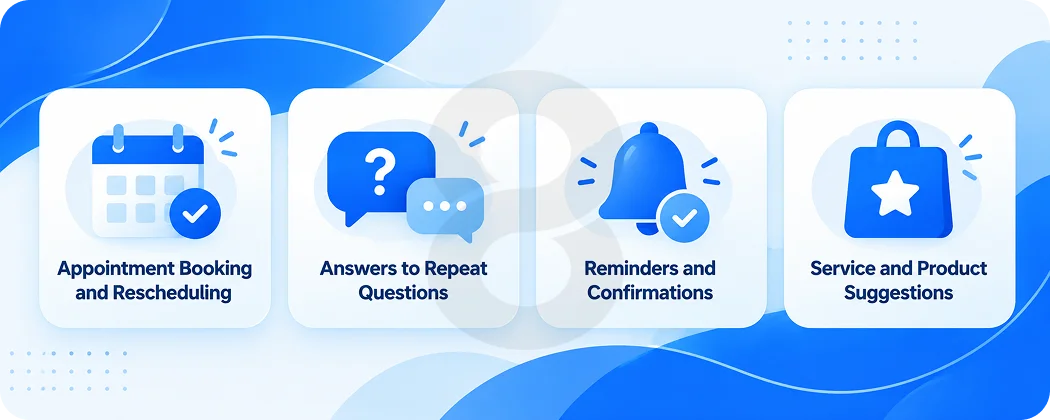
Most salon front desks repeat the same four jobs all day: booking, answering routine questions, sending reminders and suggesting services. A chatbot can take each one over and give your team those minutes back for clients.
Appointment Booking and Rescheduling
The bot asks which service the client wants, which stylist they prefer and when they are free. It then checks the live calendar and offers slots that fit the full length of the service. A full color appointment needs a longer block than a fringe trim, and the bot has to know that. Rescheduling and cancelling follow the same path. The client picks a new time and the old slot goes back on the calendar for someone else.
Answers to Repeat Questions
Clients ask about walk-ins, balayage prices, parking and whether you stock a certain product brand. A chatbot answers from a knowledge base that you control. When a price changes you update it once and every channel gives the new answer.
Reminders and Confirmations
The bot sends a confirmation the moment a booking lands and a reminder before the visit. Clients can confirm, cancel or move the slot by replying in the same thread. A cancellation two days out gives you time to fill the chair. BLS lists time management among the core skills for stylists and points out that clients who get timely hair care are more likely to return.
Service and Product Suggestions
A hair salon AI chatbot can read a client’s booking history and suggest a gloss with a color visit or a treatment with a long cut. Keep suggestions tied to what the client already books. Random upsells read like spam.
How a Salon Chatbot Automates Bookings Step by Step
A booking conversation takes a handful of messages. Behind each one the bot reads from or writes to a system the salon already uses.
| Step | What the client does | What the chatbot does | System involved |
|---|---|---|---|
| 1. Greeting | Opens chat on the website or Instagram | Asks for the service and recognizes returning clients | CRM or client database |
| 2. Service choice | Picks “cut and color” | Looks up duration, price and the stylists who offer it | Service menu |
| 3. Time selection | Picks a stylist and a day | Shows open slots that fit the full service length | Booking calendar |
| 4. Details | Shares name, phone number and notes | Checks contact details and saves notes for the stylist | CRM |
| 5. Deposit (optional) | Pays a hold fee | Sends a secure payment link | Payment gateway or POS |
| 6. Confirmation | Receives a summary | Writes the booking and schedules reminders | Calendar and messaging |
Step 3 is where cheap bots break. A bot that only sees free 30-minute blocks and ignores color processing time will double-book a stylist on a busy Saturday. It needs the same service rules your front desk follows, which usually calls for proper system integration with your scheduling software instead of a copied calendar.
Returning clients are the easy win. When the bot recognizes a phone number it can offer the same service with the same stylist in one tap. That depends on a client record the bot can read, so salons with scattered data often start with CRM development before the chatbot.
A waitlist is worth adding early. When a client cancels, the bot can message waitlisted clients in order and give the slot to the first one who confirms. The calendar refills without anyone at the desk making calls.
Customer Support Tasks a Chatbot for Beauty Salon Teams Can Take Over
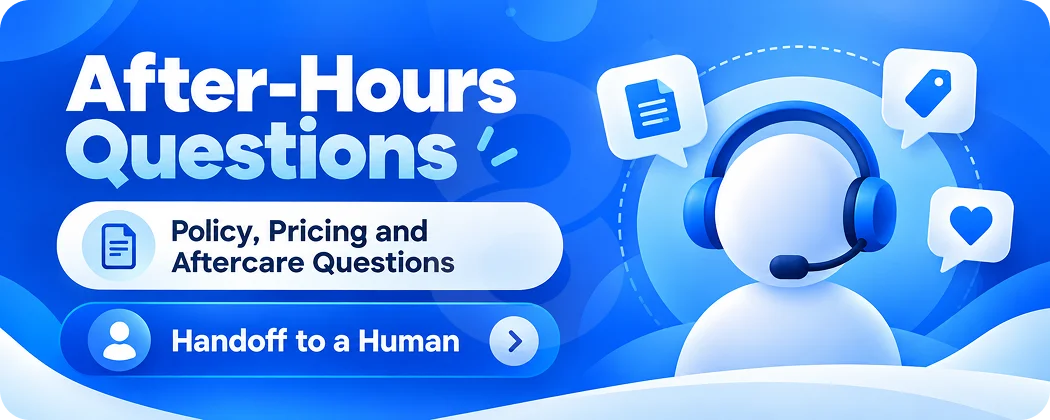
Booking covers half of what your desk does. The other half is support: questions before a visit, policy questions at checkout and the moments when a client needs a person. A well-built bot covers all three.
After-Hours Questions
Many clients plan appointments in the evening on their phones. A chatbot answers them then. Without one the question waits until morning, and a client who wanted an answer at night may book with a salon that gave one.
Policy, Pricing and Aftercare Questions
Cancellation fees, deposit rules, patch-test requirements before color and aftercare for keratin treatments are all written policy. Load them into the bot once and it quotes them the same way every time. That consistency helps when a client questions a fee at the register.
Handoff to a Human
A color correction, a complaint or a client unhappy with a result needs a person. Build the handoff in from the start. The State of the AI Connected Customer research from Salesforce found that 45% of consumers are more likely to use an AI agent when there is a clear escalation path. Your bot should say plainly that it is a bot, pass the full conversation to staff and tell the client when to expect a reply.
Hair Salon Chatbot Template vs Custom Build
A hair salon chatbot template is a prebuilt flow with greeting, menu, booking and FAQ blocks. You enter your services, connect a calendar and go live. It suits a single salon with a short menu and standard slot lengths. Once your rules outgrow the template, a custom build starts to pay for itself.
| Factor | Template | Custom build |
|---|---|---|
| Setup | Mostly configuration | Design, integration and testing |
| Booking logic | Fixed slot lengths | Service durations, processing time and stylist skills |
| Integrations | Whatever the vendor supports | Your booking system, POS, CRM and app |
| Language handling | Buttons and keyword matching | Free-text understanding through an AI model |
| Branding | Vendor widget in your colors | Your voice and your interface, inside your own app |
| Data | Stored on the vendor’s platform | Stored where you decide |
| Best fit | One location with a simple menu | Several locations, custom pricing or a branded app |
One sensible path is to launch a template, learn what clients ask and where the flow fails, then move to AI chatbot development once the gaps are clear. The template becomes your research phase.
Features Worth Building Into a Hair Salon AI Chatbot
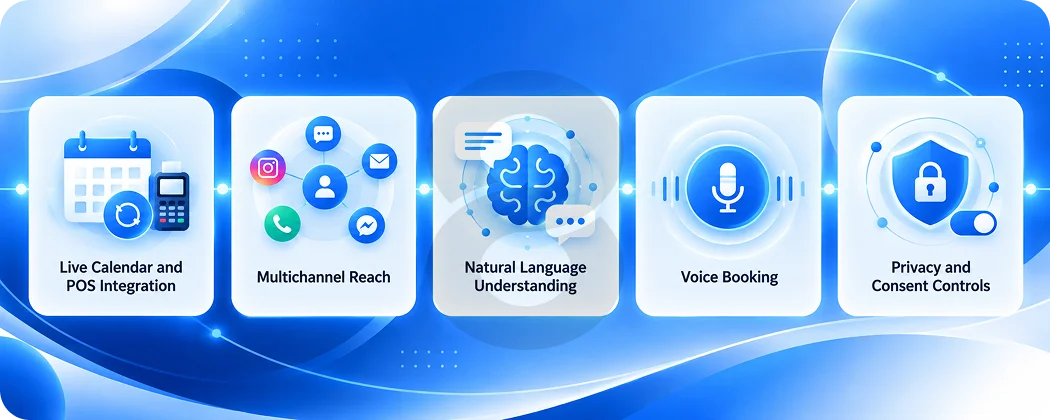
A hair salon AI chatbot is only as useful as the systems behind it. The five features below decide whether the bot books real appointments or collects messages that someone has to process the next morning.
Live Calendar and POS Integration
Two-way sync is the minimum. The bot reads availability and writes bookings back, so staff never retype a thing. POS integration lets the bot take deposits, check gift card balances and attach a booking to the client’s purchase history.
Multichannel Reach
Clients message from your website, Instagram, Facebook, WhatsApp and SMS. One bot should serve every channel from the same rules and the same calendar. A salon with its own booking app should put the chat inside the app as well, a pattern common in on-demand booking apps.
Natural Language Understanding
Clients type messages like “can I get my roots done thurs after work”. A rules-based bot stalls on that sentence. A model built through generative AI development reads the service, the day and the time window and replies with matching slots. Guardrails stop it from inventing prices or promising services you do not offer.
Voice Booking
Plenty of clients still call. An AI-powered voice assistant can pick up during busy hours, book the slot and text a confirmation with the same booking logic the chat uses.
Privacy and Consent Controls
The bot stores names and phone numbers and sometimes notes about allergies or scalp sensitivity. Collect only what the stylist needs. Ask for consent before sending marketing messages and follow the messaging rules that apply where you operate.
What Shapes the Cost of a Salon Chatbot
Scope sets the price far more than the chat window does. A template subscription and a custom AI build sit far apart, and the gap comes from the drivers in this table.
| Cost driver | Lower cost | Higher cost |
|---|---|---|
| Conversation design | Button menus and a few flows | Free-text AI covering many intents |
| Integrations | One booking calendar | Booking, POS, CRM, payments and loyalty |
| Channels | Website widget | Web, Instagram, WhatsApp, SMS, voice and app |
| Languages | One | Two or more |
| Locations | Single salon | Several salons sharing staff |
| Hosting and AI usage | Low message volume | High volume with model usage fees |
| Maintenance | Occasional menu updates | Ongoing tuning, monitoring and testing |
Testing is easy to cut from a budget and costly to skip. Before launch, run the bot through double bookings, last-minute cancellations, misspelled service names and clients who change their mind halfway through. Structured software testing catches the failures your clients would otherwise find first.
How to Roll Out a Salon Chatbot and Measure Results
In 2022, Gartner predicted that chatbots would become the primary customer service channel for roughly a quarter of organizations by 2027. The same release warned that service leaders struggle to find metrics that show whether a bot is working. A salon can avoid that trap by choosing its numbers before launch.
- Collect the questions clients ask most from your DMs, email and front-desk notes.
- Write down service rules: duration, processing time, which stylists perform each service and deposit terms.
- Connect the booking system and test two-way sync with real appointments.
- Launch on one channel first, usually the website or Instagram.
- Read transcripts every week during the first month and correct wrong answers.
- Add more channels, voice booking and upsell prompts once the core flow holds up.
Then track a short list: the share of chats that end in a booking, the share handed to staff, no-show and late-cancellation rates and the number of calls the desk still answers by hand. If handoffs stay high after the first month, your knowledge base has gaps worth filling before you add features.
Brief your staff before launch. Stylists should know what the bot promises, where handed-off chats arrive and who answers them during service hours. A bot that passes clients to an inbox nobody checks does more harm than having no bot at all.
How 8ration Builds AI Chatbots for Salons and Beauty Businesses
We build custom AI chatbots and connect them to the systems a business already runs. For a salon that means the booking calendar, POS, CRM and the client app if there is one. Our first step is mapping the service rules: durations, processing times, stylist skills and deposit policies. In our experience, those rules take more work than the conversation design, and they decide whether bookings come out right.
From there we design the conversation, ground the model in the salon’s own menu and policies and test it against real edge cases before launch. We also build voice assistants for phone booking and agentic AI systems that complete multi-step tasks, such as moving a client’s appointment and rebooking a linked service in the same exchange.
When a salon wants the chat inside its own app, our mobile team builds it into iOS and Android apps. After launch we review transcripts and adjust the bot as menus, prices and staff change.