


The world is adopting new technologies to connect physical objects to the internet, automating activities to achieve better results without manual intervention. The Internet of Things (IoT) plays a vital role in connecting physical devices online to create a smarter, more efficient world across all industries.
Digital transformation is not only changing but also becoming smart. The innovation that is driving today is that of connected ecosystems, where physical devices are thinking, communicating, and acting in real time. The source of that intelligence is the Internet of Things (IoT) and IoT software development.
What is the Internet of Things, then? Fundamentally, it allows ordinary things to feel information, network, and make intelligent decisions using very little human intervention. IoT is much more than intelligent devices.
The global installed base of IoT-connected devices is expected to reach nearly 39.6 billion by 2033, reflecting significant global IoT adoption growth.
Here, we will be going through 45+ Internet of Things examples that are transforming industries, enhancing efficiency, and enabling scalable and future-ready digital transformation.
Top 50 Internet of Things Examples to Know in 2026
IoT is changing everyday life and business processes. This table presents 50 real-world Internet of Things examples that will allow visualizing practical applications and generating ideas on how to transform digitally.
# |
Industry / Sector |
IoT Example |
Key Benefit / Use Case |
| 1 | Smart Home | Smart Thermostats | Automates temperature control, saves energy |
| 2 | Smart Home | Smart Lighting Systems | Adaptive lighting for comfort and efficiency |
| 3 | Smart Home | Voice-Controlled Assistants | Centralized device control via AI |
| 4 | Smart Home | Smart Door Locks | Remote, secure home access |
| 5 | Smart Home | Home Energy Monitoring | Tracks consumption and optimizes energy use |
| 6 | Healthcare | Remote Patient Monitoring Devices | Continuous health tracking |
| 7 | Healthcare | Smart Medical Implants | Real-time vitals monitoring |
| 8 | Healthcare | Hospital Asset Tracking | Optimizes equipment utilization |
| 9 | Healthcare | Smart Hospital Rooms | Automates climate, lighting, and monitoring |
| 10 | Healthcare | Predictive Maintenance for Medical Devices | Reduces unexpected downtime |
| 11 | Industrial (IIoT) | Predictive Maintenance Systems | Prevents machine failures |
| 12 | Industrial (IIoT) | Smart Manufacturing Lines | Self-optimizing production |
| 13 | Industrial (IIoT) | Digital Twins | Virtual simulation for asset management |
| 14 | Industrial (IIoT) | Worker Safety Monitoring | Detects hazards, reduces risk |
| 15 | Industrial (IIoT) | Energy Consumption Optimization | Reduces operational costs |
| 16 | Smart City | Smart Traffic Management | Reduces congestion, improves flow |
| 17 | Smart City | Intelligent Street Lighting | Saves energy, improves safety |
| 18 | Smart City | Waste Management Systems | Optimizes collection routes |
| 19 | Smart City | Air Quality Monitoring | Tracks pollution in real time |
| 20 | Smart City | Smart Parking Solutions | Real-time availability tracking |
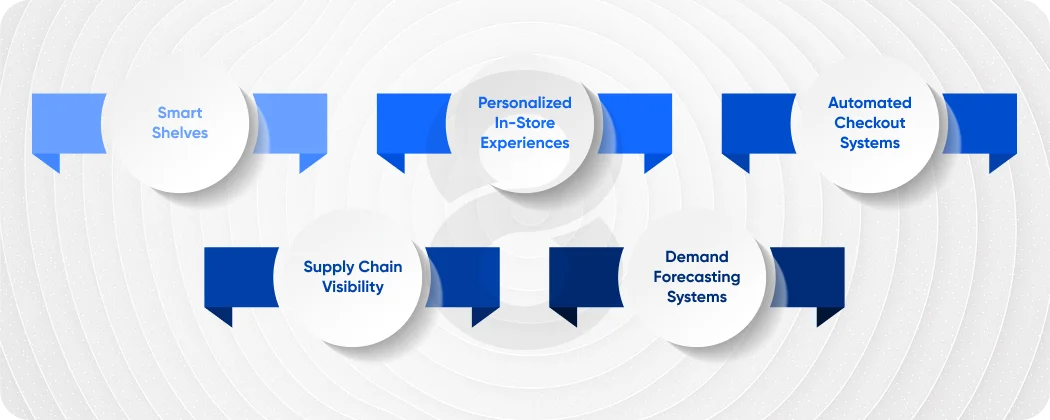
| 21 | Retail | Smart Shelves | Monitors inventory automatically |
| 22 | Retail | Personalized In-Store Experiences | Enhances customer engagement |
| 23 | Retail | Automated Checkout Systems | Eliminates long queues |
| 24 | Retail | Supply Chain Visibility | Tracks goods in real-time |
| 25 | Retail | Demand Forecasting Systems | Improves inventory planning |
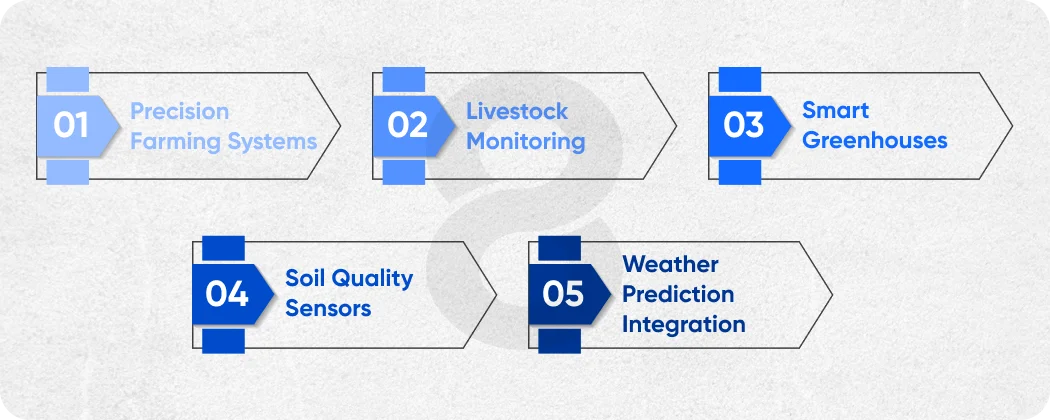
| 26 | Agriculture | Precision Farming Systems | Optimizes irrigation and crop yield |
| 27 | Agriculture | Livestock Monitoring | Tracks animal health and movement |
| 28 | Agriculture | Smart Greenhouses | Automates climate and humidity |
| 29 | Agriculture | Soil Quality Sensors | Enhances soil management |
| 30 | Agriculture | Weather Prediction Integration | Predictive data for farming decisions |
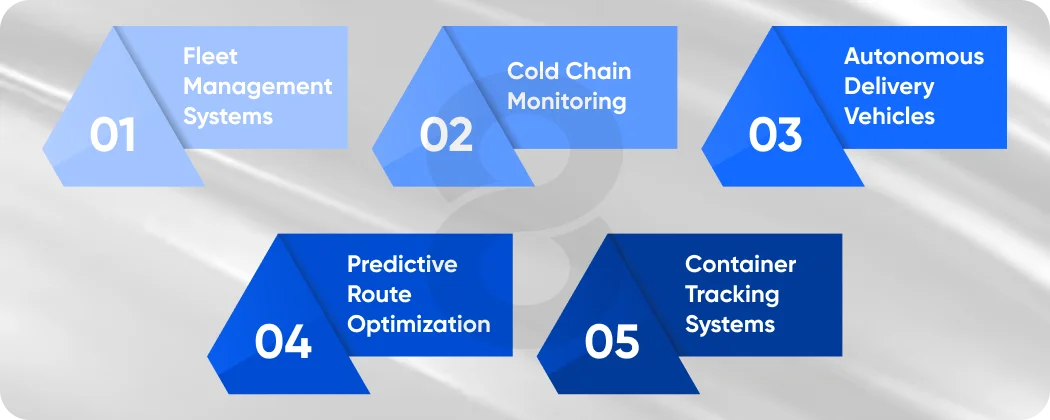
| 31 | Transportation & Logistics | Fleet Management Systems | Monitors vehicle performance |
| 32 | Transportation & Logistics | Cold Chain Monitoring | Ensures perishable goods stay safe |
| 33 | Transportation & Logistics | Autonomous Delivery Vehicles | Smart navigation & obstacle detection |
| 34 | Transportation & Logistics | Predictive Route Optimization | Reduces delays, saves fuel |
| 35 | Transportation & Logistics | Container Tracking Systems | Real-time shipment visibility |
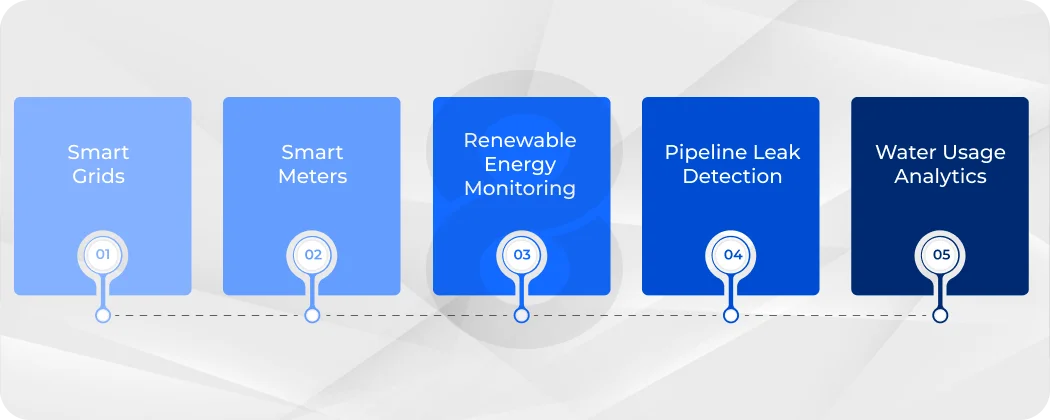
| 36 | Energy & Utilities | Smart Grids | Efficient energy distribution |
| 37 | Energy & Utilities | Smart Meters | Accurate monitoring and billing |
| 38 | Energy & Utilities | Renewable Energy Monitoring | Maximizes solar/wind output |
| 39 | Energy & Utilities | Pipeline Leak Detection | Prevents environmental hazards |
| 40 | Energy & Utilities | Water Usage Analytics | Reduces waste, optimizes consumption |
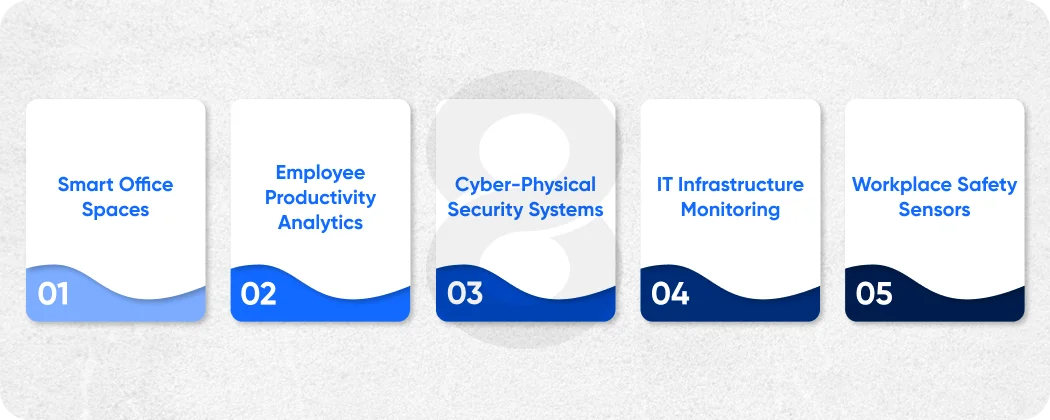
| 41 | Enterprise & Workplace | Smart Office Spaces | Automates lighting, HVAC, and room booking |
| 42 | Enterprise & Workplace | Employee Productivity Analytics | Enhances workspace efficiency |
| 43 | Enterprise & Workplace | Cyber-Physical Security Systems | Secures access and surveillance |
| 44 | Enterprise & Workplace | IT Infrastructure Monitoring | Tracks server and network health |
| 45 | Enterprise & Workplace | Workplace Safety Sensors | Detects hazards in real time |
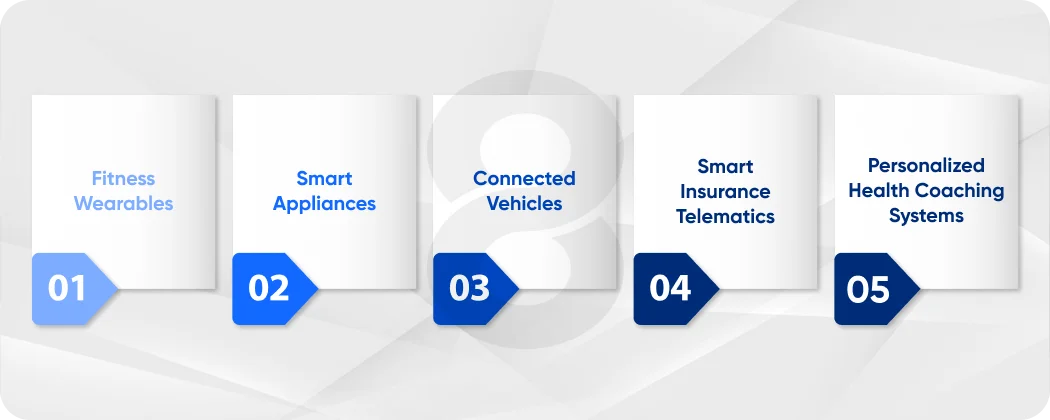
| 46 | Consumer & Lifestyle | Fitness Wearables | Monitors activity, sleep, and health |
| 47 | Consumer & Lifestyle | Smart Appliances | Connected refrigerators, ovens, and washing machines |
| 48 | Consumer & Lifestyle | Connected Vehicles | Real-time diagnostics, navigation |
| 49 | Consumer & Lifestyle | Smart Insurance Telematics | Usage-based insurance |
| 50 | Consumer & Lifestyle | Personalized Health Coaching Systems | AI-driven insights from wearables |
Smart Home Internet of Things Examples
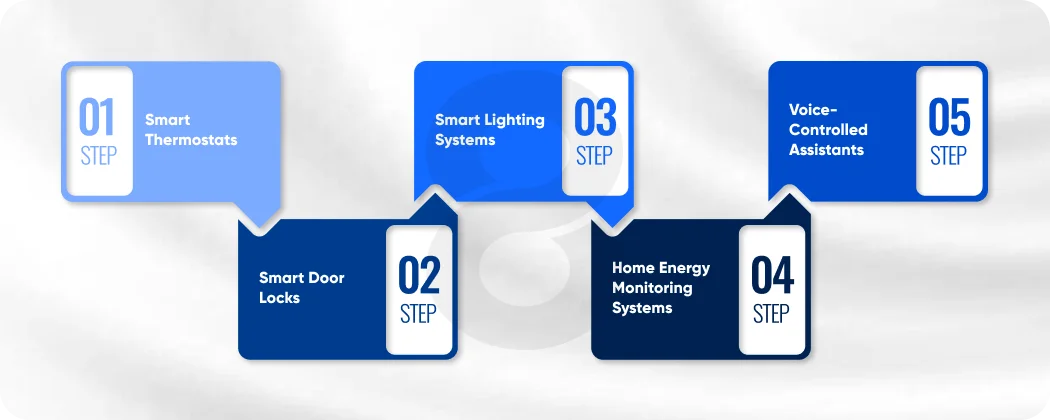
1. Smart Thermostats
Smart thermostats are smart Internet of Things apps that maintain indoor temperature automatically with occupancy sensors, user behavior patterns, and real-time weather information. These IoT devices enhance the economy, comfort, and utility costs by means of predictive automation.
Key Features:
- Occupancy-based temperature control
- Weather-aware automation
- Energy consumption analytics
2. Smart Lighting Systems
Popular examples of the IoT include smart lighting and the use of motion sensors, daylight sensors, and mobile connectivity to automatically control lighting. Being used as the real-life example of the Internet of Things, they streamline the power consumption and improve the atmosphere, as well as aid in remote control via applications or voice recognition.
Key Features:
- Motion-activated lighting
- Remote app-based control
- Energy-efficient automation
3. Voice-Controlled Assistants
Well-developed examples of the Internet of Things are voice-controlled assistants, which serve as centralized stations through which smart home ecosystems can be managed. With the help of AI and natural language processing, these IoT applications enable users to manipulate devices, retrieve data, and automate routines with a few words spoken to do it.
Key Features:
- Natural language interaction
- Multi-device integration
- Hands-free home automation
4. Smart Door Locks
One of the safe examples of IoT is smart door locks that allow controlling remote access through mobile applications, biometrics, or electronic keys. The Internet of Things applications strengthen the security of homes, offer real-time logs of access, and do not require the use of conventional keys.
Key Features:
- Biometric authentication
- Remote access control
- Real-time entry alerts
5. Home Energy Monitoring Systems
The IoT applications that are used are effective home energy monitoring systems, which monitor the real-time electricity use via connected sensors. They are a practical example of the Internet of Things to give concrete recommendations on minimizing energy waste, reducing bills, and contributing to sustainable living.
Key Features:
- Real-time usage tracking
- Appliance-level insights
- Energy optimization alerts
Healthcare IoT Examples
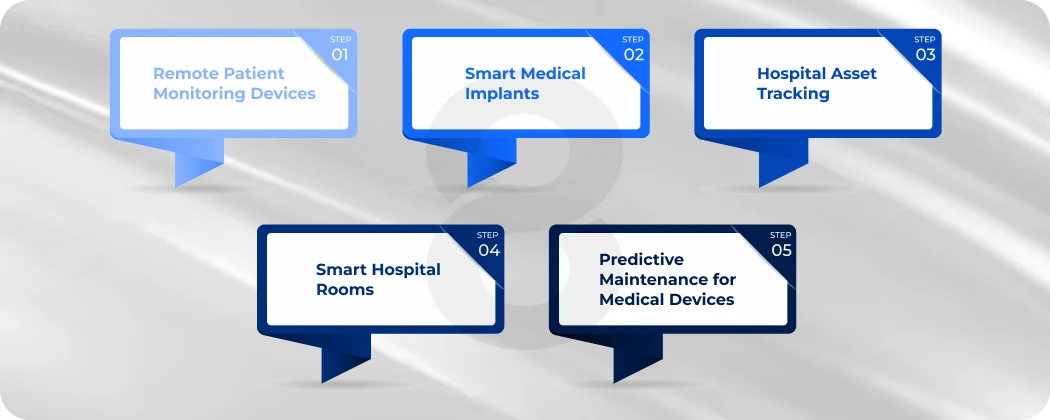
6. Remote Patient Monitoring Devices
Predictive maintenance implies sensors and machine data, and complex analytics, the IoT access to which should be utilized to continuously track the welfare of equipment. These IoT applications prevent unexpected failures and reduce downtimes, extend the life of assets in manufacturing environments since they can detect anomalies, vibration and temperature variations early.
Key Features:
- Continuous vital sign tracking
- Real-time clinical alerts
- Secure cloud-based health data
7. Smart Medical Implants
Smart medical implants combine embedded sensors and wireless connectivity into devices such as pacemakers and insulin pumps, sending real-time health data to clinicians, helping to monitor and provide personalized treatment plans and long-term patient safety in advanced Internet of Things health care ecosystems in the world safely and continuously.
Key Features:
- Embedded biosensors
- Wireless data transmission
- Personalized therapy optimization
8. Hospital Asset Tracking
Poor asset tracking systems using IoT tags, RFID, and real-time location services are used to monitor the movement of medical equipment, supplies, and inventory in hospitals to prevent losses, optimize use, improve compliance, and ensure critical equipment is available whenever it is needed by patients in a busy healthcare facility.
Key Features:
- Real-time equipment visibility
- Automated inventory management
- Loss and theft reduction
9. Smart Hospital Rooms
Smart hospital rooms integrate interconnected sensors, automation software, and patient monitoring systems to automate lighting, climatic conditions, and medical equipment to enhance patient comfort and staff productivity and to create useful IoT data to optimize clinical processes at modern health care institutions all over the world today.
Key Features:
- Automated room controls
- Integrated patient monitoring
- Enhanced patient experience
10. Predictive Maintenance for Medical Devices
Medical device predictive maintenance is an IoT sensor-based, analytics-based, and machine learning approach that guarantees the identification of performance abnormalities in real time, thwarting unforeseen failures, extending equipment life, minimizing downtimes, and providing reliable, safe, high-quality, scalable, and guaranteed healthcare services in the most critical clinical settings.
Key Features:
- Early fault detection
- Reduced equipment downtime
- Extended device lifespan
Read More: 10 Essential Healthcare App Features For 2026
Industrial IoT Examples
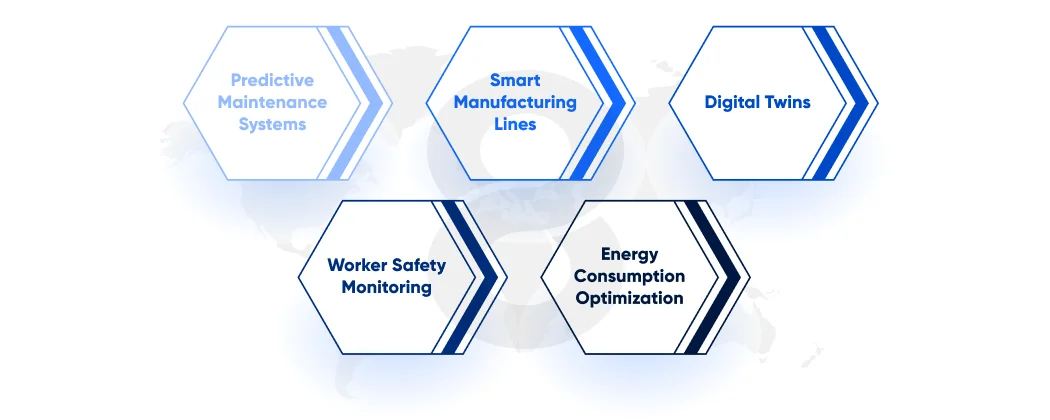
11. Predictive Maintenance Systems
Predictive maintenance involves sensors and machine data, as well as a sophisticated analytics tool, the IoT access of which is used to constantly monitor the health of equipment. These IoT applications help to avoid unexpected breakdowns and minimize downtime, as well as prolong the lifespan of assets in manufacturing settings, because they detect anomalies and changes in vibration and temperature early.
Key Features:
- Real-time equipment monitoring
- Failure prediction analytics
- Reduced maintenance costs
12. Smart Manufacturing Lines
Smart manufacturing lines are the ones that create autonomous optimization of the production processes by using interconnected machines, sensors, and IoT platforms. The applications of the Internet of Things allow real-time tracking of performance, adaptive control of the processes, and smooth communication between them enhancing throughput, quality consistency, and efficiency.
Key Features:
- Self-optimizing production flow
- Machine-to-machine communication
- Real-time process visibility
13. Digital Twins
Digital twins are virtual replicas of the physical property that are based on data from Industrial IoT, simulation models, and real-time sensor data input. The case of Internet of Things technology allows manufacturers to test the situations, predict performance problems, and optimize processes without interfering with real-life systems.
Key Features:
- Real-time asset simulation
- Predictive performance modeling
- Risk-free optimization testing
14. Worker Safety Monitoring
IoT wearables, environmental sensors, and analytics are employed in worker safety monitoring systems to monitor a worker’s fatigue level, their exposure to hazardous conditions, and unsafe behavior. These Internet of Things applications enhance workplace safety by allowing proactive notifications, compliance tracking, and real-time prevention of incidents.
Key Features:
- Wearable safety sensors
- Real-time hazard alerts
- Compliance and risk tracking
15. Energy Consumption Optimization
The sensors and analytics of the Industrial IoT are used to optimize energy solutions and gather real-time data regarding the consumption of energy across the entire factory. This is an IoT application that assists manufacturers in identifying inefficiencies, balancing loads, reducing waste, and assisting in reaching a sustainability goal through data-driven energy management plans.
Key Features:
- Real-time energy analytics
- Automated load balancing
- Sustainability optimization
Smart City IoT Examples
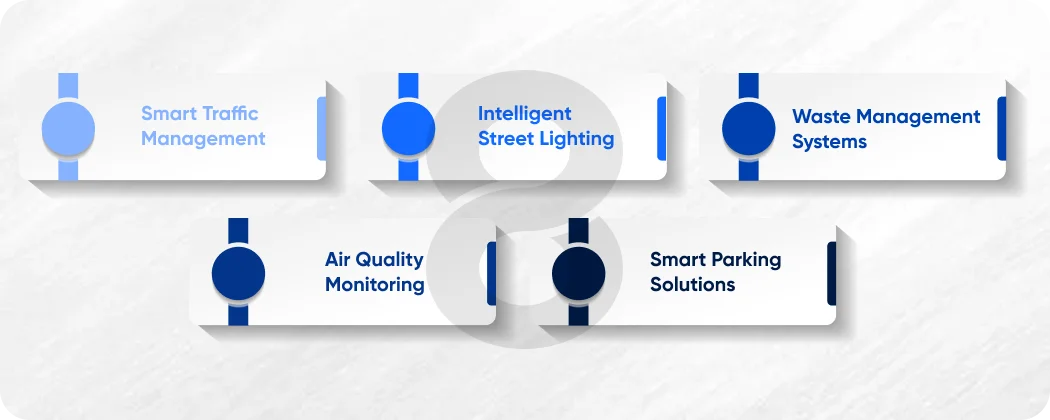
16. Smart Traffic Management
Smart traffic management is the use of IoT sensors and cameras, connected infrastructure, to analyze the actual traffic flow, reduce congestion, optimize the duration of the signal, improve urban mobility, and enable making data-driven decisions regarding the operation of the contemporary smart city ecosystem.
Key Features:
- Real-time traffic analytics
- Adaptive signal control
- IoT-based congestion detection
17. Intelligent Street Lighting
Smart street lights are based on the principles of smart use of Internet of Things (IoT) sensors and networks that enable the automatic control of the brightness of street lights depending on motion, the state of ambient lighting, and time schedules to enhance the safety of the population, reduce energy use, and sustain the smart city infrastructure.
Key Features:
- Motion-based illumination
- Energy-efficient lighting control
- Remote monitoring systems
18. Waste Management Systems
Smart bins equipped with sensors to measure the fill-levels, optimize the collection routes, make their work cheaper and less damaging to the environment, have enabled municipalities to offer efficient and data-driven urban sanitation services based on IoT.
Key Features:
- Fill-level detection
- Route optimization
- Reduced collection costs
19. Air Quality Monitoring
An example of IoT sensors is air quality monitoring systems, which are used to continuously check pollutants, temperature, and humidity in the cities and relay real-time environmental data to assist people in their health, regulation and more intelligent city development decisions.
Key Features:
- Real-time pollution tracking
- Citywide sensor networks
- Data-driven health insights
20. Smart Parking Solutions
Smart parking systems are IoT sensors and mobile apps that identify real-time parking, direct drivers to empty parking spaces, minimize traffic jams, and improve city mobility through smooth, integrated smart city parking.
Key Features:
- Real-time space availability
- Mobile app integration
- Reduced parking search time
Retail & E-Commerce Internet of Things Examples
21. Smart Shelves
Smart shelves have Internet of Things sensors, RFID, and weight sensors to monitor inventory in real time. These IoT applications allow retailers to minimize stockouts, enhance shelf space, and improve in-store availability.
Key Features:
- Real-time inventory tracking
- RFID-enabled shelf analytics
- Automated restocking alerts
22. Personalized In-Store Experiences
Beacons and sensors equipped with IoT provide a personalized in-store experience, sending targeted offers, recommendations, and product information to the mobile devices of customers. These IoT applications enhance interactions, conversions, and omnichannel retailing.
Key Features:
- Proximity-based customer targeting
- Mobile app integration
- Real-time behavioral analytics
23. Automated Checkout Systems
Sensors of IoT, computer vision, and smart carts are implemented in automated checkout systems to remove the manual scanning and long lines. The examples of the Internet of Things allow frictionless shopping, quicker transactions, and customer satisfaction enhancement in the contemporary retail setting.
Key Features:
- Sensor-based item recognition
- Queue-free checkout experience
- Real-time billing automation
24. Supply Chain Visibility
Smart supply chain visibility applications use GPS sensors, RFID tags, and real-time data platforms to monitor the supply chain of goods between the warehouse and the customer with IoT technology. These IoT applications enhance distribution network logistics visibility, minimize delays, and boost inventory precision.
Key Features:
- End-to-end shipment tracking
- Real-time logistics monitoring
- Data-driven supply optimization
25. Demand Forecasting Systems
Demand forecasting systems use IoT data of smart shelves, sales channels, and customer behavior patterns to forecast future inventory demands. These IoT applications assist retailers in improving overstocking, loss reduction, and synchronizing supply to real-time demand trends.
Key Features:
- Predictive inventory analytics
- Real-time demand signals
- AI-powered forecasting models
According to Zipdo, Nearly 80 % of industrial IoT installations use standardized communication protocols like MQTT and OPC UA, enabling more seamless data exchange in enterprise settings.
Agriculture IoT Examples
26. Precision Farming Systems
Precision farming systems place sensors and other connected items in the Internet of Things to scan the real-time soil moisture, nutrient levels, and crop health and automatically choose irrigation, fertilization, and field management choices to grow the yield of the farmers.
Key Features:
- Real-time crop analytics
- Automated irrigation control
- Data-driven farming insights
27. Livestock Monitoring
Livestock monitoring employs IoT wearables and networked sensors to track the health, location, feeding patterns and vital signs of livestock to enable farmers to diagnose diseases at the earliest practicable phase and to optimize breeding and livestock provisioning by being able to see the real-time data.
Key Features:
- Wearable health tracking
- Real-time movement data
- Early disease detection
28. Smart Greenhouses
Smart greenhouses are capitalizing on ionic applications to automatically adjust temperature, humidity, lighting, and ventilation based on real-time data about the environment, thereby providing the best growing environment, reducing energy expenditure, and improving the quality of any crops with a smart climate control application.
Key Features:
- Automated climate regulation
- Sensor-driven ventilation
- Energy-efficient operations
29. Soil Quality Sensors
Internet of Things Soil quality sensors are used to monitor the soil moisture, pH, salinity, and nutrients continuously to enable farmers to make informed decisions and decrease resource wastage, as well as enhance the crop yield by monitoring the soil health accurately.
Key Features:
- Real-time soil analytics
- Nutrient level monitoring
- Precision input optimization
30. Weather Prediction Integration
The IoT sensor data is integrated with AI-driven analytics to predict the weather patterns, providing an opportunity to conduct predictive farming and reduce the number of risks associated with climate changes and help farmers develop efficient irrigation, harvesting, and crop protection schemes.
Key Features:
- AI-driven weather forecasting
- Climate risk mitigation
- Predictive farm planning
Transportation & Logistics IoT Examples
31. Fleet Management Systems
With the help of fleet management systems, GPS, sensors, and telematics can control the positioning of vehicles, fuel consumption, driver actions, and the state of maintenance in real time. These IoT applications help the logistics companies reduce downtime, reduce costs and improve the efficiency of the fleet.
Key Features:
- Real-time GPS tracking
- Predictive vehicle maintenance
- Driver behavior analytics
32. Cold Chain Monitoring
Cold chain monitoring refers to monitoring the temperature, humidity, and handling conditions of perishable goods in real-time with the help of IoT sensors and cloud computing. This example of the Internet of Things will ensure the quality of goods, adherence to laws, and reduced spoilage during transit.
Key Features:
- Real-time temperature alerts
- Automated compliance reporting
- End-to-end shipment visibility
33. Autonomous Delivery Vehicles
The autonomous delivery vehicles are driven by the IoT-based navigation, sensors, and edge computing to act without human intervention. The IoT applications have been used to improve safety, minimize delivery time, and reduce operational costs in the logistics networks to improve last-mile delivery.
Key Features:
- Sensor-based obstacle detection
- Real-time route intelligence
- Vehicle-to-cloud communication
34. Predictive Route Optimization
Predictive route optimization involves the dynamism of delivery routes by utilizing data on the IoT, GPS, traffic sensors, and weather analytics. This IoT application enhances the precision of the delivery, reduces the use of fuel, and allows for making faster decisions during transportation processes.
Key Features:
- AI-driven route predictions
- Live traffic and weather data
- Fuel efficiency optimization
35. Container Tracking Systems
Container tracking systems are systems that make use of IoT devices, GPS, and cellular networks in order to deliver up-to-date shipment visibility into the global supply chain. Such examples of the Internet of Things can assist logistics providers to avoid losses, track the conditions, and deliver products in a timely manner.
Key Features:
- Real-time container location
- Condition monitoring sensors
- Global supply chain visibility
Read More: Android Car Operating System Overview
Energy & Utilities IoT Examples
36. Smart Grids
Smart grids are based on the idea that IoT sensors, real-time analytics, and automated control systems can be used to dynamically balance the demand and supply of electricity. These IoT applications enhance the stability of the grid, minimize disconnection, and allow energy decentralization on a large scale.
Key Features:
- Real-time load balancing
- Automated fault detection
- Distributed energy integration
37. Smart Meters
Smart meters are devices that measure energy use in real-time and send the information safely to availability companies through enabled sensors. This case of the Internet of Things allows proper billing, forecasting demand, and enhanced customer visibility within energy networks.
Key Features:
- Real-time consumption tracking
- Automated billing accuracy
- Remote meter management
38. Renewable Energy Monitoring
Renewable energy monitoring systems powered by IoT are used to monitor the performance of solar and wind energy with connected sensors and analytics systems. These IoT applications streamline production, anticipate maintenance, and make sure that energy is produced in a very efficient way out of renewable resources.
Key Features:
- Performance analytics
- Predictive maintenance insights
- Renewable output optimization
39. Pipeline Leak Detection
The pipeline leak detection systems use the IoT pressure, flow, and acoustic sensors to detect anomalies in real time. This example of IoT reduces environmental impacts, avoids expensive losses, and increases the safety of operations of oil, gas, and water pipelines.
Key Features:
- Real-time anomaly detection
- Automated alerts
- Risk mitigation controls
40. Water Usage Analytics
Water analytics applications are based on IoT sensors deployed to track consumption trends in real time in residential, industrial, and municipal networks. The applications of the Internet of Things, mentioned above, can minimize wastage, ensure leak detection in their initial stages, and support sustainable water management.
Key Features:
- Leak detection insights
- Consumption optimization
- Sustainability reporting
Enterprise & Workplace IoT Examples
41. Smart Office Spaces
Adaptable workspaces are smart office spaces that combine lighting, HVAC, and occupancy sensors powered by IoT. The following example of the Internet of Things can be used to make employees more comfortable, lower the cost of energy, and facilitate the optimization of strategies related to the so-called hybrid workplace.
Key Features:
- Automated climate control
- Occupancy-based lighting
- Space utilization insights
42. Employee Productivity Analytics
Employee productivity analytics involves the use of IoT sensors and space data to evaluate movement, collaboration patterns, and space usage. Such Internet of Things applications can assist the organization in designing an efficient working environment and enhancing the performance of the workforce.
Key Features:
- Workspace utilization tracking
- Behavioral data insights
- Productivity optimization
43. Cyber-Physical Security Systems
Cyber-physical security systems are combinations of IoT sensors, biometric access controls, and surveillance technologies to secure enterprise settings. This case of the Internet of Things empowers physical security and can work smoothly with digital identity systems.
Key Features:
- Smart access control
- Real-time surveillance
- Threat detection alerts
44. IT Infrastructure Monitoring
IT infrastructure monitoring is an IoT that monitors the health of servers as well as temperature, humidity and power consumption in real time. These IoT examples minimize downtimes, avoid hardware failures, and facilitate proactive infrastructural management.
Key Features:
- Environmental monitoring
- Predictive failure alerts
- Performance analytics
45. Workplace Safety Sensors
IoT wearables and environmental sensors are used in workplace safety sensors to detect hazardous conditions in real-time. This IoT example can make the process more compliant, decreasing accidents and improving the well-being of employees within industrial and corporate settings.
Key Features:
- Hazard detection alerts
- Wearable safety tracking
- Compliance monitoring
Read More: Best Scalable Ecommerce Technology Stack for Enterprise
Consumer & Lifestyle Internet of Things Examples
46. Fitness Wearables
IoT sensors are used to gather biometric information that includes heart rate, activity, and sleep patterns as captured by fitness wearables. These IoT applications enable users to have actionable data about their health and help them have personal wellness journeys.
Key Features:
- Biometric tracking
- Activity analytics
- Health trend insights
47. Smart Appliances
Smart appliances enable the internet linkage of household appliances, remote control, automation, and optimization of energy. This IoT case study increases convenience and improves the efficiency and predictive maintenance features of appliances.
Key Features:
- Remote device control
- Energy efficiency insights
- Predictive maintenance alerts
48. Connected Vehicles
Cars with IoT sensors, telematics, and cloud connections make connected cars able to perform real-time diagnostics, navigation, and infotainment. Such Internet of Things applications enhance user experience, vehicle performance, and safety in driving.
Key Features:
- Real-time vehicle diagnostics
- Smart navigation systems
- Predictive maintenance data
49. Smart Insurance Telematics
Smart insurance telematics is an IoT-powered insurance that uses sensor-based vehicle data to provide usage-based insurance. This is an example of the Internet of Things that provides individualized premiums, safer behavior on the road, and analysis of risks in real time.
Key Features:
- Usage-based pricing
- Driving behavior analytics
- Risk assessment insights
50. Personalized Health Coaching Systems
Individualized wellness coaching programs integrate IoT data, AI applications, and mobile applications to provide real-time wellness guidance. The examples of IoT assist in preventive care by promoting nonstop monitoring and smart knowledge.
Key Features:
- AI-driven health insights
- Continuous biometric monitoring
- Personalized coaching alerts
Read More: 30 Top Apps Like Lemon8 to Spark Ideas for Your Next Lifestyle App
Why Businesses Trust 8ration for Intelligent IoT Solutions

At 8ration, we are experts in IoT app development, which turns ideas into smart solutions and connectedness. Our team develops scalable and secure Internet of Things applications that can meet your business requirements by using the latest technologies.
Our way of integrating smart devices with industrial automation will be smooth, with real-time data insights and better operational performance. We focus on innovation and on the user experience, which assists organizations in opening new opportunities, streamlining processes, and keeping pace with the fast-paced environment of digital transformation.