


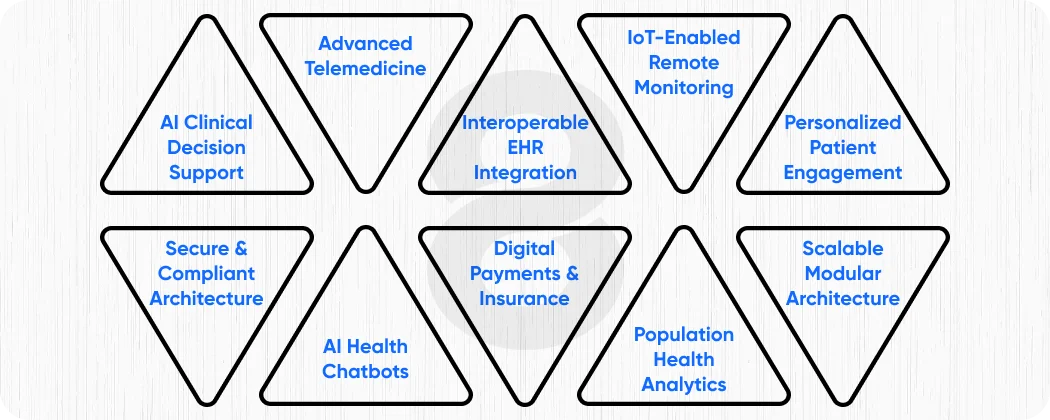
AI is transforming healthcare by combining clinical decision support systems, interoperable EHR integration, and advanced telemedicine to improve accuracy, coordination, and access to care, while remote patient monitoring powered by IoT enables continuous, real-time health tracking for proactive interventions and better chronic disease management; together with personalized patient engagement and experience layers, these features create a connected, data-driven ecosystem that enhances clinical outcomes, operational efficiency, and overall patient experience.
The healthcare sector is experiencing a digital revolution, and it is changing fast due to the development of AI, IoT, cloud, and data security systems. Due to the changing demands of patients and the growing requirements established by the regulatory bodies, the current digital solutions should not only store data or make reservations. The current platforms should provide intelligence, personalization, and real-time clinical value.
The key point of this change is healthcare apps that increase the level of patient engagement, clinical outcomes, and workflow optimization. The future of medical platforms is redefining the process of care delivery, access, and management with AI-driven diagnostics, data ecosystems with interoperability, and more.
The global mHealth apps market generated $38.9 billion in 2024 and is expected to grow at a CAGR of 15.6 % through 2034, reflecting rising demand for digital health solutions.
This article discusses the top 10 key healthcare app features, which will characterize successful digital health products in 2026. These additions are essential whether you are a healthcare startup, enterprise provider, or digital innovator to remain competitive in an environment that is becoming more and more connected in care.
Top 10 Healthcare App Features in 2026
1. AI-Powered Clinical Decision Support Systems (CDSS)
Firstly, the concept of artificial intelligence is not an option in healthcare technology anymore. Clinical Decision Support Systems based on AI are used to analyze large amounts of data, such as a patient’s history, lab findings, and images, and help clinicians make more informed and faster decisions.
In 2026, modern healthcare applications will use machine learning models, predictive analytics, and natural language processing (NLP) to reduce diagnostic errors and support the creation of evidence-based treatment plans. Consequently, clinicians are able to derive practical information without carrying a cognitive burden.
2. Advanced Telemedicine and Virtual Care Modules
Then there is telemedicine that has developed well beyond the primitive video call. Virtual care platforms will have real-time vital monitoring, asynchronous visits, and triage systems supported by AI in 2026.
The advancements are revolutionizing the use of mobile apps to provide healthcare services by providing continuous care in spite of geographical limitations. In addition, wearable device integrations enable clinicians to track the conditions of patients remotely to provide early intervention and better results.
3. Interoperable Electronic Health Records (EHR) Integration
More so, interoperability in a continuous manner is also a staple of a contemporary healthcare setup. The applications of the future should include standardized protocols like HL7, FHIR, and DICOM in order to be able to develop the data exchange in a safe and accurate way.
Interoperability of EHR access in healthcare applications may assist providers in eliminating data silos, reducing administrative drag, and increasing cross-departmental and cross-institutional care coordination. Consequently, the patients have a unified and transparent healthcare experience.
4. Remote Patient Monitoring (RPM) with IoT Integration
Also, remote patient monitoring with IoT features is turning into an ordinary expectation and not a high-value feature. Connected medical equipment, wearable sensors, and smart sensors constantly receive physiological information, e.g., heart rate, glucose level, and oxygen saturation.
The mobile app features of healthcare enable clinicians to monitor chronic conditions in real-time, identify abnormalities beforehand, and customize treatment options. Consequently, hospitals can decrease the rate of readmission and enable patients to have the power to manage their health.
5. Personalized Patient Engagement and Experience Layer
Moreover, it must be personalized to ensure user adoption in the long run. More complex analytics engines are now able to group users based on behavior, health history, and preferences to provide customized content, reminders, and treatment recommendations.
Personalization engines enhance the adherence to medications, the attendance to appointments, and the overall satisfaction of the patients with the app feature of healthcare. These systems are a major improvement in engagement and retention when they are coupled with the concept of behavioral science.
According to Statista, the worldwide digital health market is projected to reach approximately $163.06 billion in revenue by 2025, with continued annual growth expected through 2030.
6. Robust Data Security and Regulatory Compliance Architecture
Security and compliance are in the limelight as healthcare data becomes more valuable. The applications that will be used in 2026 will have to be developed using zero-trust architecture, end-to-end encryption, and role-based access control (RBAC).
Since HIPAA and GDPR, as well as region-specific healthcare laws, have to be designed for compliance, the development of healthcare apps has to focus on being compliance-oriented. Also, immutable logs and blockchain-based audit trails are promising to be effective tools to guarantee data integrity and trust.
7. AI Chatbots and Virtual Health Assistants
Among other crucial additions is the emergence of AI-driven virtual assistants. These smart robots manage the booking of medical sessions and wellness checks, health symptom assessments, medication alerts, and patient education 24/7.
As an in-built function of the modern healthcare app, conversational AI decreases the amount of administrative tasks performed and increases patient access. Besides, NLP-oriented assistants will be able to refer urgent situations to human specialists, which guarantees safety and care continuity.
8. Integrated Digital Payments and Insurance Management
No less transformative is the incorporation of secure payment gateways and insurance workflows. Patients demand more than ever clear billing, online invoicing, and real-time insurance verification in their healthcare apps.
Integrating fintech into healthcare platforms shortens the revenue cycles and reduces friction among healthcare providers. This intersection between healthcare and financial technology is the direct consequence of the mature practice of mobile app development and regulation-focused industries.
9. Population Health Analytics and Predictive Reporting
Focusing on outside patients, population health management is emerging. The analytics dashboard is advanced and is used to aggregate anonymous data to discover trends, anticipate outbreaks, and optimize resource distribution.
The features of these healthcare apps enable healthcare organizations to become service providers based on proactive models of care as opposed to reactive ones. As a result, the magnitude of the public health initiatives is more data-driven, efficient, and effective.
10. Modular, Scalable Architecture for Future Innovation
Finally, developers must prioritize scalability. They should build applications using microservices and modular architectures to enable rapid feature creation and seamless integration with third parties.
Scalable platforms are long-lasting and flexible, whether the addition of new AI models or the integration of emerging medical features of an app is necessary by 2026. This structural versatility has become a fundamental concern of progressive healthcare app development methods.
Strategic Roadmap for Implementing Healthcare App Features in 2026
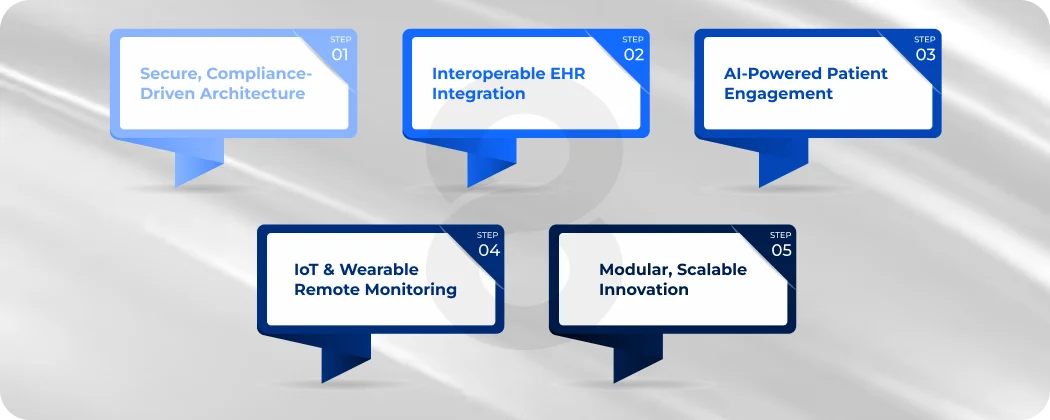
The development of modern healthcare app features in 2026 requires an organization to have a clear plan and consider patient care, ease of use, and legal requirements. Teams have the potential to develop safe and scalable applications by aligning technology with the actual healthcare requirements to enhance patient outcomes.
1. Secure, Compliance-Driven Architecture
Healthcare providers should prioritize data protection and compliance before introducing advanced tools. To maintain patient trust and ensure smooth integration across mobile healthcare apps, modern healthcare app features must include encryption, RBAC, and audit trails to meet HIPAA and GDPR standards.
2. Interoperable EHR Integration
The interoperability standards, such as FHIR and HL7, are critical in the successful development of healthcare apps. These standards facilitate safe data sharing among systems to facilitate the existence of a single patient record and enhance clinical decision-making among care units and health mobile app capabilities.
3. AI-Powered Patient Engagement
Apps need to provide custom experiences to fuel adoption. Chatbots and medication reminders powered by AI and custom educational content enhance patient adherence and satisfaction and make healthcare app functionality more applicable to patients, thus improving retention across mobile app development projects.
4. IoT & Wearable Remote Monitoring
Remote patient monitoring is a necessity in 2026, particularly in chronic care. The combination of wearables and IoT sensors allows tracking vitals in real-time, alerts, and predictive analytics, which are fundamental medical application capabilities in 2026 that make care more proactive than reactive.
5. Modular, Scalable Innovation
Healthcare platforms need to be developed on scalable, modular platforms in order to remain future-proof. This facilitates quick updates, the addition of new features, and the incorporation of new technologies, meaning that features in healthcare apps keep changing with the changes in healthcare app development.
8ration’s Vision for Next-Generation Healthcare App Innovation

At 8ration, we know that really powerful healthcare app features should not just work; they should provide quantifiable value to patients and providers.
Being one of the key partners in digital transformation and mobile application development, we are designing intuitive, secure, and scalable healthcare solutions that combine the best clinical workflow, interoperability, and patient-centric design.
Being on the cutting edge of technologies, our prowess will make your medical platform not only future-proof but also transformational to enhance care delivery and engagement.
Building Future-Ready Healthcare Applications
Digital health platforms will be successful in 2026 as they will provide intelligent, secure, and patient-centered experiences. The discussed healthcare apps are not optional anymore; they are a necessity in the care delivery today.
As mobile applications in healthcare are revolutionizing patient-provider interaction, healthcare organizations require design, interoperability, and compliance-based design.
Having these key features, healthcare providers will have the possibility of accomplishing improved results, reducing inefficiencies, and developing scalable systems that can be scaled in future changing technology and patient needs.