


AI bills are climbing fast, and most finance teams still don’t know where the money goes. Worldwide end-user spending on AI models and platforms is projected to reach $64 billion in 2026, up 63% from $39 billion in 2025, according to Gartner. Meanwhile, 79% of enterprises report AI cost overruns in the past 12 months.
The real problem is spending without visibility. Token bills arrive without context. An agent loops overnight and nobody catches it. A team buys four tools that duplicate each other. Traditional SaaS management was not built for this.
This guide will explain what AI cost management is, which tools solve which aspects of the problem, and the practices that set companies apart from those who are still settling the bill for their AI.
What is AI Cost Management?
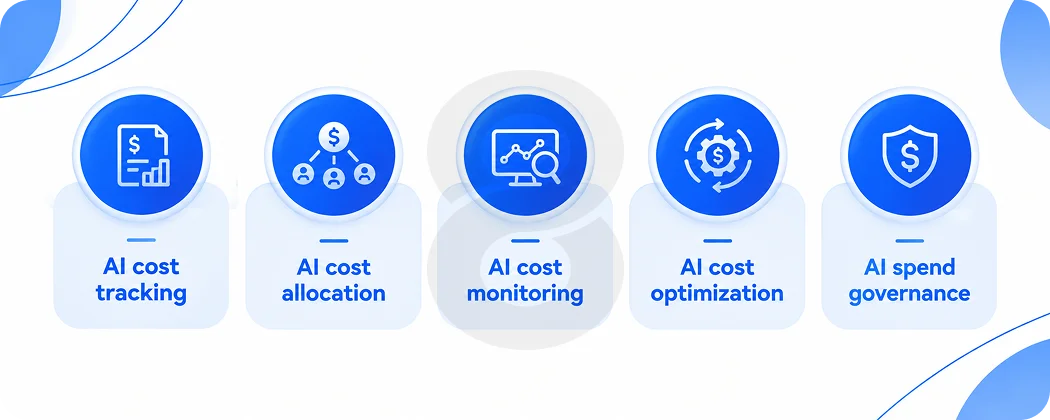
AI cost management involves tracking, allocating, monitoring, optimizing, and controlling the resources your business puts toward AI software, APIs, tokens, cloud infrastructure, GPUs and AI-powered services.
That’s a broader definition than most teams think. A business using ChatGPT Enterprise, a custom LLM through an API, an internal AI agent, and a few AI-powered SaaS products is billing at multiple rates while using ChatGPT. Managing one of them well doesn’t mean the others aren’t leaking.
Effective AI cost management covers five areas:
AI Cost Tracking
Knowing what exists and what it costs: API usage by model and endpoint, token consumption per application or user, SaaS subscriptions and seat counts, GPU and cloud compute, agent run costs, and embedded AI features inside existing tools that quietly bill on consumption.
AI Cost Allocation
Assigning spend to the team, product, customer, or project that generated it. Without allocation, the engineering org absorbs everything as overhead and nobody has an incentive to optimize.
AI Cost Monitoring
Real-time visibility into usage, budget alerts, anomaly detection for unusual spikes, and forecasting based on current usage trends. Monitoring is what turns tracking data into action.
AI Cost Optimization
Reducing spend without cutting accuracy, performance, or business value. This means model routing, prompt compression, caching, infrastructure rightsizing, and removing redundant tooling.
AI Spend Governance
Policies that control who can buy AI tools, which models are approved, what usage limits apply, and how procurement flows through security review. Governance is how you prevent the problem from recurring after you’ve cleaned it up.
Why AI Costs are Harder to Control in 2026
Most companies find their AI bills unpredictable because the pricing model is genuinely different from anything they managed before. Understanding where that difficulty comes from is the first step to addressing it.
The spend categories have multiplied. A company used to buy software licenses. Now it also buys:
| Cost category | Examples |
|---|---|
| AI SaaS subscriptions | ChatGPT, Claude, Copilot |
| LLM API usage | OpenAI, Anthropic, Mistral API calls |
| Token consumption | Input/output tokens, context length |
| Cloud/GPU infrastructure | Training, inference, idle compute |
| AI agents and workflows | Agent runs, tool calls, multi-step tasks |
| Data infrastructure | Vector databases, storage, preprocessing |
Usage-based pricing makes costs scale with activity, not with headcount. One poorly designed prompt template running at scale can cost more than a team’s entire SaaS budget. AI agents are the most unpredictable version of this: one task can trigger dozens of model calls, tool invocations, and web fetches, each with its own cost.
Shadow AI adds another layer. Employees independently buy writing assistants, coding tools, meeting transcription platforms, and design tools. Each subscription is small; the aggregate isn’t.
Best AI Cost Management Tools and Platforms in 2026
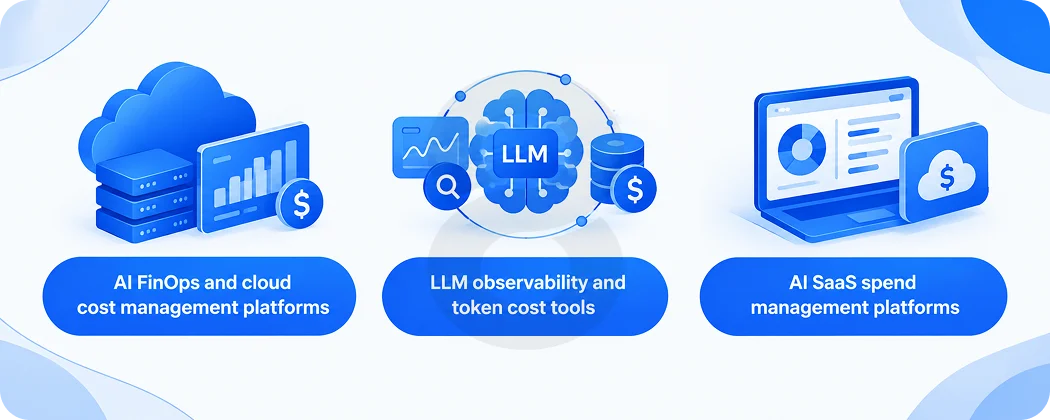
No single platform covers every layer of AI spend. The right tooling depends on where your costs actually live.
AI FinOps and Cloud Cost Management Platforms
CloudZero, Vantage, Finout, and Apptio Cloudability address cloud and infrastructure spend. They allocate compute costs by team or product, surface idle resources, and provide forecasting models. In 2026, most have added LLM-specific cost tracking alongside their existing AWS/Azure/GCP coverage.
LLM Observability and Token Cost Tools
Helicone and Langfuse operate at the request level. They show cost per API call, by model, by user, and by application. If your biggest cost driver is LLM API usage, this is where the highest-resolution data lives, down to which specific prompt template is burning most of your budget.
AI SaaS Spend Management Platforms
Torii, Zylo, and Spendflo catch what the other tools miss: the SaaS layer. They surface unused seats, identify duplicate tools, track renewal dates, and show which applications employees have stopped using.
AI SaaS increasingly requires its own category here because pricing is consumption-based rather than per-seat, and AI features are bundled into products the team already uses without anyone explicitly deciding to buy them.
How to Choose the Right Platform
| Capability | Why it matters |
|---|---|
| Multi-provider tracking | Prevents fragmented reporting across AWS, GCP, and Azure |
| Token-level visibility | Identifies which workloads are actually expensive |
| Cost allocation by team or product | Creates accountability where spend decisions get made |
| Budget alerts and spending caps | Catches runaway usage before the invoice arrives |
| Anomaly detection | Flags agent loops, misconfigured prompts, and unusual spikes |
| Forecasting | Lets finance plan rather than react |
| Governance controls | Enforces approved models and usage policies |
| ROI measurement | Connects spend to business outcomes, not just cost centers |
Best Tools for Decreasing AI Expenses
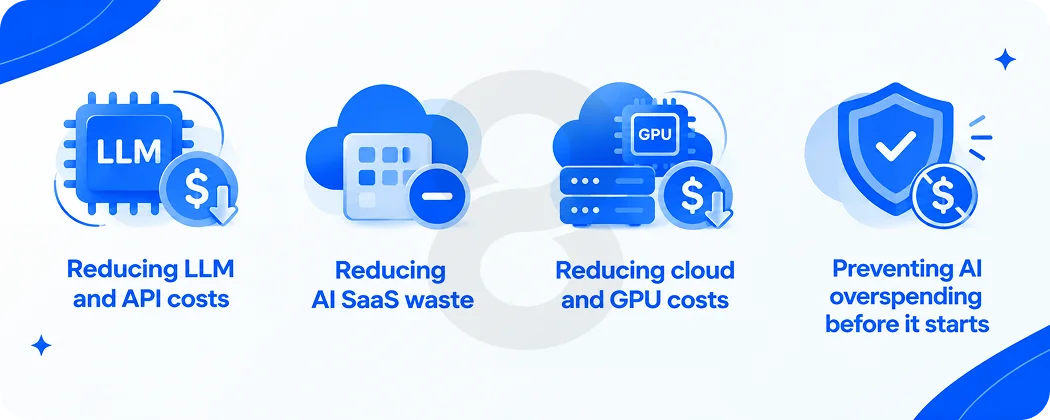
Cutting AI expenses isn’t one problem. It’s four separate problems that need different tools.
Reducing LLM and API Costs
Model routing is currently the highest-leverage technique for most teams. Not every task needs the most capable or most expensive model. A customer support categorization task that works well on a smaller model at $0.002 per thousand tokens doesn’t need to run on a frontier model at $0.06.
Routing simpler workloads to smaller, task-specific models is cited in 2026 reporting as one of the most consistent cost-reduction strategies available.
Prompt caching cuts costs on repeated or similar queries. If an agent prepends the same 2,000-token system prompt to every request, caching that context rather than re-sending it saves a predictable percentage with no change in output quality.
Reducing AI SaaS Waste
Seat audits reveal the biggest waste fastest. A platform license bought for 50 people where 15 are active costs 70% more than it should. Torii and Zylo surface this automatically; a manual audit of your software spend against login data from your SSO provider costs an afternoon and typically finds 20–30% of AI SaaS spend tied to inactive users.
Reducing Cloud and GPU Costs
Idle GPU time is the infrastructure equivalent of an empty office with the lights on. Autoscaling, scheduled workloads, and rightsizing inference nodes to actual traffic patterns rather than peak estimates eliminate most of it.
Preventing AI Overspending Before it Starts
Budget caps at the API level, approval workflows for new model access, and spending limits per team are administrative controls, not technical ones. They’re also the fastest to implement. Most LLM providers and API gateways support spend limits today; the question is whether anyone has set them.
How AI Fraud Detection Reduces Business Expenses
AI fraud detection for business expense platforms addresses a different, often overlooked, cost surface: the money leaving the business through expense reports and vendor payments.
AI systems that analyze expense submissions identify duplicate receipts, flag transactions from unfamiliar vendors, detect patterns inconsistent with an employee’s historical behavior, and score the risk of each submission automatically. The result is fewer fraudulent claims reaching approval and less time spent on manual review.
The key distinction: AI cost management controls what you spend on AI tools. AI-powered expense management uses AI to control broader business spending. They’re complementary, and confusing them leads to buying the wrong tool for the problem.
Platform categories to look at include corporate spend management tools with integrated AI controls. Airbase, Brex, and Ramp all offer varying degrees of AI-powered anomaly detection and receipt analysis. For high-volume accounts payable workflows, purpose-built AP automation with fraud signals runs deeper checks than a general spend platform.
10 Best Practices for Reducing AI Costs
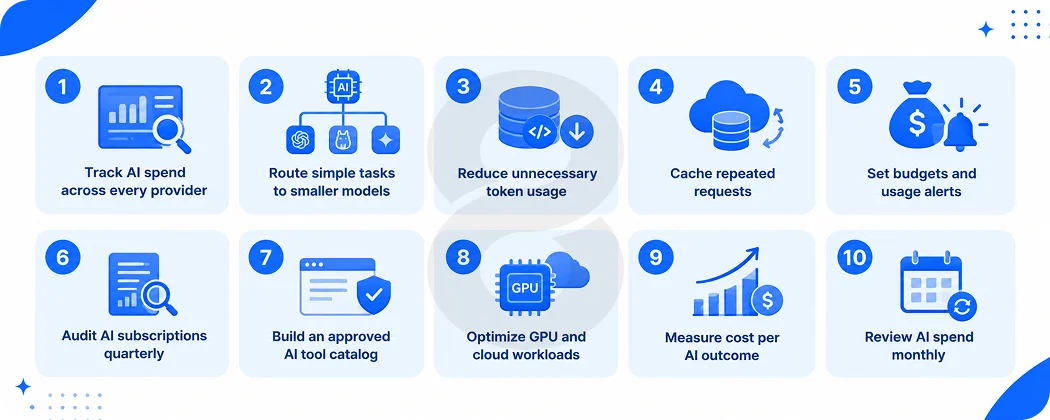
These ten practices address every major cost surface, from token-level API spend and model selection to subscription hygiene, infrastructure efficiency, and the governance controls that stop unnecessary costs from coming back.
1. Track AI Spend Across Every Provider
Visibility across all providers, teams, and billing models is the foundation of everything else. A single consolidated dashboard prevents the fragmented reporting that lets costs grow unnoticed for months.
2. Route Simple Tasks to Smaller Models
Not every task requires a frontier model. Matching model capability to task complexity, routing categorization, summarization, and templated tasks to smaller models, cuts per-request costs without any measurable drop in output quality.
3. Reduce Unnecessary Token Usage
Shorter prompts, compressed context windows, and specific output length instructions cut token costs without affecting response quality. Audit your system prompts regularly and remove any instruction that does not change the output.
4. Cache Repeated Requests
For predictable queries including FAQ responses, document summaries, and support templates, prompt caching eliminates redundant model calls entirely. Most LLM providers and API gateways support it natively and the savings compound quickly at scale.
5. Set Budgets and Usage Alerts
Team-level budgets, project caps, and API spend limits prevent surprises before they reach the invoice. Set alerts at 70-80% of the limit, not at 100%, so there is time to act.
6. Audit AI Subscriptions Quarterly
AI tool adoption moves fast and usage patterns shift. A quarterly review of seat counts against actual login data from your SSO provider typically finds 20 to 30% of AI SaaS spend tied to inactive or duplicate accounts.
7. Build an Approved AI Tool Catalog
Shadow AI purchasing is a governance gap, not a technology failure. An approved catalog with a simple request process reduces unauthorized spending while keeping the approval friction low enough that teams actually use it.
8. Optimize GPU and Cloud Workloads
Run batch inference during off-peak times, use autoscaling to react to real traffic not peak guesses and right-size nodes based on what is seen. The idle time of GPUs is frequently the biggest single item on AI infrastructure budgets.
9. Measure Cost Per AI Outcome
Replace cost per call tracking with cost per outcome tracking – per ticket solved, per qualified lead, or per document produced. This framing helps to determine which AI workloads are profitable and which are loss-making.
10. Review AI Spend Monthly
A monthly review of the total spend, cost per team, cost per model and unexpected usage patterns helps keep issues from spiraling. It also creates baseline data which enables accurate forecasting over time.
AI cost optimization: key terms compared
| Term | Primary focus |
|---|---|
| AI cost management | Track and control total AI expenditure |
| AI cost optimization | Reduce spend without losing business value |
| AI spend management | Govern purchasing, access, and usage policies |
| LLM cost management | Control model/API/token-level expenditure |
| AI FinOps | Apply financial operations principles to AI infrastructure |
These overlap significantly in practice. Most teams need elements of all five, applied to whichever cost layer is currently the biggest problem.
How 8ration helps businesses build cost-effective AI

8ration is a software and AI development company that builds custom AI applications, automation workflows, and API integrations for businesses across industries. The team works on everything from custom AI development and AI workflow automation to custom API development that connects AI capabilities with existing business systems.
On AI cost management, 8ration approaches the problem at the architecture level: which model for which task, how context is managed across agent steps, where caching applies, and how early AI app development decisions affect the cost curve at scale. The company also provides AI developer services for teams that need to build internal capability without committing to permanent headcount.
For businesses starting an AI initiative or trying to get existing deployments under financial control, 8ration’s custom software development practice covers the full stack from data pipelines and model integration through to the governance tooling that keeps spend predictable.
Final Takeaway
The goal of AI cost management isn’t to use less AI. It’s to make every dollar traceable, every workflow justifiable, and every model choice deliberate. The four things that matter: visibility into what exists and what it costs, control over who can access and spend, optimization at the model, prompt, and infrastructure level, and measurement tied to business outcomes rather than usage metrics.
Companies that build these four into their AI architecture from the start spend less and ship more.