


AI in software development for ISVs is not just about plugging a coding assistant into the process and moving on. It covers the entire lifecycle from requirements to coding, testing, deployment, support and product intelligence.
Most independent software vendors are better off not trying to capture all of the use cases for AI. It’s about selecting the games that have a chance of winning, trying them out for three months and then scaling those games that actually produce a profit.
This is the whole point of this guide. Not a list of shiny AI features. A procedure that you can execute.
What Is AI in Software Development for ISVs?
For an independent software vendor (ISV), AI in software development involves leveraging machine learning and generative AI models to support, automate, or augment software product development, testing, shipping and support.
It can be an in-house use of AI to enable your engineers to work faster, or it can be the inclusion of AI in the product you sell to customers. They’re both important and ISVs that separate the two typically reap more benefits.
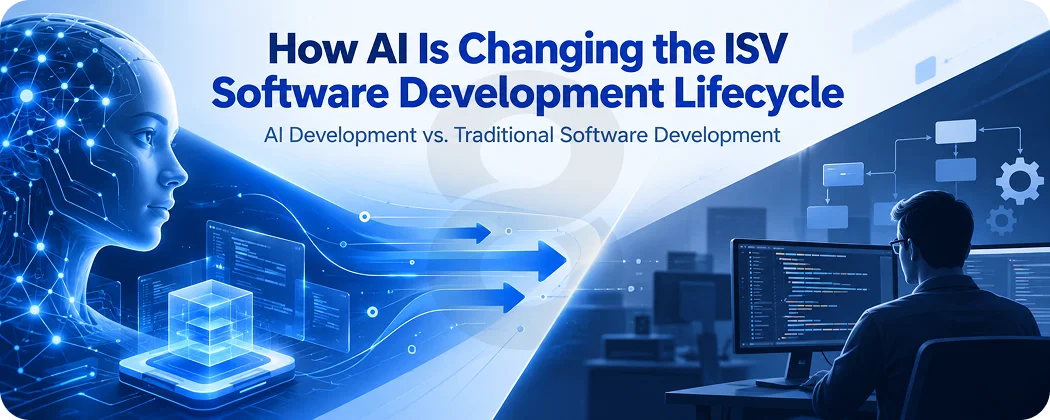
How AI Is Changing the ISV Software Development Lifecycle
AI has touched nearly every step of the way these days. It assists in developing business requirements into structured requirements for planning. It creates boilerplate and proposes functions in coding. For testing, it will create test cases and mark edge cases that may be unknown to humans.
In security, it runs a check for vulnerabilities prior to code deployments. During deployment and monitoring, it monitors logs and identifies anomalies as soon as they occur, before they become outages. Once it’s released, it’s used to feed product intelligence, including churn signals, usage patterns, and so on, that a data analyst would take weeks to find.
AI Development vs. Traditional Software Development
| Area | Traditional Approach | AI-Assisted Approach |
|---|---|---|
| Coding | Manual implementation | AI-assisted generation |
| Testing | Manually written tests | AI-generated test cases |
| Documentation | Manual | AI-assisted |
| Support | Human-first | AI-assisted/self-service |
| Analytics | Historical reporting | Predictive/intelligent insights |
None of this replaces engineering judgment. It changes where your team spends its time.
Why AI Matters for ISVs in 2026
This isn’t hype. According to Google’s 2025 DORA report, AI adoption among software professionals has reached about 90%, with more than 80% reporting increased productivity. But the same research makes a point worth sitting with: AI doesn’t create organizational excellence on its own. It amplifies whatever is already there, for better or worse</cite>. Teams with clean architecture and clear workflows get more out of AI. Teams with messy pipelines just ship low-quality work faster.
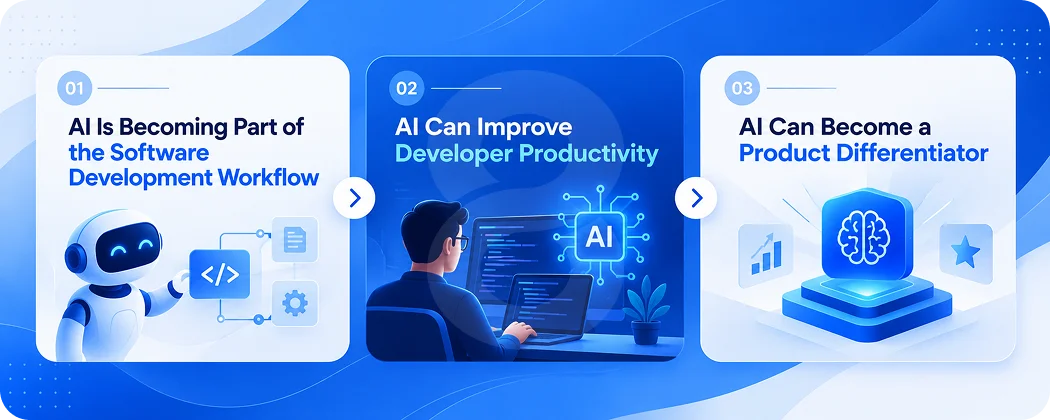
AI Is Becoming Part of the Software Development Workflow
AI has moved past the pilot-program stage. It’s now a daily tool for the majority of developers, baked into IDEs, code review tools, and ticketing systems rather than treated as a novelty add-on.
AI Can Improve Developer Productivity
The clearest wins so far show up in code generation, code completion, debugging, refactoring, documentation, test generation, and code review. These are the tasks that eat hours without requiring deep product judgment, which makes them the easiest place to start.
AI Can Become a Product Differentiator
This is the part ISVs shouldn’t skip. There’s a real difference between using AI internally to help your team and embedding AI into the product your customers pay for. The second one shows up as AI-powered search, intelligent recommendations, predictive analytics, natural-language interfaces, AI assistants, automated workflows, and intelligent reporting. If you’re weighing where AI belongs in your roadmap, it’s worth talking to a team that has shipped this kind of feature before, not just read about it. Our generative AI development team helps ISVs figure out which AI-native features are worth building into the product itself.
10 High-Impact AI Use Cases for ISVs
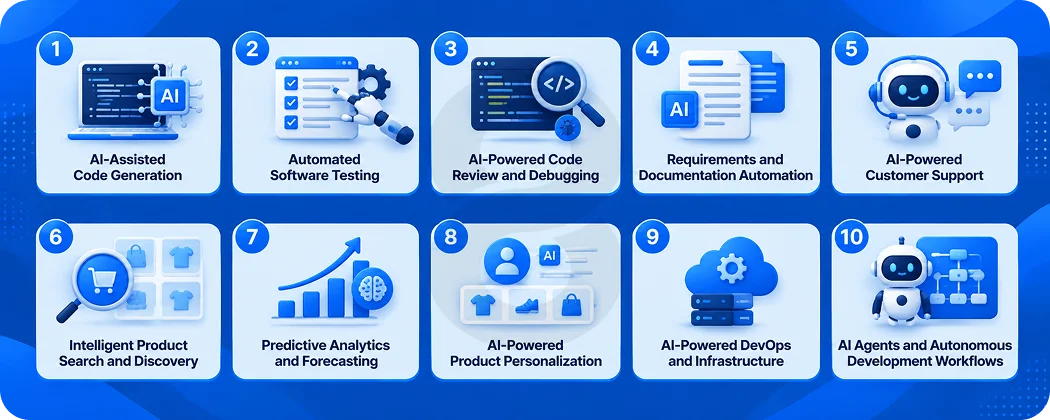
Not every use case on this list deserves your first sprint. Some are quick wins. Others need real data and real budget behind them. Here’s the full menu of AI use cases for ISVs, roughly ordered from easiest to hardest to justify.
1. AI-Assisted Code Generation
Boilerplate generation, function creation, API scaffolding, code completion, and help navigating legacy code all fall here. This is usually the first place ISVs see measurable time savings.
2. Automated Software Testing
AI can create tests, execute regression suites, create tests, detect bugs sooner, and create synthetic test data. If your QA team is already overworked, combine it with a dedicated software testing partner.
3. AI-Powered Code Review and Debugging
Before a pull request is opened, AI tools can alert the human reviewer to bugs, security vulnerabilities, code smells, performance bottlenecks and maintainability issues.
4. Requirements and Documentation Automation
AI helps convert business requirements into technical specs, turn user stories into development tasks, generate documentation from code and turn meeting notes into product specifications.
5. AI-Powered Customer Support
Consider using AI chatbots, knowledge base assistants, automated ticket classification, automatic responses, and summarizing support threads. This is typically where ISVs can achieve the biggest cost savings.
6. Intelligent Product Search and Discovery
For SaaS and enterprise ISVs, whose users tend to be overwhelmed by the sheer number of products in menus, natural-language search, semantic search, AI recommendations and personalized results are very significant.
7. Predictive Analytics and Forecasting
This use case includes churn prediction, demand forecasting, revenue forecasting, user behaviour prediction and anomaly detection and typically pays off from the moment the model is tuned.
8. AI-Powered Product Personalization
Customized dashboards, recommendations, workflows, notifications and user experience get customers to stay within your product longer.
9. AI-Powered DevOps and Infrastructure
Incident detection, log analysis, infrastructure optimization, deployment monitoring and root cause analysis cut the time spent on firefighting for your ops team.
10. AI Agents and Autonomous Development Workflows
This one is future oriented and it’s important to be honest about where it’s at. AI agents can review requirements, generate code, execute tests, resolve errors, create documentation and help with deployment.
But they work best as supervised automation, not a replacement for your engineering team. If you’re exploring this, our agentic AI development team can help you scope a pilot that keeps a human in the loop.
How Should ISVs Prioritize AI Use Cases?
This is where most companies go wrong. They start with the tool instead of the problem.
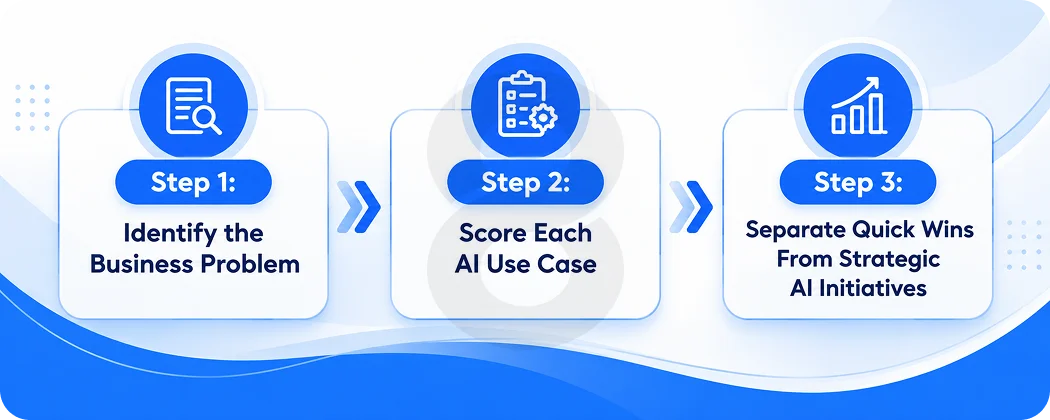
Step 1: Identify the Business Problem
Ask “what problem are we trying to solve,” not “where can we use AI.” AI should follow business value. Not the other way around.
Step 2: Score Each AI Use Case
Use a simple formula to keep the process honest:
AI Priority Score = Business Impact × Feasibility × Data Readiness ÷ Risk
Score each factor from 1 to 5 and rank your use cases against each other.
| Factor | What to Ask |
|---|---|
| Revenue impact | Will this move a number leadership cares about? |
| Cost reduction | Does this cut hours or spend measurably? |
| Developer productivity | Does this free up engineering time? |
| Customer experience | Will users notice and value this? |
| Implementation complexity | How hard is this to actually build? |
| Data availability | Do we have the data this needs, today? |
| Security risk | What’s exposed if this goes wrong? |
| Compliance risk | Does this touch regulated data or workflows? |
Step 3: Separate Quick Wins From Strategic AI Initiatives
Quick wins: code assistance, documentation, testing, support automation.
Strategic initiatives: AI-powered product features, predictive analytics, AI agents, intelligent personalization.
Run the quick wins first. They fund the confidence (and often the budget) to go after the strategic ones.
The 90-Day AI Prioritization Roadmap for ISVs
This is the part that actually answers the promise in the title.
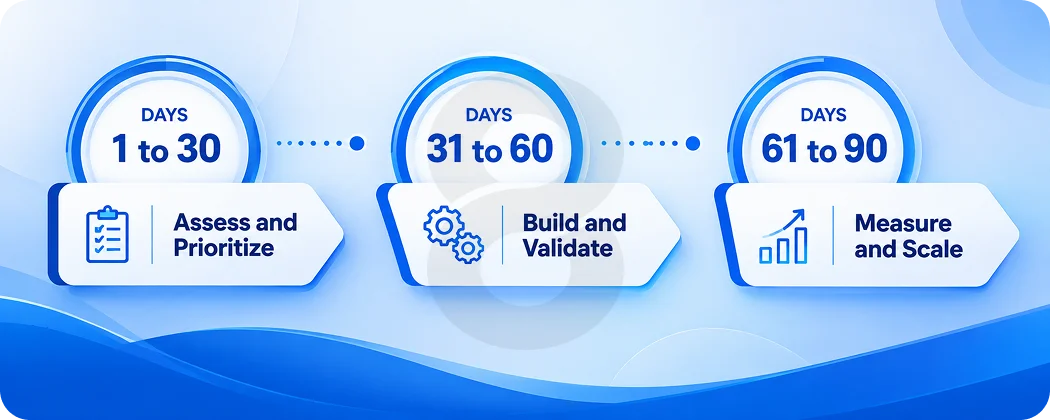
Days 1 to 30: Assess and Prioritize
Audit existing workflows, identify repetitive tasks, interview your engineering and product teams, map the data you actually have available, identify AI opportunities, score them using the formula above, and pick one to three pilot projects. No more than three.
Deliverable: an AI opportunity map and a prioritized use-case list.
Days 31 to 60: Build and Validate
Select your AI tools and models, build a working proof of concept, set evaluation criteria before you start (not after), integrate it into an actual workflow, test for accuracy and security, and collect feedback from the people who’ll actually use it.
Deliverable: a working AI prototype with measurable results.
Days 61 to 90: Measure and Scale
Measure ROI, track productivity, evaluate output quality, monitor infrastructure costs, document what you learned, put basic governance in place, and decide honestly what to scale, what to tweak, and what to kill.
Deliverable: an AI implementation roadmap for the next 6 to 12 months.
How to Measure the ROI of AI in Software Development
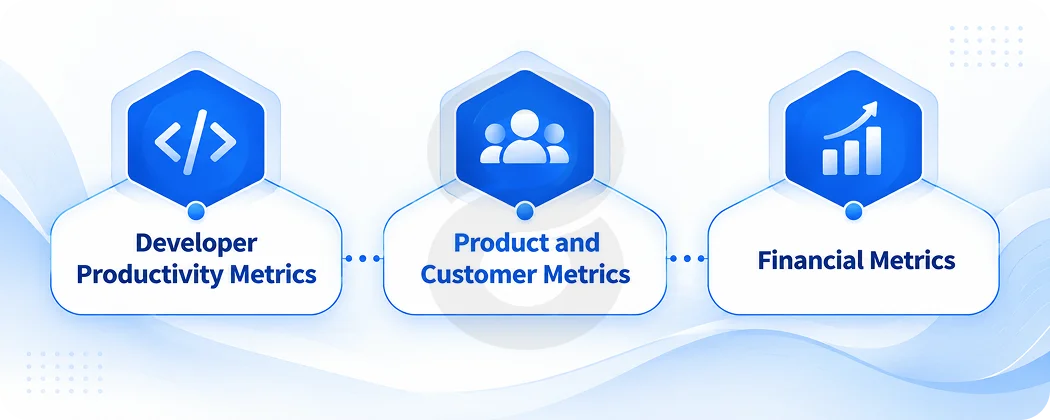
ROI conversations fail when they stay vague. Break it into three buckets.
Developer Productivity Metrics
Track development cycle time, deployment frequency, code review time, bug resolution time, and time spent on repetitive tasks. These are the metrics that show whether AI is actually saving engineering hours or just adding another tool to context-switch between.
Product and Customer Metrics
Feature adoption, customer satisfaction, support resolution time, retention, conversion, and user engagement all tell you whether the AI feature or workflow is landing with the people who matter most: your paying customers.
Financial Metrics
AI infrastructure costs, development savings, support cost reduction, revenue generated by AI features, and ROI per initiative. The DORA research is a useful reminder here too: AI’s payoff depends far more on the surrounding engineering practices and organizational systems than on which model or tool you picked.
AI Risks ISVs Need to Consider
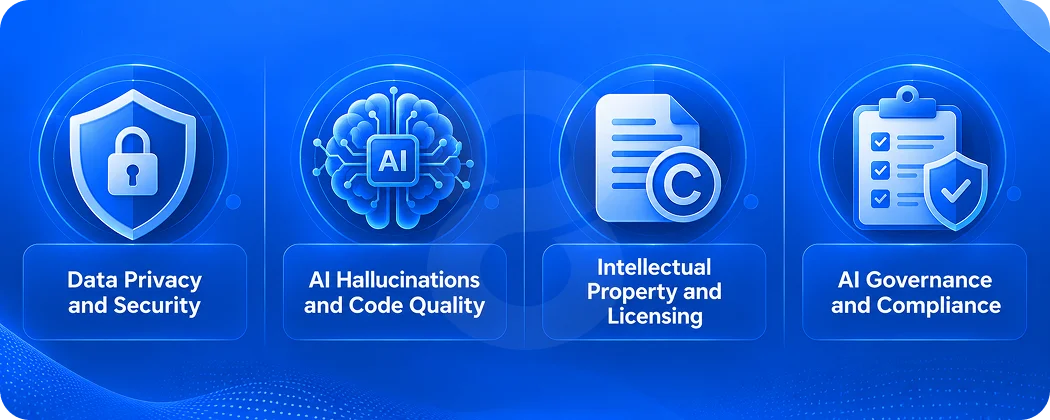
Data Privacy and Security
Sensitive source code, customer data, proprietary datasets, and third-party AI providers all create exposure points. Know exactly what data leaves your environment and where it goes.
AI Hallucinations and Code Quality
AI-generated code still needs human review, testing, and validation. Confidently written and subtly wrong is a real failure mode, not a rare one.
Intellectual Property and Licensing
Understand training-data concerns, who owns AI-generated code under your contracts, open-source license terms, and third-party model terms before you ship anything built with them.
AI Governance and Compliance
The NIST AI risk management framework, released in January 2023, gives organizations a voluntary structure for managing AI risk across design, development, deployment, and evaluation. It’s worth reading even if you’re not in a regulated industry, because auditors and enterprise buyers increasingly expect to see something like it in place.
Common AI Adoption Mistakes ISVs Should Avoid
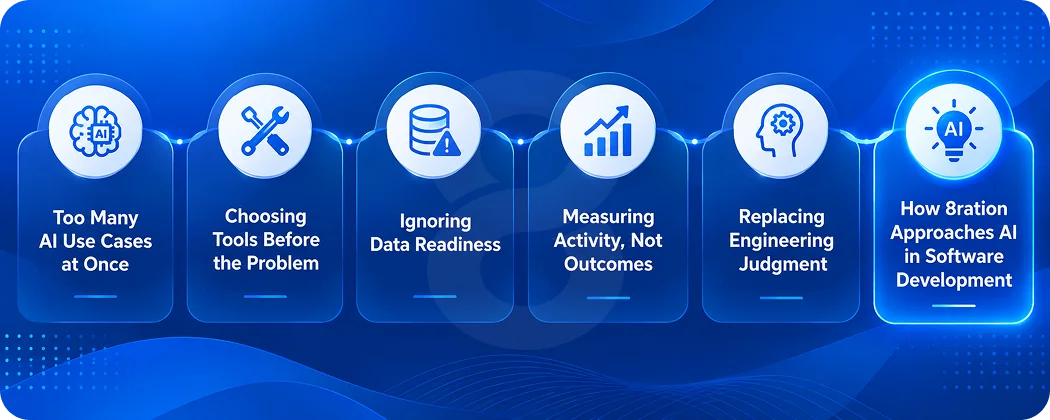
Most failed AI initiatives don’t fail because the technology was weak. They fail because of a handful of avoidable, repeated decisions made early in the process.
Too Many AI Use Cases at Once
Launching code assistants, a support chatbot, and predictive analytics in the same quarter spreads your team thin. One to three focused pilots beat fifteen scattered experiments every single time.
Choosing Tools Before the Problem
Picking a vendor because it’s popular, then searching for a use case to justify it, gets priorities backward. The tool should follow the problem, never the other way around.
Ignoring Data Readiness
AI initiatives quietly fail when the underlying data is incomplete, inaccessible, inconsistent, or poorly governed. This usually isn’t obvious until you’re three weeks into a pilot.
Measuring Activity, Not Outcomes
“How many people use our AI tool” is the wrong question to anchor a pilot on. “What business result did AI actually improve” is the question worth answering.
Replacing Engineering Judgment
Human review, testing, security checks, and accountability don’t disappear because a machine wrote the first draft. Someone still has to own what ships to production.
Build vs. Buy vs. Integrate: Which AI Approach Is Right for an ISV?
| Approach | Best For |
|---|---|
| Use existing AI tools | Developer productivity, documentation, support, internal workflows |
| Build custom AI capabilities | Proprietary data is a real competitive advantage, AI sits at the core of the product, deep customization is required |
| Integrate AI via APIs | LLM APIs, AI search, AI assistants, recommendation engines, AI infrastructure |
Most ISVs don’t need to build a model from scratch. Our AI chatbot development team, for example, mostly integrates existing large language models into products rather than training anything proprietary, because it’s faster and cheaper for the vast majority of use cases. Custom model-building only makes sense when your data really is the moat.
What Should an ISV Do After the First 90 Days?
Scale whatever the pilot actually proved out. Put a real AI governance model in place instead of an informal one. Build an engineering culture where using AI tools well is a normal skill, not a novelty. And put together a 6 to 12 month AI product roadmap so the next round of decisions isn’t made from scratch.
The goal was never “add AI everywhere.” It’s finding where AI creates measurable product, engineering, customer, or financial value, and doing more of that.
How 8ration Approaches AI in Software Development
8ration works with ISVs across the software lifecycle, from architecture and coding through testing, deployment, and long-term support. On the AI side specifically, our teams handle everything from AI-assisted development workflows to embedding AI features directly into client products, whether that’s an intelligent chatbot, a recommendation engine, or an automated testing pipeline.
We also work with clients through software consulting to help scope which AI use cases are worth a pilot before any code gets written, which tends to save clients months of wasted effort on the wrong bet.
Final Takeaway
ISVs don’t need an AI-everywhere strategy. They need an AI-prioritization strategy. Identify the problem worth solving. Score it honestly. Pilot it in 90 days. Measure what actually happened. Scale what worked and kill what didn’t. That cycle, repeated every quarter, will get an ISV further than any single AI tool ever will.