


Businesses are investing heavily in AI, but a significant portion of these investments are never yielding any value in production. S&P Global Market Intelligence polled more than 1,000 businesses in North America and Europe on their AI plans in the 2025 survey, and the percentage of companies that canceled the majority of their AI projects rose from 17% to 42%. Only one in three organizations made it to production with 46% of their AI PoCs cancelled before that.
The model is not often the issue. The trouble with enterprise AI is that everything else about it is murky. Unclear goals, disjointed data, legacy systems that are not connected, missing governance, and teams that were never integrated.
This article examines the actual enterprise AI failure rate, the patterns of failures in AI agents, what contributes to the project failure rate of AI agents and what organizations can do differently before the next budget cycle.
What Is the Enterprise AI Failure Rate?

The failure rate of enterprise AI varies depending on the organization. The definition of failure varies by the research organizations: some report projects that did not go to production; others report pilots that did not reach scale; and others report those that did not show measurable ROI. That is a distinction that everyone reads the headlines about.
Why No Universal Rate Exists
A canceled pilot is not the same as a failed production deployment. An experiment stopped after a clean test is not the same as a project that burned $7 million before being quietly abandoned. The table below shows how the major research sources differ in what they actually measured.
| Source | Finding | What It Measures |
|---|---|---|
| S&P Global Market Intelligence (2025) | 42% of organizations abandoned most AI initiatives; 46% of PoCs scrapped before production | Pre-production abandonment rate |
| RAND Corporation (2024) | More than 80% of AI projects fail, roughly twice the rate of comparable IT projects | Broad failure across project types |
| MIT Project NANDA (2025) | Only 5% of generative AI pilots achieved measurable revenue acceleration | GenAI pilot-to-value conversion |
| Gartner (2025 forecast) | Over 40% of agentic AI projects predicted to be canceled by end of 2027 | Future agentic AI cancellations |
| McKinsey (2025) | Only 6% of organizations qualify as AI high performers; 39% report any EBIT impact | Financial return from AI investment |
Why the Statistics Can Mislead
A canceled proof of concept is not automatically a waste. Stopping a pilot before it consumes production resources is exactly the outcome a good governance process is supposed to produce. The real concern is not that some projects stop early. It is that so few make it to the finish line even when organizations intended them to.
Why AI Enterprise Solutions Fail
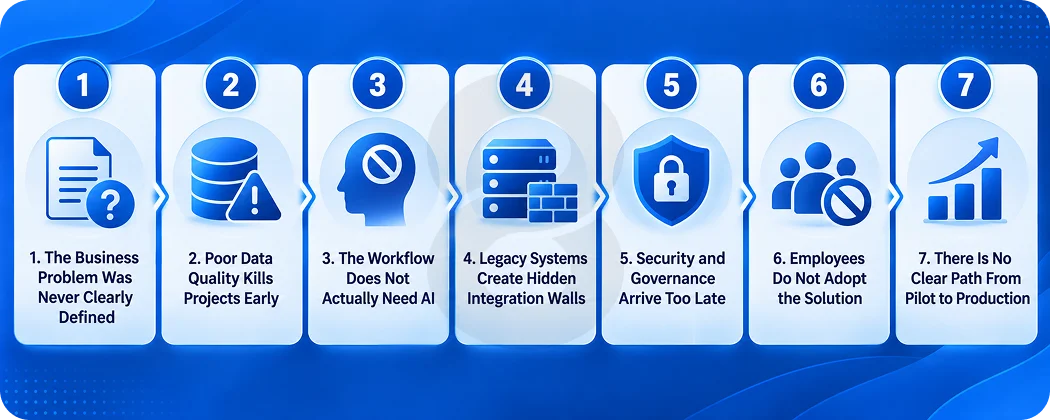
Enterprise AI failure is rarely one thing. It is usually several misalignments arriving at the same time: a problem that was never precisely defined, data that was not ready, systems that were not connected, and employees who were never given a reason to change how they worked.
1. The Business Problem Was Never Clearly Defined
Most failed AI initiatives start from the wrong end. “We need AI” becomes the brief, and teams spend months selecting models and building infrastructure before anyone has specified what success looks like.
A chatbot without a target metric is a demo. A chatbot designed to reduce average customer response time from 10 minutes to 3 minutes is a project. The difference between those two framings determines whether the organization can ever declare the work done or measure whether it worked.
2. Poor Data Quality Kills Projects Early
AI systems are only as reliable as the data they learn from and retrieve at runtime. Informatica’s 2025 CDO Insights survey identified data quality and readiness as the top obstacle to AI success, cited by 43% of respondents.
Fragmented records, outdated databases, duplicate entries, and inconsistent formatting are not edge cases in enterprise environments. They are the norm. This problem is particularly acute for generative AI development systems that rely on retrieval-augmented generation, where bad source data produces confident-sounding wrong answers at the exact moment a customer or employee needs accurate information.
3. The Workflow Does Not Actually Need AI
Not every business problem benefits from generative AI, an AI agent, or autonomous decision-making. Gartner noted explicitly that many proposed agentic use cases do not require agentic implementations at all.
Sometimes a rules engine, a search index, or a simple automation tool solves the problem faster, cheaper, and with greater reliability. The instinct to reach for AI first costs organizations significant time and money when the actual problem is a process question, not a machine learning question.
4. Legacy Systems Create Hidden Integration Walls
An AI demo runs against clean sample data on a developer’s machine. A production AI system has to connect with CRM platforms, ERP systems, HR databases, payment infrastructure, authentication layers, and document repositories built across multiple decades of IT decisions.
| Pilot Environment | Production Environment |
|---|---|
| Clean, prepared data | Fragmented, inconsistent enterprise data |
| Single system scope | Multiple legacy systems and APIs |
| Controlled testing | Real authentication, rate limits, permissions |
| No governance requirements | Security, compliance, audit requirements |
| Fast iteration | Change management across departments |
8ration’s system integration services specifically address this layer, mapping the technical dependencies that stand between a working AI prototype and a working AI deployment.
5. Security and Governance Arrive Too Late
Access controls, data privacy requirements, model auditability, and human approval workflows are not things to layer onto an AI system after the core functionality is built. They are architectural decisions that shape what the system can and cannot do.
For agentic AI development, this is especially critical. An AI that generates text needs to be reviewed. An AI that executes transactions, updates customer records, or sends communications needs to be governed from the first design decision.
6. Employees Do Not Adopt the Solution
An AI system that no employee trusts or uses delivers zero business value regardless of its technical accuracy. McKinsey’s 2025 research confirms that organizations reporting significant returns from AI are twice as likely to have redesigned end-to-end workflows before selecting their technology approach.
Retrofitting AI into workflows people already have does not work as well as rebuilding the workflow around validated AI capabilities.
7. There Is No Clear Path From Pilot to Production
The most common point of failure for enterprise AI is not technical failure inside the pilot. It is the absence of a defined path out of it. Organizations optimize for a convincing demo rather than a deployable system.
A production AI system needs security review, infrastructure provisioning, integration testing, user training, monitoring, and a plan for when the model makes a mistake. None of those exist inside a proof of concept. Teams that plan for them from the start are the ones that ship.
Why AI Agent Failure Rates Are Higher
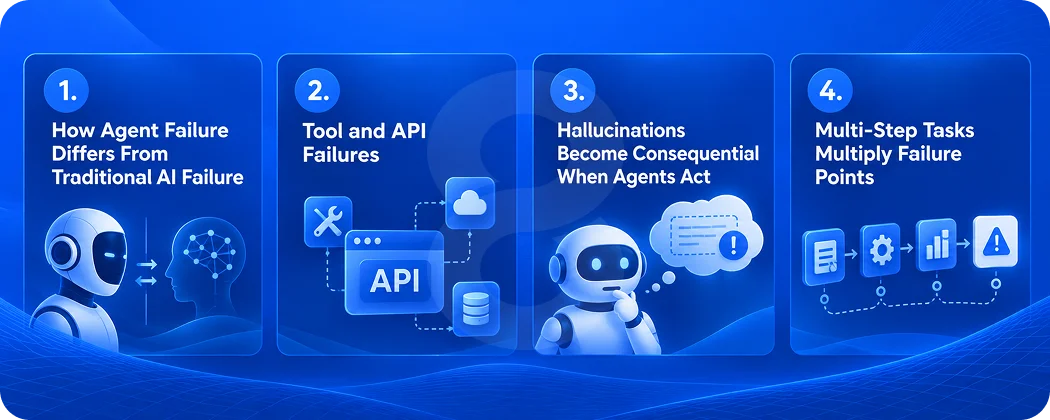
A traditional AI application generates an output. An AI agent plans what to do, selects tools, executes actions, interprets results, and decides what to do next. Every one of those steps is a potential failure point, and agentic systems chain them together across dozens of decisions in a single task.
How Agent Failure Differs From Traditional AI Failure
| Traditional AI | AI Agent |
|---|---|
| Generates a prediction or text output | Plans and executes multi-step tasks |
| Output is reviewed before any action is taken | May take actions before review occurs |
| Bounded by a single function | Operates across multiple tools and systems |
| Easier to test in isolation | Failure modes multiply with each step added |
| Limited system access required | Needs permissions across many enterprise systems |
Tool and API Failures
An agent can make the correct decision and still fail because an API is unavailable, an authentication token has expired, or a downstream system returns unexpected data. Production AI chatbot development and agentic systems need fallback handling, retry logic, and monitoring for these failure modes. Most pilot implementations have none of these.
Hallucinations Become Consequential When Agents Act
A language model generating a wrong answer in a chatbot is a problem a user can catch and dismiss. A language model embedded in an agent that generates a wrong action, an incorrect purchase order, an erroneous record update, or an unauthorized data retrieval, produces a business consequence that requires manual correction.
The risk profile changes when AI systems move from generating text to taking actions on behalf of an organization.
Multi-Step Tasks Multiply Failure Points
A five-step automated workflow has fewer opportunities to fail than an agent coordinating 20 tool calls across multiple systems. Each additional decision, each additional API call, each additional permission check adds a point where the task can stop. Reliability engineering for agentic systems is substantially more demanding than reliability engineering for traditional software or single-pass AI inference.
What Is the Agentic AI Project Failure Rate?
Gartner’s June 2025 forecast is the most specific public estimate available: over 40% of agentic AI projects will be canceled by the end of 2027, driven by escalating costs, unclear business value, and inadequate risk controls. This is a forward-looking prediction, not a measured historical count, and it applies specifically to the agentic category.
Why Gartner’s Forecast Points to Structural Problems
Gartner identifies three drivers behind the expected cancellations.
Escalating costs accumulate when organizations discover that agentic systems require substantially more infrastructure, monitoring, and human oversight than a simple AI integration.
Unclear business value materializes when teams cannot connect the agent’s activity to a metric the business actually cares about. An agent that answers questions faster than a human is not valuable if no one can measure whether the faster answers are correct.
Inadequate risk controls create liability the moment an agent takes an action that harms a customer, exposes sensitive data, or violates a regulation.
Gartner also warns that many vendors are engaging in “agent washing,” rebranding existing chatbots, RPA tools, and basic assistants as agentic AI without meaningful autonomous capabilities. Gartner estimates only around 130 of the thousands of vendors claiming agentic capabilities are building real agentic systems.
Is the Technology the Problem?
For most canceled agentic projects, the answer is probably not. The issue is that organizations are applying agentic architectures to problems where the overhead of autonomous decision-making does not justify the outcome. A well-designed workflow with standard automation often solves the same problem with lower risk, lower cost, and greater predictability.
The Hidden Enterprise AI Gaps Most Organizations Miss
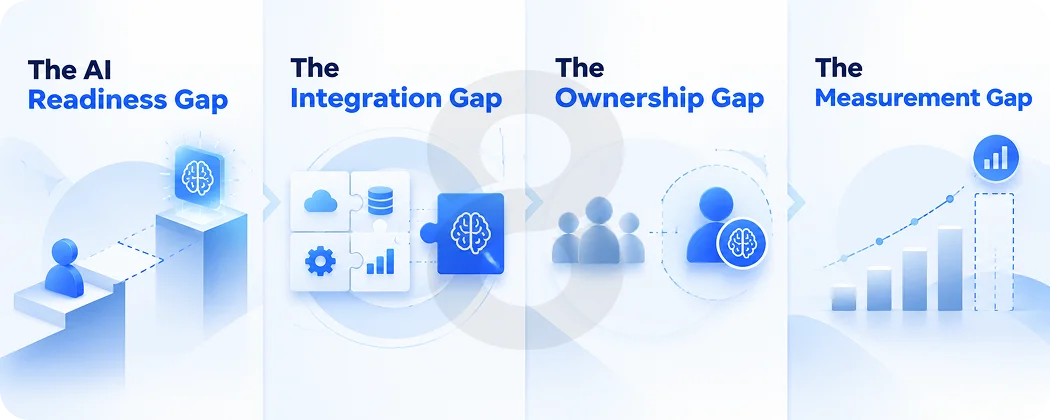
Most post-mortems on failed enterprise AI projects focus on technical choices. The gaps that actually kill projects tend to be quieter.
The AI Readiness Gap
Does the organization have clean, accessible data? Can internal APIs support real-time AI queries? Are there clear data owners who can authorize access? Are there measurable KPIs that an AI system could move? Many organizations answer yes to the first question in a room and discover the honest answer during implementation.
The Integration Gap
AI does not operate in isolation. It has to fit inside an existing technology ecosystem that was built before AI was a consideration. 8ration’s AI development services are structured to address integration at the design phase rather than treating it as a post-launch task.
The Ownership Gap
Who is responsible for the business outcome of the AI system? If the answer is “the AI team,” the project is at risk. The AI team can be accountable for the system’s technical performance. The business outcome belongs to the department whose workflow the AI is embedded in. When those are the same person or when there is a clear handoff between them, projects move forward. When ownership is vague, projects drift.
The Measurement Gap
Organizations frequently measure what is easy to measure: model accuracy, response latency, token cost. Executives need to see what is harder to measure: time saved per employee, error reduction rate, conversion rate, customer satisfaction change. The absence of a measurement plan at the start of a project makes it nearly impossible to argue for continued investment when the early results are inconclusive.
Enterprise AI Pre-Investment Checklist
Before committing a budget, a team, or a timeline to an enterprise AI initiative, these ten questions narrow the gap between pilot optimism and production reality.
- What specific business problem are we solving?
- What is the current baseline we are measuring against?
- Does this problem actually require AI, or would automation or search serve better?
- Is the required data available, clean, and accessible?
- Can AI systems integrate with our existing infrastructure within budget?
- What happens operationally when the model makes a wrong decision?
- Who owns the business outcome, not just the technical delivery?
- How will ROI be measured, and when will it be reviewed?
- Are governance and security requirements defined before development starts?
- What is the explicit plan from pilot to production deployment?
How 8ration Works With Enterprise AI
8ration builds AI-powered applications for enterprises and growing businesses across industries including fintech, healthcare, logistics, and e-commerce. The team works across the full AI development stack: custom generative AI systems, agentic AI implementations, AI chatbots, voice interfaces, and AI integrations within existing software products.
What separates successful AI projects from abandoned ones, in 8ration’s experience working with both startups and enterprise clients, is whether the business outcome is defined before a line of code is written.
The team includes dedicated AI architects, integration specialists, and QA engineers who have seen what breaks between proof of concept and production, and build to avoid those points from the start.
Final Thoughts!
Enterprise AI does not usually fail because AI stopped working. It fails because the organization around the AI was not ready for production. The data consistently points to the same gaps: a problem statement that was never precise, data that was not ready, integration that was underestimated, governance that arrived too late, and employees who were never brought along.
The companies most likely to reach production are not the ones buying the most advanced models. They are the ones that treat AI as an operational system from day one, define what success looks like before they start building, and plan for the transition from pilot to production before the pilot is finished.
Business problem, clean data, integration, governance, people, measurement. When those align, enterprise AI delivers. When even one is missing, the probability of joining the abandonment statistics rises sharply.