




The automobile industry currently experiences a major digital transformation. The development cost for an automotive mobile application typically falls between $10,000 and $500,000+, which depends on the app’s features and the chosen platform and its overall difficulty.
The development costs for custom solutions that incorporate advanced technologies such as GPS and AI, and IoT exceed standard budget limits. From connected vehicle apps and automobile monitoring structures to EV charging structures and on-demand roadside help, automobile mobile apps are reshaping how drivers engage with their automobiles and offerings. Whether you’re a startup entering the mobility area, an OEM trying to digitize the client experience, or an organization building fleet control equipment, understanding the automotive app development fee is the first vital step before writing a single line of code.
In this comprehensive blog, we break down the whole lot you need to know about automotive app development cost in 2026, from core feature units and platform alternatives to group structures and real-world pricing estimates. We also provide actionable tips to help you lessen charges without sacrificing high quality.
What Is Automotive App Development?
Automotive app development refers to the process that involves creating, testing, and launching mobile and web applications that operate within the automotive sector. The applications that are developed for these purposes can be used by drivers and vehicle owners through customer-facing platforms or by dealerships and fleet operators through business-facing systems, or they can be integrated directly into vehicle entertainment systems. Each category serves a distinct target audience with awesome technical needs and knowledge; those differences are essential before estimating any improvement budget.
The scope of automobile apps is broader than most human beings understand. Beyond the plain examples like experience hailing and GPS navigation, the enterprise encompasses linked vehicle apps that sync with an automobile’s onboard diagnostics (OBD) system; EV charging and range control systems; fleet monitoring and management structures, vehicle condo and vehicle reserving apps, roadside assistance and emergency SOS equipment; car maintenance reminders; and dealership CRM and stock control solutions.
Each of these classes comes with its own specific set of technical requirements, and compliance issues, all of which immediately impact the overall car app improvement fee. A related automobile app that communicates with car hardware in real time is fundamentally more complex and more pricey than an easy provider booking app. Recognizing this early enables you to set sensible budgets and avoid ugly surprises mid-challenge.
Understanding Automotive Software Types
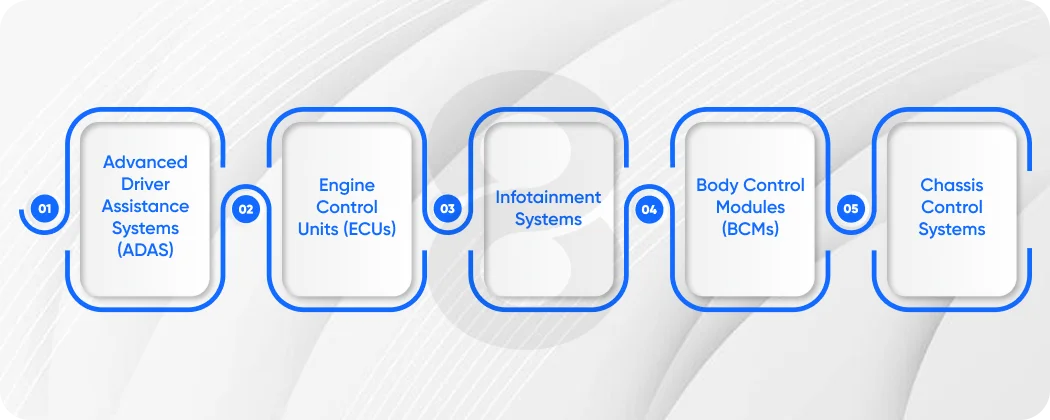
Automotive software program systems are the backbone of modern automobiles, dealing with the entirety from easy engine manipulation to the most complex independent driving features. These systems allow a wide range of operations, from regulating engine parameters and controlling emissions to delivering rich infotainment experiences and supporting self-driving technologies.
Beyond managing inner mechanics and electronics, car software programs dramatically improve the consumer experience through advanced infotainment systems, real-time connectivity answers, and clever driver assistance functions. The diversity of use instances throughout the car’s surroundings has given rise to numerous distinct software program categories, each serving a completely unique function within the modern automobile. Here is a more in-depth take; take a look at the essential types:
1. Advanced Driver Assistance Systems (ADAS)
ADAS are designed to enhance the protection of each driver and passenger with the aid of using sensors, cameras, radar, and AI-powered processing while the car is in motion. These structures have regularly emerged as a preferred feature across the car industry, extensively appreciated for their measurable effect on street protection and accident prevention.
Key functionalities of ADAS include the following:
- Lane-preserving help maintains the car focused inside of the lane markings
- Adaptive speed control mechanically adjusts speed based on the surrounding site visitors
- Collision warning indicators for drivers are approaching front- or rear-end dangers
- Blind-spot tracking detects automobiles in areas outside the driver’s direct line of sight
- Cross-site visitors alerts warn of approaching vehicles whilst reversing out of parking areas
All of these functions make contributions drastically to decreasing accidents and enhancing basic automobile protection. For developers building apps that interface with ADAS hardware, the real-time records requirements and protection compliance standards worried about are a meaningful component within the overall car app development fee.
2. Engine Control Units (ECUs)
ECUs modify overall engine performance and manipulate important functions along with fuel injection, ignition timing, and emission management. They are the number one drivers behind improvements in motor performance, gasoline efficiency, and emissions reduction, essentially acting as the brain of the vehicle’s
Modern motors can comprise dozens of car ECUs, accountable for a selected subsystem. The most typically controlled functions consist of:
- Fuel injection timing and amount management
- Ignition device control for foremost combustion
- Exhaust emission tracking and management
- Turbocharger and throttle frame regulation
- Real-time fault detection and diagnostic code era
When car apps want to read or interact with ECU facts, for instance, in fleet diagnostics or related automobile structures, the OBD-II integration requirements that this creates are a key contributor to usual improvement complexity and cost.
3. Infotainment Systems
Infotainment structures in contemporary vehicles serve a dual purpose of handing over amusement through media playback, navigation, and Bluetooth or Wi-Fi connectivity while additionally acting as a significant hub for the general in-vehicle user experience. They are designed to integrate seamlessly with different automobile additives and an increasing number of functions as the primary interface between the motive force and the vehicle’s virtual surroundings.
Modern infotainment systems normally support a broad feature set, which includes the following:
- Audio and video media playback with streaming service integration
- Turn-via-flip navigation with actual-time site visitors updates
- Hands-unfastened calling and voice command assist
- Smartphone mirroring through Apple CarPlay and Android Auto
- Vehicle settings control through a centralized touchscreen interface
As consumer expectations for in-car virtual reviews rise, driven by the same smartphone reviews customers revel in every day, infotainment systems have ended up being one of the most actively evolving regions of the automobile software landscape, with substantial implications for automobile app development fees when building companion apps or embedded HMI solutions.
4. Body Control Modules (BCMs)
BCMs are crucial additives in vehicle systems that control everyday features, together with lighting, windshield wipers, door locks, and power windows. They play an essential role in making sure that all of these subsystems talk successfully with every other to facilitate a clean, dependable, and secure riding experience.
The core capabilities managed by means of a regular BCM consist of:
- Interior and outside lights control, including computerized headlights
- Power window and critical locking system control
- Windshield wiper speed and rain-sensing automation
- Horn, alarm, and car security machine coordination
- Battery and strength distribution tracking across car subsystems
While BCMs normally operate in the background without direct person interaction, car apps focused on faraway automobile control, along with smart key apps or remote lock and light manipulation capabilities, rely upon BCM statistics and verbal exchange protocols, adding a layer of hardware integration complexity to those improvement initiatives.
5. Chassis Control Systems
Chassis coordinates the suspension, steering, and braking factors of a vehicle to supply an excellent, precise experience and the most appropriate overall performance. These systems in real time, continuously adjusting to street situations, driving behavior, and automobile dynamics to hold the automobile stable and responsive under all driving situations.
Key additives controlled by using chassis-manipulated structures:
- Electronic stability control (ESC) for skid and rollover prevention
- Anti-lock braking device (ABS) for managed prevention on slippery surfaces
- Active suspension adjustment based on road-floor comments
- Electric power steering (EPS) calibration for responsive management
- Traction is manipulated to save you from wheel spin throughout acceleration
For automobile app builders constructing overall performance tracking tools, tune-up day apps, or superior fleet protection structures, chassis management information represents a rich supply of real-time telemetry, though getting access to and processing it at scale meaningfully impacts automobile app development fees.
The automotive software and electronics market will experience a 4.5% compound annual growth rate until 2035, which will result in a market size of approximately $519 billion as vehicles adopt software-defined systems and advanced central computing architectures.
Read More: 30 Best Android Automotive Apps for 2026
Key Factors Affecting Automotive App Development Cost in 2026
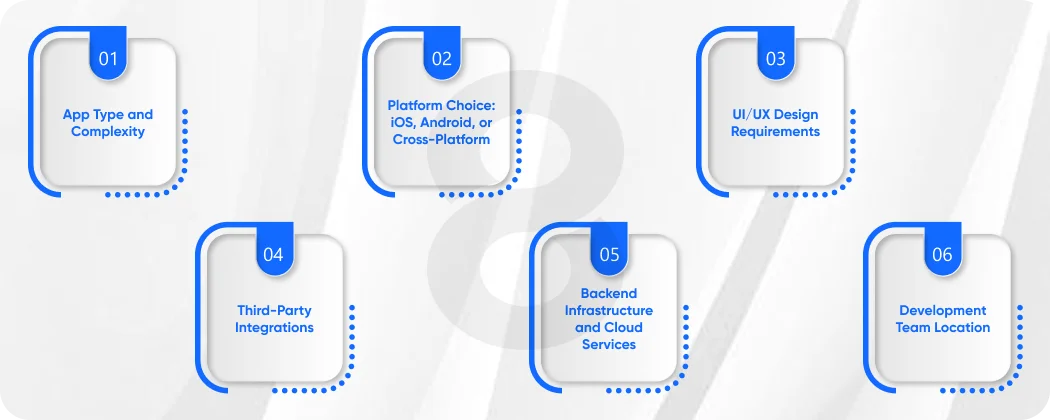
There is no one-size-fits-all solution to a great deal of automotive app development costs. The very last figure relies upon a huge mixture of strategic, technical, and operational variables. Before asking for a quote from any development associate, it is well worth informing them of the 6 factors that have the best influence on your very last invoice.
1. App Type and Complexity
The kind of car app you need to build is the single largest driving force of value. An easy vehicle provider reservation app is much less expensive to develop than a real-time fleet control platform with AI-powered route optimization and predictive protection signals. Complexity isn’t always pretty much the range of capabilities; it is approximately how those functions interact, how a great deal of actual-time information processing is required, and how many external structures the app has to connect with.
| App Type | Complexity Level | Estimated Cost Range |
| Service Booking App | Low | $10,000 – $30,000 |
| Vehicle Tracking App | Medium | $30,000 – $80,000 |
| Fleet Management Platform | High | $80,000 – $200,000 |
| Connected Car / OBD App | High | $60,000 – $150,000 |
| EV Charging Network App | Very High | $100,000 – $300,000 |
| Ride-Hailing Platform | Very High | $150,000 – $500,000+ |
2. Platform Choice: iOS, Android, or Cross-Platform
Choosing to build for an unmanaged platform is less expensive initially; however, it limits your audience. Cross-platform frameworks like React Native or Flutter permit you to build once and deploy on both iOS and Android, generally lowering development time by 30–40%. For most car app corporations, cross-platform development represents the best balance of price, velocity, and attainment. Native improvement is best endorsed when you want deep hardware-level access or the most real-time performance for safety-critical telematics features.
| Platform | Development Time | Relative Cost |
| iOS Only | 3–6 months | Base cost |
| Android Only | 3–6 months | Similar to iOS |
| Both (Native) | 6–12 months | 1.7x – 2x base cost |
| Cross-Platform (React Native / Flutter) | 4–8 months | 1.2x – 1.5x base cost |
3. UI/UX Design Requirements
Automotive apps call for remarkable UX design, especially for in-car or hands-free use cases wherein drivers need short, accessible interfaces with minimal cognitive load. A trendy UI layout bundle charges between $5,000 and $20,000, while premium, studies-subsidized UX design for connected car experiences can exceed $50,000. The key design issues that pressure price upward encompass driving force-safe interfaces with massive faucet targets, darkish mode and high-assessment presentations for varied light situations, accessibility compliance, lively onboarding flows, and custom-branded layout structures.
4. Third-Party Integrations
Most car apps cannot function in isolation; they depend closely on outside APIs, hardware SDKs, and record services. Common integrations that affect the car app improvement value consist of:
- Telematics and OBD-II hardware APIs (e.G., Geotab, Verizon Connect)
- Mapping and navigation services (Google Maps, HERE, Mapbox)
- Payment gateways (Stripe, PayPal, Braintree)
- CRM and ERP systems (Salesforce, SAP)
- Government and compliance APIs for emissions and vehicle registration data
- Insurance and telematics scoring APIs
- Each integration provides engineering time, licensing prices, and ongoing preservation overhead for your venture finances.
5. Backend Infrastructure and Cloud Services
A robust, scalable backend is crucial for automobile apps dealing with real-time records, mainly fleet tracking, related automobile telemetry, and EV charging fame. Backend wishes typically encompass RESTful or GraphQL API development; real-time records processing via WebSockets or MQTT for IoT devices; cloud website hosting on AWS, Google Cloud, or Azure; database structure spanning PostgreSQL, MongoDB, and Redis; and analytics and reporting pipelines. Backend improvement commonly accounts for 30–50% of the full automotive app development value, making it the single largest line item in maximum assignment budgets.
6. Development Team Location
Where your improvement team is based has a dramatic impact on your total budget. Offshore groups in South Asia or Eastern Europe can be three to five times more expensive than North American or Western European businesses, and a lot of those groups deliver work that fits or exceeds Western quality requirements while being well vetted.
| Team Location | Avg. Hourly Rate | Cost for 1,000 Hours |
| USA / Canada | $100 – $200/hr | $100,000 – $200,000 |
| Western Europe (UK, Germany) | $80 – $150/hr | $80,000 – $150,000 |
| Eastern Europe (Poland, Ukraine) | $40 – $80/hr | $40,000 – $80,000 |
| South Asia (India, Pakistan) | $20 – $50/hr | $20,000 – $50,000 |
| Southeast Asia (Philippines, Vietnam) | $25 – $55/hr | $25,000 – $55,000 |
Read More: Top Automotive Software Solutions Driving the Future of Mobility
Build vs. Buy: Which Is the Better Choice for Your Automotive App?
One of the biggest decisions businesses face is whether to build an automotive app from scratch or purchase a ready-made platform. While pre-built solutions reduce upfront costs and speed up deployment, they often limit customization, scalability, and long-term innovation.
Custom development requires a higher initial investment but gives you complete control over features, integrations, security, and future growth. The right choice depends on your budget, business goals, timeline, and the level of competitive advantage you want to achieve.
|
Factor |
Build a Custom Automotive App | Buy a Ready-Made Solution |
| Initial Cost | Higher upfront investment |
Lower initial cost |
|
Time to Launch |
4 to 12 months | A few days to weeks |
| Customization | Fully customizable |
Limited customization |
|
Scalability |
Built to grow with your business | May require migration later |
| Ownership | Complete ownership of code and IP |
Vendor owns the platform |
|
Third-Party Integrations |
Unlimited integration possibilities | Limited by provider |
| Security & Compliance | Cutomized to your requirements |
Standard security measures |
|
Long-Term Cost |
Better ROI over time | Ongoing subscription and licensing fees |
| Best For | Enterprises, startups with unique ideas, OEMs, fleet businesses |
MVPs, small businesses, proof of concepts |
Typical Cost Estimates for Automotive App Development
Based on industry data and real project benchmarks, here are the typical cost ranges for automotive mobile app development in 2026, broken down by project scope:
| Project Scope | Features Included | Timeline | Estimated Cost |
| MVP / Starter | Basic booking, user auth, push notifications | 2–4 months | $10,000 – $40,000 |
| Mid-Range App | GPS tracking, payments, admin panel, analytics | 4–8 months | $40,000 – $120,000 |
| Full-Featured Platform | Real-time telematics, AI features, multi-role, CRM integration | 8–14 months | $120,000 – $300,000 |
| Enterprise Solution | Fleet management, IoT hardware, custom backend, compliance | 12–24 months | $300,000 – $500,000+ |
The global automotive software market was valued at $29.32 billion in 2024 and will grow to an estimated value of $66.18 billion by 2030, which corresponds to a compound annual growth rate of 15% from 2025 to 2030. The rising software usage for vehicle connectivity and safety systems and vehicle operations systems drives this expansion.
Components of an Automotive Mobile App & Their Costs
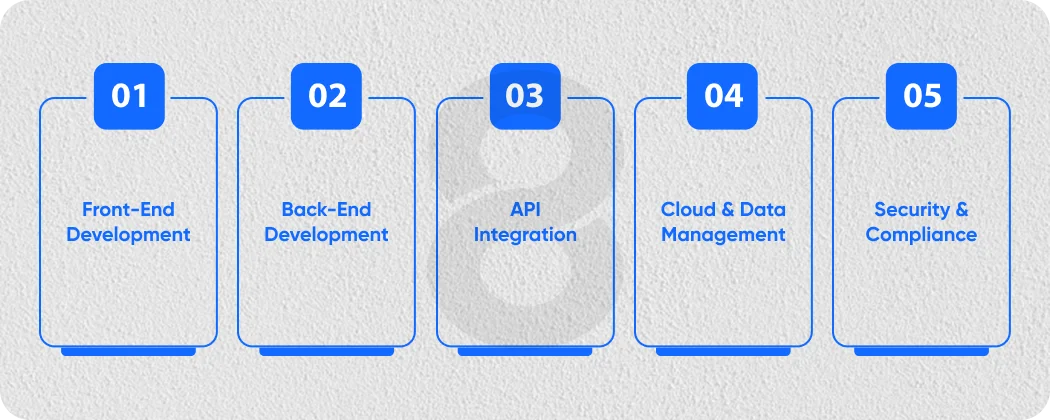
Automotive cell apps consist of several essential components, every contributing to the app’s capability, person experience, and overall performance. Understanding these components also allows in estimating the automotive app development cost, so you can plan your finances effectively.
1. Front-End Development
The front-end is the person going through part of the app. It handles screens, buttons, menus, and the overall interface, making the app intuitive and secure for drivers.
Key points:
- Interactive displays, menus, and navigation
- User-pleasant UI/UX for smooth engagement
- Responsive design across gadgets
Estimated Cost: $15,000 – $50,000, relying on complexity
2. Back-End Development
The returned-end powers the app, handling databases, server logic, and stable information processing. It guarantees real-time operations, car information management, and person authentication.
Key points:
- Server and database management
- User authentication and security
- Real-time processing of automobile and app facts
Estimated Cost: $25,000 – $80,000, depending on scale and features
3. API Integration
APIs connect the app to outside services like automobile diagnostics, mapping structures, and cloud structures. Proper API integration ensures seamless capability and more advantageous capabilities.
Key points:
- Connects to OBD or car diagnostic structures
- Integration with GPS, mapping, and cloud offerings
- Enables real-time information exchange
Estimated Cost: $10,000 – $40,000
4. Cloud & Data Management
Cloud infrastructure manages massive volumes of records securely and supports app scalability. It permits syncing vehicle and user records throughout multiple devices.
Key points:
- Secure cloud storage for car and ride information
- Real-time data syncing
- Scalable and far off get right of entry to
Estimated Cost: $5,000 – $25,000
5. Security & Compliance
Security is vital in car apps due to sensitive data like vicinity, diagnostics, and private statistics. Compliance ensures consumer trust and legal protection.
Key points:
- Data encryption and stable authentication
- Compliance with information protection requirements
- Protection against breaches and cyber threats
Estimated Cost: $5,000 – $20,000
Read More: Automotive Diagnostics Software – AI-Driven Insights
Automotive App Development Cost Breakdown by Development Phase
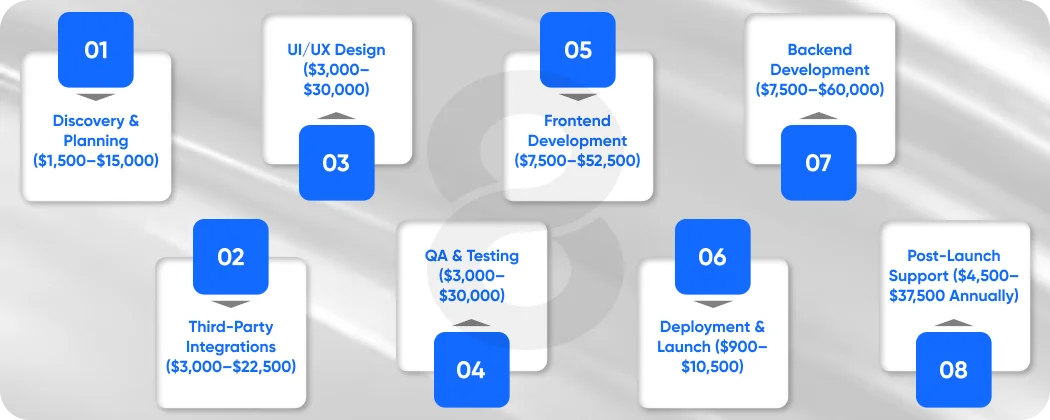
Understanding how the price range is allocated across exclusive improvement phases is important for making plans for a car cell app. Costs vary based on app complexity, platform, features, and 0.33-party integrations. Here’s an in-depth breakdown:
- Discovery & Planning ($1,500–$15,000): This section includes collecting requirements, engaging in market studies, defining the app’s target market, and deciding on the technology stack. Proper planning guarantees a clean roadmap and reduces the danger of sudden changes later.
- UI/UX Design ($3,000–$30,000): Design is essential for personal engagement. It includes wireframes, interactive prototypes, visible design, and consumer checkout. Investing in design improves usability, customer satisfaction, and retention.
- Frontend Development ($7,500–$52,500): This section covers coding the app for iOS and Android systems. The value depends at the variety of capabilities, complexity of the interface, and whether the app is local, hybrid, or go-platform.
- Backend Development ($7,500–$60,000): Backend work includes APIs, databases, server logic, and cloud infrastructure. This ensures easy data access, app performance, scalability, and protection. Complex features like real-time monitoring or telematics can increase fees.
- Third-Party Integrations ($3,000–$22,500): Many car apps depend on external offerings along with fee gateways, map services, telematics, or CRM structures. Integration costs vary depending at the quantity and complexity of APIs used.
- QA & Testing ($3,000–$30,000): Quality assurance ensures the app runs easily on all gadgets and meets performance, usability, and safety requirements. This consists of guide checking out, automatic exams, and performance optimization.
- Deployment & Launch ($900–$10,500): Launching the app entails submitting it to app stores, putting in place servers, and configuring CI/CD pipelines. Proper deployment ensures a smooth launch and instantaneous consumer get right of entry to.
- Post-Launch Support ($4,500–$37,500 annually): After launch, apps require renovation, Trojan horse fixes, updates, and characteristic upgrades. Continuous guidance ensures your app stays applicable, steady, and purposeful as people’s needs evolve.
Automotive Mobile App Development Cost by Regions
Development costs vary significantly depending on the region where your development team is based. The expenses for automotive app development will be determined by the local labor market conditions and cost of living and specialized talent availability in each geographic area. Understanding these regional differences helps you make smarter budgeting decisions from the very start of your project.
| Region | Average Hourly Rate (USD) |
| North America | $100 – $250 |
| Western Europe | $70 – $150 |
| Eastern Europe | $30 – $70 |
| India | $20 – $50 |
| Southeast Asia | $15 – $40 |
Typical Cost Estimates for Automotive App Development in 2026
The cost of developing an automotive app depends on complexity, features, integrations, and platforms (iOS, Android, or both). Below is a general estimate for different app types:
| App Complexity | Development Duration | Estimated Cost (USD) |
| Basic Automotive App | 2-3 months | $10,000 – $45,000 |
| Medium Complexity App | 4-6 months | $45,000 – $90,000 |
| Complex Automotive App | 7-12 months | $90,000 – $160,000+ |
Final Thoughts!
The development process of an automotive application requires knowledge of its development costs, yet successful application development requires more than understanding its financial requirements. To achieve maximum returns from your investment.
The vision statement needs to be established, which defines the target audience and application objectives and essential application functions.
The scalability plan needs to address the future development needs of your application, which will determine its performance throughout its entire lifespan.
An automotive application development company with experienced professionals will deliver dependable services along with high-quality results and uninterrupted growth capabilities.
The creation of a budget-friendly automotive application that provides business benefits, together with user engagement and smooth user interaction, requires three essential elements. The development costs of an automotive mobile application have now become clear to you because you possess this understanding.