


Somewhere on your company’s shared drive right now, there’s a folder called “FINAL_v3_USE_THIS_ONE.” Inside it sits a logo that legal flagged eight months ago. Someone in sales is attaching it to a deck as you read this.
That’s the problem a digital asset management system exists to solve. Not storage. Chaos. The slow bleed of hours that happens when forty people share one Dropbox and nobody owns the taxonomy.
This guide covers everything that custom DAM development actually involves.
Why Shared Drives Collapse Under Real Content Volume
Every company starts the same way. A few folders, sensible names, everyone behaves. Then marketing doubles, an agency gets folder access, a rebrand happens, and suddenly there are four versions of every product shot and nobody knows which one survived legal review.
The math on this is uglier than most founders expect. Knowledge workers burn roughly a fifth of their day hunting for files they already have, and creative teams have it worse because visual assets don’t respond well to filename search.
You can’t grep a photo. When someone can’t find the approved banner, they recreate it. And now there are five versions instead of four.
A digital asset management system replaces that sprawl with one searchable source of truth. Files carry metadata instead of relying on folder paths. Permissions follow roles instead of tribal knowledge.
Old versions stay archived but visible, so nobody resurrects the 2023 logo. The shift sounds small until you watch a designer find a usable asset in eleven seconds instead of eleven minutes.
The market reflects how widespread the pain is. Cloud deployments now account for nearly 80% of DAM implementations, according to Fortune Business Insights, and multimedia assets like video and graphics make up roughly 70% of what these platforms manage.
Video is the real pressure point. One product launch can generate more raw footage than a company produced in its entire first three years.
Read More: How to Build a Custom Digital Product Sales Platform for Your Business
Custom Build vs Off Shelf DAM Software
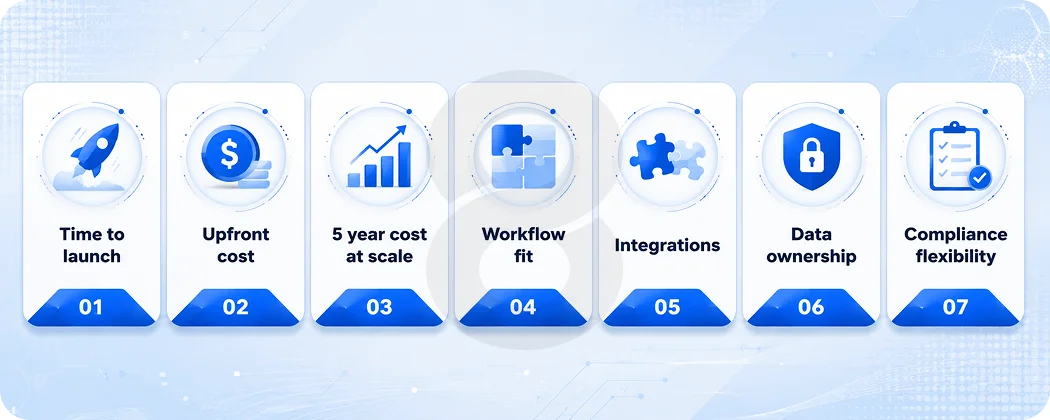
Here’s the honest answer most agencies won’t give you. If you’re a 15 person marketing team with standard needs, buy something. SaaS DAM platforms exist, they work, and you’ll be live in a month.
The calculus changes when your business has shape to it. Maybe your assets need to flow into a PIM, an ERP, and three regional CMS instances. Perhaps you handle medical imagery with HIPAA obligations, or licensed sports content with rights windows that expire by territory.
Or you’re paying per seat pricing across 400 users and the annual renewal now exceeds what a build would have cost. Enterprise DAM subscriptions routinely pass $29K a year, and that number climbs every renewal cycle while the feature gaps stay exactly where they were.
Custom development means the workflow bends to your team instead of the reverse. It also means you own the roadmap. When a platform built around the way your team already works needs a new approval step, you add it.
You don’t file a feature request and wait two quarters. Companies that invest in custom software built around the way their teams already work stop fighting their tools, which sounds like a slogan until you’ve lived the alternative.
Here’s how the two paths compare in practice.
| Factor | Off the Shelf DAM | Custom Built DAM |
|---|---|---|
| Time to launch | 2 to 8 weeks | 4 to 9 months |
| Upfront cost | Low (subscription) | $40,000 to $250,000+ |
| 5 year cost at scale | Often higher (per seat fees) | Predictable after build |
| Workflow fit | You adapt to the tool | Tool adapts to you |
| Integrations | Prebuilt connectors only | Anything with an API |
| Data ownership | Vendor controlled | Fully yours |
| Compliance flexibility | Limited to vendor certifications | Built to your exact requirements |
Features Worth Building Into a Custom DAM
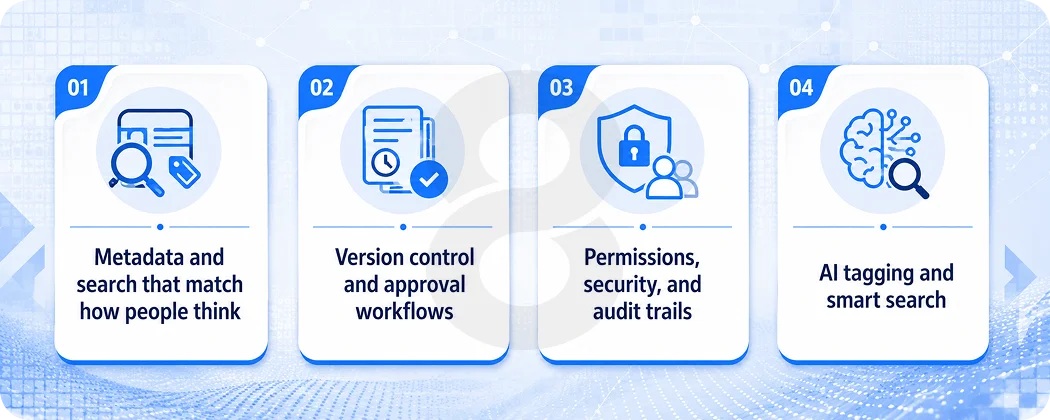
Feature lists on vendor sites run forty items deep. Most of them are padding. A working digital asset management system needs maybe eight things done properly, and everything else is decoration you can add in phase two.
Metadata and search that match how people think
Search is the product. Everything else supports it. That means a metadata schema designed around how your team actually describes assets.
A fashion retailer thinks in seasons, colorways, and shoot locations. A manufacturer thinks in part numbers, certification status, and revision dates.
Build for those words. Then add faceted filters, saved searches, and visual previews in results, because nobody finds an image by reading filenames, and a library people open voluntarily is the only kind that survives.
Version control and approval workflows
Every asset needs a paper trail, because someday someone will ask which version legal approved and the honest answer will be a shrug. The system should know who uploaded it, who touched it, what changed, and which version is actually cleared to ship.
Then put routing on top, so an asset moves from draft to review to published on its own instead of through that Slack thread where you ping the same person three times and eventually just publish whatever you have.
Teams pushing product imagery to eCommerce stores and marketplace listings feel this one in their bones. A stale image on a live product page turns into refunds and angry reviews before anyone even notices it’s wrong.
Permissions, security, and audit trails
Nobody gets excited about this part. Access tied to roles, expiring share links for outside partners, watermarks on downloads, and a log of every single action. It reads like the homework section of the spec, and teams skim past it every time.
Then an agency leaks an embargoed campaign on a Tuesday and suddenly the only question in the building is who had that file. Meanwhile, you either have a log that answers it in thirty seconds or you have a week of awkward meetings. Build the boring stuff. Future you, the one running on cold coffee during the incident review, will be grateful.
AI tagging and smart search
This is where builds in 2026 separate from builds in 2019. Vision models can auto tag thousands of legacy assets, detect faces and products, and let users search by describing an image instead of remembering its filename.
Closing that gap takes custom AI models trained on your own asset library, not an off the shelf API call. The difference shows up the first time someone searches “summer campaign hero shot” and actually finds it.
Read More: Best B2B Software Solutions for Small Businesses (2026 Guide)
What Custom DAM Development Costs in 2026
Nobody can quote your project from a blog post, and anyone who tries is guessing. What follows are honest ranges based on what comparable builds cost across the industry right now.
A lean MVP with upload, metadata, search, roles, and basic sharing lands between $40K and $70K. That’s a system one team can live in. A mid tier platform adds workflow automation, version control, CDN delivery, and a couple of integrations, and runs $80K to $150K.
Enterprise builds with custom AI tagging, rights management, multi region storage, and connections into ERP or PIM systems start around $200K and climb from there.
| Build Tier | Typical Scope | Cost Range | Timeline |
|---|---|---|---|
| MVP | Upload, metadata, search, roles | $40,000 to $70,000 | 3 to 4 months |
| Mid tier | Workflows, versioning, 2 to 3 integrations, CDN | $80,000 to $150,000 | 4 to 6 months |
| Enterprise | AI tagging, rights management, ERP and PIM sync, SSO | $200,000+ | 6 to 9 months |
Three things move the number more than anything else. Storage architecture comes first, because video heavy libraries need rendition pipelines and CDN strategy that image libraries don’t.
Integrations come second, since every system you connect adds discovery, mapping, and testing time. Migration comes third and gets underestimated constantly. Moving 200K mislabeled legacy files into a clean schema is a project inside the project.
Budget around twenty percent of build cost annually for maintenance. Anyone who skips that line item learns about it the hard way when a storage API deprecates.
How the Build Actually Plays Out
The dangerous part of a DAM build isn’t the code. It’s the two weeks at the start when decisions get made that can’t be cheaply unmade.
Discovery comes first, and it should hurt a little. Auditing what assets exist, interviewing the people who use them, and mapping how files move from creation to publication. Skip this and you build a beautiful system for a workflow that doesn’t exist.
The taxonomy and metadata schema get designed here too, ideally with the actual end users in the room arguing about field names. Those arguments are cheap now and brutally expensive later.
After that the work runs in normal agile rhythm. Core upload and search first, then workflows and permissions, then integrations, with migration running in parallel because cleaning legacy metadata always takes longer than planned.
Some teams handle parts of this internally and fill gaps through staff augmentation, adding vetted engineers to their existing squad</a> rather than outsourcing the whole thing, which works well when there’s already a strong technical lead inside.
A sensible build also leaves room for what comes next. Plenty of companies eventually want field teams or sales reps pulling approved assets from their phones, which is when lightweight companion mobile app stops being a luxury and starts being the most used part of the system.
Read More: Hire CRM Developer vs. Buy Ready-Made CRM Software: What’s Right for Your Business?
Mistakes That Quietly Kill DAM Projects
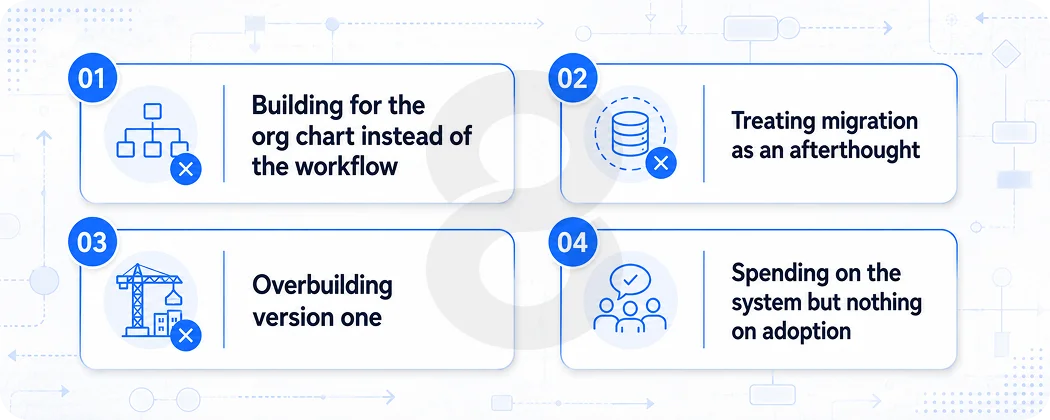
The post mortems all rhyme. Here are the patterns that show up again and again.
Building for the org chart instead of the workflow tops the list. Executives spec the system, end users get trained on it later, and adoption flatlines because the tool solves problems the daily users never had. The fix is embarrassing in its simplicity. Put the designer who searches for assets forty times a day on the project team from day one.
Treating migration as an afterthought comes next. The new system launches gorgeous and empty, the old drive stays where it was, and within a month everyone has drifted back to the familiar mess. Migration with metadata cleanup belongs in the launch plan, not the someday pile.
Overbuilding version one kills its share of projects too. Eighteen months of development for a platform with features nobody requested, while the team suffers with the old chaos the entire time. Ship the core in four months, let real usage drive the roadmap.
The last one stings the most. Companies spend six figures on the system and zero dollars on adoption. No training, no internal champion, no enforcement that new assets go into the DAM and nowhere else. A digital asset management system with empty search logs is just expensive storage.
How 8ration Approaches DAM Builds
8ration builds custom platforms for companies whose content operations stopped fitting inside generic tools. The work usually starts before any code, with a discovery phase that maps how assets actually move through the business and where the hours leak out.
From there the team designs the metadata schema and integration layer around what discovery revealed. Builds run in agile sprints with working software at the end of each cycle, so the people who’ll live in the system see it early and shape it while changes are still cheap.
AI tagging, rights tracking, and automated renditions get added where they earn their place, which isn’t every project.
What separates this from a typical agency engagement is what happens after launch. Migration support, user training, performance monitoring, and a maintenance arrangement so the platform keeps pace as asset volume grows.
With 350 plus engineers and ten years of building production systems across eCommerce, healthcare, media, and manufacturing, the team has seen most versions of content chaos and knows which fixes hold up after the launch excitement fades.
For a conversation about whether a custom digital asset management system fits your situation, or whether you’d honestly be better served buying one, reach out through the contact page. Sometimes the right answer is “don’t build this,” and you deserve to hear that before spending money, not after.