


Somewhere between the pitch deck and the actual app store listing, every founder asks the same question. How hard can building an eCommerce app really be? The honest answer sits somewhere between the agency sales page and the horror stories floating around your group chat.
Global online retail is closing in on seven trillion dollars in 2026 and online sales now account for more than a fifth of total retail spending worldwide with that share climbing every year.
Most of that growth is happening on a phone screen. If a clean answer on cost, timeline, features, or whether an app is even worth it sounds useful right now, this eCommerce app development guide is built to get there without the usual sales pitch.
What Counts as eCommerce App Development Right Now
eCommerce app development means building a dedicated mobile or web app. People browse a catalog, manage a cart, and pay right inside it, without ever touching a website. That sounds simple until the scope gets real.
A working app needs inventory syncing, payment processing, push notifications, and an admin side. Nobody outside the ops team will ever see that admin side. But they’ll absolutely complain about it the moment it slows down.
The reason this keeps landing on every retail roadmap for 2026 isn’t hype dressed up as urgency. Online retail now eats up more than fifth of total global retail sales and that share keeps climbing every year. A bigger slice of that spending happens inside apps now. Apps load faster, remember login details, and send a notification instead of waiting for someone to wander back on their own.
It also helps to know what an app is not. A progressive web app is somewhere between a mobile site and native app. You install it straight from a browser. It works fine for a smaller catalog or a brand still testing demand. A native app costs more and takes longer to ship. But it wins on speed and the kind of push notification a browser tab can’t match.
None of this means every brand needs a native app on day one. A fast, well built mobile site can carry a small catalog just fine. But once repeat purchases, loyalty programs, or a big product catalog enter the picture, that math changes. eCommerce application development starts paying for itself through retention, not a single wave of new sales.
The Types of eCommerce Apps You Could Build
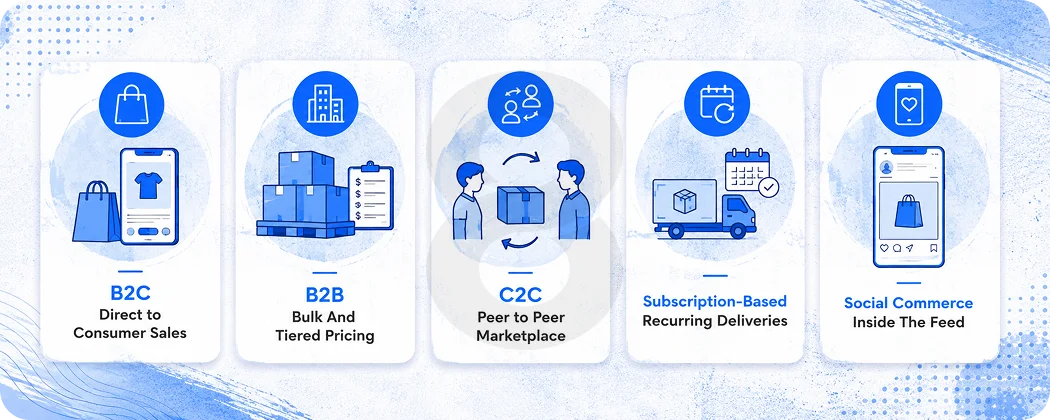
Not every eCommerce app needs the same feature list. Business models don’t sell the same way, so why would they need the same build.
Pick the wrong one early and you’ll pay for it later. It happens more than people admit. The decision gets baked into your data structure from day one, and untangling it six months in is a special kind of pain.
Take a B2B catalog running tiered pricing. Under the hood, it shares almost nothing with a C2C marketplace, even though both might show a near identical product grid on screen. Here’s how the main types actually break down, and which kind of brand tends to run each one once it’s live.
| App Type | What It Actually Does | Real World Example |
|---|---|---|
| B2C | Sells directly to individual shoppers through a single catalog and one checkout flow | Sephora, Nike |
| B2B | Handles bulk orders, tiered pricing, and account based purchasing approvals | Alibaba, Grainger |
| C2C | Lets individual sellers list items and sell to other individuals, with the platform taking a cut | eBay, Etsy |
| Subscription based | Charges on a recurring schedule for curated boxes or repeat deliveries | Dollar Shave Club, BarkBox |
| Social commerce | Sells inside a social feed instead of a separate storefront | Instagram Shopping, TikTok Shop |
Most brands launch B2C first. B2B and marketplace features come later, usually once a wholesale arm or a partner network shows up on its own, not because someone planned for it on a roadmap.
Read More: Top 10 eCommerce Solution Providers for the B2B Industry
Trying to build both from day one almost never pays off. The exception is when wholesale demand is already there, confirmed, before development even starts.
How eCommerce App Development Works: Step-by-Step
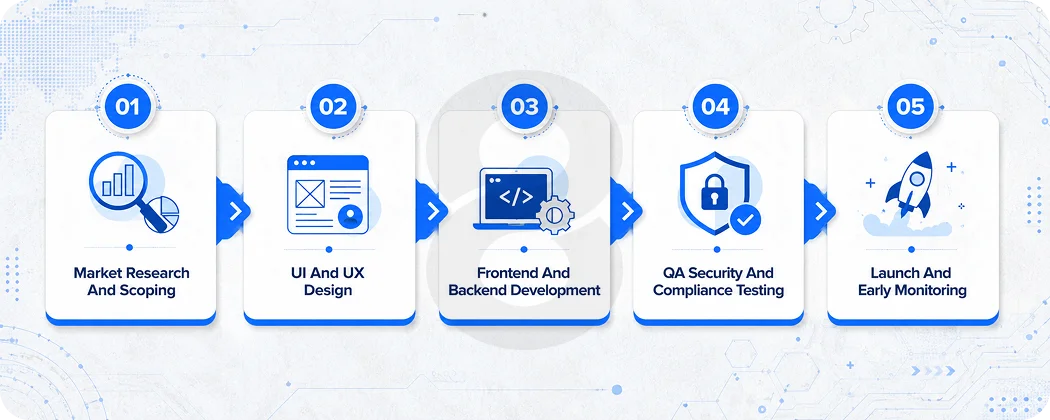
None of this is complicated on paper. It just never runs on time. Every project plan promises a clean timeline, and every project plan is lying a little. Here’s what actually happens in each phase, minus the two weeks it always slips by.
Market research and scoping
Everything downstream gets decided here, tech stack, team size, all of it. Tear down the competitors. Talk to actual target users. Write down a feature priority list instead of arguing about it three months in. Skip this step and you’ll likely end up rebuilding a core feature halfway through the build and that costs more than the research ever would have.
UI and UX design
Wireframes first. Then a clickable prototype, tested by someone who isn’t on the team, on an actual phone, not a laptop screen. Catching usability problems here costs a fraction of catching them after launch, once customers are already inside the app and leaving one star reviews about it.
Frontend and backend development
This phase eats the most calendar time, usually eight to sixteen weeks depending on how much you’re building. And here’s the part people don’t expect. The backend, the payment processing, the inventory sync, the order routing, takes more hours than every visible screen combined. Nobody outside the team will ever lay eyes on most of that work.
QA, security, and compliance testing
Catching functional bugs is the easy part. The real time sink is payment flow testing, load testing under actual traffic, and a security pass on anything that touches card data. Rush this step and you’ve basically scheduled your first post launch fire in advance.
Launch, and the part nobody plans for
Launch day isn’t the finish line. It’s the start of a completely different job. App store delays show up. Crash reports come in from some device nobody bothered testing. Real users start behaving in ways no one predicted. All of it lands in the first week, and somehow always at the worst possible moment.
Read More: 7 eCommerce Giants Winning the Mobile App Game (and How They Do It)
Features Your App Cannot Skip
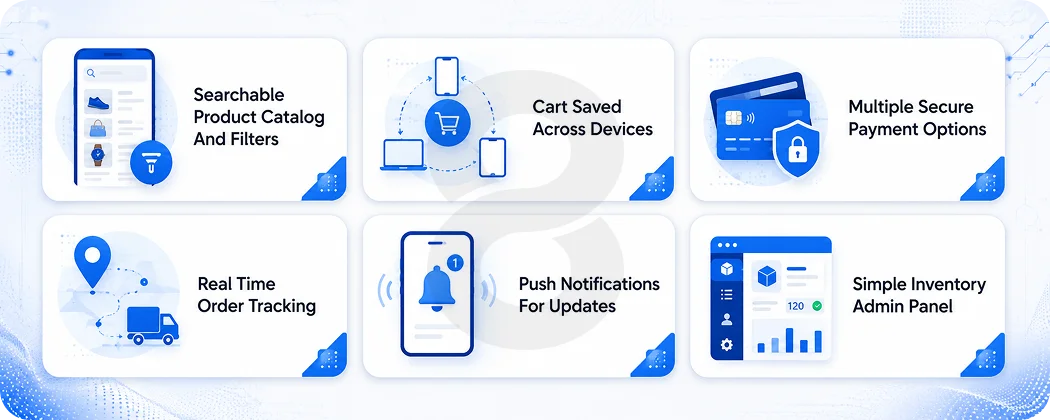
Feature lists for eCommerce apps tend to balloon fast mostly because every stakeholder has a favorite addition they consider non-negotiable. The list below is the actual floor, no matter how small the first version needs to stay.
- A product catalog with real search and filtering, not just a scroll
- A cart that saves items across sessions and across devices
- At least two payment options, including a digital wallet
- Order tracking that updates without the user refreshing anything manually
- Push notifications for restocks and order status changes
- An admin panel that lets a non technical team member update inventory without calling a developer
Everything else, AI recommendations, AR try ons, loyalty tiers, all of it waits. None of it earns a spot until the basics run without friction first.
Tech Stack Choices That Actually Matter
Every developer has a favorite stack, and most of the debate around it is noise. What actually matters is whether the stack can handle real traffic, not a clean demo running on someone’s laptop.
For cross platform mobile builds, React Native and Flutter cover most use cases without forcing two separate native teams. For backend work, Node.js and Django both hold up under heavy order volume, though the choice usually comes down to what the existing team already knows well, plus whichever cloud provider already hosts the rest of the business.
PostgreSQL handles structured order and inventory data well. MongoDB or another document store fits better when your catalog has a lot of variation between product types.
Pitch decks skip the part that actually matters. The software running underneath the storefront handles inventory sync, order routing, and payment retries when a card fails the first time. None of that shows up in a demo.
A fragile backend hides behind a polished frontend just fine, until traffic spikes. And it always spikes during the one sale event the business was actually counting on.
Payment security adds its own layer of stack decisions. Any app handling card data needs to follow PCI DSS standards, and most teams meet this requirement by routing through a certified payment processor instead of building card storage themselves from scratch.
Read More: How to Build an Ecommerce Inventory Management System
The Real Cost of Building an eCommerce App in 2026
Every founder wants this answered before anything else. Features can wait. Timelines can wait. The number can’t. So here’s the right range, not the kind vague enough to mean nothing.
A simple build with one catalog, standard checkout, and basic admin tools costs $40K to $80K. Add personalization, loyalty program, and multi platform support and you’re at $80K to $150K. Push into AI recommendations, multi vendor support, and heavy backend work and the number climbs past $250K fast.
Read More: eCommerce App Development Cost: Your Ultimate Guide for 2026
Here’s the part nobody mentions in the pitch meeting. Your feature list isn’t what drives the price up. Integrations are. Every payment gateway, shipping carrier, ERP connection, and CRM sync adds real hours to the build. Those hours pile up faster than any single feature on a wishlist ever could.
| Build Tier | What You Get | Typical Cost Range |
|---|---|---|
| Starter or MVP | Product catalog, cart, one payment gateway, basic admin panel | $40,000 to $80,000 |
| Mid range | Personalization, loyalty program, multi platform support, analytics dashboard | $80,000 to $150,000 |
| Enterprise or full featured | AI recommendations, multi vendor support, ERP and CRM integration, advanced security | $150,000 to $250,000 plus |
Most agencies quoting in US dollars land somewhere in these ranges. Two things move the final number though. Where the team sits is one. The other is how much backend you’re already carrying over from an older build. Either one can swing the quote twenty to thirty percent in either direction.
How These Apps Make Money Beyond the First Sale
Product sales alone almost never pay back the budget in year one. Smart teams know this going in, so they build two or three revenue paths from day one instead of staking everything on one checkout flow.
Direct sales still do the heavy lifting for most stores. Makes sense. Margin and pricing stay in house, and there’s nothing simpler to set up.
Subscriptions come next, and they earn their place fast. A recurring fee for restocks, curated boxes, or early access to new drops gives the business a second income stream that doesn’t crater the moment holiday season ends.
Then there’s the marketplace model, charging a small commission instead of holding your own inventory. It only really works once a few hundred vendors are active on the platform. Before that, the commission barely covers what hosting costs each month.
Sponsored listings and in app advertising bring in a smaller, steadier stream for apps with enough daily traffic to make ad placements worth a brand’s budget.
Freemium tiers round out the list for apps offering a service layer on top of products, things like early access, free shipping thresholds, or styling help, gated behind a paid tier. Most apps that survive past year two end up running two of these models at once, rarely just one, and the right mix usually depends on catalog size more than industry.
Read More: 15 Best Apps Like Temu for E-Commerce Store Ideas
Trends That Are Actually Worth Your Time in 2026
Every trend list in this industry gets recycled every January with a new year slapped on the title. Most of it is noise. A handful of these actually deserve a real budget in 2026. The rest is hype wearing a roadmap costume.
Start with AI personalization. It used to mean a recommendation widget bolted onto a product page and called a day. Not anymore. Now AI adjusts search ranking, nudges pricing, and decides which products a returning visitor sees first, and it’s doing that based on what someone actually bought last time, not what they clicked once and forgot about.
Agentic commerce is the one nobody’s ready for. Gartner’s research points to a near future where AI shopping assistants complete purchases on a customer’s behalf, full stop, no human clicking “buy” at the end.
Which means your product data, pricing, and inventory feeds now need to make sense to a machine reading them cold, not just a person thumbing through a phone.
Read More: Artificial Intelligence in Ecommerce: How AI Drives Sales, Growth, and ROI
Headless commerce earns its spot for a simpler reason. One backend, feeding a website, an app, and a kiosk, not rebuilding the storefront three separate times because someone wanted a new channel. It costs more going in. It pays for itself the day a brand needs to launch somewhere new without starting from scratch again.
Progressive web apps still matter too but mostly for brands that aren’t ready to commit to a native build yet. You lose a few native features. You gain a launch that’s faster and cheaper. Buy now and pay later, one click checkout, and basic AR try-ons… all worth a look.
Voice commerce, though. Still waiting on its moment after years of people swearing it’s about to arrive. Most mid sized brands haven’t given it a real budget line, and honestly, they probably shouldn’t yet.
Where Most eCommerce App Projects Quietly Fail
Launch day rarely kills these projects. The real damage shows up six months later, slow and quiet, for reasons nobody bothered writing into the original scope document.
Cart abandonment is the one everyone notices first. Industry average sits close to seventy percent, and that number comes straight from the Baymard Institute. Most of that gap has nothing to do with pricing or product fit.
It comes down to checkout friction, plain and simple. Too many form fields, accounts forced on people who just wanted to buy something, shipping costs that show up out of nowhere right at the end. That combination does most of the damage.
Security fails quietly too, until it doesn’t. Payment data and personal information need real encryption, GDPR compliance, and PCI DSS adherence from the start, not as an afterthought bolted on later. Try retrofitting security after a breach and you’ll pay multiples of what building it in properly would have cost.
A handful of higher value platforms have started testing a blockchain layer for transaction verification, mostly inside marketplaces where buyers and sellers have no built in reason to trust each other yet.
Inventory sync is the failure nobody talks about enough. Show a customer an in stock item that sold out twenty minutes ago, and you’ve done more damage to trust than almost anything else on this list.
Nine times out of ten, that happens because the backend and the storefront were never actually wired together properly. Returns sit right next to it. A slow, confusing return process sends customers straight to a competitor faster than one bad product ever could.
And then there’s the boring one, the one that hits everyone eventually. Teams budget for the build and somehow forget the maintenance comes after. Bugs need fixing. Operating systems update.
The business keeps changing while the app slowly drifts further from what it actually needs to do. None of that stops costing time and money just because nobody planned for it.
Read More: Best Scalable Ecommerce Technology Stack for Enterprise
How 8ration Can Help You Build This Without Losing Your Mind
8ration has been building eCommerce apps for years now, and not the templated kind. Early stage startups validating an MVP, established retailers tired of dragging around an old platform nobody wants to touch anymore, the work covers both ends of that spectrum.
It always starts the same way. A scoping conversation comes first because figuring out what the app actually needs to do matters more than jumping straight into building it. Design and app development then run side by side in sprints and working builds get shared early on purpose. Catching a wrong direction early costs a conversation. Catching it late costs a budget.
Already running a website and just need the ecommerce storefront piece, built for speed and actual conversion? Same team, same backend discipline either way. Payment processing, inventory sync, admin tooling that lets someone change a price without calling a developer about it, all of it gets the same attention.
Support doesn’t show up later as a surprise line item either. Bug fixes, performance monitoring, the feature requests that start rolling in the second real customers touch the app, that’s all part of the relationship from day one. Nobody’s negotiating a separate retainer three months in.