



Game developers often face recurring challenges during development. Game Programming Patterns offer proven guidelines to resolve these common problems within the specific constraints of game architecture.
Behind all the fluid animation, control, and in-game world, there is a good base. Whereas customers rate games based on graphics and gameplay, programmers understand that the longevity of success depends on the tendencies of game programming.
With the increasing complexity of games in terms of platforms, engines, and expectations of players, the lack of structure in the code results in technical debt, bugs, and performance problems.
Mobile gaming accounts for nearly 50% of total gaming industry revenue, highlighting the importance of efficient architecture and game programming patterns in popular platforms.
This guide examines the patterns of game programming using a practical viewpoint on how they enhance performance, minimize development time, and enable game development to be scalable.
What Are Game Programming Patterns and Why They Matter
Game programming patterns are software design solutions that are reusable for interactive, real-time systems. In contrast to traditional patterns of application, game-oriented patterns deal with issues like endless cycles, the lifecycle of objects, event management, and memory optimization.
Games are not static systems. They respond to input continuously, AI decisions, physics calculations, and rendering pipelines. In the absence of formal structures, such complexity results in highly linked code, which is hard to debug or maintain.
Development teams achieve this by using established patterns:
- Less dirty and more modular code
- Reduced debug time and debug cycles
- Better performance and memory regulation
- Simple integration of new developers
- Scalability over the long term in terms of updates and platform
Succinctly, game programming patterns are architectural guardrails that ensure that your game stays intact throughout its developmental history.
Read More: How Much Does It Cost to Make a Video Game
The Core Challenges in Game Development Architecture
One should be aware of the issues that patterns address before getting immersed in the patterns.
The development of modern games has to deal with
- Live responsiveness with low latency
- Huge masses of active objects
- Mobile and console platform limitations
- Active live operations and regular changes in features
- Improvement of performance between GPUs and CPUs
Conventional software structures are unable to cope with these requirements. This is how special patterns of game formation have been created to solve problems peculiar to the interactive systems.
Essential Game Programming Patterns Every Studio Should Know
The Game Loop Pattern
The game loop is the pulse of any game. It takes continuous input, runs the game state, and displays frames.
This pattern ensures:
- Consistent frame updates
- Decoupling of logic and rendering
- Resistive behavior in performance
A properly put loop enables the developers to streamline single steps without disrupting the flow. Without it, even basic games will become unstable under the load.
Component Pattern for Flexible Entities
The systems based on inheritance are rigid as the size of a game increases. This is addressed by the Component Pattern, which decomposes behavior into components.
Entities are not made up of huge class hierarchies but rather of modular components such as:
- Movement components
- Rendering components
- Physics components
- Input components
The method is very popular in contemporary engines, as it can both facilitate the creation of mobile games and massive simulations. It is also very similar to the commercial game design patterns of commercial engines.
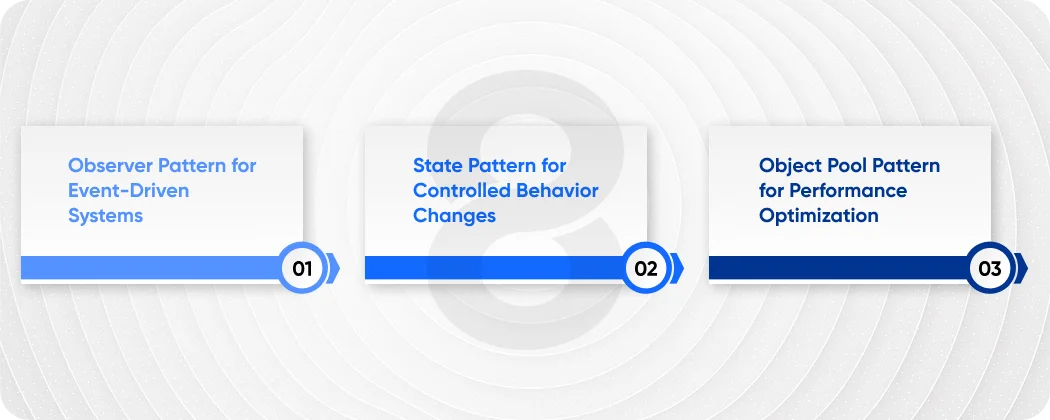
Observer Pattern for Event-Driven Systems
Games have collisions, scoring, and changes in the UI events. The Observer Pattern provides the ability for systems to respond to these events without being closely coupled.
For example:
- When health changes, a health system informs the UI of this
- Milestone events are heard by an achievement system
- Audio triggers are activated by gameplay actions
This trend enhances maintainability and minimizes system-to-system dependencies.
State Pattern for Controlled Behavior Changes
State is frequently used to drive game characters, enemies, and UI elements. The typical examples are idle, attacking, stopped, or defeated.
The State Pattern:
- Imprisons behavior in state objects
- Eradicates complicated conditional logic
- Enhances AI transparency and debugging
It is among the most feasible patterns of game design, programming of AI and UI systems.
Object Pool Pattern for Performance Optimization
The creation and destruction of objects may damage performance, particularly in games where there is a lot of action. The Object Pool Pattern addresses this through the reuse of objects rather than the recreation of objects.
This pattern is critical for:
- Bullets and projectiles
- Particle effects
- Enemy spawning systems
It is especially useful in 3d game development, where memory management and performance optimization are important because of the intricate assets, physics simulation, and rendering requirements.
Read More: How Long Does it Take to Make a Video Game
How Game Programming Patterns Improve Performance and Scalability
Application of the techniques of game programming is not an academic perfection. It directly influences real-life performance and business.
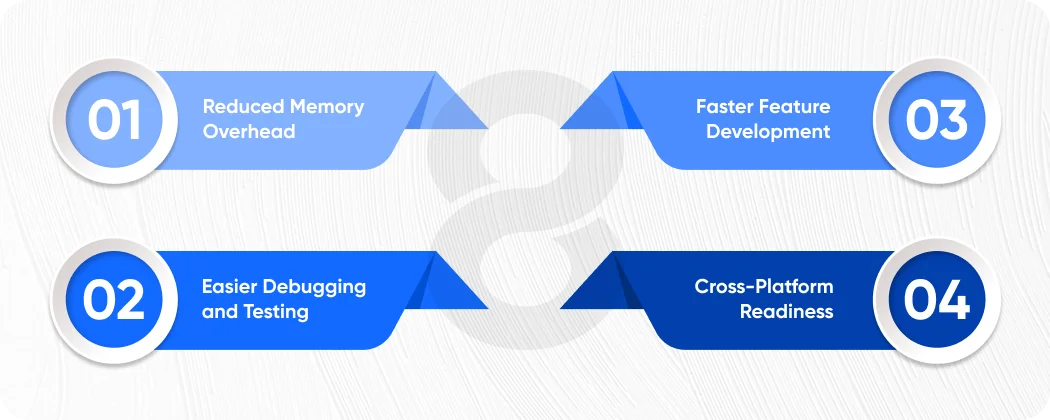
Reduced Memory Overhead
Game programming patterns like object pooling and modular component systems decrease the memory fragmentation and minimize the garbage collection, therefore making game development smoother and increasing the frame rates, thereby improving performance, in 3D and mobile game development.
Faster Feature Development
Development teams can easily add new mechanics, improve the gameplay, and provide updates without rewriting core logic using modular and reusable structures and game programming patterns, simplifying the patterns of game development and the release cycles.
Easier Debugging and Testing
A fundamental rule of game programming patterns is decoupled systems, which make debugging, testing, and maintenance easier by isolating problems and allowing the developer to fix faults in game design programming patterns that maintain consistency in cross-platform performance.
Cross-Platform Readiness
Architecture based on game programming patterns can easily scale to other platforms and other environments with very consistent performance and stability in mobile game development, PC titles, and complex 3D game development environments.
Zipdo reports that digital transformation has minimized the time spent in game development by 25%, which highlights the importance of systematic patterns and tools in accelerating the process.
Game Programming Patterns in Mobile and 3D Game Development

Mobile Game Development Considerations
Unlike PCs or consoles, mobile devices have limited resources, and therefore, it is essential to optimize their performance. The effective patterns of game development are used to address the major constraints and guarantee seamless gameplay, even when operating on low-end devices:
- Battery consumption
- CPU and GPU constraints
- Memory limits
- Network reliability
Trends such as lightweight components, event-driven systems, and pooling are vital to the ease of mobile experiences, which allow developers to build responsive, scalable, and interactive games without reducing their performance or satisfaction to the players.
3D Game Development Complexity
On the contrary, 3D game development presents special challenges that require building architecture. Patterns that scale up Large-scale worlds, real-time physics, and complex AI systems demand patterns that are high-performance and allow smooth gameplay experiences:
- Complicated physics simulations
- Complex pipeline rendering
- Large asset management
- AI-driven environments
Patterns here also provide that systems can be performant despite more complex scenes and facilitate modularity, quicker iteration, and long-term scalability of systems for both developers and designers.
Read More: 9 Best Game Engines for Mobile Development
Aligning Programming Patterns With Game Design Goals
Patterns are not technical tools only. They have an impact on the flexibility of iterating on gameplay by designers.
With high correspondence of programming and game design patterns, it is possible to:
- Faster prototyping
- Greener mechanical integration
- Less conflict between design and engineering departments
Whenever patterns are selected on purpose, creative thinking evolves into a playable feature more quickly.
Common Mistakes Teams Make With Game Programming Patterns
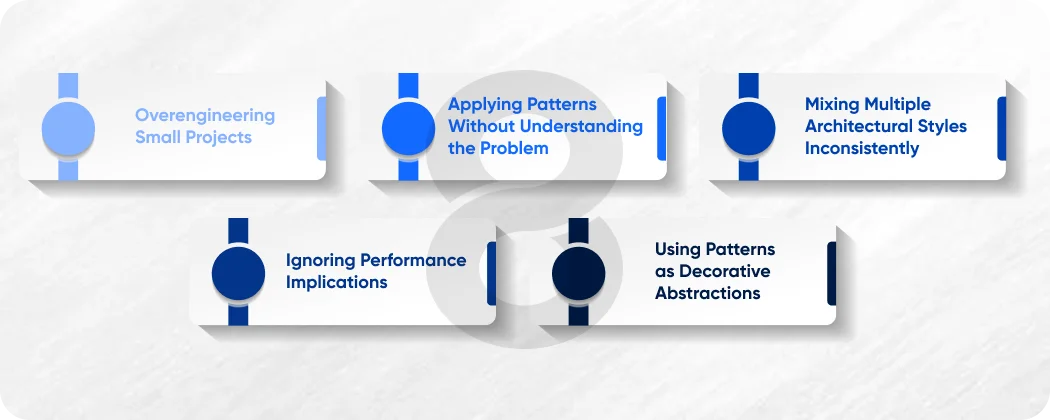
Even professional developers tend to have difficulties with appropriate implementation. Poor usage of game programming patterns may result in inefficiency, increased development time, and unstable gameplay. The knowledge of these errors will guarantee a seamless project and better quality games.
1. Overengineering Small Projects
Making use of complicated patterns of game development in small-sized games raises the workload. Teams are a waste of time and resources that decelerate development and introduce unnecessary complexity that would be eliminated with simpler architecture.
2. Applying Patterns Without Understanding the Problem
It is confusing to implement patterns without analyzing the unique challenges of the game. To effectively code the game design using the game design patterns, one needs to be aware of the technical and gameplay objectives to code the pattern correctly.
3. Mixing Multiple Architectural Styles Inconsistently
Flaky architectures cause the codebase to be difficult to maintain. The unplanned combination of multiple game design patterns tends to cause bugs, decreased performance, and more time in the debug phase, frustrating both game designers and programmers.
4. Ignoring Performance Implications
Failure to optimize the development of 3D games or mobile applications may reduce frame rate and consume more memory. It is important to know the impact of every pattern on the resources in order to play the game comfortably.
5. Using Patterns as Decorative Abstractions
Some teams use the appearances pattern over the functionality one. A strategic application of game programming patterns is certain to deliver practical benefits and maintain modularity, scalability, and manageability of the code in the long term.
Read More: How to Hire the Best Game Development Team for Your Project
Choosing the Right Patterns for Your Game Project
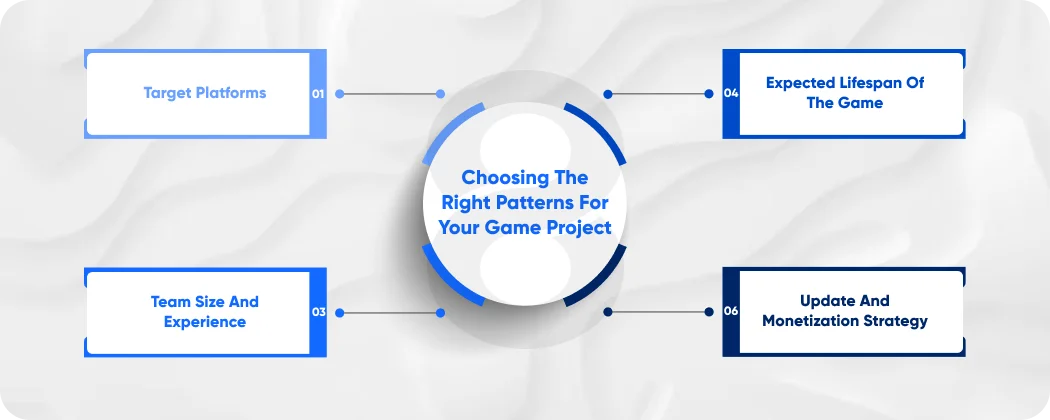
The proper choice of game programming patterns will make sure that your project will run well, scale effectively, and satisfy the players. With the capability to match patterns with game type, platform, and team expertise, the development process is enhanced and accelerated to become more structured and ready for the future.
1. Target Platforms
Processing platform-specific constraints through game development patterns. There should be different memory management, performance optimizations, and input handling in mobile, PC, and console games to ensure smooth gameplay on the different devices.
2. Team Size and Experience
The more advanced the programming patterns of a game design are, the more advanced your team should be. Both small and large teams can use simple, modular patterns, but more complex architectures can be used by large teams to deal with scalability effectively.
3. Expected Lifespan of the Game
Game programming patterns should be maintainable over a long period when it comes to long-term projects. The decision to use reusable, modular patterns will guarantee the game will be able to grow, add new changes, and be stable during its lifecycle without having to rewrite it over and over.
4. Update and Monetization Strategy
Combine game development trends that contribute to the frequent updates and live processes. Properly designed architecture enables the addition of features without inconvenience, monetization based on events, and a uniform experience for the player between games of different versions.
Why Studios That Use Game Programming Patterns Ship Better Games
Studios that are willing to use game programming patterns on a regular basis are at an apparent competitive edge, as these organized patterns enable teams to streamline development tasks, optimize performance, and release high-quality and scalable games that can keep up with the developing player expectations.
Studios that practice the patterns of game programming regularly:
- Provide stable releases at a faster rate
- Scale features rewritable systems
- Keep code bases cleaner in the long run
- Adjust to changes in the market
That is why the studios that have the highest performance apply architecture as a strategic investment and not as a technical consideration, where all the components of game creation are efficient, maintainable, and addressed towards the design objectives as well as player satisfaction.
How 8ration Apply Game Programming Patterns in Client Projects

This development process goes through game programming patterns that have been tried and tested in each level of the stack. This ensures:
- High-performance gameplay
- Future-ready scalability
- Faster development cycles
- Reduced maintenance costs
Regardless of whether the project is mobile game development, immersive 3D experiences, or cross-platform titles, our architecture systems provide growth.
With any game that needs to perform, scale, and monetize, architecture is more than ever a crucial factor.
Read More: How to Make a Video Game – Launch Your First Game
Final Thoughts!
Games in the modern world do not appear in one version. They are developing products that require scalability, performance, and maintainability. Even the most innovative ideas fail to have a long-lasting survival without the right basis.
By learning and implementing patterns in game programming, development teams have the ability to control complexity and achieve sustainable growth. Such trends are not shortcuts. They are tested and known structures that facilitate innovation and do not restrict it.
When you are aiming at creating high-quality games that will run on multiple platforms and can withstand time, then investing in the proper programming patterns is no longer an option. It is essential.