



Most publishing companies still think the problem is attention spans. It is not. People still spend hours every day consuming content. Honestly, probably more than ever before. The difference is that they no longer consume it the same way they used to, and that is the part a lot of traditional magazines reacted to too slowly.
Because if we are being realistic, print did not suddenly become “bad.” It just became less convenient. And convenience quietly became one of the most important things in media without publishers fully realizing how much that would affect behavior long term. That is exactly why more businesses are now investing into a proper digital magazine app instead of relying only on physical circulation and traditional publishing models.
According to the Reuters Institute Digital News Report 2025, news consumption has shifted strongly toward mobile-first experiences, with smartphones now the primary device for many audiences, especially younger people, to access news each day. This reflects a broader move away from traditional platforms toward mobile, social media, and video-driven formats.
People Still Read Constantly, Just Not the Way Publishers Expected
This is where things usually get misunderstood. A lot of publishers say things like:
- People do not read anymore.
- That is obviously not true.
- People read all day.
They read articles, newsletters, social content, long-form blogs, reviews, captions, notifications, reports, summaries, and discussions constantly. What changed is the environment around the reading experience.
Now people expect:
- Fast access
- Cross-device continuity
- Instant recommendations
- Personalized experiences
- Flexible consumption
Traditional print cannot naturally keep up with those expectations anymore. That is why the demand for a strong digital magazine app keeps growing across modern publishing businesses.
At 8ration, publishing-focused platforms are usually designed around modern reading behavior first instead of simply recreating a print experience digitally. That difference matters more than people expect.
The Real Problem Is Friction
This is honestly where most publishing businesses quietly lose readers. Not because the content is weak. Because the experience feels slower than everything else users interact with daily. Think about how people consume digital content now. Everything is immediate. Music starts instantly. Videos open instantly. Shopping happens instantly. Messaging happens instantly.
Then someone opens an outdated magazine platform and suddenly:
- Navigation feels clunky
- Pages load slowly
- Subscriptions feel annoying
- Search barely works properly
That friction adds up very quickly. And users rarely complain directly anymore. They just stop returning. This is exactly where a properly built magazine app changes the situation because the goal is not simply moving content online. The goal is removing unnecessary friction from the entire reading experience.
Read More: The Complete Guide to White Label App Development for Agencies
Younger Audiences Never Built Print Habits Properly
This is another thing traditional publishers underestimated badly. Older generations grew up building routines around physical magazines. Younger audiences mostly did not. Their habits were formed digitally from the beginning.
So naturally, they expect:
- Interactive content
- Mobile accessibility
- Continuous updates
- Personalized recommendations
- Integrated experiences
And when those things are missing, the platform immediately feels older than the content itself. That is why modern mobile app development strategy has become so important for publishing companies now.
Because if the experience feels disconnected from current digital behavior, retention becomes much harder regardless of content quality.
Static Publishing Is Quietly Losing Against Interactive Platforms
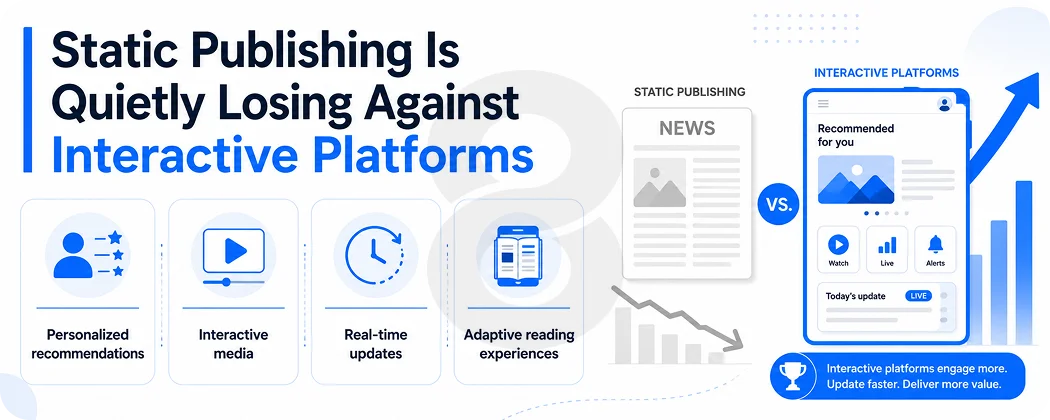
This shift is happening everywhere now. People do not only want information anymore. They want engagement around the information.
That includes:
- Personalized recommendations
- Interactive media
- Real-time updates
- Adaptive reading experiences
This is where modern software development becomes incredibly important inside publishing businesses. Because publishing platforms are no longer functioning like static media containers.
They are becoming interactive ecosystems. That changes how systems need to be built completely. A strong digital magazine app now behaves closer to a content platform than a traditional magazine.
And honestly, that is exactly where publishing was always heading anyway.
AI Is Quietly Changing Reader Expectations Already
Most readers probably would not even describe it this way directly, but AI is already shaping how people expect digital product platforms to behave. Users now expect systems to understand them better automatically.
Through proper AI development, publishing platforms can now:
- Recommend more relevant content
- Improve reader retention naturally
- Reduce discovery friction significantly
- Adapt content visibility intelligently
And with structured AI integration, all of this happens quietly in the background without making the experience feel artificial.
That is one of the biggest advantages modern publishing businesses gain from a properly designed digital magazine app.
At 8ration, AI systems inside publishing products are usually introduced gradually so the experience feels smoother instead of overly engineered.
Traditional Print Publishing vs Modern Digital Publishing
Area |
Traditional Print |
Digital Magazine App |
| Accessibility | Limited physically | Available instantly |
| Reader Behavior | Passive consumption | Interactive engagement |
| Personalization | Same experience for everyone | Adaptive content delivery |
| Publishing Speed | Fixed cycles | Continuous publishing |
| Analytics | Limited visibility | Real-time insights |
Mobile Is Quietly Becoming the Entire Publishing Environment
This is one of the biggest shifts happening right now. People are no longer “checking content online occasionally.” Their phones became the primary content environment entirely.
That means readers are consuming content during:
- Commutes
- Lunch breaks
- Travel
- Waiting periods
- Short attention windows throughout the day
This is exactly why mobile app development strategy directly affects publishing retention now. Because if your mobile experience feels outdated, readers notice immediately even if they never explain it clearly.
At 8ration, publishing products are usually built mobile-first instead of trying to force desktop-style experiences into smaller screens later. That difference changes usability a lot more than most teams expect initially.
Read More: The Complete Guide to Magazine App Development for Publishers in 2026
Publishing Companies Are Becoming Technology Companies Without Realizing It
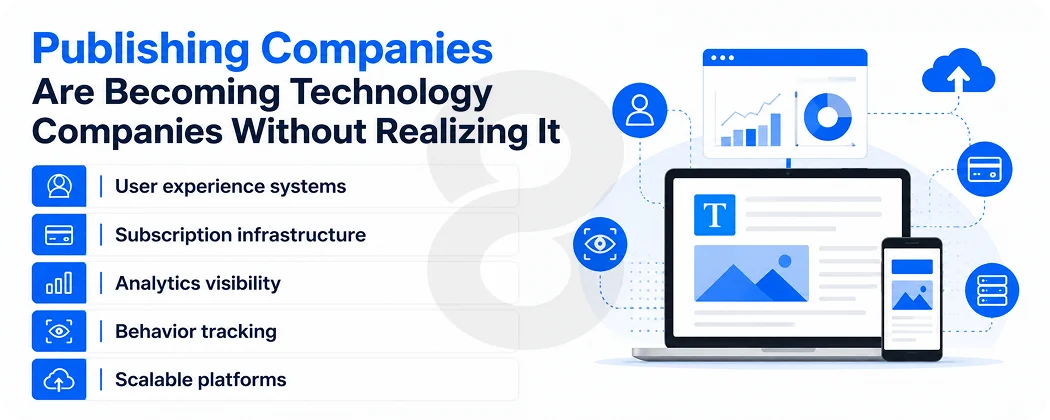
This is honestly one of the biggest mindset shifts happening right now. Most publishing businesses still think they are primarily media companies. But operationally, they are becoming technology businesses too.
They now depend heavily on:
- User experience systems
- Subscription infrastructure
- Analytics visibility
- Behavior tracking
- Scalable platforms
That is exactly why enterprise app development now plays a much bigger role inside modern publishing environments.
Because without scalable systems underneath the content, growth becomes extremely difficult to maintain properly.
What a Strong Digital Publishing System Actually Improves
Business Area |
Improvement |
Why It Matters |
| Reader Retention | Better engagement | Longer subscription cycles |
| Accessibility | Easier content access | Higher daily interaction |
| Analytics | Real behavioral visibility | Smarter publishing decisions |
| Revenue | Scalable monetization | Stronger long-term growth |
| User Experience | Lower friction | Better audience loyalty |
How the 8ration Team Approaches Digital Publishing Products
One thing the 8ration team focuses on heavily is reducing the gap between content and interaction. A lot of publishing platforms unintentionally create friction everywhere. Too many interruptions, unnecessary steps, and complex navigation can negatively impact the user experience and gradually reduce engagement over time.
Instead, the focus is placed on:
- Cleaner reading experiences
- Behavior-focused UX decisions
- Scalable backend systems
- AI-supported personalization
- Cross-platform consistency
The goal is not simply building another content app. The goal is building an environment readers naturally keep returning to without feeling forced into it. And honestly, that difference usually decides retention more than publishers initially expect.
Read More: Why Media Companies Are Losing Audiences Without the Right Entertainment Software
If Readers Keep Leaving Quietly, The Experience Is Probably Part of the Problem
A lot of publishing companies assume declining engagement only comes from changing media habits. That is only part of the story. The bigger issue is usually that the experience surrounding the content no longer matches what users expect digitally anymore.
If your platform feels slow, disconnected, outdated, or difficult compared to modern apps, readers notice that immediately even if they never explain it directly. A properly built digital magazine app changes how people interact with your publication completely. And right now, that shift matters more than ever because digital expectations are only increasing.
Final Thoughts
Print publishing is not disappearing completely. But relying on print alone is becoming harder every single year because user behavior already changed long ago. The publishing businesses adapting successfully are not abandoning quality journalism or strong editorial work.
They are improving how that experience gets delivered digitally.
And that is exactly where a strong digital magazine app becomes valuable. Not because digital sounds modern. Because convenience, accessibility, personalization, and engagement now decide whether readers continue returning long term. The future of publishing is not really about choosing between print and digital anymore. It is about building experiences people actually want to stay connected to consistently.