


Modern app monetization has pivoted from intrusive advertising toward value-oriented models that prioritize user intent and long-term engagement. By leveraging strategies like tiered subscriptions, usage-based pricing, and AI-driven premium features, developers can build sustainable revenue streams that respect the user experience while maximizing lifetime value.
The mobile app business has shifted from being a mere utility tool to a tremendous source of revenue. In 2026, apps no longer need to be placed as advertisements or sold to monetize the business. The users are now seeking high-quality experiences, and developers have to make money in a manner that does not disrupt the engagement of the user. Good app monetization strategies not only guarantee stable revenue but it can also retain users and enhance their lifetime value (LTV).
The app monetization software market (tools that help developers implement and optimize revenue models) was valued at about $13.25 billion in 2024 and expected to grow to $27.58 billion by 2032 (8.9 % CAGR). This reflects rising investment in monetization tech.
This guide will discuss optimal strategies for monetizing Android and iOS apps, the most effective mobile app monetization strategies, and practical recommendations on how to transform your app into a lucrative digital property. This guide will help you choose the appropriate approach to be used in achieving maximum revenue, regardless of whether you are developing a gaming app, a productivity tool, or a lifestyle app.
Read More: Why 80% of Apps Fail in the First Year
Reasons Why Mobile App Monetization is Important in 2026
Mobile apps have become a part of people’s lives. Users dedicate an average of 3.6 hours daily on their mobile devices, and the apps fall under entertainment, productivity, social network, and e-commerce applications. Such high engagement is an ideal way to make users’ attention a source of revenue in the case of developers.
Mobile applications keep increasing their revenues exponentially. According to industry estimates, consumer spending on apps by 2026 will have increased to a record of $233 billion, compared to 131 billion in 2023, with the total global application revenue (ads, subscriptions, and in-app purchases) expected to be more than 613 billion. It is thus not only a business objective, but an area of competition.
The right model of the monetization of apps is a guarantee of future existence. The developers must not look at the immediate revenue potential only, but also at the user retention, engagement, and user satisfaction. Mobile app monetization strategies that are not executed well are at risk of losing users, attracting adverse reviews, and not enjoying returns. It is more so in the case of iOS applications, where one is more likely to incur a higher initial cost, and in that of Android applications with a larger global user base, even including those who are price-sensitive.
In 2026, apps will no longer be successful based on downloads, but rather on their ability to transform engagement into revenue, and thus monetization strategy will be one of the main components of app design.
Learning About Mobile App Monetization Models
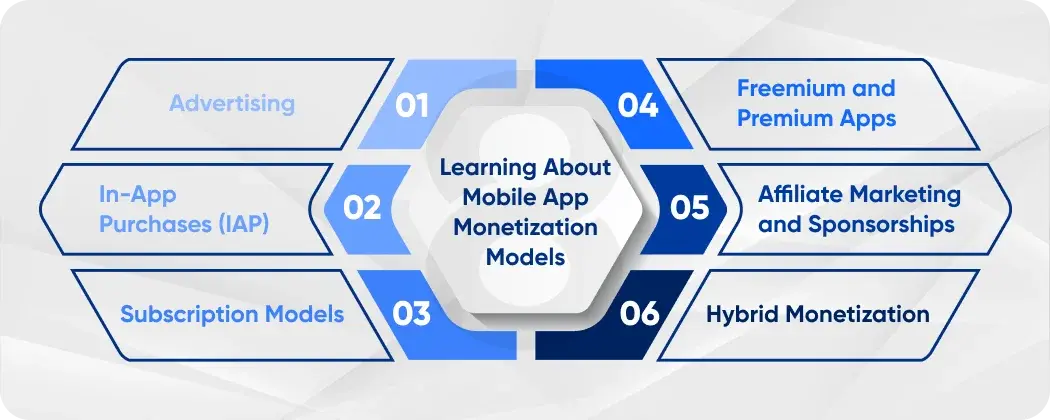
A mobile app monetization model determines your app monetization strategy. The models selected will be based on the type of app, intended audience, platform, and future long-term revenue targets. There are those models that would work better with high-engagement free applications and others that work in a premium or subscription-based ecosystem.
The main monetization strategies are:
- Advertising: Placing advertisements within your application, e.g., banners, interstitials, or native ads.
- In-App Purchases (IAP): This is the sale of digital items, consumables, or features on the app.
- Subscription Models: The use of recurring payments to access high-value content or services.
- Freemium and Premium Apps: Providing free applications with paid upgrades or paid applications.
- Affiliate Marketing and Sponsorships: Using brands or services to make money.
- Hybrid Monetization: Integrating a number of models to diversify revenue streams.
The pros and cons of every model are present, and the most effective apps frequently combine strategies, with the optimization process that starts with the consideration of the user behavior and engagement statistics.
Read More: 50+ AI App Ideas Generating Millions in Revenue
Top 15 Mobile App Monetization Strategies for 2026
The selection of appropriate mobile app monetization strategies is a limited business choice in 2026. Due to the growing rejection of intrusive advertising by users, companies need to consider value-oriented revenue models that are in line with the intent of the user and long-term interaction. These are the best monetization models that can be used in apps that are cross-platform and industry.
1. Subscription-Based Monetization
One of the most common and certain monetization models of apps these days is subscription-based app monetization. Users are charged a recurring monthly or annual subscription fee to enable them to make use of premium features, tools, or content exclusivity. This model moves the idea of revenue generation based on volume traffic to the long-term value of the user to the business, as it is best suited in businesses that are long-term growth-oriented.
Subscriptions are the most effective way of monetizing mobile apps of many startups and enterprises since it ensures a steady cash flow and allows them to invest in products continually. Android app monetization strategies, as well as the monetization strategy of the iOS apps, have been largely dependent on subscriptions because of the platform support and familiarity of the users.
Subscriptions also produce better customer relationships, together with improved relationships since the user is gaining more updates, improvements, and customer support in return for their commitment.
Key advantages:
- Revenue that is predictable and recurring
- Increased lifetime value per user
- Promotes constant enhancement of products
- Best in SaaS, fitness, education, and media apps
- Quite frequently regarded as the optimal app monetization approach in terms of scale
2. In-App Purchases (Value-Based, Non-Ad)
In-app purchases enable users to purchase online digital products, advanced functionality, or consumable resources through the application itself. It is a monetization model of apps that is not based on the revenue of advertising, but it directly depends on the perceived value of the app.
This strategy works remarkably well in cases where the users have found the app already useful and require an improvement to the experience. It is common in productivity applications, creative applications, financial applications, and service-based applications–not only games.
In-app purchases have become an essential part of mobile app monetization strategies since they provide the consumer with the ability to control their expenditure and businesses with the power to monetize power users efficiently.
Key advantages:
- Directly user-based revenue
- Flexible pricing options
- Encourages repeat spending
- Products in several types of apps
- Strong alternative to ads
3. Free Version with Paid Upgrades
The freemium model offers the users free fundamental functionality and a paid option to use premium features, tools, or capabilities. The model of monetizing this app will minimize the friction during the acquisition phase and enable users to test the product and then make a financial commitment.
Freemium is among the most used Android mobile app monetization strategies, and it is also a successful monetization strategy for iOS applications. When done correctly, the free users will be the channel of premium conversion and not a burden.
The success of freemium is determined by the well-set boundaries of value-free features, which should be helpful, but premium features should feel necessary.
Key advantages:
- Low barrier to entry
- Big user acquisition potential
- Clear upgrade incentives
- Strong conversion funnel
- Apps monetization model that can be scaled
4. Single-Time Premium App Purchase
Among the most transparent and clean monetization strategies of the mobile app outside of advertising, a one-time and upfront fee charged to the user is one of the options. There is no subscription, in-app purchase, or ad to users.
This model is applied in niche, high-value applications where there is a clear definition of functionality and long-term maintenance is predictable. The benefits of this approach are greatest in the case of professional tools, calculators, offline utilities, and creative software.
Even though it is not widely used nowadays, this is a reliable mobile app monetization strategies among users who want to own it instead of paying monthly.
Key advantages:
- Easy pricing
- Advertisements off, no distractions
- Builds trust with users
- No recurrent billing complication
- Powerful positioning of premium apps
5. Feature-Based Unlocks
The monetization of features enables users to gain access to particular features instead of subscribing to a complete package. This will provide flexibility to the users and match expenditure with the actual requirement.
This is an effective monetization model of apps because, in particular, productivity, finance, photo editing, and utility apps, the user might only need some of the advanced features.
Releasing features makes subscriptions less fatiguing and more likely to convert those users who are not eager to invest in such recurring payments.
Key advantages:
- User-controlled spending
- Higher perceived fairness
- Less demanding upsellings
- Works well with modular apps
- The powerful substitute to subscriptions
6. Usage-Based Pricing
Usage-based pricing charges the user based on the usage of the app, e.g., API calls, storage usage, number of transactions, or actions taken. This mobile app monetization strategies is directly related to the value provided to the price.
This is a strategy that is getting increasingly popular among AI-based products, SaaS providers, analytics applications, and automation services. It maintains the interest of the casual users, and the heavy users will provide the revenue in proportion.
The so-called usage-based Near misses are the best mobile app monetization practices on a scalable product.
Key advantages:
- Value-aligned pricing
- Fair for all user types
- Highly scalable
- Stimulates the use of the product
- Reduces churn risk
7. Transaction & Commission-Based Monetization
Applications used in making payments, booking, or trading can be monetized by a percentage of transactions. This is a mobile app monetization strategy that expands automatically with the increase in the number of users.
Fintech apps, marketplaces, booking, and on-demand solutions are all based on revenue through transactions as opposed to advertising. This strategy will provide a win-win situation in which revenue can only increase when users gain actual value.
Key advantages:
- Revenue scales with usage
- No upfront cost for users
- Close congruence with business development
- Perfect with platform-based applications
- Sustainable long-term model
In‑app purchase market revenue alone, a key segment of monetization, is predicted to more than double from $192 billion in 2023 to nearly $450 billion by 2030, with a ~12.9 % CAGR.
8. White-Label Monetization & Licensing
Licensing will enable the business to sell its app technology to companies in order to use or resell it internally. White-labeling solutions allow clients to rebrand the app in their own names.
This is a B2B based mobile app monetization strategy that forms high-value contracts and recurring enterprise revenue without the need to use consumer ads. It is among the strongest but a neglected approach to monetizing mobile apps.
Key advantages:
- High revenue per client
- Long-term contracts
- Strong enterprise appeal
- Minimal end-user dependency
- Scalable across industries
9. Enterprise Plans & Custom Pricing
Enterprise monetization is offered to large enterprises that have sophisticated requirements, including security, integrations, compliance, and white-glove services.
It is a model that boosts customer lifetime value considerably, and this has been extensively utilized in collaboration tools, customer relationship management applications, and workflow platforms.
Enterprise pricing is the optimal approach to app monetization when the company is trusted by the consumers.
Key advantages:
- High-value contracts
- Lower churn rates
- Tailor-made feature monetization
- Strong brand credibility
- Stable sources of revenue
10. Digital Content Sales
Apps have the capability of selling high-quality digital content in the form of courses, templates, guides, or exclusive media. This type of app monetisation is especially effective in fields of education, creator, and professional. In contrast to subscriptions, as a content sales user, one can pay once and enjoy the app without ads. Excellent content enhances authority and recurrent interaction.
Key advantages:
- High-margin revenue
- No regulated billing needed
- Gets along with expert-led applications
- Builds brand authority
- Lightweight content repositories
11. User Contributions and Donations
In donation-based monetization, monetization is pegged on the goodwill of the user and not the necessity. The plan is best to do with community or open-source applications or mission applications.
It builds trust and transparency and eliminates commercial pressure on user experience, even though this does not apply universally. It is an ethical monetization model of apps that is still a niche.
Key advantages:
- Establishes a good relationship with the community
- Fully ad-free experience
- Low operational complexity
- Encourages user loyalty
- Perfect value product
12. AI-Powered Premium Features
Monetization of AI-based capabilities like automation, personalization, predictive insights, or content generation is possible individually.
This will make AI a layer of premium value and not a free add-on. It is quickly emerging as a monetization strategy of mobile applications in 2026. Pricing with AI is efficient with Android and iOS.
Key advantages:
- High perceived value
- Premium differentiation
- Future-proof monetization
- Scales with innovation
- High willingness to pay among the users
13. API Access / Developer Monetization
With well developed infrastructure, Apps can be monetized by selling API access to external developers or companies.
This model of monetization of apps transfers revenues to organizations and allows monetization in large scale B2B. It occurs in fintech, data platforms, AI solutions, and mapping solutions.
Key advantages:
- High scalability
- Business-focused revenue
- Low user friction
- Strong ecosystem growth
- Predictable pricing models
14. Premium Membership and Community Membership
The monetization of relationships, expertise, and networking, and not features, is through charging for exclusive community access. This model is good for professional, coaching, creator-driven, and fitness apps. Emotional investment and retention are enhanced through community-based monetization.
Key advantages:
- Strong user loyalty
- High engagement levels
- Potential of recurrence of revenue
- Creates a distinction between itself and competitors
- Value beyond features
15. Non-Ad Hybrid Model of Non-Monetization
The most successful applications are those that integrate several non-ad features, including subscriptions, unlocking features, enterprise, and transactions.
This hybrid form of app monetization diminishes the reliance on one stream of revenue, and it can be customized according to the various groups of users. It is the strongest monetization technique of mobile apps to be successful in the long-term.
Key advantages:
- Revenue diversification
- Reduced financial risk
- Increased total profitability
- Elastic pricing system
- Articles in every category of apps
How to Choose the Right App Monetization Strategy
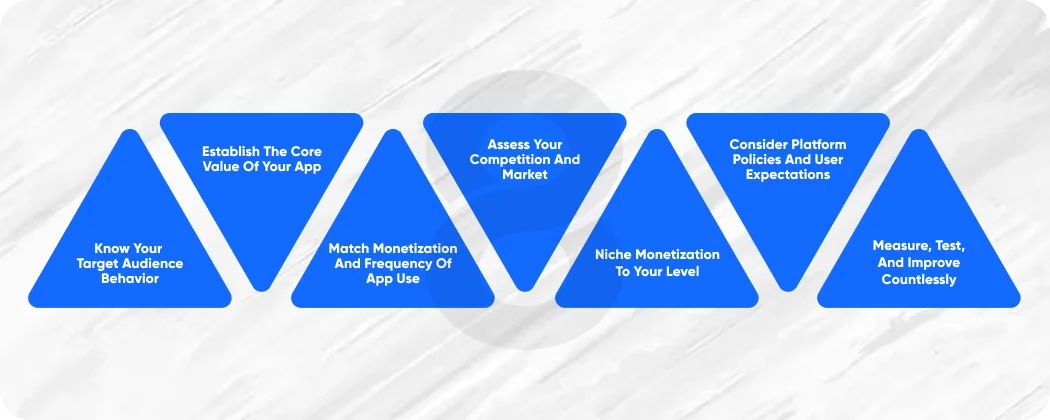
The decision of the appropriate app monetization model is not a duplication of what your competitors are achieving, but rather how to get in line with how users expect in the products, the value, and the long-term business objectives. The most successful mobile app monetization results will be created in 2026 based on the strategies that are both natural to users and sustainable to the business on Android and iOS platforms.
The choice of an incorrect monetization strategy may restrict it, cause churn, and ruin trust. This is why companies should consider various factors prior to the finalization of their monetization plans for mobile apps.
1. Know Your Target Audience Behavior
The most appropriate way to start selecting the monetization model that suits the apps is to comprehend the interaction of your users with your product. The willingness to pay, frequency of usage, and expectation of the different user segments vary.
As an example, professional users tend to use subscriptions or feature-based pricing, whereas casual users can use one-time purchases. Android app monetization strategies and even the strategy of monetization of iOS apps are successful because the price does not seem to be imposed on the user, but rather similar to the value of the user.
An in-depth knowledge of user intent will be used to decide on which monetization would be recurring, usage-based, or transactional.
Key considerations:
- Frequency of app usage
- User willingness to pay
- Expert vs non expert audience.
- Price sensitivity
- Value perception
2. Establish the Core Value of Your App
All successful app monetization models begin with a value proposition. No monetization strategy can be effective when the users are unable to recognize the value of making your app worth using.
The best apps to subscribe to are those that provide value on an ongoing basis, e.g, productivity tools or learning platforms. The most appropriate app monetization strategy will be determined by how the users will be rewarded using your product in the long run. The monetization strategy must improve, not impede, the main experience.
Key considerations:
- Is the value continuous or discontinuous?
- Is the app addressing a problem that is recurring?
- Are superior features mandatory or optional?
- Speed of value creation among the user base?
- Is monetization outcome-oriented?
3. Match Monetization and Frequency of App Use
The frequency of usage is an important variable when choosing the appropriate mobile app monetization strategies. High-frequency apps have an advantage over low-frequency ones in their subscriptions or use-based pricing, whereas recurring fees might become an issue with low-frequency apps.
To use the example of planners or fitness trackers, which people use on a daily basis, it is more suitable to sell them as subscriptions, but occasional-use apps like calculators or converters might be better served by premium purchases. Flexible pricing is supported both in Android and iOS ecosystems, and frequency-based decisions are necessary. Pricing according to the use is a guarantee of long-term retention, as well as a lowering of churn.
Key considerations:
- Every day, once or twice per week, or rarely
- User engagement duration
- Retention patterns
- Readiness to make recurrent payments
- Long-term value delivery
4. Assess Your Competition and Market
The important step in the process of choosing the appropriate monetization model of apps is the competitive analysis. The knowledge of the way similar apps make money would assist in determining what the market expects and what prices to set.
Nonetheless, it is dangerous to blindly imitate your competition. Rather, find areas where you can create a superior value or price flexibility. Most of the most successful mobile app monetization efforts are done by enhancing current approaches and not copying them.
This is applicable to the Android app monetization strategies and to the monetization strategy of the iOS apps, where the expectations of the user might be slightly different, but value is at the centre.
Key considerations:
- Industry pricing standards
- Competitive models of monetization
- Differentiation opportunities
- Competitor complaint by the users
- Value gaps in the market
5. Niche Monetization to Your Level
The stage of app growth will directly affect the most logical app monetization model. Newer apps tend to focus on the acquisition and engagement of users, whereas mature apps are concerned with optimizing their revenue.
Limited or freemium works well in the initial stages of growth, but as the business grows, subscriptions, enterprise, or hybrid can be better applied. Selecting an optimal approach to app monetization is not a simple choice that can be made once. Scalable monetization allows you to expand with your app.
Key considerations:
- Early-stage product vs mature product
- Need for rapid adoption
- Revenue growth priorities
- Price model scalability
- Long-term business vision
6. Consider Platform Policies and User Expectations
Android and iOS have certain billing policies and user expectations, as well as pricing norms. Although this guide is platform-neutral when it comes to monetization, it is imperative to comprehend platform behavior.
The iPhone method of monetizing apps is commonly supported by subscription acceptance and high-end pricing, whilst Android apps’ monetization approaches might depend on versatility and tiered prices. An integrated method that does not interfere with both ecosystems brings positive outcomes.
Key considerations:
- Guidelines on platform billing
- User payment behavior
- The acceptance rate of the subscriptions
- Refund policy and compliance policy
- Platform rice parity
7. Measure, Test, and Improve Countlessly
There is no ideal monetization strategy for a mobile app on the first day. Continuous testing will enable you to optimize pricing, packaging, and access to features based on actual user behaviour.
Subscriptions: A/B testing, feature bundles, and price levels assist in finding the optimal mobile app monetization strategy to use for your audience. Optimization based on data makes a company successful in the long-term without interfering with user experience.
Key considerations:
- Conversion rates
- Churn analysis
- User feedback
- Revenue per user
- Long-term retention metrics
Read More: How the Most Downloaded Apps Monetize in 2026
8ration’s Final Take: Monetization That Creates Value, Not Friction

To determine the appropriate monetization model to use with apps, there must be a clear balance between the business goals and the actual user value, and this is where 8ration is strategic-first. The most effective app monetization model is the one that does not seem like a forceful one but rather like a fair, transparent, and, natural, the process that does not seem to be an imposition on what the users experience and avail from the product.
We assist companies in crafting mobile app monetization strategies at 8ration such that it is platform-agnostic and does not violate user trust. Through intensive study of the intended audience, the determination of quantifiable value, competitive scanning, and constant performance optimization, our team constructs monetization models, which are perfectly compatible with Android and iOS and which prove over time.