


In 2026, global consumers are projected to download approximately 143 billion apps from Google Play alone, up nearly 30% from 2021 levels, highlighting sustained demand for mobile applications in native vs pwa decisions.
The reason your next big digital product will fail is not a bad idea; it is a bad choice of technology. In the era of milliseconds that determine user loyalty and mobile devices that control the attention span. Selecting between native apps and progressive web apps is not a technical consideration any longer, but a strategy.
Native apps are quick and have a high level of device control, and PWAs are quick, accessible, and affordable through the browser. As modern app development is an innovation, one should be aware of the impact that each of the approaches will have on scalability, user experience, security, and ROI in the long run. This guide breaks it down because it lets you choose the right base for sustainable online success.
What Is a Native App?
To begin with, understanding the fundamentals is crucial. The nature of a native app is best described by its very definition: a native app is a software application created to execute in a particular operating system, i.e., iOS or Android. They are written in platform-specific programming languages, Swift or Objective-C, on iOS. Or Kotlin or Java on Android, and are simply installed in application stores, e.g., Google Play or the Apple App Store.
Native applications are fully integrated with the operating system, and thus, they are capable of making full use of device hardware, such as GPS, camera, biometric authentication, accelerator, and push notification.
Examples of Native Apps
Some well-known examples of native apps include:
- Spotify
- Google Maps
All these applications prove the ability of native architecture to support high performance, animation, and real-time responsiveness.
Read More: MVP Development Cost – The Executive’s Budgeting Guide
What Is a Progressive Web App (PWA)?
Speaking further about the issue of Native vs Progressive Web App, PWAs have to be mentioned.
Then what are progressive web apps? A progressive web app is an application that is developed on the web platform using the standard web technologies, i.e., HTML, CSS, and JavaScript, and advanced APIs and service workers. PWAs are native-app-like and are built upon the concepts of browser interaction.
In contrast to conventional web applications, PWAs can be pinned on the home page of the user, can be used offline, support push notifications, and provide quick load times, even under conditions with low network speeds.
Progressive Web Apps Example
Popular progressive web app examples include:
- Twitter Lite
- Starbucks PWA
- Uber PWA
These are just a few instances of how PWAs can enhance performance and engagement by a significant margin without having to complicate the development process.
Native vs Progressive Web App: Architectural Differences

The comparison of the Native App and Progressive Web App at the architectural level shows the underlying difference.
Native apps are binaries that are compiled and installed on the device, and they communicate directly with the OS via SDKs. This is a close-coupled system that allows improved performance and reduced latency. PWAs, in contrast, execute within a browser engine and apply service workers and caching mechanisms to create the appearance of apps.
In addition, native applications have iOS and Android codebases that need to be written separately, whereas PWAs need only one codebase, which makes web app development much more straightforward.
Architectural Comparison Table
| Feature/Aspect | Native App | Progressive Web App (PWA) |
| Codebase | Separate for iOS (Swift/Objective-C) and Android (Kotlin/Java) | Single codebase using HTML, CSS, JavaScript |
| Performance | High direct OS integration, low latency | Moderate; depends on browser engine and caching |
| Device Access | Full access to hardware (camera, GPS, sensors) | Limited access; some APIs available through browsers |
| Installation | Installed via App Store/Play Store | Can be installed via browser, no app store required |
| Offline Capability | Full offline support | Limited offline support via service workers |
| Development Complexity | Higher; separate teams needed for each platform | Lower; single team can manage multiple platforms |
| Updates | Requires app store approval | Instant updates via web, no app store needed |
Read More: Why 80% of Apps Fail in the First Year (And How to Ensure Yours Doesn’t)
Performance and Speed: Native vs PWA
Performance is often the deciding factor in the native vs PWA debate. Native apps are also quite fast in CPU-intensive applications like video gaming, real-time video processing, or augmented reality. Animations are more fluid and are faster since they are directly interacting with the OS.
The gap has, however, been reduced significantly by modern PWAs. Advanced caching, lazy loading, and background sync have now made PWAs nearly native when used by most businesses and high-performing. Nevertheless, in a scenario where absolute performance is needed, native apps are the standard of the progressive app vs. native app debate.
Read More: Flutter vs React Native – Which Is Better for Business Apps?
User Experience and Interface Capabilities
User experience (UX) plays a pivotal role in adoption and retention. In the progressive web app vs native app discussion, native apps offer superior UI consistency aligned with platform-specific design guidelines such as Material Design and Apple’s Human Interface Guidelines.
PWAs, while highly responsive, may encounter UI limitations across browsers and operating systems. That said, responsive frameworks and adaptive UI patterns have significantly improved the PWA experience.
Therefore, for content-driven or transactional platforms, PWAs often suffice, while design-intensive applications may favor native development.
Read More: How the Most Downloaded Apps Monetize in 2026
Offline Functionality and Reliability
Offline access is another critical differentiator. Local storage and background processing have been supported by native applications. Meanwhile, PWAs use service workers and IndexedDB as the means of storing data and assets. That is why the offline operation is among the most remarkable advantages of progressive web apps.
Nevertheless, native apps still offer finer control of the background tasks, and hence they are better suited to complex offline processes.
Read More: How to Promote Your App – 10 Proven Growth Strategies
Security Considerations
Security cannot be ignored when comparing the native apps and progressive web applications.
Native applications enjoy security measures provided by the OS, like sandboxing, biometric authentication, and encrypted storage. PWAs are based on HTTPS, secure service workers, and browser-based security measures.
Although PWAs are secure by design, native applications provide greater security to applications that maintain sensitive data like banking or medical records.
Read More: How Long Does It Take to Create an App
Development Cost and Time-to-Market
In business, cost efficiency is one of the areas in which PWAs excel in the PWA vs. native apps argument.
Native development will typically need two different teams or structures, which adds to the cost and time. On the contrary, PWAs share a single codebase, which minimizes the cost of development and maintenance.
PWAs can be quickly deployed, have shorter iterations, and have lower start-up costs, which makes them a good choice when one wants to develop an app at an early stage.
Read More: Mobile App Development Process – From Idea to Launch
App Store Dependency and Discoverability
Native apps are reliant on the approval processes of the app stores, which are both time-consuming and limiting. PWAs do not have to deal with this at all, providing real-time updates and an easy deployment process through the web.
Also, PWAs can be seen in search engines, which is an advantage over web apps and native applications in visibility and user adoption.
According to Grand View Insights, the Progressive Web Apps market is expected to grow to USD 21.24 billion by 2033, driven by demand for responsive, cross-platform mobile experiences.
Pros and Cons of Native Apps

In order to make the Native vs Progressive Web App a fair and full comparison, one should consider the strengths and weaknesses of native applications both technically and in terms of business.
Pros:
- It is the fastest native app because it is compiled directly to the operating system.
- Complete access to device hardware and APIs such as camera, GPS, biometrics, sensors, and background processes.
- Better user experience, including platform-specific elements of the UI and smooth animation.
- Greater security, using OS-level encryption, sandboxing, and authentication.
- Offline features that are reliable even for complicated workflows and even for data-intensive operations.
Cons:
- It is more expensive to develop and maintain because separate codebases need to be developed in order to support iOS and Android.
- More time to market, because of platform-specific development and approval in the app store.
- Addiction to the app store with the strict usage rules and the delays in updating and commission.
- Higher resource demands, which usually require more development teams and constant support.
Pros and Cons of Progressive Web Apps

PWAs provide a balance between accessibility and functionality that is modern to the users and allows them to enjoy fast and reliable app-like experiences, and allows companies to reduce costs and to speed up their digital growth.
Pros
- Lower development cost: The lower development cost decreases total development and maintenance costs by providing a single, reusable codebase.
- Cross-platform compatibility: Works without any special builds on devices, browsers, and operating systems.
- No app store dependency: Removes the process of app store approvals and allows access and user onboarding to be instant.
- SEO-friendly: Enhances the visibility, discoverability, and organic traffic of search engines by means of web indexing.
- Quick updates: Enables real-time updates without the user having to take the hassle of installing new updates.
Cons
- Limited access to some device APIs: Limits the use of higher-level hardware functionality in contrast to full native applications.
- Performance limitations for complex apps: May work with graphics-intensive, real-time, or resource-intensive application needs.
- Inconsistent browser support: Browsers differ in feature availability, which has an impact on consistency and advanced functionality.
Read More: Mobile App Development Team – Hiring Tips for Businesses
When to Choose Native App Development
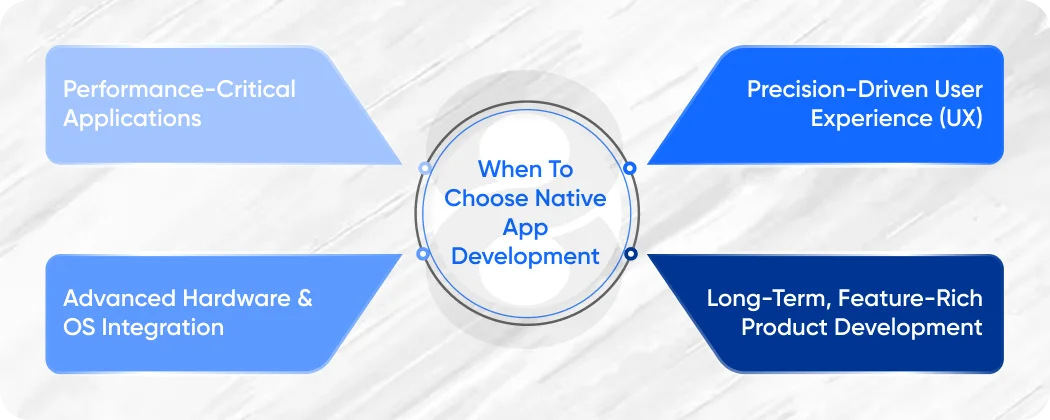
The decision to use native app development is a surety of high-quality performance, in-depth device compatibility, and refined experiences, particularly in comparison with native app and progressive web app approaches in growing, long-term, and high-impact digital assets.
Performance-Critical Applications
Native applications are the best when speed, responsiveness, and stability are most important. Native development is superior to PWA in the case of the native vs. PWA argument because it provides highly executed performance, reduced latency, and high-performance requirements.
Advanced Hardware & OS Integration
Native development is better than others in applications that need in-depth access to the hardware on the device. Native solutions are also comparatively better than progressive apps vs native apps since they support the use of GPS, camera, biometrics, and system-level APIs.
Precision-Driven User Experience (UX)
Native apps are better when there is a need for platform-specific design criteria and fluidity in the UI. Comparing native apps and progressive web apps, native development ensures the consistency of animations, gestures, and the UX sharpness in accordance with the recommendations of iOS and Android.
Long-Term, Feature-Rich Product Development
Native development provides maintainability and flexibility in the long term in the case of scalable, complex products. Such technologies as NativeScript app development close the gap between the progressive web app and the native app because it shares logic with maintaining native performance.
Read More: Top 100 App Ideas for Mobile – Launch Your Million-Dollar App
When to Choose Progressive Web Apps
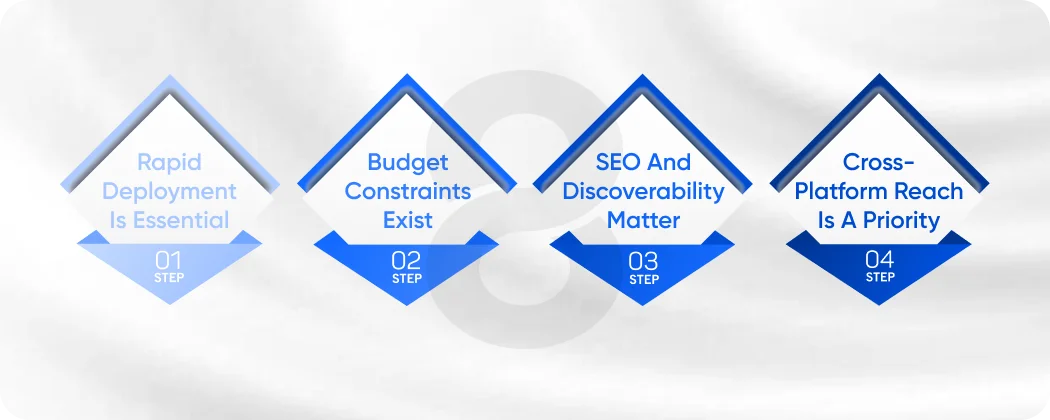
Progressive Web Apps enable businesses to appeal to users more quickly, save money, and provide them with app-like experiences across platforms, thus making them the best option in the Native App vs. Progressive Web App decision journey.
Rapid Deployment Is Essential
In situations where speed is crucial, PWAs have a quicker time to market with a single codebase, which saves time compared to native vs. PWA development and allows for smoother updates without requiring app store approvals.
Budget Constraints Exist
To the cost-conscious businesses, PWAs help reduce the cost of development and maintenance, providing the smart alternative in the progressive web app vs native app discussion without any loss in performance and user engagement.
SEO and Discoverability Matter
In comparison to native apps, PWAs can be searched by search engines, which makes them more visible and results in increased traffic, which is a major distinction between web apps and native apps when the focus of a brand is on organic growth.
Cross-Platform Reach Is a Priority
PWAs are also consistently executed across all browsers and devices, which removes platform fragmentation and removes a barrier to global users in comparison to native applications vs progressive web applications for global users.
Native App vs Progressive Web App: Final Verdict
Finally, the native app vs. progressive web app ruling revolves around your business objective, technical needs, and user expectations. No one size fits all, only informed trade-offs.
Whereas native apps are associated with unparalleled performance and integration, PWAs are agile, cost-efficient, and accessible. The hybrid approach, whereby PWAs are used to reach out to many users and native apps to serve power users, is adopted by many modern enterprises.
Driving Smarter App Decisions Through Experience and Strategy
At 8ration, we treat all digital products with only one goal: creating applications with quantifiable values, which can scale over time, and endure an exceptional user experience.
We base our outlook on native web applications and progressive web applications on practical experience in various industries and in various technology stacks. We do not impose a one-size-fits-all solution but assess performance requirements, user behavior, platform requirements, and growth objectives and suggest an approach.
Our team supports organizations in making assured, future-proof choices around apps, ensuring that organizations achieve the greatest ROI. And accelerate the achievement of digital success through the alignment of technical architecture with business goals.
Read More: Flutter App Development Cost – A Detailed Guide
Final Thoughts!
To conclude, the comparison between native apps and progressive web apps is not the issue of superiority but the issue of suitability. Native applications are superior in performance-intensive environments, whereas PWAs are high in speed and scalability and low in cost.
As digital ecosystems keep changing, those businesses that base their approach to developing apps on the needs of the users. The technical feasibility and scalability in the long run will have a competitive advantage.
The point is that the success of the chosen solution depends on the specifics of the native, PWA, or hybrid solution, which is in the strategy, well-built architecture, and user-focused design.